What Is Authoritativeness in E-E-A-T?
AI Summary
What is the Authoritativeness signal in E-E-A-T? Authoritativeness is the third letter of Google’s E-E-A-T framework and evaluates whether the rest of the world treats the content creator or the website as a recognized source on the topic. Unlike Experience and Expertise, which live inside the content and the creator, Authoritativeness is externally conferred. It is built through citations, backlinks, brand mentions, knowledge panel recognition, and other signals that reflect what others say about you rather than what you say about yourself.
What this article covers and who it is for: This article covers what Authoritativeness means in the framework, how it differs from Expertise, how Google measures it through backlinks and entity signals, the role of topic authority and topical focus, how brand mentions and knowledge panels factor in, and how to build Authoritativeness from zero without manufacturing false recognition. It is for content strategists, SEO practitioners, and business owners who need to understand why external recognition is a separate dimension from internal knowledge and how to earn it deliberately.
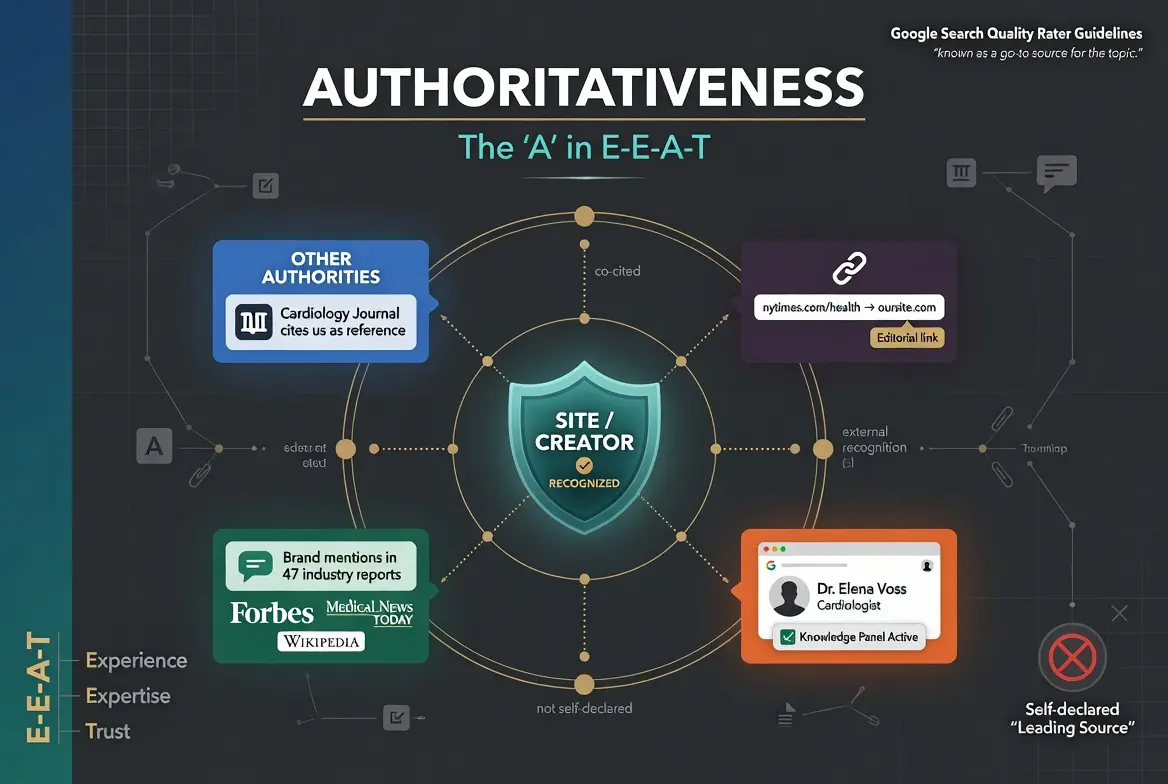
The rule: Authoritativeness is what others say about you, not what you say about yourself. A press release announcing yourself as the leading authority does not produce the signal. Three other recognized authorities citing you as their reference does. The signal is relational, externally conferred, and accumulates over time through genuine recognition rather than self-promotion.
What Authoritativeness Means in E-E-A-T
Authoritativeness is the third letter of E-E-A-T, and it asks a different question than the two E’s that precede it. Experience asks whether the writer has lived through the topic. Expertise asks whether the writer knows the topic. Authoritativeness asks whether the rest of the world treats this writer or this site as a recognized source on the topic.
The distinction matters because it shifts the locus of evaluation from the page itself to the broader web around the page. A writer can have genuine Experience and verifiable Expertise and still lack Authoritativeness if the rest of the field has not yet recognized them as a source. A site can publish accurate, well-credentialed content for years and remain low on Authoritativeness until the recognized voices in the field begin pointing to it.
Google’s Search Quality Rater Guidelines instruct human raters to evaluate Authoritativeness based on “the extent to which the content creator or the website is known as a go-to source for the topic.” The framing names two units of analysis. The creator can have Authoritativeness independently of any single site. The site can have Authoritativeness independently of any single creator. Strong configurations have both.
The shorthand version: Authoritativeness is what others say about you, not what you say about yourself. The dimension is fundamentally relational. A press release announcing yourself as the leading authority does not produce the signal. Three other recognized authorities citing you as their reference does.
For the broader cluster context on how the four signals work together as a system, the Pillar guide on E-E-A-T covers the integration. The sibling articles on Experience and Expertise cover the first two letters, and the article on Trust covers the foundation Google has named as the most important factor in the framework.
Authoritativeness vs Expertise: The External Recognition Distinction
Most discussions of E-E-A-T conflate Authoritativeness with Expertise. They are related but distinct, and the distinction is operationally important for any site trying to figure out where to invest.
Expertise lives at the writer level. It is built through training, credentials, and demonstrated knowledge. The signal can be evaluated by reading the writing and checking the credentials. The dimension is internal in the sense that it depends on what the writer knows and how the writing reflects that knowledge.
Authoritativeness lives at the recognition level. It is built through other recognized voices in the field pointing at the writer or the site as a reference. A new writer with strong credentials has zero Authoritativeness on day one of publishing, regardless of how strong their Expertise is. The signal is externally conferred and accumulates over time.
The cardiology example clarifies the distinction. A board-certified cardiologist who completes their fellowship and begins publishing medical content has full Expertise from the moment they start writing. Their training, credentials, and demonstrated knowledge satisfy the Expertise signal. They do not yet have Authoritativeness. The Authoritativeness develops as other cardiologists begin citing their work, as medical institutions list them as a contributor, as patients and journalists treat them as a recognized voice on the topics they cover.
The reverse case is also instructive. A site can have strong Authoritativeness without every individual author having the highest level of Expertise. Major newspapers operate this way. The publication itself is the recognized authority on its beats, and individual journalists benefit from the publication’s standing while contributing to it through their own work. The institution has Authoritativeness that compounds with the Expertise of its named contributors.
The practical implication for content strategy is that operators should not expect Expertise investments to automatically produce Authoritativeness. The two signals are built differently, and a site can max out Expertise while still being low on Authoritativeness if it has not done the work to earn external recognition. Understanding how Google ranks search results clarifies why these two signals feed into the ranking systems through different pathways and why investing in one does not automatically lift the other.
How Google Measures Authoritativeness
E-E-A-T is not a direct ranking factor. It is a framework that lives in the Quality Rater Guidelines and shapes the evaluations that train Google’s ranking systems over time. For Authoritativeness specifically, Google’s algorithms measure proxies that correlate with genuine external recognition.
The proxies break into four categories.
The first is link-based signals. The number, quality, and topical relevance of backlinks from other authoritative sites in the same subject area. Not just any links. Links from sites that themselves have demonstrated authority on the topic, placed in editorial contexts that indicate genuine recognition rather than transactional placement.
The second is brand-based signals. Mentions of the brand or creator across the web, including unlinked citations. The volume, context, and co-occurrence patterns of these mentions signal whether the brand is part of the recognized conversation in the topic area or just one of many names that happen to appear.
The third is content-based signals at the topical level. The depth and breadth of substantive content across a focused topic area, indicating sustained engagement that signals topical seriousness. The calibration discipline provides the measurement framework for determining whether the content depth is actually producing the engagement and recognition signals it should be producing, or whether it is falling short despite the investment.
The fourth is entity-based signals from the knowledge graph. Whether the site or creator has been recognized as a distinct entity in Google’s knowledge graph, and how that entity is described and cross-referenced across authoritative sources. Entity recognition is the strongest form of Authoritativeness confirmation because it means Google’s systems have independently determined that the entity is notable enough to track.
All four reinforce each other. A site with strong backlinks but no brand mentions produces a thinner Authoritativeness profile than a site where all four dimensions align. The on-page SEO checklist covers the technical implementation that makes several of these signals machine-readable at the page level.
Topic Authority: Why Focus Beats Breadth
Authoritativeness is topic-specific. Google’s systems evaluate whether a site is authoritative on the particular topic being searched, not whether the site is authoritative in general. A major news publication may have broad Authoritativeness across many topics. A niche medical site may have stronger Authoritativeness on a specific condition than the news publication, because the niche site’s entire content base is concentrated on that subject.
The mechanism Google has described as Topic Authority rewards topical focus. A site with twenty substantive pages on a focused topic builds stronger Authoritativeness than a site with two hundred pages scattered across unrelated topics, because the concentration signals sustained engagement that the framework treats as a stronger indicator of genuine authority than broad but shallow coverage.
The content cluster strategy exists specifically because this compounding effect is operationally measurable. Each cluster builds topical depth that the systems can evaluate. Each page within the cluster contributes to the site’s demonstrated engagement with the subject. The cluster as a whole, anchored by a content pillar that concentrates the most comprehensive coverage into a single authoritative page, produces a Topic Authority signal that individual pages cannot produce on their own. The internal linking architecture makes these topical relationships explicit to Google, because without deliberate links between cluster pages, the topical connection is implicit rather than declared.
The implication for operators is that Authoritativeness investment is most efficient when it concentrates on topics the site can credibly own. Attempting to build Authoritativeness across too many unrelated topics dilutes the signal and prevents any single topic from reaching the depth that earns genuine recognition. The helpful content framework reinforces this same principle from Google’s content quality perspective: sites that stay focused on their areas of genuine competence produce better outcomes than sites that chase traffic across topics they cannot serve with depth.
YMYL verticals reward this focused approach the most. Industries like healthcare, dental, legal, and real estate carry higher Authoritativeness requirements because Google scrutinizes content in these areas more aggressively. A dental practice that builds a deep cluster of patient-facing content on procedures, conditions, and preventive care accumulates Topic Authority that scattered competitors cannot match.
Backlinks as the Authoritativeness Signal Substrate
Backlinks remain the substrate that the Authoritativeness signal builds on, even after many years of Google improving how the systems evaluate them. The reason is that links are the most observable form of cross-site recognition that Google can measure directly. Other Authoritativeness signals are softer and require more interpretation. Links are concrete data points the systems can analyze at scale.
The contemporary framework for evaluating links is more sophisticated than the original PageRank model. The systems weight links by the authority of the linking site within the relevant topical neighborhood, the relevance of the linking page to the linked content, the diversity of linking domains, the naturalness of the anchor text distribution, and the rate at which links are accumulating relative to what would be expected for the linked site’s profile. None of these dimensions are captured by simple link counts or by surface-level metrics from third-party tools.
The implication for operators is that link-building strategies that ignore the contemporary evaluation framework produce profiles that look strong in tools like Ahrefs Domain Rating or Moz Domain Authority but fail to translate to actual ranking benefit. The metrics that matter are downstream of what Google’s systems are evaluating, not direct measures of it. The link building services landscape is full of vendors who optimize for tool metrics rather than the underlying signals those metrics approximate.
One important boundary worth naming directly. Google’s link spam policies address the practices that violate guidelines, including paid links without proper disclosure, link exchanges, and large-scale guest posting purely for link acquisition. Sites that pursue links through these methods accumulate signals that look like Authoritativeness in third-party tools but increasingly fail to translate to actual ranking benefit as Google’s systems improve at detecting the patterns.
The path that scales is editorial link acquisition. Real journalists writing real coverage. Real publications citing the site as a reference. Real industry conversations including the site or creator as a recognized voice. None of these can be manufactured at scale, which is precisely why they produce Authoritativeness signals that the framework recognizes consistently.
For more on the connection between Authoritativeness signal building and the broader Credibility infrastructure of a site, the Credibility discipline covers the operational architecture.
Brand Mentions and Unlinked Citations
The Authoritativeness signal includes mentions of the brand or creator across the broader web even when those mentions do not include direct links. The mechanism is that Google’s systems use brand mention patterns as corroborating evidence for the link-based signals, and the absence of brand mentions is itself a signal that the link profile may not reflect genuine recognition.
The pattern that makes brand mentions effective at the Authoritativeness level breaks into three components.
The first is volume. The brand or creator name appears across a substantial number of authoritative sources in the relevant topic area. The volume signals that the recognition is broad enough to be treated as established rather than isolated.
The second is context. The mentions occur in contexts where the brand is being treated as a reference source rather than just being named in passing. A journalist citing the site as a source on the topic produces a stronger signal than a list of similar sites where the brand happens to appear.
The third is co-occurrence with other recognized authorities. The brand is mentioned alongside other recognized voices in the field, in contexts that suggest the systems should treat them as peers in the topic area. The co-occurrence pattern is one of the cleanest signals Google’s systems use to establish topical Authoritativeness because it is difficult to manufacture without the underlying recognition that produces it organically.
The implication for brand-building is that the work of getting mentioned in the right places has compound returns even when those mentions do not include links. Building relationships with industry publications, contributing expertise to journalism on the topic, participating substantively in industry conversations, all produce mention patterns that strengthen Authoritativeness independent of any link-acquisition effort.
Knowledge Panel and Entity Recognition
Google’s knowledge graph represents real-world entities, including people, organizations, places, and concepts. When a site or creator becomes a recognized entity in the knowledge graph, the recognition itself becomes part of how Authoritativeness is established. The visible artifact for many entities is the knowledge panel that appears in search results when users query the entity directly.
Entity recognition is conferred, not claimed. Google’s systems build the knowledge graph by aggregating information from authoritative sources across the web, and an entity becomes recognized when enough authoritative sources corroborate its existence and characteristics. The mechanism is consistent with the broader Authoritativeness pattern. External recognition produces the signal, not internal declaration.
The path to becoming a recognized entity is the same path as the broader Authoritativeness work, with one specific addition. The site or creator should make their entity status as machine-readable as possible through structured data. The Schema.org Person and Organization types include properties that map directly onto entity attributes, and consistent use of these schemas across the site helps Google’s systems align the published information with what the broader web is saying about the entity.
The cross-corroboration pattern is what makes entity recognition durable once it is established. Wikipedia entries, where they exist, carry substantial weight because Wikipedia’s editorial standards filter for genuine notability. LinkedIn profiles for people, Crunchbase entries for organizations, academic profiles for researchers, all serve as corroborating sources that the systems can cross-reference. The more authoritative sources confirm the entity, the more confident the systems become in surfacing it.
One worth flagging. Entity recognition compounds with the other Authoritativeness signals rather than substituting for them. A site that has a knowledge panel but lacks substantive content depth will have less Authoritativeness than a site with both. The knowledge panel is a milestone in the journey, not the journey itself.
Building Authoritativeness From Zero
The hardest case for any operator is the new site or new creator with zero Authoritativeness on day one. The signal is externally conferred, which means there is no internal effort that produces it directly. The question becomes how to create the conditions that earn external recognition over time.
The work breaks into four stages.
Stage one is establishing the substantive content base. Before any external recognition is plausible, the site needs to have content worth recognizing. The content needs to demonstrate Expertise at the writing level, cover the topic with the depth that signals topical seriousness, and survive scrutiny from anyone in the field who actually reads it. Without this base, no amount of outreach or relationship-building produces durable Authoritativeness. A content gap analysis reveals which topics the site can cover with genuine depth and where the competitive landscape offers openings that a new entrant can fill with substantive content.
Stage two is participating in the topic conversation. The recognized voices in any field tend to participate in the same conversations, whether through industry publications, conferences, podcast appearances, or substantive engagement on platforms where the conversation happens. Building Authoritativeness requires showing up where the conversation happens and contributing in ways that the existing recognized voices treat as worth engaging with. The quality of SEO writing matters here because the content that enters these conversations is the first impression the field gets of the site’s substance.
Stage three is the surface area expansion. The work of becoming a recognized source involves making the site or creator easy to cite, easy to reference, and easy to find when someone in the field is looking for a source on the topic. This includes the operational infrastructure of clean URLs, accurate schema markup, comprehensive about pages, and the editorial signals that make the site obviously a serious source rather than an occasional contributor. The technical foundation matters too. A site that cannot be efficiently crawled and indexed wastes whatever recognition it earns because Google cannot process and surface the content that earned the recognition. The crawlability discipline ensures the technical layer supports rather than bottlenecks the Authoritativeness layer above it.
Stage four is the compounding phase, where established Authoritativeness produces the conditions for additional Authoritativeness. Once a site is recognized in a topic area, journalists reference it more readily, other authoritative sites link to it more readily, and the recognition reinforces itself. The compounding phase is where the signal becomes durable. Maintaining it requires the cadence of continued publishing and updating that signals ongoing engagement with the topic rather than a one-time content investment that decays over time.
The Authority Trap: Manufactured Recognition
The most common failure pattern in Authoritativeness work is the manufactured recognition trap. A site invests heavily in tactics that produce the surface features of Authoritativeness without producing the underlying recognition that those features are supposed to signal.
The pattern shows up in several specific tactics. Coordinated guest posting campaigns where the same author is placed across dozens of low-authority sites to produce the appearance of broad recognition. Paid press release syndication that puts brand mentions across many sites without any of those mentions reflecting genuine editorial decisions. Self-placed bylines across publications with weak editorial standards. Reciprocal linking arrangements between sites that have agreed to vouch for each other rather than earning the mentions independently.
Each of these tactics produces a profile that looks authoritative in third-party tools. Domain Rating goes up. Backlink count goes up. Brand mention count goes up. The profile reads as established. None of it reflects the underlying recognition that the signals are supposed to indicate, and the gap between the surface metrics and the actual recognition has widened every year as Google’s systems have improved at detecting the manufactured patterns. The question of whether Google penalizes manufactured signals applies to link profiles just as it applies to AI-generated content: the issue is not the format but the absence of genuine substance behind the signal.
The diagnostic question for any Authoritativeness-building tactic is straightforward. Would a recognized authority in the field, looking at this tactic, see it as legitimate work that an authoritative voice would be doing? If the answer is no, the tactic is producing surface features without the underlying signal, and the returns will fade as Google’s systems continue improving at distinguishing the two.
The reverse is also worth naming. Some legitimate Authoritativeness work looks unimpressive in third-party tools because the work happens in venues that those tools do not measure well. Speaking at industry conferences. Contributing to journalism without bylines. Building relationships with researchers and analysts in the field. None of this shows up in a backlink report. All of it contributes to actual recognition over time. Sites that publish AI-generated content at scale without the editorial layer that grounds it in genuine Expertise face the same trap: the volume looks productive in a content management dashboard, but the Authoritativeness signal remains flat because the content does not produce the recognition that genuine authority earns.
Verdict
Authoritativeness is the recognition dimension of E-E-A-T. It is the only signal in the framework that cannot be self-generated, because it is conferred by other recognized voices in the field. A site can have full Experience, full Expertise, and zero Authoritativeness on day one of publishing. The Authoritativeness develops over time as the substantive work the site produces earns recognition from the field.
The proxy signals Google’s systems use include link-based signals, brand-based signals, content-based signals at the topical level, and entity-based signals from the knowledge graph. All four reinforce each other, and investment in only one category produces fragile Authoritativeness that does not match what a site actually delivers.
The topic-specific nature of the signal is the most operationally important detail in the framework. Authoritativeness is built at the topic level, not at the site level in aggregate, and the cluster effect that compounds the signal rewards focused investment over scattered breadth. Twenty substantive pieces on a single topic produce a stronger Topic Authority signal than two hundred pieces on unrelated topics.
For operators building Authoritativeness deliberately, the practical sequence is the four-stage progression. Build the substantive content base. Participate in the topic conversation where it already happens. Create the surface area that makes the site a natural reference. Let the compounding phase emerge as a function of all the preceding work.
The sibling article on Trust covers the foundation Google has explicitly named as the most important factor in E-E-A-T, where the Authoritativeness work this article describes connects to the broader question of whether a site can be relied on. The Pillar piece ties all four letters together as a system rather than four independent signals.
FAQ
What is the Authoritativeness signal in E-E-A-T?
Authoritativeness is the third letter of Google’s E-E-A-T framework and evaluates whether the rest of the world treats the content creator or the website as a recognized source on the topic. Unlike Experience and Expertise, which are built through what you know and what you have done, Authoritativeness is externally conferred through citations, backlinks, brand mentions, and entity recognition from other recognized voices in the field.
What is the difference between Authoritativeness and Expertise?
Expertise is internal. It is built through training, credentials, and demonstrated knowledge in the writing itself. Authoritativeness is external. It is built through other recognized voices in the field pointing to you as a credible source. A new writer with strong credentials has full Expertise from day one but zero Authoritativeness until the field begins recognizing and citing their work. The two signals are built through different mechanisms and investing in one does not automatically produce the other.
How does Google measure Authoritativeness?
Google measures Authoritativeness through four categories of proxy signals. Link-based signals evaluate the quality and topical relevance of backlinks from authoritative sites. Brand-based signals evaluate mentions of the brand across the web including unlinked citations. Content-based signals evaluate topical depth and sustained engagement with a focused subject area. Entity-based signals evaluate whether the site or creator has been recognized in Google’s knowledge graph. All four categories reinforce each other.
What is Topic Authority and why does it matter?
Topic Authority is the mechanism by which Authoritativeness compounds at the topical level. Google evaluates whether a site is authoritative on a specific topic, not whether the site is authoritative in general. A site with twenty substantive pages on a focused topic builds stronger Authoritativeness than a site with two hundred pages scattered across unrelated topics. The concentration signals sustained engagement that the framework treats as a stronger indicator of genuine authority than broad but shallow coverage.
How do I build Authoritativeness for a new site?
Building Authoritativeness from zero follows a four-stage progression. First, establish a substantive content base that demonstrates genuine Expertise and covers the topic with enough depth to survive scrutiny. Second, participate in the topic conversation through industry publications, conferences, and substantive engagement where recognized voices already operate. Third, expand your surface area by making your site easy to cite, reference, and find through clean infrastructure and accurate schema markup. Fourth, let the compounding phase emerge as established recognition produces the conditions for additional recognition over time.