
The signal that turns content into authority.
You can write better than your competitors, publish more consistently, calibrate every page perfectly, and have a flawlessly crawlable site, and still get outranked by a worse site that has more credibility signals.
Credibility is the multiplier. It is what tells Google “other people on the web trust this source.” When the algorithm has to choose between two well-optimized pages, credibility is the tiebreaker that decides which one ranks first.
What credibility actually means
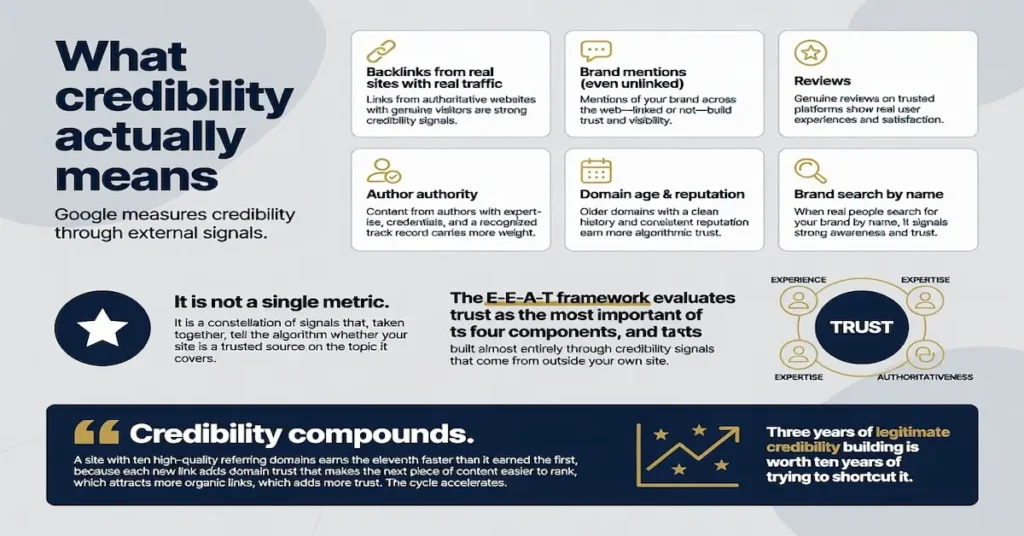
Google measures credibility through external signals. Backlinks from real sites with real traffic. Brand mentions, even unlinked ones. Reviews. Author authority. The age and reputation of the domain. Whether real humans search for your brand by name.
It is not a single metric. It is a constellation of signals that, taken together, tell the algorithm whether your site is a trusted source on the topic it covers. The E-E-A-T framework evaluates trust as the most important of its four components, and trust is built almost entirely through credibility signals that come from outside your own site.
Credibility compounds. A site with ten high-quality referring domains earns the eleventh faster than it earned the first, because each new link adds domain trust that makes the next piece of content easier to rank, which attracts more organic links, which adds more trust. The cycle accelerates. Three years of legitimate credibility building is worth ten years of trying to shortcut it.
How we build credibility
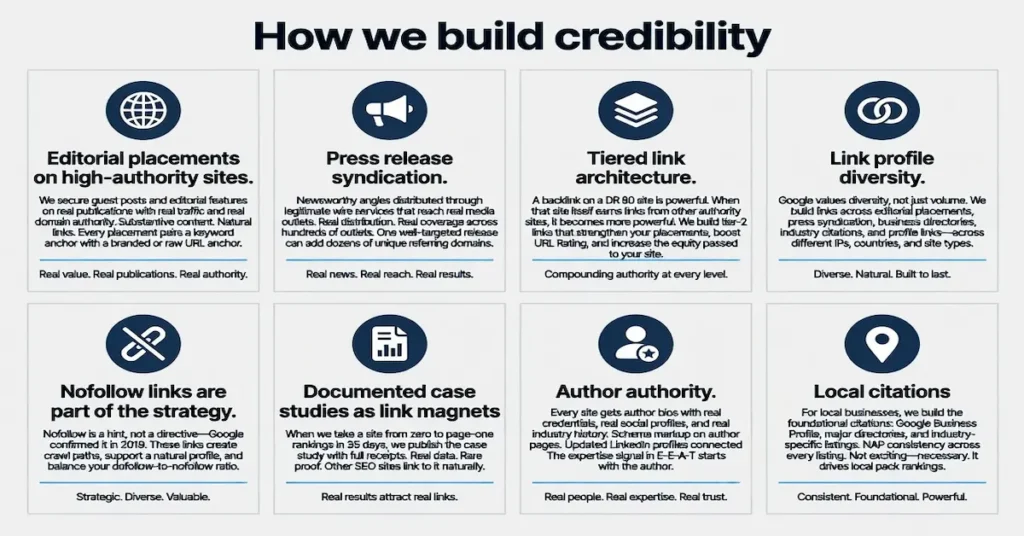
Editorial placements on high-authority sites. We secure guest posts and editorial features on real publications with real traffic and real domain authority. The content is substantive, not filler. The links are embedded naturally within articles that provide genuine value to the publication’s audience. Every placement includes a keyword anchor paired with a branded or raw URL anchor to maintain a natural link profile.
Press release syndication. Newsworthy angles distributed through legitimate wire services that reach real media outlets. Not the $50 auto-republish press releases that hit only scraper sites. Real distribution that places your brand in front of journalists and generates coverage across hundreds of outlets. A single well-targeted press release can add dozens of unique referring domains to your profile in one event.
Tiered link architecture. A backlink on a DR 80 site is powerful. A backlink on a DR 80 site that itself receives links from other authority sites is more powerful. We build tier-2 links that strengthen your existing placements, increasing the URL Rating of the pages that link to you, which increases the equity those pages pass to your site. The compounding happens at both levels simultaneously.
Link profile diversity. Google evaluates the diversity of your referring domains, not just the count. A profile with 100 links from 5 domains looks manufactured. A profile with 100 links from 80 domains across different IPs, different countries, and different site types looks organic. We build across editorial placements, press syndication, business directories, industry citations, and profile links to create the kind of diverse, natural profile that survives algorithm updates.
Nofollow links are part of the strategy. The industry treats nofollow links as worthless. The data says otherwise. Google confirmed in 2019 that nofollow is a hint, not a directive. Every nofollow link is a crawl path that leads Googlebot to your pages. A healthy dofollow-to-nofollow ratio signals a natural profile. We do not avoid nofollow links. We use them strategically as part of the diversity layer.
Documented case studies as link magnets. When we take a site from zero to page-one rankings in 35 days, we publish the case study with the receipts. Other SEO sites link to it because documented results with real data are rare. Real proof attracts real links without outreach.
Author authority. Every site we work on gets author bios with real credentials, real social profiles, and real history in the field. Schema markup on author pages so Google understands who wrote what. Personal LinkedIn profiles updated and connected. The expertise signal in E-E-A-T starts with who wrote the content and whether that person is a recognized authority.
Local citations. For local businesses, we build the foundational citations: Google Business Profile, major directories, industry-specific listings. NAP consistency across every listing. This is not exciting work. It is necessary work that 90% of small business sites skip, and it feeds directly into local pack rankings.
Dilution over disavow
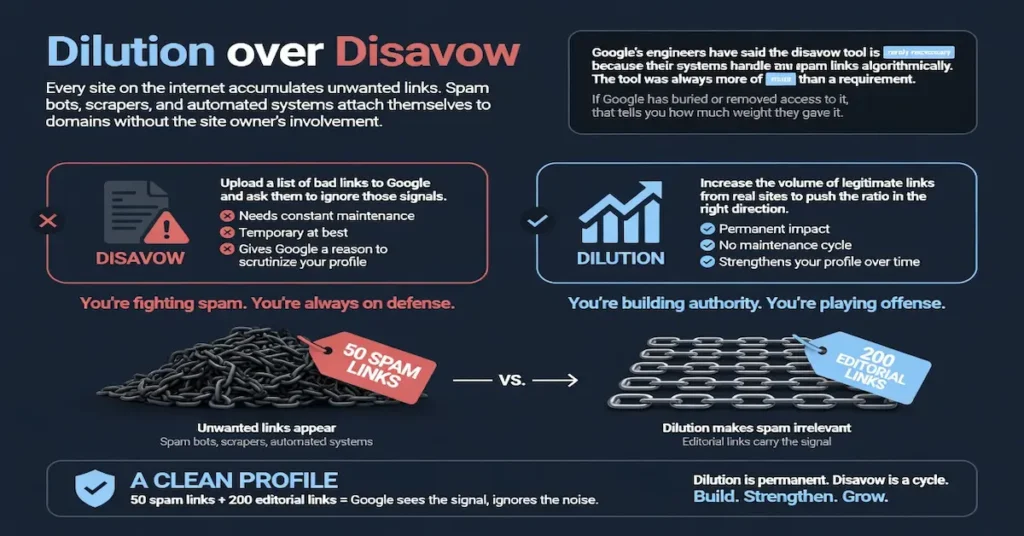
Every site on the internet accumulates unwanted links. Spam bots, scrapers, and automated systems attach themselves to domains without the site owner’s involvement. The industry’s standard response is the disavow file: uploading a list of bad links to Google and asking them to ignore those signals.
We do not disavow. Google’s own engineers have said the disavow tool is rarely necessary because their systems handle spam links algorithmically. The tool was always more of a security blanket than a requirement, and if Google has buried or removed access to it, that tells you how much weight they gave it.
Instead of disavowing, we dilute. When unwanted links appear, we increase the volume of legitimate links from real sites to push the ratio in the right direction. A profile with 50 spam links and 200 editorial links is a clean profile. The spam becomes noise that Google ignores while the editorial links carry the signal. Dilution is permanent. Disavow files need constant maintenance and give Google a reason to scrutinize your profile more closely.
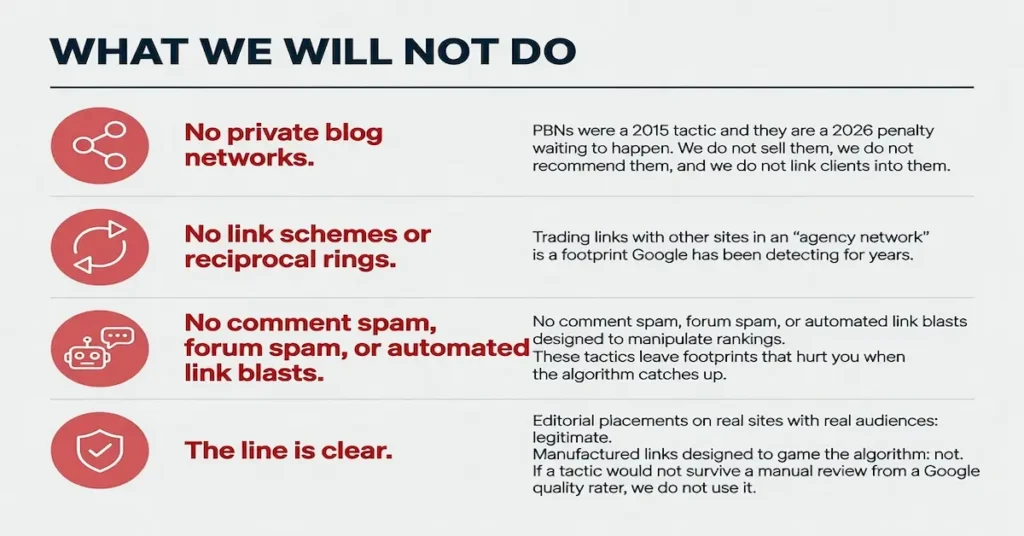
What we will not do
No private blog networks. PBNs were a 2015 tactic and they are a 2026 penalty waiting to happen. We do not sell them, we do not recommend them, and we do not link clients into them.
No link schemes or reciprocal rings. Trading links with other sites in an “agency network” is a footprint Google has been detecting for years.
No comment spam, forum spam, or automated link blasts designed to manipulate rankings. These tactics leave footprints that hurt you when the algorithm catches up.
The line is clear. Editorial placements on real sites with real audiences: legitimate. Manufactured links designed to game the algorithm: not. If a tactic would not survive a manual review from a Google quality rater, we do not use it.
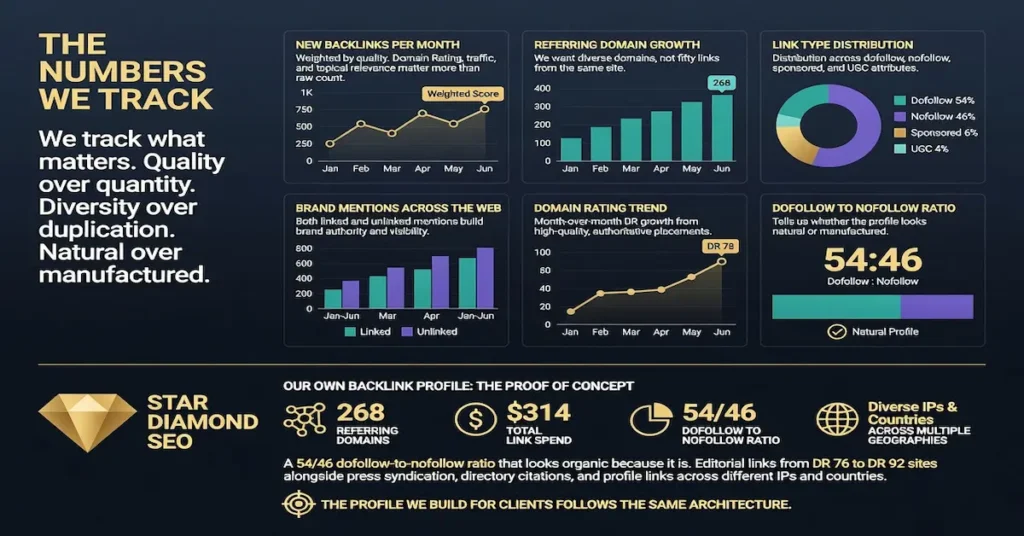
The numbers we track
New backlinks per month, weighted by quality. Domain Rating, traffic, and topical relevance matter more than raw count. Referring domain growth, because we want diverse domains, not fifty links from the same site. The link type distribution across dofollow, nofollow, sponsored, and UGC attributes. Brand mentions across the web, both linked and unlinked. Domain Rating trend month over month. And the ratio of dofollow to nofollow links, which tells us whether the profile looks natural or manufactured.
Star Diamond SEO’s own backlink profile is the proof of concept: 268 referring domains built for $314 in total link spend. A 54/46 dofollow-to-nofollow ratio that looks organic because it is. Editorial links from DR 76 to DR 92 sites alongside press syndication, directory citations, and profile links across different IPs and countries. The profile we build for clients follows the same architecture.
How credibility connects to the rest
Credibility is the last C and the multiplier on the first four. Without it, Content ranks slowly, Cadence feels thankless, Calibration hits a ceiling, and Crawlability just delivers indexed pages that do not compete.
With credibility, the wheel spins faster every month. New content ranks faster because the domain has accumulated trust. New pages benefit from the link equity already pointing at the site. The whole framework compounds.
That is why we save it for last. The first four Cs build the foundation. Credibility is the multiplier you apply once the foundation is solid.
What we offer
Our link building service handles editorial outreach, press syndication, tiered link architecture, and profile diversity as part of a comprehensive link building campaign. We also offer credibility-only engagements for sites that have great content but no link profile, usually small businesses that have been publishing for years without ever building external signals.
Start with a business consultation or an SEO site audit to find out whether credibility is your bottleneck. If you have content that should be ranking but is not, the answer is usually here.