
AI Summary
What is Content Strategy? A structured plan for what to publish, when to publish it, and how every piece connects to build the kind of topical authority Google rewards with rankings.
What it is and who it is for: Built for business owners who are either publishing content that goes nowhere or have no content plan at all. This service replaces guesswork with architecture.
The rule: Random content is wasted content. Every page exists for a reason, targets a real query, and connects to the pages around it.
The Problem
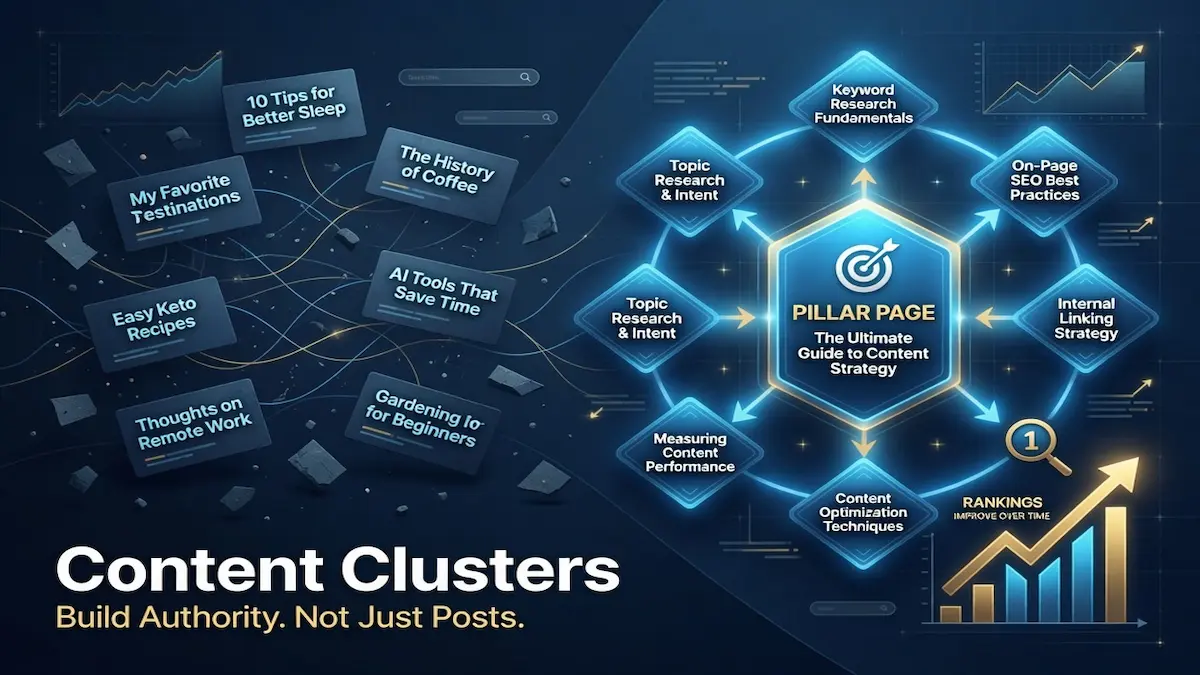
Most businesses publish content with no plan. A blog post about one topic, then another about something unrelated, then nothing for two months, then a burst of three posts that do not connect to anything. Every article is an island. None of them build on each other. Google sees a site that covers everything and masters nothing.
That is how you end up with 50 blog posts and zero rankings. Volume without architecture is noise.
What Most Agencies Sell
Four blog posts per month. That is the standard content package across the industry. They pick keywords from a tool, write generic articles, and publish them on a schedule. No cluster architecture. No internal linking strategy. No connection between the post they wrote this week and the one they wrote last month.
It looks like progress because the blog is getting longer. But Google does not reward blogs for being long. It rewards sites for demonstrating expertise, authority, and trust across a topic. Four disconnected posts per month do not build authority. They build a graveyard of content that ranks for nothing.
What I Build
Clusters. Not blog posts. Clusters.
A content cluster is a group of pages organized around a single topic, connected through deliberate internal linking, and published as a unit. One pillar page covers the topic comprehensively. Supporting articles go deeper on subtopics. Every page links to every other page in the cluster. When Google crawls one, it finds them all.
This is how Star Diamond SEO’s own site works. Every cluster on stardiamondseo.com was built bottom-up: lowest-tier articles first, pillar last, all internal links wired before anything goes live. The Content pillar explains the philosophy in full. The results are documented in Google Search Console.
The strategy starts with a content gap analysis. I pull your competitors through Ahrefs and find every keyword they rank for that you do not. Then I filter for the sweet spot: keywords with real search volume and low enough competition that a new page can rank. Those keywords get organized into clusters, mapped to URLs, and scheduled in publishing order.
What You Get
A complete content architecture. Not a list of blog post ideas. A map of exactly what to publish, in what order, targeting which keywords, linking to which pages, organized into clusters that build topical authority from the ground up.
The deliverable includes keyword research with volume and difficulty data, cluster architecture with pillar and supporting article assignments, keyword mapping to URLs, internal linking targets for every page, and a publishing calendar that sequences everything in the right order.
If you want Star Diamond SEO to write the content, we do that too. Every article follows the same production standard we use on our own site: 2,000+ words, minimum five internal links, structured HTML, FAQ with schema, and an AI detection pass before publishing. If you want to write it yourself or use your own team, the strategy document gives you everything you need.
Who This Is For
Business owners who are tired of publishing into the void. You have been writing or paying someone to write, and the traffic needle is not moving. You need someone to look at the whole picture, find the gaps your competitors are exploiting, and give you a plan that turns content into rankings instead of just filling a blog.
Also for businesses starting fresh who want to build the architecture right before the first word gets published. Getting the structure right on day one is cheaper than rebuilding it after 100 posts that do not connect to anything.
Ready to talk about it? Start with a business consultation and we will figure out whether content strategy is the right first move or whether something else needs to happen first.
FAQ
What is a content cluster?
A group of pages organized around a single topic. One pillar page covers the topic broadly. Supporting articles go deeper on subtopics. All pages link to each other through deliberate internal linking so Google understands the relationship between them.
How many articles do I need?
It depends on the topic and the competition. A typical cluster has three to eight articles plus a pillar page. Some topics need more depth. The content gap analysis determines the right number based on what your competitors are doing and where the keyword opportunities are.
Do you write the content or just plan it?
Both. The strategy deliverable is a standalone document you can hand to any writer. If you want Star Diamond SEO to write the articles, we produce them to the same standard we use on our own site: 2,000+ words, structured HTML, internal links, FAQ with schema, and AI detection cleared before publishing.
How long before I see results from content?
New content typically starts generating impressions in Google Search Console within one to three weeks of indexing. Ranking positions improve over weeks and months as Google crawls, evaluates, and re-evaluates the content. A full cluster publishing simultaneously tends to gain traction faster than individual articles published over time because Google sees the topical depth immediately.
What if I already have content on my site?
Existing content gets audited as part of the strategy. Some pages may need to be updated, consolidated, or restructured to fit the cluster architecture. Good content that already exists gets wired into the new structure. Nothing gets thrown away without reason.
How is this different from what other agencies offer?
Most agencies sell a monthly post count. Star Diamond SEO sells an architecture. The difference is that a post count fills a calendar while an architecture builds authority. Every page in the strategy exists for a specific reason, targets a specific keyword, and connects to the pages around it through a deliberate linking structure.