What Is a Content Pillar & How to Build One That Ranks
AI Summary
What is a content pillar? A content pillar is the central page in a topic cluster. It covers a broad subject comprehensively, targets the highest-volume keyword in the topic space, and connects to a set of supporting tier articles through deliberate internal links. The pillar is defined by its structural position within a cluster, not by its word count or format.
What it is and who it is for: This guide explains how content pillars work, why they outrank isolated articles, how to choose pillar topics, how to build tier structures, and how the internal linking architecture distributes authority across every page in the cluster. It is written for SEO practitioners, content strategists, and business owners building sites designed to compound in organic search and AI-generated responses.
The rule: A content pillar is not a long article. It is a structural node that organizes, amplifies, and distributes the authority generated by every page connected to it. Without the cluster beneath it, a pillar is just a blog post. The structure is the ranking advantage.
What a Content Pillar Actually Is
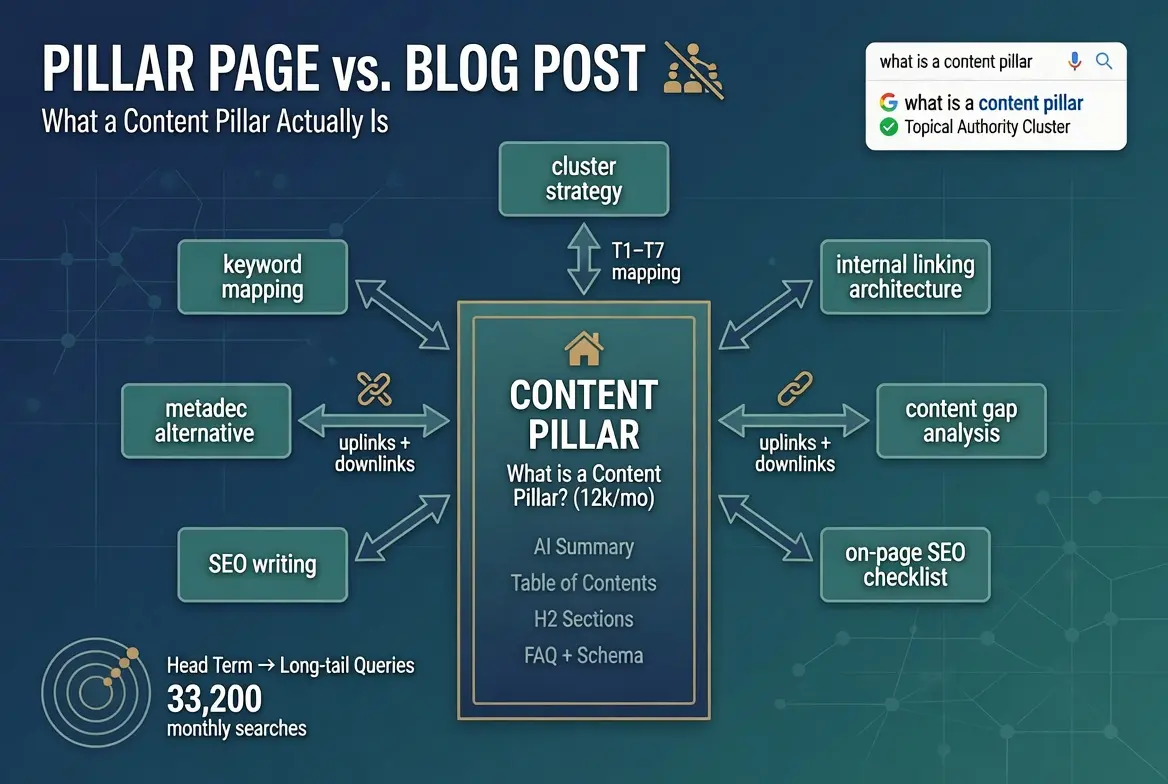
A content pillar is the central page in a topic cluster. It covers a broad subject comprehensively, targeting the highest-volume keyword in the topic space, and links to a set of supporting articles that each dive deeper into specific subtopics the pillar introduces but does not exhaustively cover. The supporting articles link back up to the pillar, creating a bidirectional linking structure that tells Google this site covers the topic from the broadest overview down to the most specific detail.
The concept is architectural, not editorial. A content pillar is not defined by its word count, its format, or its depth alone. It is defined by its position within a structure. A 3,500-word article about content strategy is just a long article if it stands alone. The same article becomes a content pillar when it connects to seven supporting articles through deliberate internal links, each one covering a subtopic the pillar introduces, each one reinforcing the pillar’s topical authority through upward-linking anchor text.
The distinction matters because most sites that claim to use content pillars do not actually build pillar structures. They publish long articles and call them pillars. The length is not what produces the ranking advantage. The structure is. A 2,000-word pillar connected to seven supporting articles through a deliberate internal linking architecture will outperform a 5,000-word standalone article on the same topic because the cluster demonstrates topical depth that a single page cannot match regardless of length.
Why Pillar Pages Outrank Isolated Articles
The ranking advantage of pillar pages comes from three mechanisms that isolated articles cannot replicate.
First, topical authority aggregation. Google’s ranking systems evaluate not just whether a single page covers a topic well, but whether the site as a whole demonstrates comprehensive knowledge of that topic. A site with one article about content pillars has minimal topical authority on the subject. A site with a pillar about content pillars connected to articles about cluster strategy, keyword mapping, internal linking, gap analysis, on-page optimization, SEO writing, and meta description alternatives has substantial topical authority. The cluster proves to Google that the site does not just know one thing about the topic. It knows everything about the topic.
Second, authority circulation. When the pillar earns an external backlink, the authority flows down through internal links to every tier article. When a tier article earns a backlink, the authority flows up through internal links to the pillar. Every backlink anywhere in the cluster benefits every page in the cluster. An isolated article can only benefit from its own backlinks. A pillar benefits from the backlinks of every page connected to it. The credibility discipline in the 5C Framework treats this authority circulation as the foundation of off-site SEO strategy.
Third, query coverage breadth. The pillar targets the head term. The tier articles target the long-tail variations. Together, the cluster covers dozens of related queries that no single page could target without becoming an unfocused mess. A searcher typing “what is a content pillar” finds the pillar. A searcher typing “how to map keywords to content pillars” finds the T2 article. A searcher typing “content gap analysis seo” finds the T4 article. Every query variation has a dedicated page, and every page reinforces the authority of every other page.
The Difference Between a Pillar Page and a Blog Post
A blog post is a standalone piece of content. It covers a topic, targets a keyword, and exists independently on the site. It may link to other content. It may not. Its ranking potential is bounded by its own authority and the domain authority of the site it sits on. Publishing another blog post on the same site does not directly strengthen the first one unless the two are deliberately connected through internal links with strategic anchor text.
A pillar page is a structural node. It exists specifically to connect a set of related content into a unified system. Its purpose is not just to rank for its own keyword but to organize, amplify, and distribute the authority generated by every page in the cluster. The pillar is the page that benefits most from the tier articles, and the tier articles are the pages that benefit most from the pillar. The relationship is mutual and structural.
The content quality standards are the same for both. A pillar page should be as well-written, as thoroughly researched, and as editorially rigorous as any article on the site. The difference is not quality. It is architecture. The pillar page carries additional structural responsibilities: linking to every tier, maintaining a table of contents that maps the cluster, covering the broad topic at a level that introduces every subtopic the tiers address, and targeting the head keyword that the entire cluster is designed to rank for.
In practice, pillar pages tend to be longer than blog posts because the scope is broader. A typical pillar runs 3,000 to 4,000 words. But length is a consequence of scope, not a requirement. A pillar that covers its topic comprehensively at 2,500 words is better than a pillar that pads to 4,000. The scope determines the length. The architecture determines the function.
Anatomy of a Content Pillar
The structure of a pillar page follows a consistent pattern that serves both reader navigation and search engine parsing.
The AI Summary block opens the page with a structured overview: a definition of the topic, an explanation of the target audience, and a statement of the core principle the article teaches. This block gives Google high-quality snippet material and gives readers an immediate assessment of whether the page addresses their question. The block is designed to produce better SERP snippets than any hand-written meta description, which is why meta descriptions are not written for these pages.
The table of contents follows, linking to every H2 section in the article through anchor IDs. The TOC serves readers who want to navigate directly to a specific section and Google’s systems that use the TOC structure to understand the article’s topical scope. Google sometimes displays individual TOC entries as sitelinks under the main result in the SERP, which multiplies the page’s visibility and click-through rate.
The body covers the broad topic through H2 sections, each addressing a major subtopic. The pillar should cover each subtopic at enough depth to demonstrate familiarity and authority, then link to the dedicated tier article that covers it exhaustively. This creates a natural reading flow: the reader gets the overview from the pillar and clicks through to the tier article for deep coverage on any subtopic that interests them.
The FAQ section targets question-based queries with direct answers. Each question is an H3. Each answer is a single paragraph. The questions are drawn from real search query data, not invented. The FAQ text matches the FAQPage schema exactly, enabling rich result display in the SERP.
The schema block contains Article schema (headline, author, publisher, dates, mainEntityOfPage) and FAQPage schema. The pillar’s Article schema does not include isPartOf because the pillar is the top of the hierarchy. The tier articles’ schemas include isPartOf pointing to the pillar URL.
Choosing the Right Pillar Topic
The pillar topic determines everything that follows. The wrong topic produces a cluster that is too narrow to justify multiple articles or too broad to cover comprehensively. The right topic produces a cluster that captures significant search volume, demonstrates genuine topical authority, and connects to the site’s commercial objectives.
Start with the content gap analysis. The highest-volume keywords where your competitors rank and you do not are the candidate pillar topics. Filter for keywords that naturally break into 4 to 8 subtopics, connect to your business’s expertise, and target an audience you want to reach.
Test the topic against four criteria. Volume: at least 1,000 monthly searches for the head term. Subtopic depth: 4 to 8 natural subtopics. Commercial relevance: connects to the site’s products, services, or expertise. Competitive achievability: the site can produce content that competes with what currently ranks, supported by a realistic authority building plan. Topics that meet all four criteria are pillar candidates. Topics that fail one or more should be reconsidered or deferred until the site’s authority supports them.
Building the Tier Structure Around the Pillar
The tier structure emerges from the keyword mapping process. The keywords clustered around the pillar topic are grouped into article-level sets. Each set becomes a tier article. The highest-volume keyword in each set becomes the article’s primary keyword. The remaining keywords become secondary keywords and LSI terms.
The tiers are numbered by their position in the hierarchy relative to the pillar. T1 articles target the major subtopics with the highest keyword volume after the pillar keyword. They are substantial articles that could stand alone as comprehensive resources on their specific subtopic. T2 through T4 articles target progressively more specific keywords, narrowing the focus and deepening the coverage.
The number of tiers follows from the keyword data, not from a template. The content strategy cluster on this site has 7 tier articles because the keyword mapping surfaced 7 distinct subtopics. A different cluster might have 3. Another might have 10. The topic determines the structure. The keyword data validates it. Forcing a predetermined number of articles onto a topic that does not support them produces thin content that weakens the cluster.
Every tier article must cover its subtopic with genuine depth. A tier article that summarizes its topic in 800 words when the topic warrants 2,500 is not a tier article. It is a placeholder. Google’s quality evaluation assesses depth relative to topic complexity. A shallow tier article does not just underperform on its own keyword. It weakens the cluster’s topical authority signal because it demonstrates that the site’s coverage of this subtopic is superficial. The content discipline in the 5C Framework treats content depth as a non-negotiable requirement across every page on the site.
The Keyword Architecture That Makes Pillars Rank
The keyword architecture of a pillar cluster follows a hierarchy that mirrors the content hierarchy. The pillar targets the broadest keyword. Each tier targets a progressively more specific keyword. No two pages in the cluster target the same primary keyword. The architecture prevents cannibalization and ensures every keyword in the topic space has exactly one dedicated page.
Each article’s secondary keywords provide topical depth without competing with other articles in the cluster. The keyword map documents every assignment before writing begins. The writer consults the map, not their intuition, when deciding which keywords to incorporate. This discipline prevents the drift that causes articles to wander into each other’s keyword territory.
The keyword architecture also informs the anchor text strategy. When T1 links up to the pillar, the anchor text matches the pillar’s primary keyword. When the pillar links down to T1, the anchor text matches T1’s primary keyword. The anchor text reinforces Google’s understanding of what each page targets. Every internal link carries a deliberate topical signal. No link is wasted on generic anchor text like “click here” or “read more.”
How Pillar Pages Distribute Authority Through Internal Links
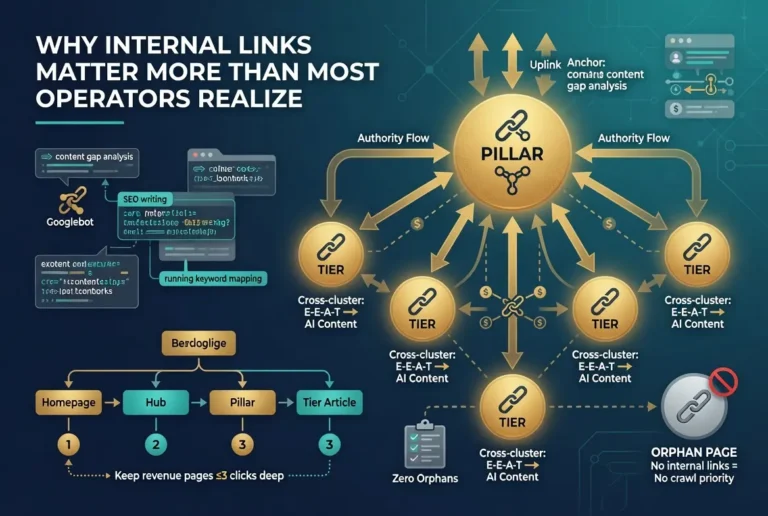
The pillar page is the authority hub of the cluster. It receives internal links from every tier article (uplinks) and sends internal links to every tier article (downlinks). This bidirectional linking creates an authority circulation system where every backlink earned anywhere in the cluster strengthens every page in the cluster.
The uplinks from tier articles to the pillar are the most important internal links in the cluster. Each tier article links to the pillar using anchor text that matches or closely relates to the pillar’s primary keyword. Seven tier articles, each linking to the pillar with a variation of the primary keyword, build a concentrated anchor text signal that reinforces Google’s understanding of what the pillar covers.
The downlinks from the pillar to the tier articles distribute the pillar’s accumulated authority. When the pillar earns a backlink, a portion of that authority flows through each downlink to the tier articles. A pillar with ten external backlinks that links to seven tier articles distributes authority to all seven. Each tier article benefits from backlinks it did not earn directly. The pillar functions as an authority amplifier for the entire cluster.
Cross-links between tier articles create secondary authority pathways. When T4 (content gap analysis) links to T2 (keyword mapping), authority flows between them independent of the pillar. These lateral links add redundancy to the authority circulation and establish topical relationships that the pillar-tier hierarchy alone does not capture. The crawlability discipline ensures that every page in the cluster is reachable through multiple internal link paths, so Google’s crawler discovers and re-evaluates every page efficiently.
The practical impact is measurable. A tier article in a well-linked cluster ranks better for its primary keyword than the same article would rank as an isolated page with the same content and the same external backlinks. The internal linking provides authority the page could not generate on its own. The cluster structure is the ranking multiplier.
Content Pillars and E-E-A-T
Content pillar structures directly reinforce E-E-A-T signals that Google’s quality evaluation systems look for. Each dimension of E-E-A-T is strengthened by the cluster architecture in ways that isolated articles cannot match.
Experience is demonstrated through specificity. A pillar that references real examples, actual data, and specific outcomes from the author’s own work signals first-hand experience with the topic. When that pillar connects to tier articles that go even deeper into specific aspects of the topic, the cumulative signal is that the author has not just surface-level familiarity but working knowledge built from doing the work.
Expertise is demonstrated through comprehensiveness. A single article can show knowledge. A cluster can show mastery. When a site covers a topic from the broadest strategic overview down to the most granular implementation detail, each connected through deliberate internal links, the expertise signal compounds. Google sees not one article that knows the topic but an entire content ecosystem built around it.
Authoritativeness is demonstrated through external validation. When other sites link to any page in the cluster, the authority flows through the pillar structure to every connected page. A cluster that earns backlinks to multiple tier articles builds authority faster than a site with scattered, unconnected content because the internal linking concentrates and distributes that authority deliberately.
Trust is demonstrated through consistency. A pillar cluster that maintains consistent quality, accurate information, clear attribution, and transparent methodology across every page builds a trust signal that no single page can establish alone. The cluster is a body of work. The trust is cumulative.
Content Pillars in YMYL Industries
Industries where Google applies heightened quality standards benefit disproportionately from content pillar architecture because the cluster structure directly addresses the depth and authority signals YMYL evaluations prioritize.
A dental practice with a pillar page about dental implants connected to tier articles covering cost, procedure, recovery, risks, candidates, and alternatives demonstrates the kind of comprehensive coverage that YMYL evaluation rewards. A competing practice with a single FAQ page about dental implants cannot match the topical authority signal regardless of how well-written that single page is.
Healthcare providers face the same dynamic. A medical practice with a content pillar about a specific condition connected to tier articles about symptoms, diagnosis, treatment options, prevention, and patient experience builds a resource that Google’s quality systems can evaluate as comprehensive, authoritative, and trustworthy. Each tier article strengthens the pillar’s position for the head term.
Law firms competing for practice area keywords see the same compounding effect. A personal injury pillar connected to tiers about car accidents, workplace injuries, medical malpractice, wrongful death, and settlement processes covers the full scope of queries potential clients search. The cluster captures the client at every stage of their research journey.
Real estate professionals building location-based content clusters follow the same architecture. A city-level pillar connected to neighborhood guides, market data articles, and buyer/seller guides creates a topical authority signal for that geographic market that isolated listing pages cannot generate.
The principle scales across every YMYL vertical. The deeper the content quality standards Google applies to a topic, the greater the advantage of building a pillar structure that systematically demonstrates the depth, expertise, and authority those standards require.
Content Pillars and AI Search Visibility
The same structural signals that help pillar clusters rank in traditional search are increasingly relevant to how AI platforms select sources for generated responses. AI search visibility depends on whether platforms like ChatGPT, Perplexity, and Google AI Overviews identify your content as a trustworthy, comprehensive source worth citing.
AI platforms favor sources that demonstrate topical depth. A site with a content pillar connected to supporting articles signals organized, comprehensive knowledge that AI retrieval systems can identify and extract. The cluster structure makes the content easier for AI systems to parse because the hierarchy is explicit: broad overview at the pillar, detailed coverage at the tiers, and clear internal links connecting them.
The editorial layer between content creation and publication is especially important for AI visibility. AI platforms are becoming more capable of distinguishing between content that reflects genuine expertise and content that assembles information without original perspective. Pillar clusters written with authentic voice, specific examples, and original analysis are more likely to be cited than clusters that read like compiled research. The approach to AI-generated content must account for this: AI tools can assist production, but the expertise, structure, and editorial judgment must come from the author.
Content architecture is becoming a dual-purpose investment. The pillar structure you build for Google rankings is the same structure that earns AI citations. The calibration discipline treats this dual optimization as a core requirement for any competitive content strategy in 2026 and beyond.
The Build Process: Bottom Up, Launch Together
The build process for a content pillar follows two principles: bottom-up writing order and coordinated publication.
Bottom-up means the deepest tier articles are written first and the pillar is written last. The cluster strategy article explains the rationale in detail. Writing the pillar last allows it to reference actual content rather than planned content, calibrate its scope against the actual coverage provided by the tier articles, and launch into a structure where every supporting page already exists.
Coordinated publication means every article in the cluster is published simultaneously. All articles are built in draft with every internal link pre-wired. The links point to URLs that will resolve when the entire cluster goes live. On publication day, every link activates. No broken links. No orphan pages. No period where published articles contain links to pages that do not exist yet.
The publication sequence: set all articles to private draft. Verify every internal link URL. Check all schema markup for accuracy. Confirm no keyword cannibalization between articles. Then publish all articles within a single session. Submit each URL through Google Search Console for indexing. The cluster enters Google’s index as a complete topical structure from its first crawl. The cadence discipline governs the publishing rhythm that keeps the site’s content fresh and the crawl signals active after the initial launch.
This process requires holding finished content unpublished until the entire cluster is complete. That discipline is difficult. The temptation to publish articles as they are finished is real. But the coordinated launch produces stronger initial indexing signals, faster authority circulation, and a cleaner crawl experience for Googlebot than dripping articles out over days or weeks. The discipline pays for itself in ranking velocity.
What a Working Pillar Structure Looks Like
The page you are reading right now is a content pillar. It sits at the top of the Content Strategy cluster under the On-Site SEO hub on Star Diamond SEO. Below it, seven tier articles cover the specific subtopics this pillar introduces.
The cluster was built bottom-up over one production session. T7 (SEO Writing) was written first. T6 (Meta Descriptions), T5 (On-Page Checklist), T4 (Content Gap Analysis), T3 (Internal Linking Architecture), T2 (Keyword Mapping), and T1 (Content Cluster Strategy) followed in sequence. This pillar was written last, after every supporting article existed and every internal link could be verified.
Every article in the cluster links up to this pillar. This pillar links down to every article. Cross-links between tier articles connect related subtopics. Links to existing live pages on the site (E-E-A-T articles, AI content articles, link types articles) connect this cluster to the broader site architecture.
This is what a working content pillar looks like. Not a long article. A system.
The SEO knowledge base covers every aspect of search optimization across all five disciplines. The full range of SEO services at Star Diamond SEO includes content strategy as a core offering. Contact us to discuss building a content pillar strategy for your site.
Common Pillar Page Mistakes
Building a pillar page without tier articles. A 4,000-word article with no supporting content linked beneath it is a long blog post, not a pillar. The pillar’s ranking advantage comes from the cluster structure. Without the cluster, there is no structural advantage.
Making the pillar too broad. “SEO” is not a pillar topic. It is an entire website. A pillar needs to be broad enough to support multiple subtopics and specific enough to cover comprehensively in one page. “Content pillar strategy” works. “Digital marketing” does not.
Making the pillar too narrow. A pillar about “how to write H2 tags for SEO” does not support a cluster because the topic does not break into enough subtopics. That is a tier article, not a pillar. If the topic only warrants one article, it does not need a pillar-tier structure.
Publishing the pillar first. When the pillar goes live before the tier articles, it launches as an isolated page. The internal links to tier articles point to pages that do not exist. Google crawls the pillar and finds broken links or no supporting content. The initial crawl assessment forms without the topical authority signals the tier articles would provide. Building bottom-up and launching together prevents this.
Duplicating coverage between pillar and tiers. The pillar should introduce each subtopic at a summary level and link to the tier article for depth. If the pillar covers a subtopic at the same depth as the tier article, the two pages compete for the same queries. The pillar’s coverage should be broad. The tier’s coverage should be deep.
Neglecting the pillar after launch. The pillar should be updated whenever new tier articles are added to the cluster. A new tier article means a new downlink from the pillar, a new entry in the table of contents, and potentially a new section that introduces the subtopic the new tier covers. A pillar that stops evolving while the cluster grows becomes stale and disconnected from its own supporting content.
The same content architecture principles that drive organic rankings now determine whether AI platforms treat your site as an authoritative source worth citing in generated responses. A well-structured pillar cluster signals the kind of organized, comprehensive expertise that both Google and AI systems reward.
FAQ
What is a content pillar in SEO?
A content pillar is the central page in a topic cluster that covers a broad subject comprehensively and connects to supporting tier articles through deliberate internal links. It targets the highest-volume keyword in the topic space and serves as the authority hub that distributes link equity to every page in the cluster. The pillar is defined by its structural position, not its word count.
How long should a pillar page be?
A typical pillar page runs 3,000 to 4,000 words, but length is a consequence of scope, not a requirement. The pillar should cover its topic comprehensively at a summary level, introducing every subtopic the tier articles address without duplicating their depth. A pillar that covers its topic thoroughly at 2,500 words is better than one that pads to 4,000 with filler content.
How many tier articles should a content pillar have?
The number of tier articles follows from the keyword data, not a template. Most effective clusters have between 4 and 10 tier articles. The topic determines how many subtopics exist, and each subtopic with sufficient search volume and depth to warrant its own page becomes a tier article. Forcing articles onto a topic that does not support them produces thin content that weakens the cluster.
Should the pillar page or tier articles be published first?
The tier articles should be written first (bottom-up) and the pillar written last. All articles should be published simultaneously so every internal link resolves from day one. This coordinated launch produces stronger indexing signals and faster authority circulation than publishing articles individually over time.
What is the difference between a content pillar and a landing page?
A landing page is designed for conversion. It targets a commercial keyword and drives visitors toward a specific action like filling out a form or making a purchase. A content pillar is designed for topical authority. It targets an informational keyword and drives ranking power to an entire cluster of related content. Both can exist on the same site serving different functions in the marketing funnel.
Do content pillars work for local SEO?
Yes. Local businesses can build content pillars around their service areas or specialties. A dental practice can build a pillar about dental implants with tier articles covering cost, procedure, recovery, and alternatives. A real estate agent can build a city-level pillar with neighborhood guides as tier articles. The cluster architecture works at any scale and for any geography.