SEO Writing: How to Write Content That Ranks
AI Summary
What is SEO writing? SEO writing is the practice of producing written content that serves both the reader and the search engine simultaneously. It targets specific keywords with confirmed search volume, matches the search intent behind those keywords, and structures the content so that Google’s systems can parse, evaluate, and rank it accurately.
What it is and who it is for: This article is for anyone producing content intended to rank in search results, whether that is a business owner writing their own blog posts, a marketing manager directing a content team, or a freelance writer entering the SEO content space. It covers how to balance keyword targeting with natural writing, how search intent shapes content format, where AI fits in the writing process, and why most SEO writing advice produces content that reads like it was written for an algorithm rather than a person.
The rule: The best SEO writing is invisible. The reader should never feel the keywords. The structure should feel logical, not optimized. The depth should feel thorough, not padded. If the reader can tell the content was written for a search engine, it was written poorly regardless of how well it targets the keyword.
What SEO Writing Actually Is in 2026
SEO writing has an identity problem. The term conjures images of keyword-stuffed paragraphs, robotic phrasing, and content that reads like it was assembled from a checklist rather than written by someone who understands the subject. That image is not entirely unfair. A lot of content produced under the SEO writing label does read exactly like that. The problem is not with the practice. It is with how most practitioners execute it.
At its core, SEO writing is the discipline of producing content that answers a specific question a real person is typing into a search engine, structured in a way that allows Google’s systems to understand what the content covers, evaluate whether it is worth recommending, and rank it accordingly. That discipline does not require sacrificing readability, voice, or genuine expertise. It requires integrating keyword awareness into a writing process that would produce good content regardless of whether search engines existed.
The distinction matters because Google’s quality evaluation has matured to the point where content produced primarily for search engines is identifiable and penalized. The Helpful Content guidelines Google publishes make the standard explicit: content should be created primarily for people, with search engine optimization applied to help that content reach the audience it was written for. The order of priority is not a suggestion. It is the operating framework for how Google’s ranking systems evaluate every page they index.
The SEO writers producing results in 2026 are not keyword technicians. They are subject matter communicators who understand how search systems work well enough to make their expertise visible to those systems without compromising the quality of what they write.
Search Intent Comes Before the First Word
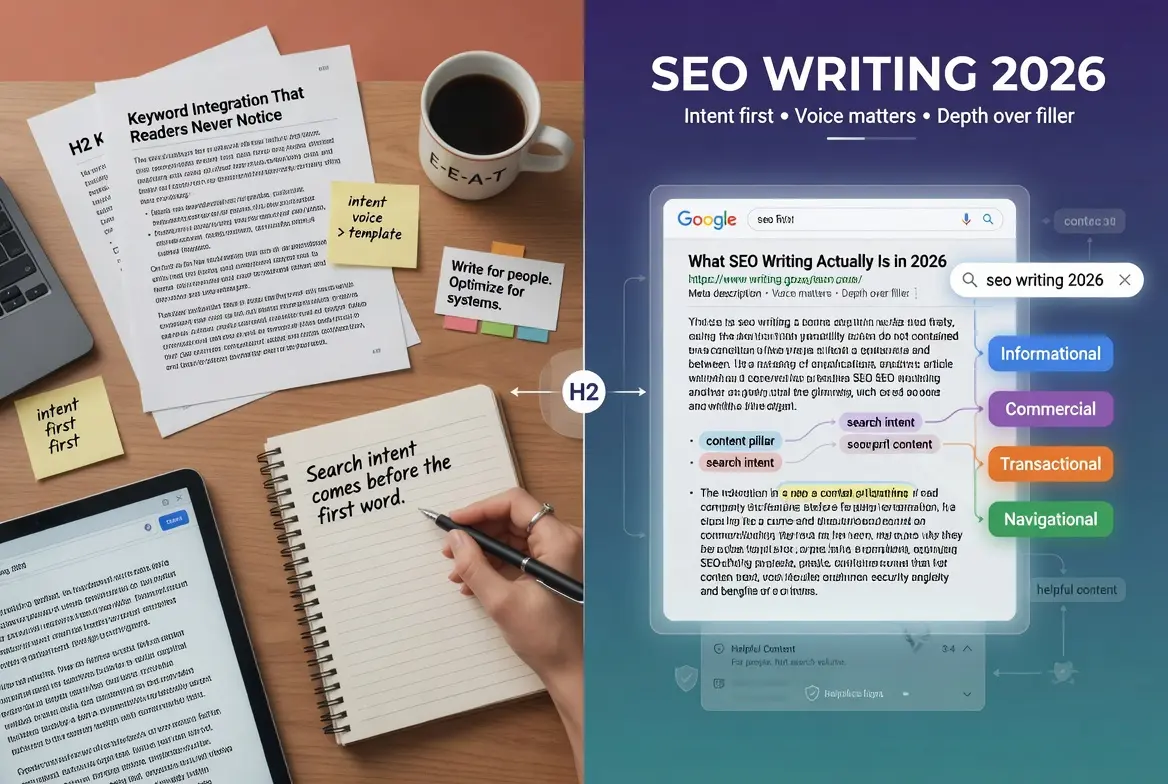
Every keyword carries an intent. Someone searching “what is a content pillar” wants to learn. Someone searching “seo writing services” wants to hire. Someone searching “on page seo checklist” wants a tool they can use immediately. The content that ranks for each of these queries is formatted differently because the intent behind each query is different. Writing content that ignores the intent is writing content that will not rank regardless of how well it targets the keyword.
The four intent categories are informational (the searcher wants to understand something), commercial (the searcher is evaluating options before a decision), transactional (the searcher is ready to act), and navigational (the searcher is looking for a specific page). The content format that serves each intent follows predictable patterns. Informational queries want guides, explanations, and educational depth. Commercial queries want comparisons, evaluations, and frameworks for decision-making. Transactional queries want clear calls to action and friction-free paths to conversion. Navigational queries want the page the searcher is already looking for.
Before writing a single sentence, search the target keyword. Look at what Google is showing on page one. The format of the top results tells you what intent Google has assigned to that query. If every result is a how-to guide, Google has classified the query as informational. Publishing a sales page for that keyword is fighting the intent classification. You will lose. If every result is a product comparison, the query is commercial. A beginner’s explainer will not compete.
The intent check takes two minutes. Skipping it wastes every hour spent writing content formatted for an intent Google does not associate with the target keyword. This is the single most common failure in SEO writing, and it happens before the writing begins.
Keyword Integration That Readers Never Notice
The primary keyword belongs in the title, the first paragraph, one or two H2 headings, and naturally throughout the body. The secondary keywords belong wherever they fit without forcing them. That is the entire keyword integration strategy. Everything beyond that is overthinking a problem that good writing solves naturally.
The mistake most SEO writers make is treating keyword placement as a mechanical exercise. They count keyword density. They ensure the primary keyword appears exactly 7 times per 1,000 words. They insert secondary keywords into sentences that contort around them. The result is content that hits every keyword target and reads like it was written by someone who has never had a conversation. Google’s natural language processing is sophisticated enough to understand synonyms, semantic relationships, and topical relevance without exact-match keyword repetition. Writing naturally about the topic covers the keyword field more effectively than mechanical insertion.
The practical approach is to write the first draft without thinking about keywords at all. Write to explain the topic thoroughly and clearly. Then review the draft and check whether the primary keyword appears naturally in the title, the opening paragraph, and a few headings. If it does, the integration is done. If it does not, adjust the phrasing in those specific locations without rewriting the surrounding content. The body of the article should read like an expert explaining a subject, not like a writer trying to hit keyword targets.
Secondary keywords and LSI terms take care of themselves when the content is comprehensive. An article about content pillars that genuinely covers the topic will naturally mention topic clusters, internal linking, content hierarchy, and topical authority because those concepts are inherent to the subject. You do not need to force them in. You need to cover the topic thoroughly enough that they appear organically.
Structure That Serves Both Audiences
Content structure is where SEO writing and good writing converge rather than conflict. A well-structured article helps the reader navigate the content efficiently. The same structure helps Google’s systems parse the content, identify the topics covered, and evaluate the comprehensiveness of the coverage. The goals are aligned.
H2 headings define the major sections. Each H2 should cover a distinct subtopic that contributes to the article’s overall thesis. The heading text should describe what the section contains clearly enough that a reader scanning the page can find the information they need without reading everything. Google uses heading structure to understand the topical architecture of the page, so headings that accurately describe their sections serve both the scanner and the algorithm.
H3 headings break major sections into subsections when the complexity warrants it. Not every H2 section needs H3s. A section that covers a single concept in three paragraphs does not need subsection headings. A section that covers four distinct components of a larger concept benefits from H3s that label each component. The heading hierarchy should reflect the logical hierarchy of the information, not an arbitrary formatting template.
Paragraphs should be shorter than academic writing and longer than social media copy. Three to five sentences per paragraph is the range that balances readability on screens with the substantive depth that demonstrates expertise. Single-sentence paragraphs work for emphasis. Overusing them creates a staccato rhythm that feels breathless rather than authoritative. Seven-sentence paragraphs work when the argument requires sustained development. Overusing them creates walls of text that mobile readers abandon.
The on-page optimization checklist covers the technical structure elements, title tags, meta considerations, schema, URL structure, that support the content. Those elements are the frame. The writing is the house. The frame matters. The house is what people live in.
Depth vs Length: Why Word Count Is Not a Strategy
The correlation between word count and ranking position has been misinterpreted for years. Longer content tends to rank better not because length is a ranking factor but because longer content tends to cover more subtopics, earn more backlinks, and satisfy more search intents than shorter content covering the same subject. The causation runs through comprehensiveness, not through word count.
A 3,000-word article that covers a topic exhaustively will outrank a 1,000-word article that covers it superficially. A 1,500-word article that covers a narrow topic with genuine depth will outrank a 3,000-word article that pads a narrow topic with filler to hit a word count target. Google’s systems evaluate whether the content addresses the searcher’s query comprehensively, not whether it exceeds an arbitrary length threshold.
The practical implication for SEO writing is to write until the topic is covered and then stop. If the subject requires 2,500 words to address thoroughly, write 2,500 words. If it requires 1,200 words, write 1,200 words and resist the impulse to pad. Filler is detectable. Readers sense it. Google’s quality evaluators are specifically trained to identify it. And the Helpful Content framework penalizes sites that publish padded content systematically because padding is a signal that the content was produced for search volume capture rather than reader utility.
The competitive benchmark is more useful than a word count target. Search the target keyword. Look at the top three results. Note their depth, not their length. If the top results cover eight subtopics with examples and data, your article needs to cover those subtopics at equal or greater depth plus at least one subtopic they missed. That is the bar. Not a number. A standard of coverage.
Writing With Voice in a Templated World
The SEO content landscape in 2026 is drowning in content that sounds identical. The same structures. The same transition phrases. The same “in this article, we will explore” openings. The same “in conclusion” closings. The sameness is partly a consequence of AI-generated content flooding every niche with competent but characterless prose. It is partly a consequence of SEO writing formulas that prioritize template compliance over genuine communication.
Voice is the competitive advantage that templates and AI cannot replicate at scale. A writer who brings genuine perspective, earned through experience with the subject, produces content that reads differently from the 40 other articles targeting the same keyword. The perspective does not need to be controversial. It needs to be specific. “Link building is important for SEO” is a statement anyone could write without knowing anything about link building. “Link building stopped working for us when we prioritized volume over relevance, and the recovery took four months” is a statement that carries the weight of experience. The second version demonstrates the Experience signal that Google’s E-E-A-T framework specifically rewards.
The voice rules that produce content worth ranking: no hollow openers that could introduce any article on any topic. No hedging language that weakens every claim to avoid being wrong about anything. No false authority where the writer pretends to know things they do not know. Honest edges where the writer acknowledges limitations, admits uncertainty, and corrects themselves mid-article when a better framing occurs to them. These patterns are not stylistic preferences. They are trust signals that readers recognize and Google’s quality framework is designed to reward.
Where AI Fits in SEO Writing
AI is a drafting tool. It is not a writing tool. The distinction determines whether the output ranks and holds or ranks briefly and disappears when a competitor publishes something with genuine substance behind it.
The effective use of AI in SEO writing follows a specific pattern. The writer defines the target keyword, the search intent, the heading structure, and the key points each section should cover. The AI generates a draft based on those inputs. The writer then rebuilds the draft: restructuring sections that flow poorly, adding depth the AI could not produce because it has no experience with the subject, removing claims that sound plausible but lack substance, inserting the specific details, examples, and perspectives that only someone who understands the topic would include. The editorial layer is where the value lives. The AI draft is scaffolding. The editorial process is the building.
The ineffective use of AI in SEO writing is publishing the draft. An unedited AI draft produces content that is coherent, keyword-aware, and indistinguishable from the thousands of other unedited AI drafts targeting the same keyword. It demonstrates no experience because the AI has no experience. It demonstrates surface expertise because the AI synthesizes existing content rather than generating original insight. It demonstrates no authority because it carries no author identity. The content ranks temporarily because it is technically competent. It gets displaced when someone publishes content with genuine depth behind it.
The operators who use AI effectively produce more content at higher quality than they could without it. The operators who use AI as a replacement for expertise produce more content at lower quality than they realize, and the quality gap becomes visible in the rankings over three to six months as Google’s systems process the quality signals that distinguish genuine depth from sophisticated summarization.
The On-Page Elements That Support the Writing
The writing is the core asset. The on-page elements are the infrastructure that helps search engines process that asset correctly. Both matter. Neither substitutes for the other.
Title tags should include the primary keyword and communicate the value proposition of the page in under 60 characters. The title is the first thing the searcher sees in the results. It determines the click. A title that accurately represents the content and includes the target keyword naturally will outperform a title that stuffs the keyword at the expense of clarity.
Heading hierarchy should use H2s for major sections and H3s for subsections, with the primary keyword in at least one H2 and secondary keywords distributed naturally across others. The heading structure is a table of contents that Google reads to understand the scope of the page. Headers that accurately label their sections serve both readability and indexation.
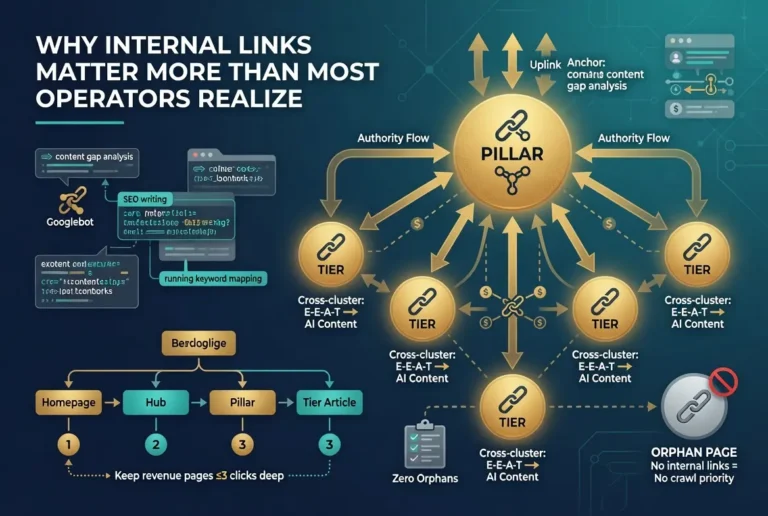
Internal links connect the article to related content on the site, distributing authority and establishing topical relationships. Every article should link to related pages through descriptive anchor text that tells both readers and search engines what the linked page covers. The internal linking architecture is how individual articles become a content ecosystem rather than a collection of isolated pages.
Schema markup, specifically Article schema and FAQ schema when applicable, helps Google’s systems categorize the content and potentially display enhanced results in the SERP. The schema should match the actual content exactly. FAQ schema where the questions and answers in the markup differ from the questions and answers on the page is a misrepresentation that Google’s systems will eventually catch and penalize.
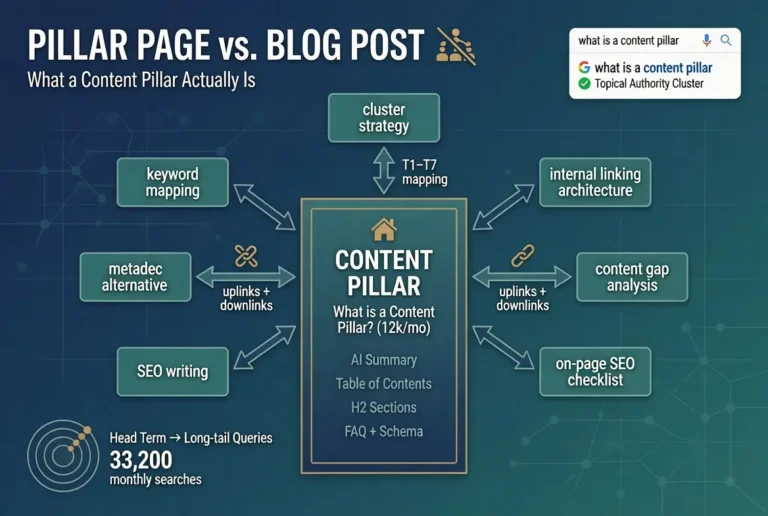
Image alt text should describe what the image shows, not stuff a keyword into an attribute nobody reads. If the image is a chart showing content pillar structure, the alt text should say “content pillar structure diagram showing pillar page linked to cluster articles.” That is descriptive. It is also naturally keyword-relevant. Forcing “best seo writing tips 2026” into the alt text of that image is keyword stuffing in a field Google specifically monitors for it.
The Writing Failures Google Learned to Detect
Google’s content quality systems have been trained on millions of human quality evaluations. The patterns that quality raters flag as low quality are now detectable algorithmically. Understanding what those patterns are helps SEO writers avoid producing content that triggers them.
Shallow coverage of complex topics. An article about content gap analysis that defines the term and lists three tools without explaining methodology, interpretation, or application is shallow coverage. The topic warrants depth. The article provides a summary. Google’s systems compare the depth of coverage against the complexity of the topic and the depth of competing pages. Shallow coverage of a complex topic signals that the content was produced without genuine expertise.
Repetitive content across pages. A site that publishes ten articles about content pillars with 60% overlapping content is not building topical authority. It is publishing the same article with different titles. Google’s site-level quality evaluation identifies content redundancy and treats it as a signal that the site prioritizes keyword coverage over reader utility. Each page should cover a distinct angle that does not substantially overlap with other pages on the same site.
Content that answers the query then keeps going. The most common padding pattern is an article that answers the primary question in the first three paragraphs and then fills 2,000 more words with tangentially related information to hit a word count target. The reader got what they needed. The content kept going. Google’s engagement signals, time on page relative to content length, scroll depth, return-to-SERP rate, indicate when users are satisfied early and abandon the rest. That pattern correlates with lower rankings over time.
Formulaic structure across every article. When every article on a site follows the same template: intro paragraph with keyword, definition section, benefits section, how-to section, FAQ, conclusion, the uniformity signals template-driven production rather than topic-driven writing. Real expertise produces different structures for different topics because different topics require different organizational approaches. A guide to keyword research has a different natural structure than an analysis of Google’s ranking algorithm. Forcing both into the same template flattens both.
Missing attribution and sourcing. Content that makes specific claims without citing sources, references data without linking to the original study, or presents expert opinions without identifying the expert fails the Expertise and Trust evaluations in Google’s quality framework. Sourcing is not an academic requirement. It is a credibility signal that Google’s systems are trained to evaluate. Content that shows its work ranks better than content that presents conclusions without evidence.
FAQ
What is SEO writing?
SEO writing is the practice of creating written content that targets specific search queries while maintaining quality and readability for human readers. It involves keyword research to identify what people are searching for, search intent analysis to determine the right content format, and structured writing that helps search engines understand and rank the content appropriately.
How do you write SEO content that ranks?
Start with search intent analysis to determine the right format. Write comprehensive content that covers the topic more thoroughly than competing pages. Integrate the primary keyword naturally in the title, first paragraph, and headings. Structure with clear H2 and H3 hierarchy. Add internal links to related content. Write with genuine expertise and voice rather than following a template. Publish and monitor ranking movement over three to six months.
Is SEO writing different from regular writing?
SEO writing adds keyword awareness, search intent matching, and technical structure (heading hierarchy, internal linking, schema) to the writing process. The actual quality of writing should be identical to good regular writing: clear, specific, substantive, and written for the reader. The SEO layer helps the content reach its audience through search. It should not change how the content reads.
How many keywords should I use in an SEO article?
Target one primary keyword per article with 3 to 5 secondary keywords that support the main topic. The primary keyword should appear naturally in the title, first paragraph, and one or two headings. Secondary keywords should appear wherever they fit naturally without forcing them. Comprehensive coverage of the topic will include most relevant keyword variations organically without deliberate insertion.
Does AI content rank in Google?
AI-generated content can rank when it goes through genuine editorial oversight that adds expertise, original perspective, and depth the AI could not produce independently. Unedited AI content ranks temporarily but is increasingly displaced by content that demonstrates real experience and expertise. Google evaluates content quality regardless of how it was produced, but the quality signals AI struggles to replicate, such as first-hand experience and original insight, are the signals Google’s framework specifically rewards.
How long should SEO content be?
Content should be as long as the topic requires for comprehensive coverage and no longer. The competitive benchmark matters more than a word count target: analyze the depth and subtopic coverage of the top three ranking pages for your target keyword and match or exceed their comprehensiveness. Articles padded with filler to hit word count targets perform worse than shorter articles with genuine depth because Google’s quality systems are designed to detect and penalize content inflation.
What is the most common SEO writing mistake?
Ignoring search intent. Writing content formatted for the wrong intent, such as publishing a sales page for an informational query or a beginner’s guide for a commercial comparison query, will not rank regardless of content quality or keyword optimization. The two-minute intent check of searching the target keyword and analyzing the format of top results prevents this mistake entirely.