Content Gap Analysis: Find Topics Your Competitors Own
AI Summary
What is a content gap analysis? A content gap analysis is the process of identifying keywords and topics that competing websites rank for and your website does not. The analysis compares your keyword profile against multiple competitors to surface the specific search queries where your site is invisible despite having the relevance and capability to compete.
What it is and who it is for: This article is for SEO practitioners, content strategists, and business owners who need a systematic method for deciding what to write next. It covers how to select the right competitors, run the analysis, filter the raw data into actionable opportunities, and convert those opportunities into a content plan that targets the highest-value gaps first.
The rule: A content gap analysis does not tell you what to write. It tells you where you are invisible. The gap between knowing where you are invisible and knowing what to build requires strategic interpretation that no tool provides automatically. The tool surfaces the data. The operator decides what it means.
What a Content Gap Analysis Actually Tells You
A content gap analysis answers a single question: what are people searching for that your competitors can answer and you cannot? The answer is a list of keywords, and that list represents the specific search queries where potential customers, readers, or clients are finding your competitors instead of you because you have not published content that targets those queries.
The analysis does not tell you whether those gaps matter. A competitor might rank for thousands of keywords that are irrelevant to your business, your audience, or your content strategy. The raw output of a gap analysis is data. The value of the analysis depends entirely on the interpretation layer that follows: which gaps represent genuine opportunities, which are noise, and which should be prioritized based on commercial value, competitive difficulty, and alignment with your existing content architecture.
The tools that run gap analyses, primarily Ahrefs Content Gap and SEMrush Keyword Gap, produce the raw keyword lists. They do not produce strategy. An operator who runs the analysis, exports 12,000 keywords, and starts writing articles targeting the highest-volume terms has confused data with direction. The data tells you where the gaps are. The strategy determines which gaps are worth closing and in what order.
Choosing the Right Competitors to Analyze
The competitors you select for the analysis determine the quality of the output. Choose the wrong competitors and the gap list will be filled with keywords that are either irrelevant to your market or impossible to compete for. Choose the right competitors and the list becomes a roadmap of achievable, relevant opportunities.
The right competitors are not necessarily your business competitors. They are your content competitors: the sites that rank for the keywords your audience searches for. A local SEO agency in Fort Wayne does not compete for content with Moz or Ahrefs. Those sites rank for tens of thousands of SEO keywords at authority levels that a new site cannot match on head terms. But the local agency does compete with mid-tier SEO blogs, agency sites with similar domain authority, and niche publications that cover the same topics at a similar depth.
Select 5 to 11 competitors across two tiers. The first tier is direct content competitors: sites at a similar authority level that cover the same topics and target the same audience. These competitors surface the gaps you can realistically close with quality content and reasonable link building. The second tier is aspirational competitors: larger sites with broader keyword coverage that rank for terms you want to own eventually. These competitors surface the long-tail opportunities where they rank with thin content that your deeper coverage can displace.
Run the competitors through Ahrefs or SEMrush to verify their keyword profiles before including them in the analysis. A competitor with 50 organic keywords provides minimal gap data. A competitor with 5,000 organic keywords provides a rich dataset of opportunities. The more keywords the competitors rank for, the more gaps the analysis can surface.
Running the Analysis: Step by Step
The mechanical process of running a content gap analysis is straightforward. The strategic decisions embedded in the process determine whether the output is useful.
In Ahrefs, navigate to Content Gap. Enter your domain in the “But the following target doesn’t rank for” field. Enter 3 to 5 competitor domains in the competing domains fields. Run the analysis. Ahrefs returns every keyword that at least one competitor ranks for and your domain does not. Export the results as CSV.
Run the analysis in batches rather than loading all competitors at once. First batch: the direct competitors (3 to 5 mid-authority sites in your niche). This surfaces the immediately actionable opportunities. Second batch: the aspirational competitors (3 to 5 larger sites). This surfaces the broader keyword landscape and long-tail opportunities. Export both batches separately, then merge and deduplicate the combined dataset.
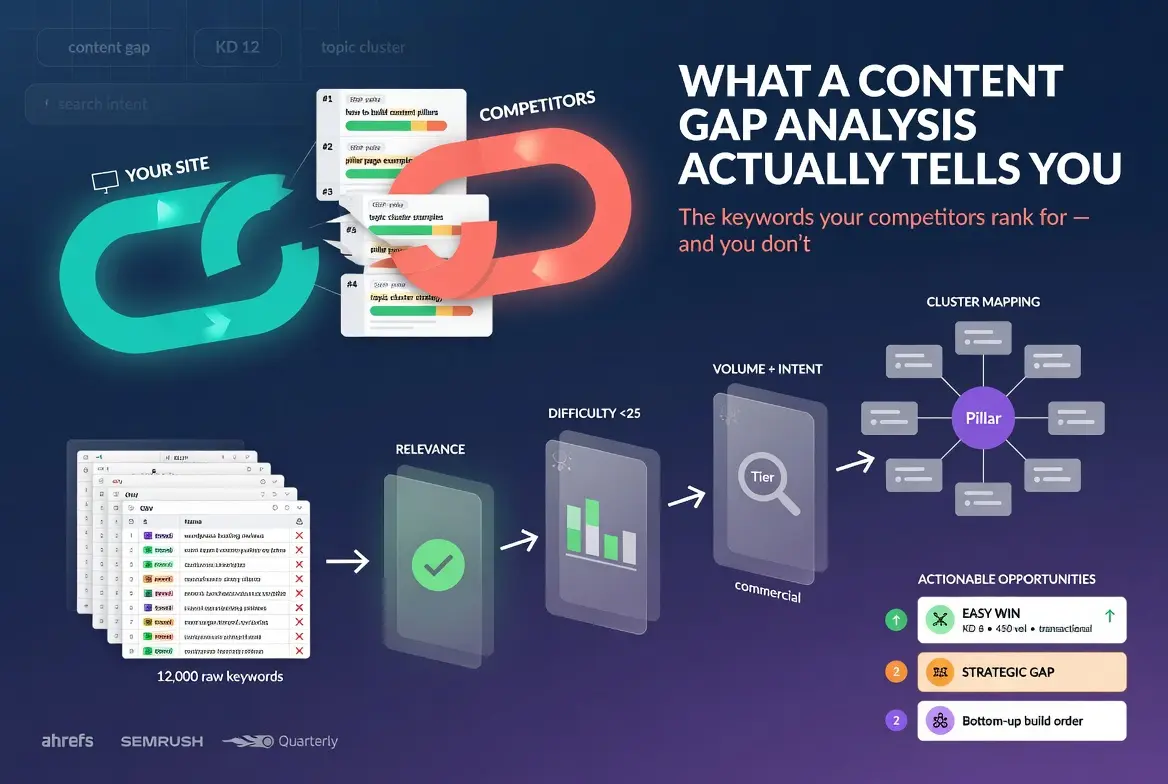
The raw export will be large. An analysis against 11 competitors across two batches can produce 10,000 to 15,000 raw keywords. Most of them are noise: branded terms for the competitors, keywords in unrelated verticals that the competitors happen to rank for, extremely low-volume terms, and keywords with difficulty scores that exceed your site’s current authority. The raw export is not the deliverable. The filtered, categorized, prioritized dataset is the deliverable.
Filtering 12,000 Keywords Into Actionable Opportunities
The filtering process transforms a raw keyword dump into an actionable opportunity set. Each filter removes a layer of noise and sharpens the remaining data toward keywords that are relevant, achievable, and commercially valuable.
Filter by relevance first. Remove every keyword that does not relate to your content categories, your services, or your audience’s interests. Competitor sites rank for thousands of keywords outside your niche. An SEO agency’s competitors might rank for “wordpress hosting reviews” or “email marketing software.” Those are real keywords with real volume. They are not your keywords. Remove them.
Filter by difficulty second. Set a maximum keyword difficulty threshold based on your site’s current authority. A new site with domain rating under 20 should focus on keywords with KD under 20. A more established site can push higher. The difficulty filter is not absolute, KD is a made-up number based on backlink profiles of current ranking pages, but it provides a useful sorting mechanism for prioritization. Low KD keywords are not necessarily easy to rank for. They are keywords where the current competition has weaker backlink profiles, which means quality content with modest link support can compete.
Filter by volume third. Set a minimum volume threshold that aligns with your traffic goals. For most sites, 100 monthly searches is a reasonable floor. Keywords below that threshold can still be valuable for long-tail targeting within a cluster, but they should not drive cluster planning decisions on their own.
Filter by intent fourth. Classify the remaining keywords by search intent: informational, commercial, transactional, navigational. This classification determines where each keyword belongs in your content architecture. Informational keywords become blog posts and educational content. Commercial keywords become comparison pages and evaluation guides. Transactional keywords become service pages and landing pages. The intent determines the content format, which determines the cluster position.
What survives the four filters is your opportunity set. For a well-targeted analysis against 11 competitors, expect 1,000 to 2,000 keywords to survive from an initial pool of 10,000 to 15,000. That filtered set is the foundation for content planning.
Categorizing Gaps by Content Type
The filtered keyword set needs organization before it becomes a content plan. Categorization groups related keywords into clusters that map to your site’s content architecture.
Map each keyword to your existing hub categories. If your site architecture has 10 hub categories, each keyword in the filtered set should belong to one of them. Keywords that do not fit any existing category either reveal a gap in your site architecture (you need a new category) or are outside your content scope (remove them).
Within each category, group keywords by subtopic. Keywords like “content pillar,” “topic cluster,” “pillar page structure,” and “how to build a content pillar” all belong to the same subtopic cluster. Grouping them reveals the content pillar opportunity: one pillar article targeting the head term supported by tier articles targeting the long-tail variations. The cluster structure emerges from the keyword groupings rather than being imposed on them.
Flag the easy wins. Keywords with high volume, low difficulty, and clear commercial intent are the opportunities that should move to the front of the production queue. These are the keywords where a quality article, properly optimized and supported by a few internal links, can reach page one within three to six months. Easy wins build traffic momentum that supports the harder keyword targets you pursue later.
Flag the strategic gaps. These are high-volume, higher-difficulty keywords that represent the major topics in your space. You will not rank for them immediately. But building the content cluster around them, tier articles targeting the long-tail variations, establishes topical authority that makes the pillar page competitive over time. Strategic gaps are six-to-twelve month projects. Easy wins are one-to-three month projects. Both belong in the plan. They belong in different phases.
Prioritizing: What to Build First
Priority is not determined by keyword volume alone. The highest-volume keyword in your gap set might require a domain authority you do not have yet, content depth you cannot produce with current resources, and a link building campaign you cannot afford. Volume without achievability is a wish list, not a plan.
The prioritization framework that produces the fastest measurable results evaluates each opportunity against four criteria. Volume: how many people search for this per month. Difficulty: how competitive the current ranking landscape is. Commercial value: how directly this keyword connects to revenue generation. Content readiness: how much of the supporting content already exists on your site.
A keyword with 500 monthly searches, zero difficulty, high commercial intent, and an existing cluster it can link into is a higher priority than a keyword with 10,000 monthly searches, moderate difficulty, informational intent, and no existing content to support it. The first keyword produces traffic within weeks. The second keyword requires months of cluster building before the pillar has enough support to compete.
Build a scoring system. Volume divided by difficulty plus one gives you a raw priority score that floats high-volume, low-difficulty keywords to the top. Multiply by a commercial value modifier (2x for transactional, 1.5x for commercial, 1x for informational) and the scoring accounts for revenue potential. Sort by the combined score. The top of the list is your production queue.
Turning Gaps Into Cluster Plans
The gap analysis identifies individual keyword opportunities. The cluster strategy organizes those opportunities into content architectures that build topical authority systematically.
Each keyword cluster becomes a pillar-and-tier structure. The highest-volume keyword in the cluster becomes the pillar target. The long-tail variations become tier article targets. The build order is bottom up: write the deepest tier articles first, then work upward through the tiers to the pillar. By the time the pillar is written, the supporting content already exists, the internal links are pre-wired, and the pillar publishes into a structure that demonstrates topical depth from day one.
Map the keywords to each tier article before writing begins. Each article gets a primary keyword, 3 to 5 secondary keywords, and a set of LSI terms that provide topical depth. The keyword mapping prevents overlap between articles in the same cluster and ensures every article targets a distinct query set.
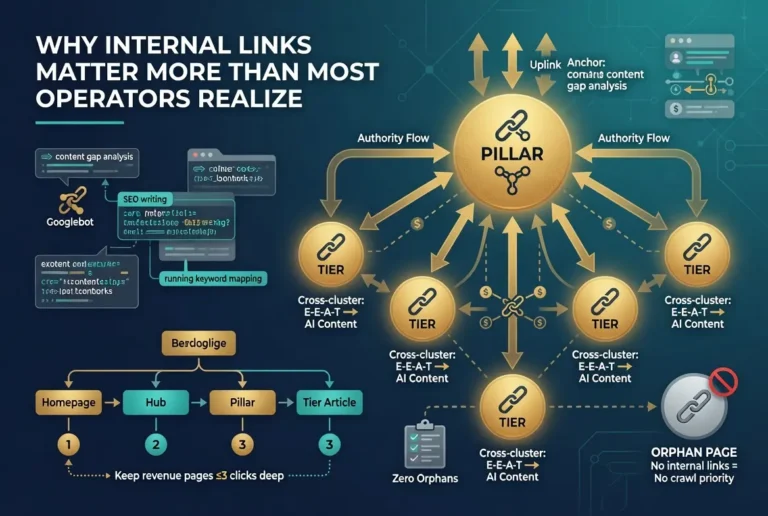
Pre-wire the internal links before any article is published. Every tier article includes links up to the pillar and cross-links to other tier articles in the same cluster. The pillar includes links down to every tier. Articles also link out to existing live pages on the site. Build everything in draft, wire all the links, then publish the entire cluster at once so every link resolves immediately. No broken links. No going back to edit. One coordinated launch.
This is how Star Diamond SEO builds every content cluster. The gap analysis surfaces the opportunities. The cluster plan organizes them. The bottom-up build order produces them. The pre-wired linking architecture connects them. The result is a cluster that hits Google’s index as a complete, interconnected content structure rather than a series of isolated pages published over weeks with links added as an afterthought.
Common Mistakes That Waste the Analysis
The gap analysis process has several failure modes that produce data without producing results.
Analyzing the wrong competitors. Including competitors with domain authority three to five times higher than yours floods the gap set with keywords you cannot compete for. Including competitors in adjacent but different niches floods it with keywords that are irrelevant. The competitor selection is the most important decision in the entire process. Get it wrong and the best analysis in the world produces the wrong roadmap.
Skipping the relevance filter. The raw export contains every keyword the competitors rank for and you do not. That includes their branded terms, their location-specific pages, their career listings, their product pages in verticals you do not serve. Publishing content targeting irrelevant keywords dilutes your site’s topical focus, which is the opposite of what a content strategy should produce.
Treating all gaps as equal. A gap in a high-commercial-intent keyword with 5,000 monthly searches is not the same opportunity as a gap in a low-intent keyword with 200 monthly searches. The volume, intent, difficulty, and strategic value of each gap vary enormously. Treating the gap list as a flat production queue instead of a prioritized strategic plan produces content that fills the calendar without advancing the business.
Running the analysis once and never again. Your competitors publish new content. Your site publishes new content. The gap set changes continuously. An analysis run six months ago reflects a competitive landscape that no longer exists. Run the analysis quarterly at minimum. Compare the current gap set against the previous one. The keywords that appeared in the new analysis but not the old one represent emerging opportunities. The keywords that disappeared from the gap set represent opportunities you have closed through your own publishing.
Ignoring the gaps your competitors have against you. The gap analysis is bidirectional. Running it in reverse, with your domain as the competitor and their domains as the target, shows keywords you rank for that they do not. These are your competitive advantages. Defending them with continued content investment is as important as closing the gaps in the other direction. An internal linking strategy that reinforces your strongest content protects the positions you have already earned.
Gap Analysis Is Not a One-Time Exercise
The content gap analysis is the diagnostic tool that drives ongoing content planning. Running it once produces a snapshot. Running it quarterly produces a trend line. The trend line is more valuable than the snapshot because it shows whether your content operation is closing gaps faster than new ones emerge.
Each quarterly analysis should produce three outputs. First, the new opportunities: keywords that appeared in the gap set since the last analysis, representing topics where competitors have published new content or new search demand has emerged. Second, the closed gaps: keywords where you now rank that you previously did not, confirming that the content you published is reaching the audience. Third, the persistent gaps: keywords that have appeared in multiple consecutive analyses without being addressed, indicating either deprioritization or a content production bottleneck.
The persistent gaps deserve particular attention. If the same high-value keyword appears in three consecutive quarterly analyses, something in the production process is preventing it from being addressed. Either the keyword is harder to write for than expected, the resources are not available, or the keyword keeps getting deprioritized in favor of easier opportunities. Persistent gaps are often the highest-value opportunities precisely because they are difficult, which is why competitors rank for them and you do not.
Track the total gap count over time as a macro metric. If the total number of relevant gaps is shrinking quarter over quarter, your content operation is outpacing the competition. If it is growing, the competition is outpacing you. The trend tells you whether the strategy is working at the portfolio level, even if individual articles succeed or fail.
The gap analysis connects to every other component of the on-page optimization and content strategy process. It feeds the cluster planning. The cluster planning drives the content production that demonstrates expertise. The content production creates pages that earn links. The links build authority that makes the next cluster easier to rank. The gap analysis is where the cycle begins. Running it consistently is what keeps the cycle turning.
FAQ
What is a content gap analysis?
A content gap analysis identifies keywords and topics that competing websites rank for and your website does not. The analysis compares your keyword profile against multiple competitors to surface specific search queries where your site is invisible. The output is a dataset of keyword opportunities that can be organized into content plans targeting the highest-value gaps first.
How do I run a content gap analysis?
Use Ahrefs Content Gap or SEMrush Keyword Gap. Enter your domain as the target and 3 to 5 competitor domains as the comparison set. Export the results. Filter by relevance to your niche, keyword difficulty appropriate for your site’s authority, minimum search volume of 100, and search intent classification. Run the analysis in two batches: direct competitors first, then aspirational competitors.
How many competitors should I include?
Select 5 to 11 competitors across two tiers. The first tier of 3 to 5 direct content competitors at similar authority levels surfaces immediately actionable opportunities. The second tier of 3 to 5 larger aspirational competitors surfaces long-tail opportunities where their thin content can be displaced by your deeper coverage. More competitors produce more data but also more noise requiring additional filtering.
How often should I run a content gap analysis?
Run the analysis quarterly at minimum. The competitive landscape changes continuously as you and your competitors publish new content. Quarterly analyses show whether your gap set is shrinking (your content operation is outpacing competition) or growing (competition is outpacing you). Compare each analysis against the previous one to identify new opportunities, closed gaps, and persistent gaps that need attention.
What should I do with the results?
Filter the raw data by relevance, difficulty, volume, and intent. Categorize surviving keywords into your site’s hub categories. Group related keywords into topic clusters. Prioritize by a combined score of volume, difficulty, and commercial value. Convert the highest-priority clusters into pillar-and-tier content plans with keyword mapping, internal link architecture, and build order defined before writing begins.
How many keywords should survive the filtering?
For a well-targeted analysis against 5 to 11 competitors, expect 1,000 to 2,000 relevant keywords to survive from an initial pool of 10,000 to 15,000 raw keywords. The exact number depends on how many competitors are included, how broad their keyword profiles are, and how strictly the relevance filter is applied. Quality of the filtered set matters more than quantity.
What is the difference between a content gap and a keyword gap?
The terms are often used interchangeably. Technically, a keyword gap identifies specific search queries competitors rank for and you do not. A content gap is broader, identifying topics, content formats, and coverage depth where competitors have published and you have not. In practice, keyword gap analysis is the tool that surfaces content gaps, and the terms describe the same strategic exercise from different angles.