Internal Linking Architecture: How Pillar Pages Distribute Authority
AI Summary
What is internal linking architecture? Internal linking architecture is the deliberate structure of links between pages on the same website. It defines how authority flows from one page to another, how Google discovers and prioritizes pages for crawling, and how the site communicates topical relationships between its content. The architecture is the wiring that makes a collection of individual pages function as an interconnected content system.
What it is and who it is for: This article is for anyone building a content-driven website who wants to understand how internal links affect rankings, how pillar pages distribute authority to supporting content, and how to design a linking structure that compounds topical authority over time rather than leaving it fragmented across disconnected pages.
The rule: A page with no internal links pointing to it is invisible to both Google and your visitors. A page with internal links pointing to it from topically related pages carries more authority than the same page standing alone. Internal linking is not a post-production task. It is a structural decision that should be designed before the first word is written.
Why Internal Links Matter More Than Most Operators Realize
Internal linking is the most underestimated lever in SEO. Operators spend thousands on backlink acquisition, hundreds of hours on content production, and significant attention on technical optimization while treating internal links as an afterthought: something added during editing, distributed randomly, and never revisited after publication. That approach leaves ranking authority scattered across the site with no deliberate structure directing it where it produces the most commercial impact.
The reason internal links matter disproportionately is that they are one of the few ranking signals entirely within the site operator’s control. You cannot control whether external sites link to you. You cannot control how Google’s algorithm weights specific ranking factors. You cannot control when Google crawls your pages. But you can control which pages on your site link to which other pages, with what anchor text, and in what structural pattern. That control, exercised deliberately, produces measurable ranking improvements without any external dependency.
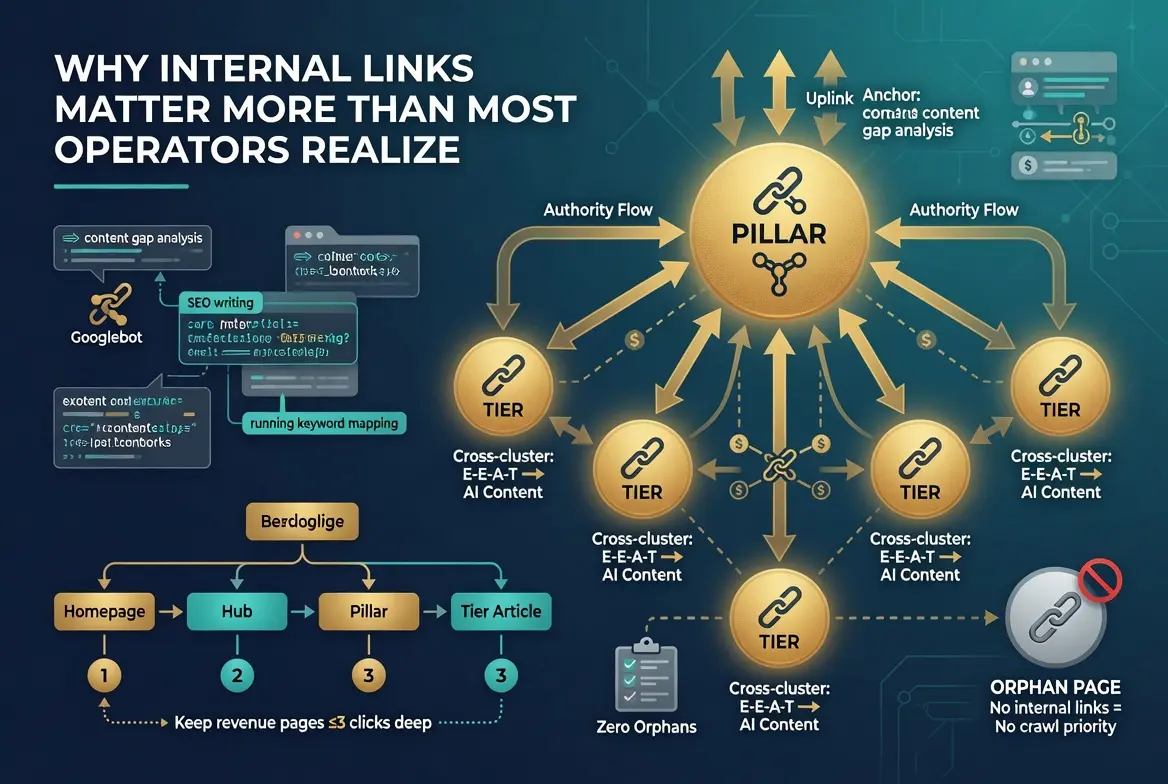
Google uses internal links for three distinct purposes. Discovery: internal links are the primary mechanism through which Googlebot finds new pages on your site. A page that no internal link points to may never be crawled. Authority distribution: the linking page passes a fraction of its own authority to every page it links to. Pages that receive internal links from high-authority pages on your site rank better than pages that receive no internal link support. Topical relationship mapping: the anchor text and context of internal links tell Google how pages relate to each other, which informs the topical authority assessment that determines which site Google treats as the definitive source on a subject.
How Authority Flows Through Internal Links
Every page on your site carries some amount of authority, influenced by its external backlinks, its age, its content quality signals, and its position in the site hierarchy. When a page links to another page on the same site, a portion of that authority transfers to the linked page. The more authority the linking page carries, the more authority it passes. The fewer outbound links the linking page contains, the more authority each individual link transfers.
This flow mechanism is why pillar pages function as authority hubs. A pillar page that earns external backlinks accumulates authority. When that pillar links to its supporting tier articles, it distributes a portion of that accumulated authority to each one. The tier articles, which may have few or no external backlinks of their own, receive ranking power they could not have earned independently. The pillar amplifies the entire cluster.
The flow is bidirectional. When a tier article earns an external backlink, the authority it accumulates flows upward through its internal link to the pillar page, strengthening the pillar’s position as well. Every backlink anywhere in the cluster benefits every page in the cluster through the internal linking web. This is the compounding mechanism that makes clusters outperform isolated pages: authority earned anywhere in the structure circulates everywhere in the structure.
The practical implication is that internal linking strategy should prioritize the pages you most want to rank. Your highest-commercial-value pages should receive the most internal links from the most authoritative pages on your site. A service page that generates revenue should be linked from every topically relevant article on the site, not buried three clicks deep with a single link from the navigation menu.
The Pillar-Tier Linking Structure
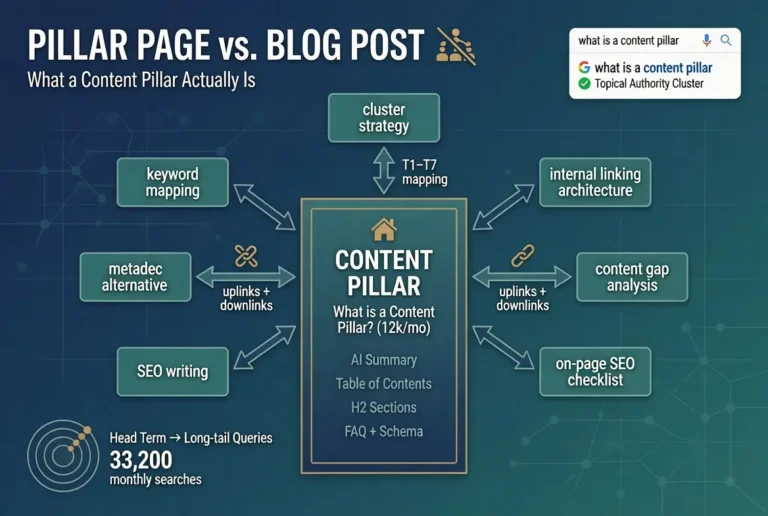
The content pillar model creates a natural internal linking hierarchy. The pillar page sits at the top of the cluster, targeting the broadest keyword. Tier articles sit below it, each targeting a more specific subtopic. The linking rules are simple and consistent.
Every tier article links up to the pillar. This is the most important internal link in the cluster structure. The uplink tells Google that the pillar is the parent page, the comprehensive resource that the tier article supports. The anchor text of the uplink should match or closely relate to the pillar’s primary keyword. Every tier article using the same anchor text pattern to link to the pillar reinforces Google’s understanding of what the pillar page is about.
The pillar links down to every tier article. Each downlink uses anchor text that matches the tier article’s primary keyword. This distributes the pillar’s accumulated authority to every supporting article while establishing the topical relationship between them. The pillar functions as a table of contents for the cluster, and the downlinks function as the table of contents entries that send both users and Googlebot to the supporting content.
Tier articles cross-link to other tier articles in the same cluster when topically relevant. Not every tier needs to link to every other tier. The links should reflect genuine topical relationships. An article about content gap analysis naturally references keyword mapping because gap analysis feeds the keyword mapping process. An article about on-page optimization naturally references SEO writing because the writing produces the content that gets optimized. These cross-links create a web within the cluster that reinforces the topical depth of the entire structure.
Cross-Cluster Linking: Connecting Hubs
Internal linking is not limited to within a single cluster. Pages in different clusters should link to each other when the topics genuinely intersect. This cross-cluster linking tells Google that your site covers a broader topical area and that the individual clusters are components of a larger knowledge base rather than isolated content silos.
The Star Diamond SEO site architecture demonstrates this in practice. The E-E-A-T cluster links to the AI Content Creation cluster because E-E-A-T evaluation directly affects how AI content is assessed. The Link Types & Attributes cluster links to the Link Services & Agencies cluster because understanding link types informs link building service evaluation. The SEO Writing article links to the E-E-A-T experience signal article because voice and expertise are writing concerns as much as quality framework concerns.
The cross-cluster links should be selective, not exhaustive. Linking every page to every other page dilutes the topical signals that internal links carry. If a page links to 50 other pages, the authority passed through each individual link is a fraction of what it would pass through 10 links. More importantly, a page that links to everything tells Google nothing about which relationships matter most. The linking pattern should reflect the actual topical hierarchy: strong connections between closely related content, lighter connections between tangentially related content, and no connections between unrelated content.
The navigation menu provides site-wide internal links to the major hub pages. These links establish the top-level architecture. The in-content links within articles provide the granular topical connections that the navigation cannot. Both layers matter. The navigation defines the structure. The content links define the relationships.
Anchor Text for Internal Links
Internal link anchor text is one of the strongest signals Google uses to understand what the linked page is about. Unlike external backlinks, where you have limited control over anchor text, internal links give you complete control. Use that control deliberately.
The anchor text should match or closely relate to the target page’s primary keyword. If the target page is optimized for “content gap analysis,” the internal links pointing to it should use anchor text like “content gap analysis,” “running a gap analysis,” or “identifying content gaps.” These variations tell Google what the target page covers while maintaining natural language in the linking article.
One keyword per link. Do not hyperlink entire sentences. “Learn how to run a content gap analysis that identifies your biggest keyword opportunities” should link only “content gap analysis,” not the entire sentence. Over-linking dilutes the anchor text signal and makes the content harder to read.
One link per target page per article. Linking to the same page three times from the same article with three different anchor texts does not triple the signal. Google typically counts the first instance and discounts subsequent links to the same target from the same page. Use one well-chosen anchor for each target page.
Unique anchors per target page across the site. If ten articles link to the content gap analysis page, each should use a slightly different but topically consistent anchor text. “Content gap analysis,” “gap analysis process,” “identifying content gaps,” “running a keyword gap analysis.” The variation creates a natural anchor text profile for the target page. Ten articles all using the exact same anchor text looks manufactured even in internal linking, and it fails to capture the semantic variations that help Google understand the full scope of what the target page covers.
Orphan Pages: The Silent Ranking Killer
An orphan page is a page on your site that no other page links to internally. Googlebot discovers pages primarily by following links from other pages. An orphan page that is not in the XML sitemap may never be crawled. An orphan page that is in the sitemap may be crawled but deprioritized because Google interprets the absence of internal links as a signal that the page is not important to the site’s structure.
Orphan pages are more common than most operators realize. They accumulate through normal site operations: a blog post published without internal links added, a service page created for a campaign and never connected to the navigation, a resource page built for a specific purpose and forgotten. Each one represents content that consumes crawl budget without contributing to the site’s topical authority and without receiving any authority from other pages.
The fix is an internal link audit. Crawl the site with Screaming Frog, Ahrefs Site Audit, or a similar tool. Identify every page with zero internal links pointing to it. For each orphan page, determine whether it should be linked from existing content (if it is still relevant and valuable), redirected to a related page (if its content overlaps with a better page), or deleted (if it serves no current purpose). The goal is zero orphan pages. Every page on the site should be reachable through at least one internal link from another page.
New content should never be published as an orphan. Before any article goes live, verify that at least one existing page links to it and that it links to at least one existing page. The internal linking should be part of the pre-publication checklist, not a post-publication task that gets forgotten. The content publishing process should build internal links into the production workflow so that no page launches disconnected from the site’s architecture.
Click Depth and Crawl Priority
Click depth measures how many clicks it takes to reach a page from the homepage. A page linked directly from the homepage is at depth 1. A page linked from a depth-1 page is at depth 2. And so on. Google uses click depth as a signal of page importance: pages closer to the homepage are treated as more important and crawled more frequently than pages buried deep in the site hierarchy.
The practical target is keeping important pages within three clicks of the homepage. For a site structured with hub categories (depth 1) containing subcategories (depth 2) containing articles (depth 3), this means the article is exactly three clicks deep: Homepage → Hub → Subcategory → Article. That is the URL structure Star Diamond SEO uses, and it keeps every article within Google’s preferred crawl depth.
Pages at depth 4 or deeper receive less crawl attention. If your site architecture requires users to click through four or more levels to reach content, the pages at the deepest levels will be crawled less frequently and may receive lower crawl priority. The solution is not to flatten the URL structure (deep URLs with meaningful hierarchies are fine) but to ensure that internal links from higher-authority pages provide direct pathways to deep content. A depth-4 page that is linked from a depth-1 page effectively operates at depth 2 for crawl purposes because the direct link provides a shortcut past the intermediate levels.
The homepage is the most authoritative page on every site. It receives the most external backlinks and sits at depth 0. Internal links from the homepage carry the most authority. Use them strategically. The homepage should link to the hub category pages and to the most important content pages on the site, the pillar pages that anchor each content cluster. Do not link from the homepage to every page. Link to the pages that distribute the most authority to the most content through the pillar-tier structure.
Designing the Architecture Before Writing
The internal linking architecture should be designed before the content is written, not discovered after it is published. This is the principle that separates deliberate content systems from accidental content collections.
Before writing a single article in a new cluster, map the complete linking structure. Identify the pillar page. Identify every tier article. Determine which tier articles link to which other tier articles based on genuine topical relationships. Identify the existing live pages that the new cluster should connect to through cross-cluster links. Document every link: source page, target page, anchor text. This link map becomes the blueprint that every article in the cluster follows during production.
Pre-wiring the links before publication means building all articles in draft with every internal link already in place. The links point to URLs that do not resolve yet because the target pages are not published. When the entire cluster launches simultaneously, every link resolves on day one. No broken links. No orphan pages. No going back to add links that were forgotten during production. The cluster hits Google’s index as a complete, interconnected structure.
This approach requires discipline. It is easier to write an article, publish it, and add links later. It is also less effective. An article published without internal links accumulates crawl signals as an isolated page. By the time the links are added, Google has already formed an initial assessment of the page’s importance and topical relationships. Changing that assessment after the fact is slower than establishing it correctly from the start.
The content cluster strategy defines what gets built. The internal linking architecture defines how it connects. Both decisions should be made before production begins. The writing fills the structure. The structure should not be an afterthought of the writing.
Auditing Your Internal Link Structure
An internal link audit reveals the gap between your intended architecture and your actual architecture. Run it quarterly, or after any significant content addition, to ensure the site’s linking structure reflects your current content strategy.
Crawl the site and generate a report of every internal link: source URL, target URL, anchor text, and HTTP status code. Tools like Screaming Frog, Ahrefs Site Audit, and Sitebulb produce this data in exportable formats. The report shows the complete internal link graph of your site.
Check for orphan pages: pages with zero internal links pointing to them. Check for broken internal links: links pointing to URLs that return 404 errors, usually caused by deleted pages or changed URLs without redirects. Check for redirect chains: internal links that pass through one or more 301 redirects before reaching the final destination, which wastes crawl budget and dilutes authority transfer. Check for excessive linking: pages with more than 100 internal outbound links, which dilutes the authority passed through each individual link.
Evaluate anchor text distribution for your most important pages. Pull every internal link pointing to each pillar page. Review the anchor text. Is it consistently relevant to the pillar’s primary keyword? Is there enough variation to cover the semantic field? Are any pages linking to the pillar with generic anchors like “click here” or “read more” that waste the anchor text signal?
Evaluate click depth for your highest-priority pages. Are your pillar pages reachable within two clicks of the homepage? Are your most commercially valuable pages reachable within three? Pages buried deeper than three clicks may need additional internal links from higher-level pages to ensure adequate crawl priority and authority transfer.
The audit produces a task list. Fix broken links. Add links to orphan pages. Update generic anchor text. Reduce redirect chains. Add shortcut links to deep pages from higher-authority pages. Each fix strengthens the internal linking architecture and improves the authority distribution across the site. The cumulative impact of a thorough internal link audit often exceeds the impact of acquiring several new external backlinks because the improvements affect every page on the site, not just the pages receiving new external links.
FAQ
What is internal linking architecture?
Internal linking architecture is the deliberate structure of links between pages on the same website. It determines how authority flows between pages, how Google discovers and prioritizes content for crawling, and how the site communicates topical relationships between its content. A well-designed architecture distributes authority to the pages that matter most and builds topical depth that Google rewards with higher rankings.
How many internal links should a page have?
Articles over 2,000 words should contain a minimum of five internal links to other pages on the site. The links should use descriptive anchor text related to the target page’s primary keyword. There is no strict maximum, but pages with more than 100 outbound internal links dilute the authority passed through each individual link. Focus on quality and relevance rather than quantity.
What is an orphan page?
An orphan page is a page on your site that no other page links to internally. Orphan pages are difficult for Googlebot to discover, receive no internal authority from other pages, and signal to Google that the page is not important to the site’s structure. Every page on the site should be reachable through at least one internal link from another page.
How does internal linking affect rankings?
Internal links distribute authority from one page to another, help Google discover and crawl content, and establish topical relationships between pages. Pages that receive internal links from high-authority pages on the site rank better than pages with no internal link support. The anchor text of internal links is one of the strongest signals Google uses to understand what the linked page is about.
Should I link from every page to every other page?
No. Linking every page to every other page dilutes the authority signal of each individual link and tells Google nothing about which relationships are most important. Internal links should reflect genuine topical relationships. Link pages that are genuinely related and let the linking pattern communicate the topical structure of the site to Google.
How deep should pages be from the homepage?
Important pages should be reachable within three clicks of the homepage. Pages at click depth 4 or deeper receive less crawl attention and lower crawl priority. If deep pages are important to your strategy, add internal links from higher-authority pages that provide direct pathways past the intermediate levels, effectively reducing the page’s operational click depth.
How often should I audit internal links?
Audit internal links quarterly or after any significant content addition. Use crawling tools to identify orphan pages, broken links, redirect chains, generic anchor text, and pages buried at excessive click depth. The audit produces a task list of fixes that strengthen authority distribution and improve crawl efficiency across the entire site.