
Google rewards rhythm. We help you keep one.
Publishing one piece a year is a graveyard. Publishing five pieces in a week and then nothing for two months is whiplash. Google’s quality systems read both as the same signal: a site that is not actively maintained.
What works is rhythm. Consistent, predictable publishing on a schedule Google can pattern-match against. That is Cadence, the second pillar in the 5C Framework, and the one most agencies ignore because it cannot be sold as a line item on a proposal.
Why cadence matters more than volume
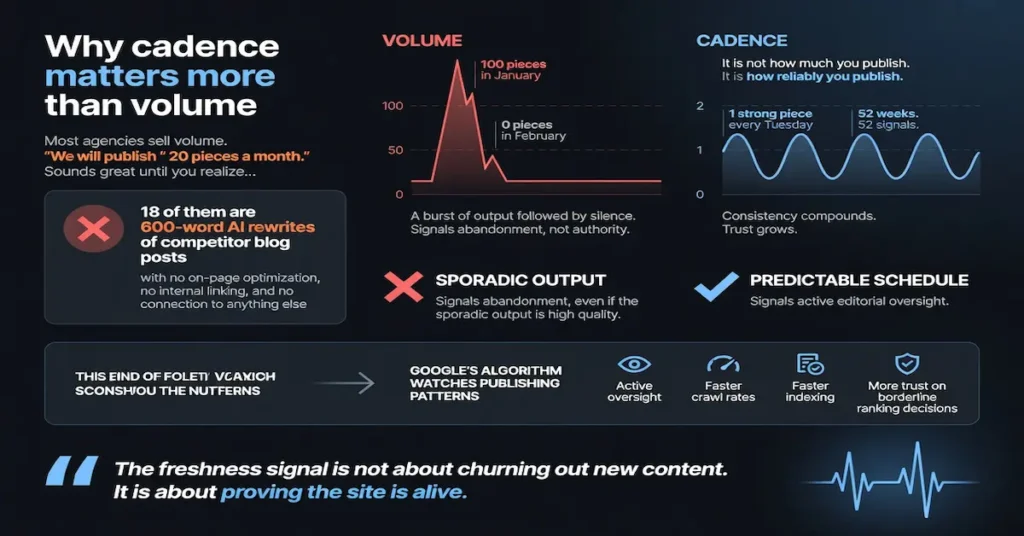
Most agencies sell volume. “We will publish 20 pieces a month.” Sounds great until you realize 18 of them are 600-word AI rewrites of competitor blog posts with no on-page optimization, no internal linking, and no connection to anything else on the site.
Cadence is different. It is not how much you publish. It is how reliably you publish. A site that publishes one strong piece every Tuesday for 52 weeks beats a site that dumps 100 mediocre pieces in January and goes silent in February.
Google’s algorithm watches publishing patterns. Sites that maintain a predictable schedule signal active editorial oversight. Sites with sporadic output signal abandonment, even if the sporadic output is high quality. Active oversight earns faster crawl rates, faster indexing, and more trust on borderline ranking decisions.
The freshness signal is not about churning out new content. It is about proving the site is alive.
What happens when cadence breaks
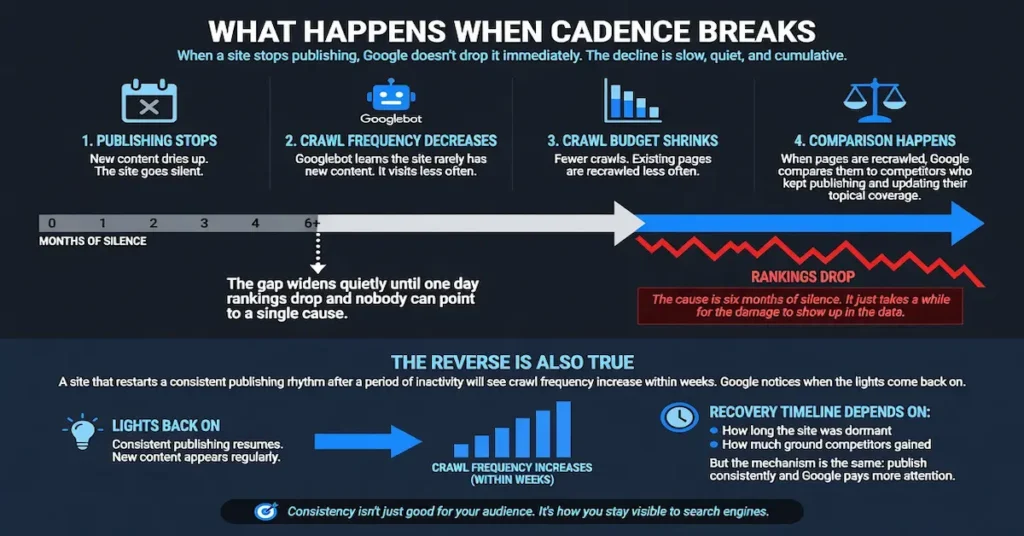
When a site stops publishing, Google does not immediately drop it from the index. What happens is slower. Crawl frequency decreases because Googlebot learns that the site rarely has new content to find. As crawl budget decreases, existing pages get recrawled less often. When those pages do get recrawled, Google compares them against competitors who have been publishing consistently and updating their topical coverage. The gap widens quietly until one day rankings drop and nobody can point to a single cause.
The cause is six months of silence. It just takes a while for the damage to show up in the data.
The reverse is also true. A site that restarts a consistent publishing rhythm after a period of inactivity will see crawl frequency increase within weeks. Google notices when the lights come back on. The recovery timeline depends on how long the site was dormant and how much ground competitors gained in the meantime, but the mechanism is the same: publish consistently and Google pays more attention.
How cadence connects to clusters
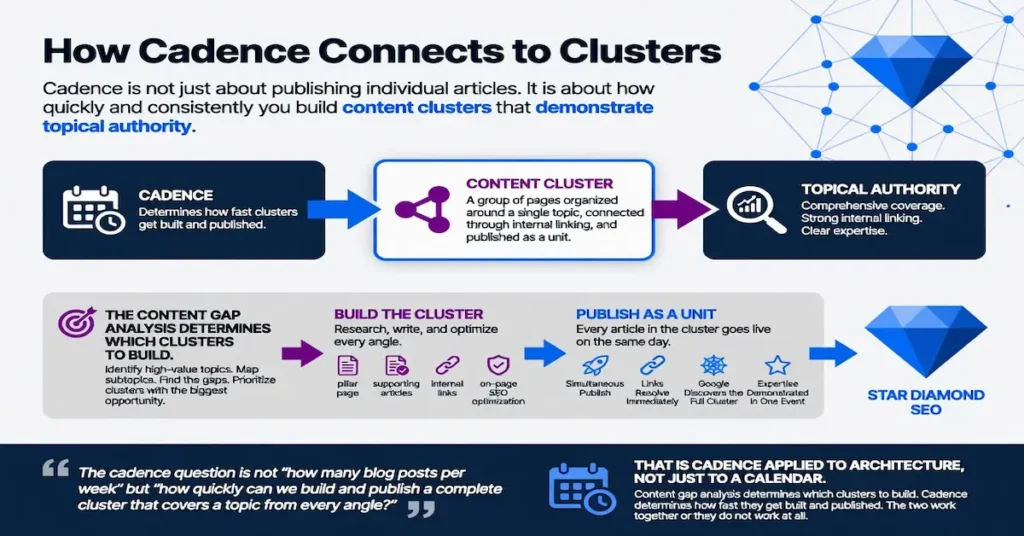
Cadence is not just about publishing individual articles. It is about how quickly and consistently you build content clusters that demonstrate topical authority.
A content cluster is a group of pages organized around a single topic, connected through internal linking, and published as a unit. The cadence question is not “how many blog posts per week” but “how quickly can we build and publish a complete cluster that covers a topic from every angle?”
Star Diamond SEO publishes clusters simultaneously. Every article in the cluster goes live on the same day so that all internal links resolve immediately. Google crawls one page, follows the links, discovers the entire cluster, and sees a site that just demonstrated comprehensive expertise on a topic in a single publishing event. That is cadence applied to architecture, not just to a calendar.
The content gap analysis determines which clusters to build. Cadence determines how fast they get built and published. The two work together or they do not work at all.
How we approach cadence
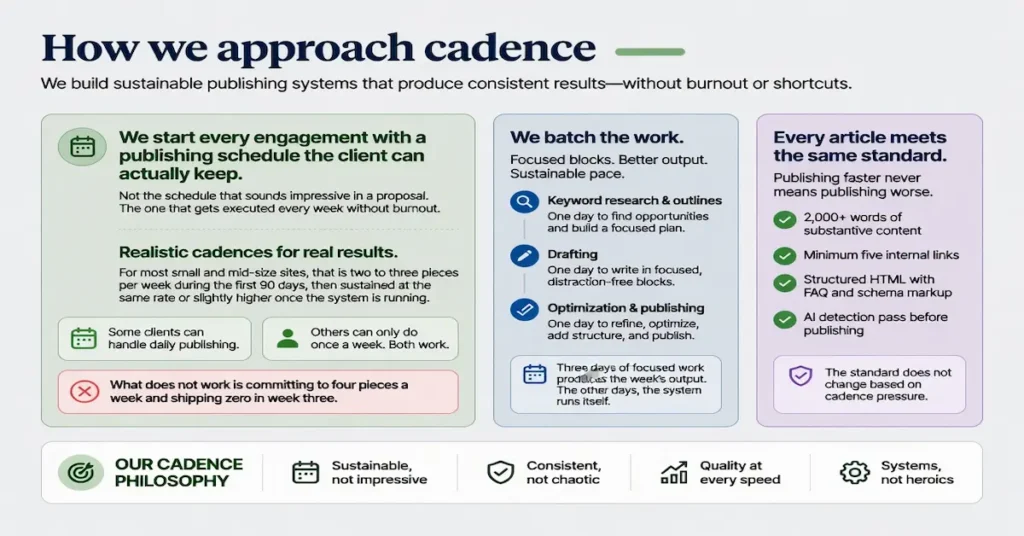
We start every engagement with a publishing schedule the client can actually keep. Not the schedule that sounds impressive in a proposal. The one that gets executed every week without burnout.
For most small and mid-size sites, that is two to three pieces per week during the first 90 days, then sustained at the same rate or slightly higher once the system is running. Some clients can handle daily publishing. Others can only do once a week. Both work. What does not work is committing to four pieces a week and shipping zero in week three.
We batch the work. One day for keyword research and outlines, one day for drafting, one day for optimization and publishing. Three days of focused work produces the week’s output. The other days, the system runs itself.
Every article follows the same production standard: 2,000+ words of substantive content, minimum five internal links, structured HTML with FAQ and schema markup, and an AI detection pass before publishing. The standard does not change based on cadence pressure. Publishing faster never means publishing worse.
How we measure it
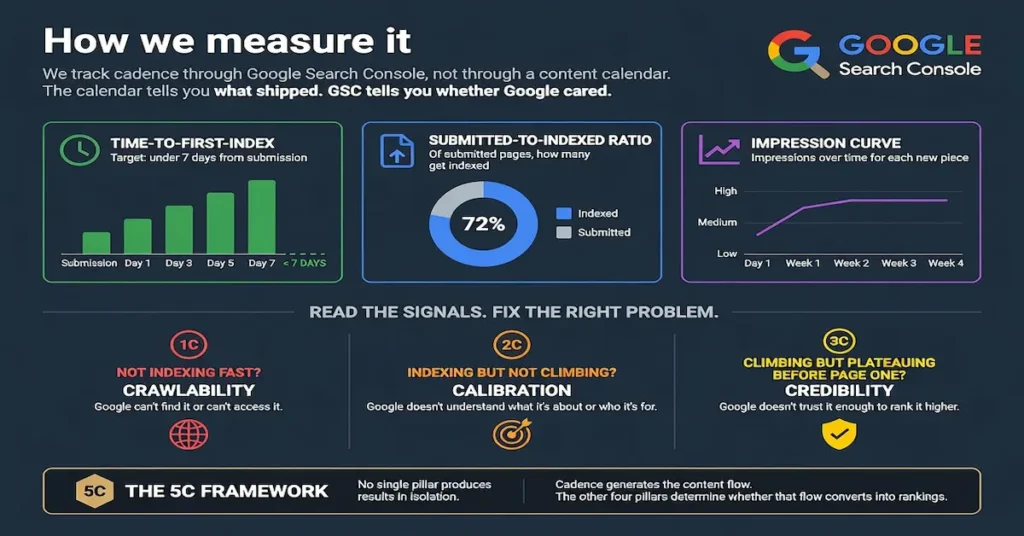
We track cadence through Google Search Console, not through a content calendar. The calendar tells you what shipped. GSC tells you whether Google cared.
The metrics that matter are time-to-first-index (target: under 7 days from submission), the ratio of submitted-to-indexed pages, and the impression curve on each new piece. If new content is not indexing fast, cadence is not the problem. Crawlability is. If it is indexing but not climbing, Calibration is. If it is climbing but plateauing before page one, Credibility is.
The 5C Framework exists because no single pillar produces results in isolation. Cadence generates the content flow. The other four pillars determine whether that flow converts into rankings.
The Lab proves the model
We document our own publishing cadence publicly. Real schedules, real metrics, real moments where we shipped late and watched the impact in GSC. The receipts are public because the methodology is public.
Star Diamond SEO launched on a brand new domain with zero backlinks, zero domain authority, and zero indexed pages. The publishing cadence from day one is documented. The E-E-A-T signals that come from practicing what you sell are impossible to fake. When a client asks “how do you know cadence matters this much?” the answer is in the data we publish about our own site.
How cadence connects to the rest
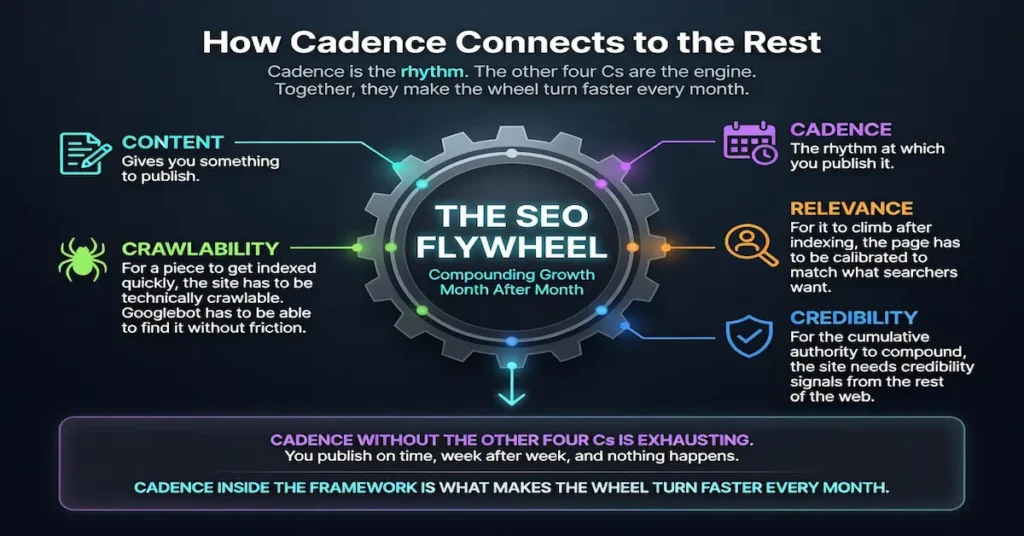
Content gives you something to publish. Cadence is the rhythm at which you publish it. Both are inputs to a larger system.
For a piece to get indexed quickly, the site has to be technically crawlable. Googlebot has to be able to find it without friction. For it to climb after indexing, the page has to be calibrated to match what searchers want. And for the cumulative authority to compound, the site needs credibility signals from the rest of the web.
Cadence without the other four Cs is exhausting. You publish on time, week after week, and nothing happens. Cadence inside the framework is what makes the wheel turn faster every month.
What we offer
We build editorial calendars that match your team’s actual capacity. We handle the publishing if that is what you need, or we hand you a system you can run yourself. We build the pillar and cluster architecture so every piece you publish connects to the larger strategy instead of floating alone.
We track cadence metrics in your Search Console alongside ranking and impression data so you can see the cause and effect. And if our content strategy service determines that cadence is not your problem, we will tell you that before we sell you a publishing package you do not need.
Start with a business consultation to find out whether cadence is the lever that moves your rankings or whether the real issue is somewhere else in the framework.