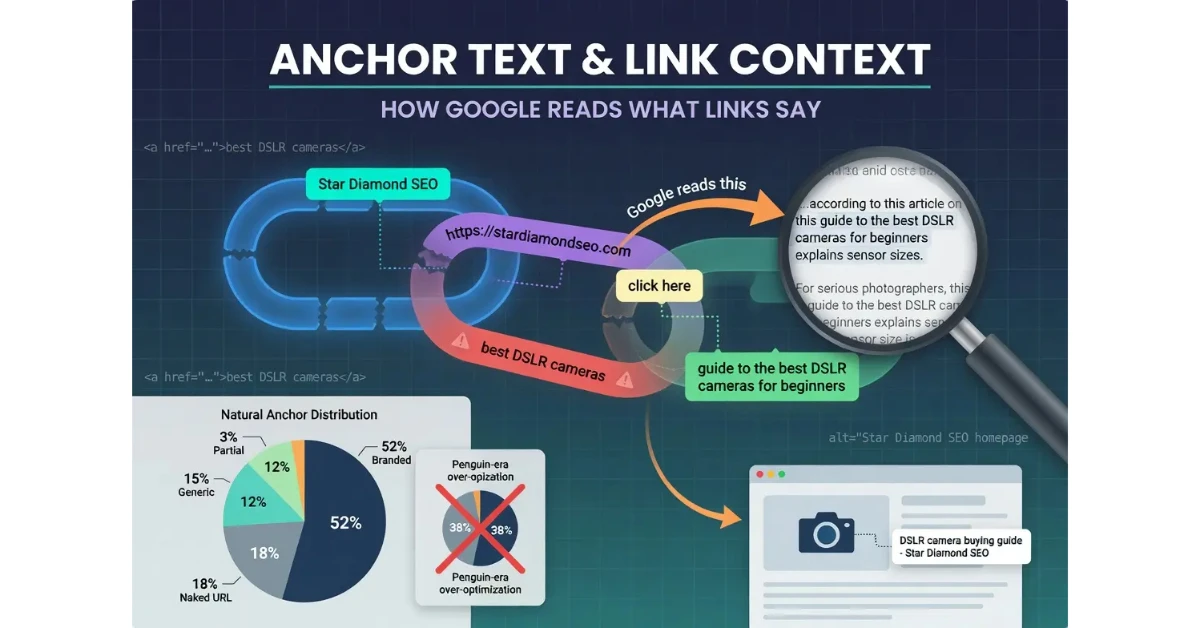
Anchor Text & Link Context: How Google Reads What Links Say
AI Summary
What is anchor text? Anchor text is the visible, clickable text inside an HTML link. Google’s systems read the anchor as the description of what the linked page is about, which makes it one of the strongest signals in link evaluation.
What it is and who it is for: Anchor text and the surrounding link context shape how Google evaluates every link the site has. Both matter for any site building backlinks, accepting editorial mentions, or trying to avoid the over-optimization penalties that took down many SEO operators in earlier algorithm updates.
The rule: Natural editorial link building produces a specific anchor text distribution dominated by branded anchors, naked URLs, and generic descriptions. Profiles with high percentages of exact match anchors signal manipulation because organic linking does not produce that pattern.
Table of Contents
What Anchor Text Is and Why It Matters
Anchor text is the visible, clickable text inside an HTML link. The technical structure wraps text inside an anchor tag, and that wrapped text is what users see and click. The anchor text functions as the description of the linked page from the perspective of the linking site, and Google’s systems read it as one of the strongest signals about what the linked page is actually about.
The mechanism that makes anchor text matter is the assumption built into the link evaluation system. When a site chooses to link to another page, the linking site is implicitly making a statement about what the linked page is about. The anchor text is that statement made explicit. A site that links to a page using “Google Search Console tutorial” as the anchor is telling Google’s systems that the linked page is about Google Search Console tutorials. The cumulative pattern of anchor text across all links pointing to a page shapes how Google understands the topical focus of that page.
The implication is that anchor text is one of the few link signals that the linked page does not directly control. The linking site decides what the anchor text says, and the linked page receives whatever anchor pattern accumulates across all its inbound links. Operators can influence anchor text through the relationships they build and through the placements they earn, but they cannot dictate what every linking site chooses to write.
The shorthand version: anchor text is what other sites say about your page when they link to it. The natural pattern that emerges from genuine editorial linking is fundamentally different from the pattern that emerges from coordinated link building, and Google’s systems have grown more capable of distinguishing the two over time.
For the broader context on how anchor text fits with the other link attributes, the Pillar guide on Link Types and Attributes covers the full framework. The sibling articles on Dofollow Links, Nofollow Links, and Sponsored and UGC Attributes cover the other dimensions.
The Anchor Text Categories
The framework recognizes several anchor text categories, and each category sends a different signal. Understanding the categories is the foundation for evaluating any inbound link profile and for shaping outbound link practices.
Exact match anchors use the exact target keyword as the anchor text. A page targeting “best DSLR cameras” has an exact match anchor when another site links to it using “best DSLR cameras” as the visible text. The signal is the strongest possible match between the anchor and the target keyword, which makes exact match anchors valuable when they appear naturally and risky when they appear in patterns that suggest manipulation.
Partial match anchors include the target keyword along with other words. A link to the same page using “guide to the best DSLR cameras for beginners” is a partial match because it contains the target keyword embedded in additional context. Partial match anchors are common in natural editorial linking because writers tend to embed keyword references inside fuller descriptive phrases rather than using bare keyword strings.
Branded anchors use the linked site’s brand name. A link to a page on Star Diamond SEO using “Star Diamond SEO” as the anchor is a branded anchor. Branded anchors are the most natural form of editorial linking because writers reference sites by their brand name when citing them, and the pattern accumulates organically over time as the brand earns recognition.
Generic anchors use phrases like “click here,” “read more,” “this article,” or “learn more” that say nothing specific about the linked page. Generic anchors are common in editorial linking because writers often use them to avoid breaking the flow of their prose with descriptive anchor phrases. The category is sometimes treated as worthless by SEO operators who do not understand its role in natural link patterns.
Naked URL anchors use the URL itself as the visible text. A link to stardiamondseo.com that displays the URL “https://www.stardiamondseo.com” as the anchor is a naked URL. The pattern is common in informal writing, in citations, and in references where the writer wants to surface the URL itself rather than burying it inside descriptive text.
Image anchors use an image as the clickable element rather than text. The alt text attribute on the image functions as the anchor text from Google’s perspective when the image is wrapped in an anchor tag. Image anchors are common in linked logos, infographics, and any context where visual elements link to other pages.
Each category has its place in a natural anchor profile. The work is not to maximize any single category but to maintain a distribution that reflects how genuine editorial linking actually produces anchors over time.
What Natural Anchor Distribution Looks Like
The natural anchor distribution that emerges from genuine editorial linking has specific characteristics that Google’s systems have grown capable of recognizing. Understanding the pattern is essential for both evaluating an existing inbound profile and for thinking about what a healthy profile should look like over time.
Branded anchors typically dominate natural profiles. Writers cite sites by their brand name because that is how brands work in journalism and editorial writing. A profile where forty to sixty percent of inbound anchors are branded variations is consistent with natural editorial linking patterns. Higher percentages of branded anchors are also common for established brands that have earned strong brand recognition.
Naked URLs are the second-most common natural pattern. Citations, references in academic-style writing, and links in informal contexts often use the URL itself as the anchor. A profile where ten to twenty percent of inbound anchors are naked URLs reflects the natural patterns of citation-style linking that occurs in many editorial contexts.
Generic anchors are the third common pattern. Writers use “click here,” “read more,” and similar phrases when the surrounding prose has already established what the link is about. A profile where ten to twenty percent of inbound anchors are generic reflects natural editorial flow rather than the carefully optimized patterns that SEO operators sometimes produce.
Partial match anchors round out most of the remaining profile. Writers naturally embed keyword references inside fuller phrases, and the partial match category captures those references. A profile where fifteen to thirty percent of inbound anchors are partial matches reflects substantive content discussion that includes keyword variations as part of natural writing.
Exact match anchors are the smallest category in natural profiles. Writers rarely use bare keyword strings as anchors because the construction does not flow well in editorial prose. A profile where less than five percent of inbound anchors are exact match is consistent with natural editorial linking. Higher percentages signal either deliberate optimization or unusual content circumstances that warrant closer inspection.
The implication for operators building or evaluating link profiles is that the distribution itself is the signal. Profiles that match natural patterns pass evaluation more readily than profiles that deviate from those patterns regardless of how authoritative the individual links may appear in third-party metrics.
For more on the broader credibility infrastructure that supports earning natural anchor distributions, the Credibility discipline covers the operational architecture.
Over-Optimization: The Penguin Problem
The over-optimization penalty is the most consequential anchor text issue operators face, and the one that has produced the most catastrophic ranking losses in the history of SEO. The original Penguin algorithm update in April 2012 specifically targeted sites with unnatural link profiles, and anchor text over-optimization was the primary signal Penguin used to identify those sites.
The mechanism is straightforward. Sites that built links through tactics where the operator controlled the anchor selection (paid placements, guest posting campaigns, comment spam, directory submissions) accumulated profiles with disproportionately high percentages of exact match and partial match anchors. The pattern was statistically distinct from natural editorial linking, and Penguin learned to identify the pattern and demote sites that exhibited it.
The consequences for affected sites were severe. Sites that had built ranking profiles over years through aggressive link building lost most or all of their rankings overnight when Penguin rolled out. Recovery required either disavowing the unnatural links and waiting for the next algorithmic refresh or rebuilding the profile from scratch with natural patterns. Many sites never recovered.
The contemporary framework continues to apply over-optimization detection at the algorithmic level. The systems have grown more sophisticated since 2012, and the detection now operates continuously rather than through discrete update cycles. Sites that develop unnatural anchor patterns experience suppression that may not be visible as a discrete penalty but produces ongoing ranking caps that the operator cannot identify without auditing the link profile.
The threshold for over-optimization is not a fixed number. The systems evaluate anchor distribution in context with other signals including the linking domains, the topical relevance, the link velocity, and the broader pattern of the site’s growth. A profile with twenty percent exact match anchors might pass evaluation if the surrounding signals all support natural growth, while a profile with eight percent exact match anchors might trigger suppression if other signals suggest manipulation.
The defensive implication for operators is that anchor text discipline is essential whenever the operator has any control over anchor selection. Guest posts the operator writes should use natural anchors. Press releases should use branded anchors. Outreach campaigns should diversify anchor patterns deliberately to avoid producing the engineered pattern that triggers suppression.
Link Context: The Surrounding Text
The link context is the surrounding text that frames the link. Google’s systems read the paragraph the link sits in as additional information about what the link is about, and the surrounding context can either reinforce or undermine the signal the anchor text alone would send.
The mechanism is that links do not exist in isolation on a page. They sit inside paragraphs, sections, and broader content structures, and the systems read all of that context as part of evaluating what the link represents. A link to a page about car audio embedded in a paragraph discussing subwoofer installation reinforces topical relevance. The same link embedded in a paragraph discussing home improvement signals confusion about what the link is for.
The contextual signal works in both directions. A link with a generic anchor like “read more” can still pass strong topical relevance if the surrounding paragraph clearly establishes what the link is about. A link with an exact match anchor can pass weak relevance if the surrounding paragraph is unrelated to the linked page’s topic. The contextual evaluation means anchor text alone is not the complete signal.
The practical implication for operators is that link placement matters as much as anchor selection. A link earned in a contextually relevant paragraph passes stronger signal than a link placed in a generic about-us section or in a footer regardless of what the anchor text says. The work of earning quality links includes the work of earning links in the right contexts within the linking page, not just on the linking site as a whole.
The contextual evaluation also affects how operators should think about the surrounding text on their own pages. When the site links out to authoritative sources, the surrounding paragraph should genuinely support the link with relevant discussion of what the linked page covers. When the site receives links from other sites, the operator should consider whether the surrounding context on the linking page accurately represents what the linked page is about.
For the broader content production discipline that supports proper link contextualization, the Content discipline covers the operational architecture.
Image Anchors and Alt Text
Image anchors are an underdiscussed corner of the anchor text framework, and one where operators frequently miss optimization opportunities. When an image is wrapped in an anchor tag, the alt text on the image functions as the anchor text from Google’s perspective.
The mechanism is that Google’s systems cannot read image content directly the way they read text. The systems use the alt text attribute on the image to understand what the image is about, and when the image is also a link, the alt text additionally functions as the description of the linked page. The dual function makes alt text particularly valuable on linked images.
The most common context where this matters is the linked logo. Sites place their logo in the header and link it to the homepage. The alt text on the logo functions as anchor text on the homepage link, which means thousands of internal links across a site may be carrying whatever alt text the logo image has. Sites that use generic alt text like “logo” or that omit alt text entirely lose the anchor text signal on every internal logo link.
The second common context is infographics and embedded images that are linked to source pages. A site that publishes an infographic with an attribution link back to the source has an image anchor on the linked image. The alt text on the image becomes the anchor text on the source link, and the value of the link to the source depends partly on whether the alt text describes the source accurately.
The third common context is sponsor logos, partner badges, and similar visual elements that link to external sites. The alt text on these images functions as anchor text on the external links, and operators who care about how their links are perceived by external systems should ensure the alt text reflects what the external site actually represents.
The implementation pattern is to write alt text that serves both accessibility (describing the image for screen readers) and link signaling (describing the linked page when the image is a link). The two purposes align in most cases because both benefit from clear, descriptive alt text that explains what the image represents.
Auditing Your Anchor Profile
The audit pattern for inbound anchor profiles is the operational discipline that catches problems before they trigger algorithmic suppression. Sites that build links over time accumulate anchor patterns that may drift from natural distributions for various reasons, and periodic audits identify the drift.
The audit starts with pulling the inbound link profile from a backlink analysis tool. Ahrefs, SEMrush, and Moz all surface the anchor text data for inbound links to a site, and the data can be exported and analyzed at the distribution level. The first cut of the audit is the percentage breakdown across the anchor categories: branded, naked URL, generic, partial match, exact match, and image.
The audit then compares the distribution to the natural patterns described earlier. Profiles where exact match anchors exceed five to eight percent warrant closer inspection. Profiles where branded anchors fall below thirty percent warrant inspection. Profiles where the distribution shifts dramatically over short time windows warrant inspection because rapid pattern changes signal either coordinated link building or unusual organic events.
The third cut of the audit identifies the specific links contributing to over-optimization patterns. The audit surfaces which inbound links are using exact match anchors and which linking sites are placing those links. The pattern usually points to specific link sources that need attention, whether that means disavowing the links, requesting anchor text changes from the linking site, or building offsetting natural links to dilute the pattern.
The fourth cut of the audit tracks the trend over time. Anchor profiles that are moving toward more natural distributions are healthier than profiles that are moving toward less natural distributions, and the trend line is itself a signal. Sites that catch the trend early can address issues before they trigger algorithmic suppression. Sites that do not audit may discover the issues only when rankings drop without explanation.
The operational cadence for anchor profile audits is quarterly at minimum for sites actively building links and twice yearly for established sites in maintenance mode. The discipline is part of the broader off-site SEO maintenance work that healthy sites incorporate into their ongoing process.
Common Anchor Text Mistakes
The most common anchor text mistakes operators make are predictable. They show up across new sites learning the framework, established sites that have grown careless about link building practices, and sites that have used aggressive link building tactics without understanding the over-optimization risk.
The first common mistake is the exact match concentration. Sites that build links through tactics where they control anchor selection (guest posting, paid placements, outreach with anchor specifications) accumulate profiles with disproportionate exact match percentages. The fix is the discipline of using branded anchors and natural variations even when the operator has the option to specify exact match anchors.
The second common mistake is the dismissal of branded and generic anchors. Operators who treat exact match as the only valuable anchor type undervalue branded and generic anchors that actually dominate natural profiles. The mental model that healthy profiles are mostly branded with small percentages of other categories is closer to reality than the model that exact match should be maximized.
The third common mistake is the inconsistent internal anchor strategy. Sites optimize external link anchors but neglect internal linking, where the operator has full control over anchor selection. Internal linking with thoughtful anchor variation reinforces the topical signal of pages and provides a controlled environment to demonstrate natural anchor patterns to Google’s systems.
The fourth common mistake is the missing or generic alt text on linked images. Sites use linked images extensively (logos, infographics, sponsor badges) without descriptive alt text, losing the anchor signal those images would otherwise carry. The fix is the editorial discipline of writing descriptive alt text on every linked image as part of the publishing workflow.
The fifth common mistake is the failure to audit. Sites build link profiles for years without ever auditing the anchor distribution, and discover problems only when ranking suppression begins affecting traffic. The audit discipline is the cheapest insurance against over-optimization risk and the most direct way to identify issues before they become catastrophic.
Verdict
Anchor text is the visible, clickable text inside an HTML link, and Google’s systems read it as one of the strongest signals about what the linked page is about. The category breakdown into branded, naked URL, generic, partial match, exact match, and image anchors describes how editorial linking actually works, and natural profiles maintain distributions across these categories that reflect organic patterns rather than engineered ones.
The over-optimization penalty has been the most consequential anchor text issue in the history of SEO. The original Penguin algorithm in April 2012 demonstrated that anchor text patterns alone could destroy rankings overnight when those patterns deviated from natural editorial distributions. The contemporary framework continues to apply over-optimization detection algorithmically, and sites with unnatural anchor distributions experience ongoing suppression that may not be visible as discrete penalties but produces real ranking caps.
The link context surrounding the anchor matters as much as the anchor itself. A link earned in a contextually relevant paragraph passes stronger signal than a link with the same anchor placed in a generic context. The contextual evaluation means anchor text alone is not the complete signal, and operators who think about link placement only at the anchor level miss the broader picture.
Image anchors and alt text deserve direct attention because they extend the anchor text framework into visual elements. The alt text on linked images functions as anchor text, and sites that use generic alt text or omit it entirely lose signal on every linked image throughout the site.
The audit discipline is the operational practice that catches anchor profile problems before they trigger algorithmic suppression. Quarterly audits for active link builders and twice-yearly audits for maintenance-mode sites are the cadence that healthy operations maintain.
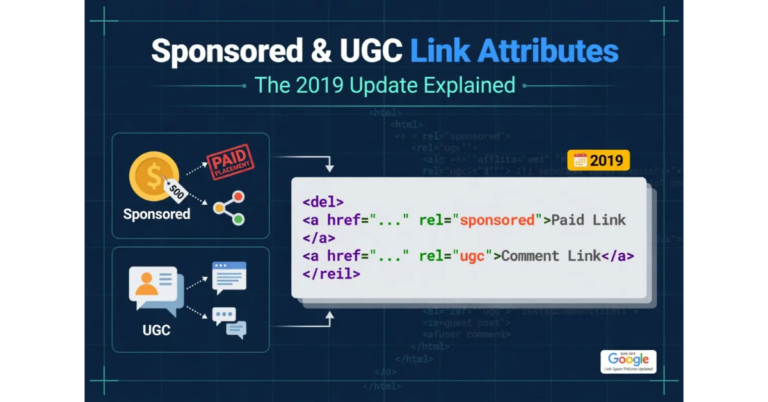
For the broader framework that ties anchor text together with the other link attributes, the Pillar guide covers the full system. The sibling article on Dofollow Links covers the default standard. The article on Nofollow Links covers the explicit non-endorsement attribute. The article on Sponsored and UGC Attributes covers the 2019 update and the disclosure requirements that shape how attributes interact with anchor text on commercial relationships.
Frequently Asked Questions
What is anchor text in SEO?
Anchor text is the visible, clickable text inside an HTML link. Google’s systems read the anchor as the description of the linked page from the perspective of the linking site, which makes it one of the strongest signals about what the linked page is about.
What are the main anchor text categories?
The main categories are exact match (uses the exact target keyword), partial match (includes the keyword in fuller phrases), branded (uses the linked site’s brand name), generic (uses phrases like click here or read more), naked URL (uses the URL itself as visible text), and image anchors (uses an image with alt text functioning as the anchor).
What does a natural anchor text distribution look like?
Natural profiles are typically dominated by branded anchors at forty to sixty percent or higher, with naked URLs and generic anchors each at ten to twenty percent, partial match at fifteen to thirty percent, and exact match at less than five percent. The distribution reflects how editorial writers actually link to sources rather than how SEO operators optimize for keywords.
What is anchor text over-optimization?
Over-optimization is the pattern where a site has accumulated a disproportionately high percentage of exact match or partial match anchors in its inbound link profile. The pattern is statistically distinct from natural editorial linking, and Google’s systems use it as a signal of manipulation, which can trigger algorithmic suppression of rankings.
How much exact match anchor text is too much?
The threshold is not a fixed number. The systems evaluate anchor distribution in context with other signals. A profile with five to eight percent exact match anchors may pass evaluation if other signals support natural growth. Higher percentages typically warrant closer inspection, and rapidly increasing percentages signal coordinated link building.
Does the surrounding text on a linking page affect link evaluation?
Yes. Google’s systems read the paragraph and broader context surrounding the link as additional information about what the link is about. A link in a contextually relevant paragraph passes stronger signal than the same link with the same anchor in an unrelated context. Link placement matters as much as anchor selection.
What is image anchor text?
When an image is wrapped in an anchor tag, the alt text on the image functions as the anchor text from Google’s perspective. Image anchors appear most commonly in linked logos, infographics, and visual elements that link to other pages. Generic alt text or missing alt text loses the anchor signal those images would otherwise carry.
How often should I audit my anchor text profile?
The operational cadence is quarterly for sites actively building links and twice yearly for established sites in maintenance mode. The audit identifies anchor distribution problems before they trigger algorithmic suppression and is the cheapest insurance against over-optimization risk.