What Does an SEO Company Do?
What an SEO Company Actually Does
An SEO company makes your website more visible in organic search results. That is the entire job description. Everything underneath it, the audits, the keyword research, the content, the links, the reporting, exists to serve that single outcome. If your website shows up when someone searches for what you sell, the SEO company is doing its job. If it doesn’t, no amount of reporting makes up for it.
The work breaks into categories that most SEO companies will list on their services page: technical optimization, on-page SEO, content production, link building, local SEO, and reporting. What those categories actually contain varies enormously from one company to the next. A $900 per month retainer and a $6,000 per month retainer both get called “SEO services,” but they are not the same product. The difference lives in the depth of execution, not the list of deliverables.
The industry itself has a transparency problem. Most business owners who hire an SEO company cannot evaluate whether the work being done is good, adequate, or completely hollow. The terminology sounds technical enough to discourage questions. The reporting looks professional regardless of whether anything productive happened that month. This article exists to close that gap. By the end of it, you should be able to look at what an SEO company delivers and know whether the work connects to outcomes or whether you are paying for activity.
The SEO Audit: Where Every Engagement Starts
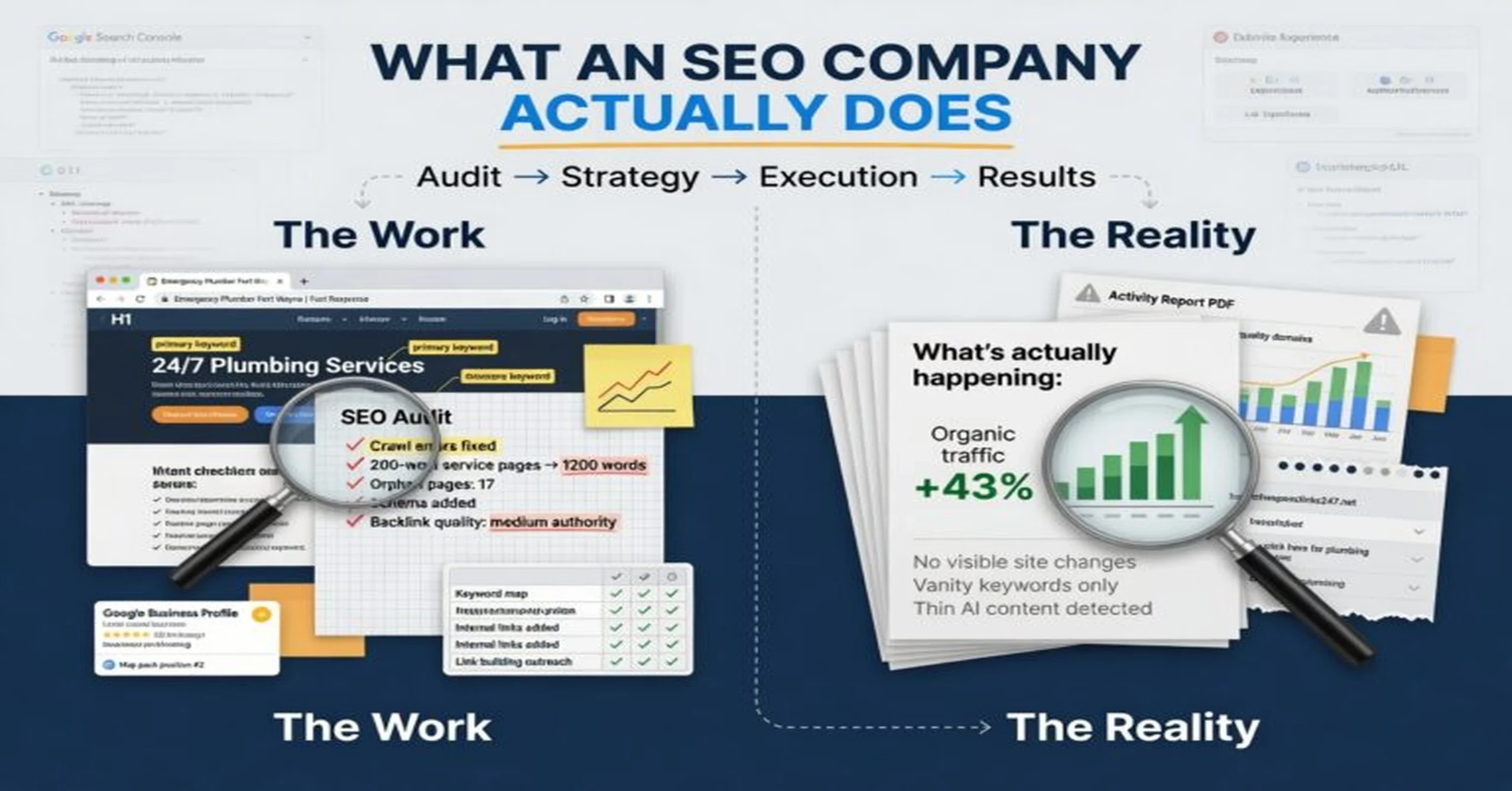
Every legitimate SEO engagement starts with an audit. The audit is the diagnostic phase. It tells the SEO company where your site stands right now, what is working, what is broken, and what opportunities exist that you are not capturing. Without an audit, any strategy is guesswork wearing a suit.
A proper SEO audit covers three layers. The technical layer examines whether search engines can crawl and index your site without obstruction. The content layer evaluates whether your pages cover the topics your audience searches for and whether they cover them well enough to compete. The authority layer assesses your backlink profile, brand presence, and how the broader web treats your site as a source. Each layer produces a list of findings. The findings get prioritized. The priorities become the strategy.
The red flag is an SEO company that skips the audit and jumps straight to recommendations. That means they are applying a template strategy to your site without understanding what your site actually needs. Template strategies produce template results, which is to say, roughly nothing.
I haven’t worked with every SEO company on the market, so I can’t tell you what a universal “good audit” looks like in practice. What I can tell you is that the audit should produce specific findings, not vague observations. “Your site needs better content” is not a finding. “Your service pages average 200 words, target no specific keywords, and have no internal links connecting them to supporting content” is a finding. The specificity is the difference.
Keyword Research and Strategy
Keyword research is where the SEO company figures out what your potential customers are actually typing into Google. This sounds simple. It is not. The gap between good keyword research and bad keyword research determines whether the entire engagement produces revenue or produces vanity metrics that look good in a slide deck.
Bad keyword research targets the highest volume terms and calls it a strategy. “Plumber” has 300,000 searches per month. Targeting it when your plumbing business operates in one city is not a strategy. It is a fantasy dressed up with a search volume number. Good keyword research matches the keyword to the business. “Emergency plumber Fort Wayne” has a fraction of the volume and roughly 100% of the commercial intent that matters to a plumbing business in Fort Wayne.
The research should produce a keyword map that connects specific keywords to specific pages on your site. Each page targets a primary keyword and a cluster of related terms. The pages connect to each other through internal links that tell both users and search engines how the content relates. This structure is what separates a site that ranks from a site that publishes content and hopes.
Search intent is the layer most SEO companies talk about but fewer actually implement. Every keyword carries an intent: informational (the searcher wants to learn), commercial (the searcher is comparing options), transactional (the searcher is ready to buy), or navigational (the searcher is looking for a specific site). The content that targets each keyword needs to match the intent. A product page targeting an informational keyword will not rank because it does not answer the question the searcher asked. An educational blog post targeting a transactional keyword will rank but will not convert because the reader wanted to buy, not learn.
On-Page Optimization
On-page optimization is what most people picture when they think of SEO. Title tags, meta descriptions, header hierarchy, image alt text, URL structure. The visible elements on the page that help search engines understand what the page is about and how it relates to the queries people are searching.
The basics matter more than most operators give them credit for. A title tag that includes the primary keyword and stays under 60 characters. A meta description that gives the searcher a reason to click. An H1 that matches the search intent. Headers that break the content into logical sections search engines can parse. Alt text on images that describes what the image shows rather than stuffing a keyword into a field nobody reads.
Then there is the layer above the basics. Internal linking that connects related pages and distributes authority across the site. Schema markup that tells search engines exactly what type of content the page contains, whether it is an article, a FAQ, a product, a local business, or a review. E-E-A-T signals that demonstrate the author’s experience, expertise, authoritativeness, and trustworthiness directly on the page through author bios, credentials, sourcing, and transparency.
An on-page SEO checklist covers roughly 30 to 40 elements per page. Some of them take seconds to fix (updating a title tag). Some of them take hours (restructuring the internal linking architecture across a 200-page site). The SEO company should be working through both, not just the fast ones.
Technical SEO
Technical SEO is the infrastructure layer. If the content is what search engines rank, the technical foundation is what lets them find it, read it, and decide to include it in the index at all. A site with outstanding content and broken technical SEO is like a restaurant with an incredible menu and a locked front door.
The core technical elements include crawlability (can Googlebot access every page it should and none of the pages it shouldn’t), indexation (are the right pages in Google’s index and are duplicate or thin pages excluded), site speed (does the page load fast enough to satisfy both users and Core Web Vitals thresholds), mobile usability (does the site work properly on mobile devices, which is where the majority of searches happen), and site architecture (is the URL structure logical and shallow enough that no important page is more than three clicks from the homepage).
The technical work that actually moves the needle is rarely glamorous. Fixing redirect chains. Cleaning up orphan pages. Resolving crawl errors in Google Search Console. Compressing images. Implementing lazy loading. Setting canonical tags correctly on pages with parameter variations. Submitting an XML sitemap that reflects the actual structure of the site. None of this shows up in a client presentation as exciting work, but all of it determines whether the content and links the company builds have a foundation to stand on.
A technical SEO agency that cannot explain their findings in plain language is either not doing the work or does not understand it well enough to communicate it. Both are problems.
Content Production
Content is the asset that ranks. Links point to it. Technical SEO supports it. Keywords target it. But the content itself is what appears in the search results and what the visitor reads when they arrive. If the content is thin, generic, or obviously produced without genuine knowledge of the topic, none of the other work saves it.
An SEO company’s content services typically include blog posts, service page copy, landing pages, and sometimes more specialized formats like case studies, data-driven reports, or resource guides. The production volume varies by retainer level. A smaller engagement might produce two to four pieces per month. A larger one might produce eight to twelve. The volume matters less than the quality and the strategy behind it.
The strategy is where content production connects to keyword research. Every piece of content should target a specific keyword cluster, serve a defined search intent, and link to related pages within the site architecture. Content produced without this strategic layer is just publishing. It fills a blog page. It does not build ranking authority.
The quality bar has risen substantially since 2024. Google’s helpful content framework specifically targets content produced primarily for search engines rather than for people. AI content creation has flooded every niche with surface-level articles that hit the keyword targets without providing genuine value. The SEO companies that produce content worth ranking are the ones whose writers understand the topic, bring real perspective or editorial discipline to the work, and create pages that answer the searcher’s question better than what already exists on page one.
Link Building and Off-Page SEO
Links are the currency of authority in SEO. When another website links to your page, it signals to Google that someone else on the web considers your content worth referencing. The more authoritative the linking site, the stronger the signal. This is why link building is one of the core services an SEO company provides, and it is also the service area with the widest gap between good and bad execution.
Good link building earns links through content that deserves to be referenced, outreach to relevant publications, digital PR, guest contributions to authoritative sites, and the slow accumulation of citations and mentions that comes from being a genuine participant in your industry’s conversation. The links are dofollow by default, come from topically relevant sites, and appear in editorial contexts that make sense.
Bad link building buys links from networks, places them on irrelevant sites, uses exact-match anchor text at a density that looks artificial, and produces a backlink profile that Google’s systems are increasingly good at identifying as manufactured. The sites linking to you have names you have never heard of. The pages those links appear on contain content that reads like it was generated by a tool and reviewed by nobody. The links technically exist. They technically count as backlinks. They functionally do nothing or actively harm the site they point to.
Ask any SEO company you are evaluating where their links come from. The answer should be specific. If the answer is vague, the links are probably cheap.
Local SEO
For businesses that serve a geographic area, local SEO is often the highest-value service an SEO company provides. Local SEO targets the searches that include location intent: “dentist near me,” “plumber Fort Wayne,” “best coffee shop downtown.” These searches carry strong commercial intent because the person searching is looking for something nearby and usually ready to act.
The local SEO work centers on Google Business Profile optimization. The profile is what appears in the local map pack at the top of search results, and that map pack captures a disproportionate share of clicks for local queries. Optimizing the profile means ensuring the business name, address, and phone number are consistent everywhere they appear online. It means selecting the right categories, writing a description that includes relevant terms naturally, posting regularly, responding to reviews, and adding photos that show the actual business.
Beyond the profile, local SEO includes building citations across directories and local platforms, earning reviews from real customers, creating location-specific content on the website, and implementing local business schema markup that helps search engines understand where the business operates and what it offers. For businesses with multiple locations, each location needs its own optimized profile and its own landing page on the website.
Local SEO services for small business are often the most cost-effective SEO investment a business owner can make. The competition is limited to the geographic area. The search volume is lower but the conversion rate is higher. And the Google Business Profile is free to use, which means the SEO company’s work goes directly toward making a free asset perform better.
Reporting and Communication
Reporting is where most SEO engagements either build trust or lose it. The SEO company should be providing regular reports, typically monthly, that show what was done, what changed, and what it means for the business. The format varies. The content should not.
A useful SEO report includes keyword ranking changes (which keywords moved up, which moved down, and why), organic traffic trends (overall and broken down by landing page), technical health status (crawl errors, indexation issues, Core Web Vitals), content published and its early performance, links earned and their quality, and any actions taken on the site during the reporting period. The report should connect to business outcomes. Rankings and traffic are intermediate metrics. The terminal metrics are leads, calls, form submissions, and revenue.
The report should not be the only communication. An SEO company that sends a PDF once a month and disappears until the next one is not managing a relationship. The company should be available for questions, proactive about flagging issues (an algorithm update that affected rankings, a technical problem that appeared between reports, a competitor making moves), and willing to explain what they are doing and why in language the business owner can follow.
An SEO report template that is heavy on charts and light on actionable context is a warning sign. Pretty graphs of upward trends feel good to look at. They mean nothing if the report does not explain what drove the trend, whether it is sustainable, and what happens next.
How to Tell Good Work From Expensive Reports
This is the section the competing articles on this topic do not write, because most of them are SEO companies themselves and the last thing they want is a client who can evaluate their work critically.
Good SEO work produces observable changes on the site. Pages get updated. New content appears. Technical issues get resolved and you can verify the resolution in Google Search Console. Links appear from sites you can visit and recognize as real. Rankings move on keywords that connect to your business, not vanity terms that look impressive on paper but drive no revenue.
Bad SEO work produces reports. The reports look professional. The deliverables are described in language that sounds productive. But the site itself has not changed in any way you can see or verify. The content is thin or obviously templated. The links come from sites you have never heard of in industries unrelated to yours. The keyword rankings that improved are terms nobody who would hire you would ever search.
Actually, let me put this more directly. If you are three months into an SEO engagement and you cannot point to specific things on your website that are different, better, or new because of the work the SEO company did, you are probably paying for activity reports, not results. The work should be visible. The outcomes should be measurable. And the SEO company should be able to explain, without jargon, what they did this month and why it matters.
The trust signals that matter in an SEO engagement are the same ones that matter in any business relationship. Transparency about what is being done. Honesty about what is working and what is not. Accountability when results do not meet expectations. Willingness to explain the strategy in terms the client can evaluate.
How to Hire the Right One
The SEO company you hire should be able to rank their own website. Search for “SEO company” or “SEO services” in their local market. If they are not on page one for their own service keywords, that tells you something about what they can deliver for yours.
Ask for case studies with specific numbers. Not “we increased traffic 300%,” because traffic from irrelevant keywords is worthless. Real case studies connect SEO work to business outcomes: leads generated, revenue attributed, ranking positions on commercially valuable keywords. If the case studies are vague, the results probably were too.
Ask about their content process. Who writes the content? Do they understand your industry or are they generalists producing surface-level articles from secondary research? The content quality bar in 2026 is high enough that generic AI-assisted content without editorial oversight and subject matter input is increasingly a liability rather than an asset.
Ask about their link building approach. Where do the links come from? Can they show you examples of links they have built for other clients? Are the linking sites real, topically relevant, and editorially independent? If the answer to any of these questions is unclear, the link building is probably the kind that produces numbers in a report and risk in Google’s systems.
Ask about communication cadence. How often will you hear from them outside of the monthly report? Who is your point of contact? Can you call them when you have a question, or are you submitting tickets into a queue?
The right SEO company will welcome these questions. The wrong one will deflect them. For a complete evaluation framework covering contract terms, red flags, and the decision criteria that predict results, read the full guide on choosing the best SEO company.FAQ
What does an SEO company do?
An SEO company improves a website’s visibility in organic search results through technical optimization, content production, keyword targeting, link building, local SEO, and ongoing performance reporting. The work aims to make the website appear when potential customers search for products or services the business offers.
How much do SEO services cost?
SEO services typically cost between $1,500 and $5,000 per month for small to midsize businesses. Local SEO engagements often start lower, while enterprise and ecommerce campaigns can exceed $7,500 per month. Pricing depends on the scope of work, competitive landscape, and size of the website.
How long does it take for SEO to produce results?
Most SEO campaigns produce observable results within three to six months, with significant impact typically visible between six and twelve months. The timeline depends on the site’s starting position, the competitive landscape, the volume of work being done, and the site’s existing authority.
What is the difference between an SEO company and an SEO agency?
The terms are largely interchangeable. Both refer to service providers that perform search engine optimization for clients. Some providers use “agency” to signal broader service offerings that may include paid advertising, social media, or web development alongside SEO. The distinction is branding, not substance.
What should an SEO report include?
A useful SEO report includes keyword ranking changes, organic traffic trends by page, technical health status, content published during the reporting period, links earned and their quality metrics, and a connection between the SEO work and business outcomes like leads, calls, or revenue.
How do I know if my SEO company is doing a good job?
Look for observable changes on your website: new content, updated pages, resolved technical issues. Verify that keyword rankings are improving on terms that connect to your business. Check that backlinks come from real, relevant websites. If you are several months into an engagement and cannot point to specific improvements on your site, the work may not be producing real value.
What is the difference between organic SEO and paid search?
Organic SEO improves visibility in the unpaid search results through optimization and content. Paid search (PPC) places ads above the organic results for a cost per click. Organic SEO takes longer to produce results but generates traffic without ongoing ad spend. Paid search produces immediate visibility that stops the moment the budget runs out.