SEO Company Southern Indiana: Bloomington, Evansville, Columbus
AI Summary
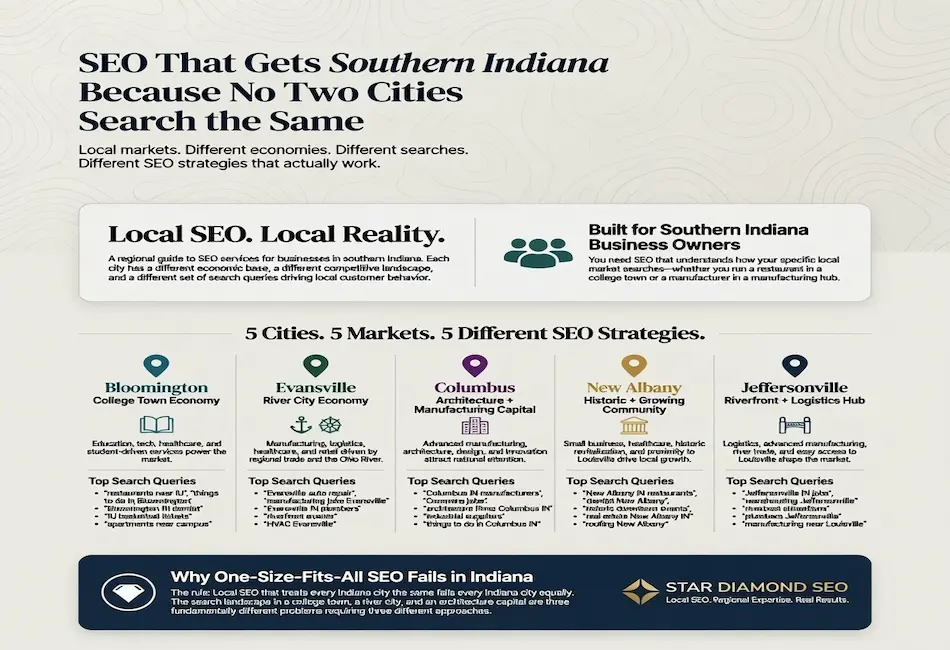
What is this page? A regional guide to SEO services for businesses in southern Indiana, covering Bloomington, Evansville, Columbus, New Albany, and Jeffersonville. Each city has a different economic base, a different competitive landscape, and a different set of search queries driving local customer behavior.
What it is and who it is for: Built for business owners in southern Indiana who need SEO that accounts for how their specific local market searches. A restaurant in Bloomington competes for visibility against a completely different set of businesses than a manufacturer in Columbus. This page explains how SEO strategy adapts to each market and how Star Diamond SEO serves the region.
The rule: Local SEO that treats every Indiana city the same fails every Indiana city equally. The search landscape in a college town, a river city, and an architecture capital are three fundamentally different problems requiring three different approaches.
Why Southern Indiana Businesses Need Local SEO
Southern Indiana does not operate like one market. It operates like five or six smaller markets that happen to share a region on the map. Bloomington runs on the university. Evansville runs on healthcare and manufacturing. Columbus is an architecture and engineering town anchored by Cummins. New Albany and Jeffersonville are Louisville suburbs that pull search traffic from both sides of the state line. The businesses in each of these cities are competing for attention from customers who search differently, compare differently, and buy differently.
That matters for SEO because search behavior follows economic reality. A homeowner in Evansville searching for a contractor is comparing three or four local options against each other. A student in Bloomington searching for a restaurant is scrolling through dozens of results filtered by walking distance and reviews. A procurement manager in Columbus searching for an industrial supplier is running a completely different type of query than either of them. The SEO strategy that works for one of these scenarios will not transfer cleanly to the others.
Most SEO agencies sell a fixed package that treats geography as a variable you swap into a template. Change the city name, keep the strategy the same, collect the retainer. That approach produces mediocre results everywhere because it was not built for anywhere specific. The businesses that rank consistently in their local market are the ones whose SEO reflects the actual search patterns of their actual customers in their actual city.
Star Diamond SEO is based in Indiana. We understand how these markets connect and where they diverge because we operate in the same state, watch the same Google Search Console data, and track the same competitive dynamics that southern Indiana businesses face. That proximity is not a marketing line. It is a practical advantage that shows up in the specificity of the recommendations we make.
Bloomington SEO
Bloomington is Indiana University. Roughly 45,000 students cycle through every year, and the businesses that thrive there have figured out how to capture that population’s attention alongside the permanent residents who keep the city running between semesters. That dual audience creates a search environment that is unusual for a city of roughly 85,000 people. The query volume spikes and drops with the academic calendar. The types of businesses that dominate local search shift depending on whether classes are in session.
Restaurants, bars, apartments, and entertainment venues compete fiercely for visibility in Bloomington because the customer base is young, mobile-first, and review-driven. Google Business Profile optimization matters more here than in most Indiana cities because that demographic lives in Google Maps. They are not typing URLs. They are scrolling the local pack, checking star ratings, and making decisions in under thirty seconds. If your GBP is incomplete, your hours are wrong, or your last review response was six months ago, you are invisible to the people most likely to walk through your door.
For non-student-facing businesses in Bloomington, the SEO challenge is different. Professional services, healthcare providers, and B2B companies need organic visibility for queries that the university population is not generating. The competition is thinner for these terms, which means a well-structured content strategy can produce results faster than in a larger metro. The keyword difficulty for Bloomington-specific professional service queries is low enough that a new site with good content architecture can reach page one within a few months of consistent publishing.
Evansville SEO
Evansville is the largest city in southern Indiana and the economic center of the tri-state region where Indiana, Kentucky, and Illinois meet. Population is roughly 120,000 in the city proper and closer to 315,000 in the metro. Healthcare, manufacturing, logistics, and retail drive the local economy. Deaconess Health System, Berry Global, and the Toyota manufacturing presence shape the employment landscape, and the businesses that serve those industries form the core of the local search market.
The SEO opportunity in Evansville is underexploited. The city is large enough to generate meaningful search volume across most service categories but small enough that the competition for local rankings is manageable. Most Evansville businesses either have no SEO strategy at all or are running one that was set up years ago and never updated. That gap between the available search volume and the quality of the competition is exactly where a focused SEO effort produces outsized returns.
The tri-state dynamic adds a layer that pure population numbers do not capture. Evansville businesses draw customers from Henderson, Kentucky and parts of southeastern Illinois. Google’s local algorithms account for the user’s location when serving results, which means an Evansville business with strong local SEO can appear in search results for users across the river without building separate pages for those markets. Proper Google Business Profile configuration and service area settings handle the cross-state visibility.
Columbus SEO
Columbus is a city of roughly 50,000 people that punches significantly above its weight class economically. Cummins Inc. is headquartered there, and the engineering and manufacturing ecosystem that surrounds Cummins creates a business environment that is more sophisticated than the population would suggest. Columbus is also internationally recognized for its architecture, with buildings designed by Eero Saarinen, I.M. Pei, and other architects who do not typically work in small Indiana cities. That reputation draws tourism and professional visitors at rates unusual for a city this size.
For SEO, Columbus presents an interesting situation. The business community is corporate-influenced in a way that most small Indiana cities are not, which means the decision makers are often familiar with digital marketing concepts but may not have applied them to their local presence. The B2B companies that serve the Cummins supply chain, the professional services firms, and the hospitality businesses that cater to corporate visitors all have search visibility gaps that a targeted local SEO strategy can fill.
The query volume for Columbus-specific searches is lower than Bloomington or Evansville because the population is smaller. But the commercial intent behind those searches tends to be higher. Someone searching for a professional service in Columbus is more likely to be a decision maker with budget authority than someone running the same search in a college town. That intent differential means the value per ranking position is higher even though the raw traffic numbers are smaller.
New Albany SEO
New Albany sits directly across the Ohio River from Louisville, Kentucky. That geographic reality defines everything about its search environment. New Albany businesses compete for visibility with Louisville businesses in many categories because Google serves results based on proximity, and the two cities are separated by a bridge, not a meaningful distance. A user in downtown Louisville searching for a service is roughly the same distance from a New Albany provider as from a provider in Louisville’s east end.
This creates both a challenge and an opportunity. The challenge is that Louisville is a significantly larger market with more established competitors who have been investing in SEO longer. The opportunity is that Google’s local algorithms give weight to businesses that are physically close to the searcher, and New Albany businesses can capture Louisville-area searches that Louisville businesses assume belong to them. The key is building local signals strong enough that Google treats your New Albany location as relevant to cross-river queries.
Citation consistency matters more in border markets than anywhere else. If your business address shows up as New Albany, Indiana in some directories and Louisville, Kentucky in others, Google cannot confidently determine your service area. Clean, consistent NAP data across every directory, combined with a Google Business Profile that accurately defines your service area to include the Louisville metro, is the foundation that makes cross-river visibility possible.
Jeffersonville SEO
Jeffersonville shares New Albany’s cross-river dynamic with Louisville but has developed a distinct identity around the River Ridge Commerce Center, one of the largest mixed-use developments in the region. The city has attracted logistics, distribution, and light manufacturing operations that take advantage of the I-65 corridor and proximity to UPS’s Louisville hub. That economic base creates a different search profile than New Albany’s more residential and retail-focused market.
The businesses in Jeffersonville that benefit most from local SEO are the ones serving both the local residential population and the commercial operations at River Ridge. A restaurant near the development captures lunchtime traffic from workers who search on their phones at 11:30 AM. A staffing agency captures queries from HR managers at the logistics operations. An industrial supplier captures procurement searches from companies that would otherwise default to Louisville vendors.
Like New Albany, Jeffersonville’s SEO strategy needs to account for the Louisville metro overlap. But the commercial angle at River Ridge adds a B2B dimension that New Albany’s market does not have at the same scale. Building content that targets both the residential “near me” queries and the commercial procurement queries gives a Jeffersonville business two distinct streams of search visibility from a single site.
How Star Diamond SEO Works With Southern Indiana Businesses
Every engagement starts with a free Google Search Console audit. Not a generated report from a third-party tool. An actual review of what Google is telling you about your site: where your impressions are coming from, which pages are performing, where the gaps are, and what the data says about your competitive position in your specific local market.
From there, the strategy is built around what the data shows, not around a package we sell to every client regardless of situation. A Bloomington restaurant and an Evansville manufacturer need fundamentally different SEO work. The restaurant needs GBP optimization, review management, and local pack visibility. The manufacturer needs technical SEO, content that demonstrates expertise, and organic visibility for commercial-intent queries. We build the scope around what will actually move the needle for your business in your market.
Star Diamond SEO serves all of southern Indiana from our base in Albion. The work is remote by nature since SEO does not require anyone to be in the same room. What it requires is someone who understands your market, knows how to read the data, and builds a strategy specific to your competitive situation. That is what we do.
See the full range of SEO services we offer or request your free GSC audit to get started.
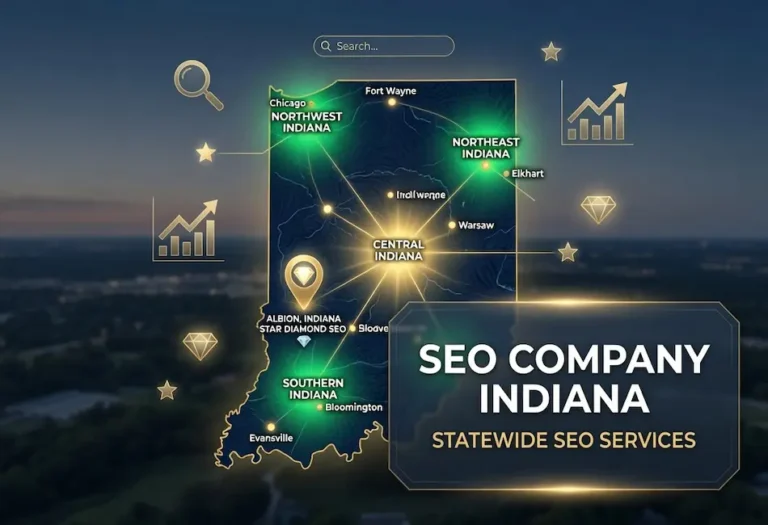
We also serve businesses across central Indiana, northeast Indiana, and northwest Indiana. For a statewide overview, see the Indiana SEO hub page.
FAQ
Does Star Diamond SEO work with businesses in Bloomington?
Yes. We serve businesses throughout Bloomington and Monroe County, including both student-facing businesses and professional services. All SEO work is handled remotely, which means location is not a barrier to working together. Contact us to discuss your Bloomington SEO needs.
How is SEO different for Evansville compared to Indianapolis?
Evansville has lower competition for most local search terms, which means a focused SEO strategy can produce faster results with less investment. The tri-state dynamic also creates cross-border visibility opportunities that Indianapolis does not have. The search volume is smaller, but the cost to compete is proportionally lower, which often makes the ROI better for Evansville businesses than for businesses in more competitive metros.
Can a New Albany business rank in Louisville search results?
Yes. Google serves local results based on proximity and relevance, not state lines. A New Albany business with strong local SEO signals, consistent citation data, and a properly configured Google Business Profile service area can appear in search results for users on the Louisville side of the river. The key is building those local signals deliberately rather than hoping Google figures it out on its own.
What industries do you serve in southern Indiana?
We work with businesses across industries including healthcare, manufacturing, professional services, restaurants and hospitality, home services, legal, and retail. The SEO fundamentals apply across industries. The strategy specifics, particularly keyword targeting, content approach, and competitive positioning, are built around your industry and your local market. Learn how to evaluate an SEO company before making a decision.
How much does SEO cost for a southern Indiana business?
Pricing is custom per client because the right scope for a Bloomington restaurant is fundamentally different from what a Columbus manufacturer needs. The free GSC audit is what makes the pricing conversation honest. Once we see your data, we can tell you exactly what would move the needle and what it would cost. Start with the audit.