Link Building Pricing: What Every Package Actually Costs
AI Summary
What does link building cost? Link building pricing ranges from $15 per link on marketplace platforms to $2,000 or more per placement on major editorial publications. The range is that wide because “a link” is not a standardized product. A link from a content farm and a link from an editorially independent publication with 100,000 monthly visitors are priced differently because they are fundamentally different assets with different impacts on rankings.
What it is and who it is for: This article is for business owners and marketing managers evaluating link building proposals, comparing vendor pricing, or setting a link building budget for the first time. It breaks down what each price tier actually buys, how pricing models differ between agencies, freelancers, and managed services, and the cost metrics that separate productive investment from expensive waste.
The rule: The cost of a link is not the price on the invoice. It is the price divided by the ranking impact it produces. A $500 link that moves a commercial page from position 8 to position 4 is cheaper than a $15 link that does nothing, because the first one generates revenue and the second one generates a line item in a report.
The Link Building Pricing Landscape in 2026
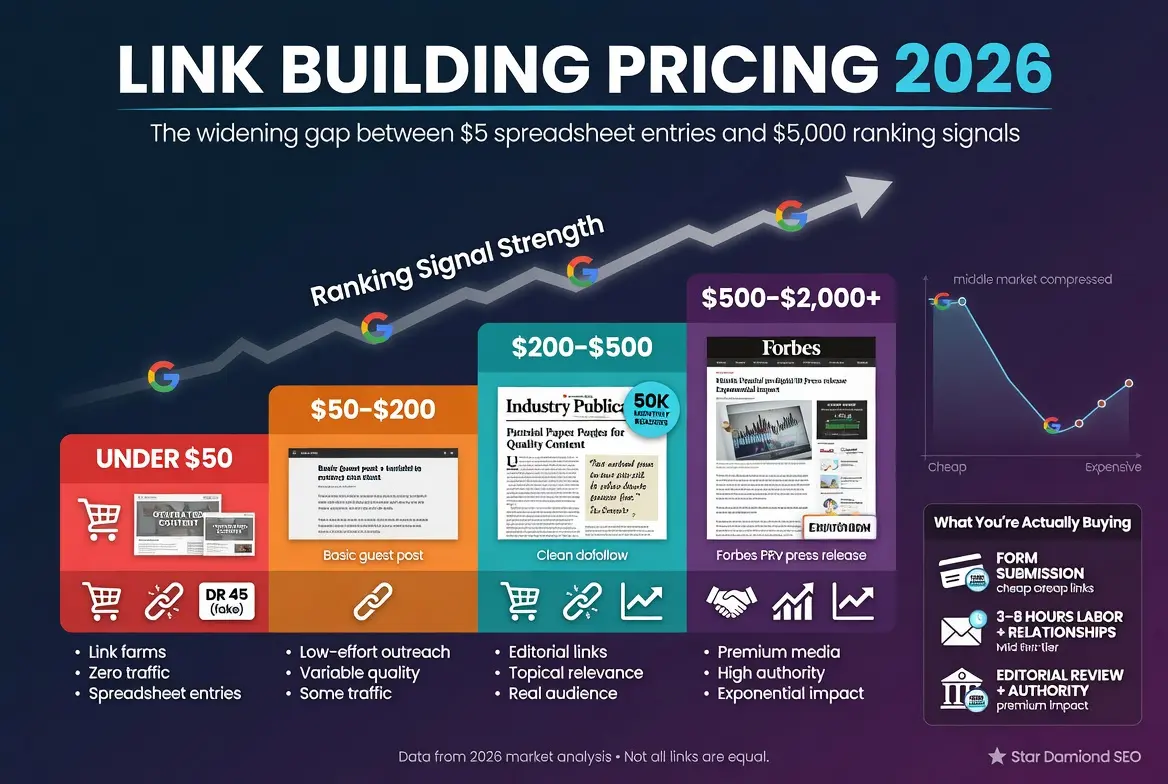
Link building pricing has never been standardized, and the range between the cheapest and most expensive options has widened every year since the practice began. In 2026, you can find links priced at $5 on Fiverr and links priced at $5,000 from premium digital PR agencies. Both are called “link building.” They are not the same product in any dimension that affects rankings.
The market bifurcation that began with Google’s Helpful Content Updates accelerated through 2024 and 2025. Cheap links became cheaper because the sites hosting them lost traffic, authority, and editorial credibility. Quality links became more expensive because the sites hosting them became scarcer as Google’s systems improved at identifying and discounting manufactured placements. The middle of the market compressed. What remains is a clear division between links that function as ranking signals and links that function as spreadsheet entries.
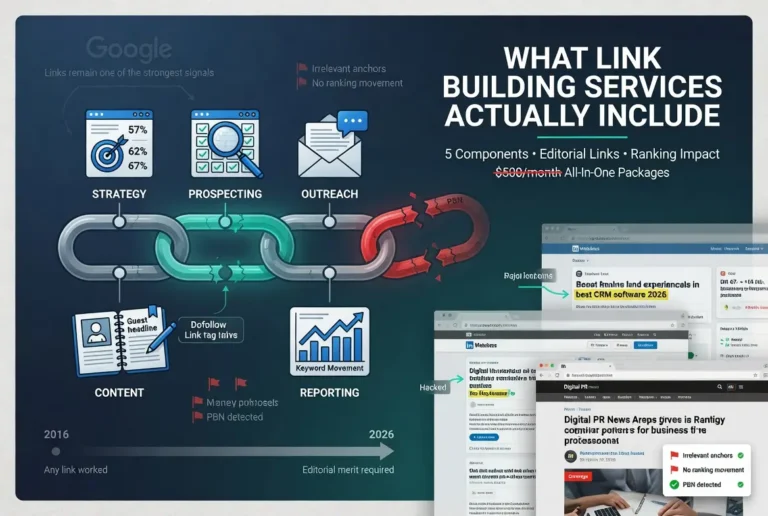
Understanding link building pricing requires accepting that you are not buying a link. You are buying the labor to earn a placement, the relationship that makes the placement possible, and the authority of the site that hosts it. A $200 link from a topically relevant industry publication with 50,000 monthly readers costs what it costs because acquiring it required prospecting, personalized outreach, content creation or coordination, and an editorial acceptance process that rejects most submissions. A $15 link from a site that accepts everything costs what it costs because acquiring it required a credit card and a form submission. For the full guide covering methods, quality evaluation, and how to choose between providers, see the complete link building services guide.What Each Price Tier Actually Buys
Under $50 Per Link
At this price point, you are buying placements on sites that exist primarily as link hosting platforms. The sites may have domain authority scores that look respectable because they have been accumulating inbound links from other sites in the same network. The traffic is minimal or nonexistent. The content is thin, often generated, and exists to provide a context for the outbound links the site sells. Google’s systems have become increasingly effective at identifying these sites and discounting or ignoring the links they host.
The math is straightforward. At $15 to $50 per link, the vendor cannot afford to spend meaningful time on prospecting, outreach, or content creation. The placement is automated or semi-automated, drawn from a database of sites the vendor controls or has standing arrangements with. The result is a link that appears in backlink analysis tools but passes minimal authority because the linking site has no genuine audience, no editorial independence, and no topical authority that Google’s systems recognize.
$50 to $200 Per Link
This range covers the low end of legitimate guest posting and outreach-based placement. The vendor is spending 1 to 3 hours per link on prospecting and outreach, which produces placements on real sites with some traffic, topical relevance, and editorial presence. The content quality is variable. Some vendors at this price point produce competent guest posts. Others produce thin articles that the host site accepts because the editorial standards are low.
Links in this range can produce ranking impact when they come from topically relevant sites with genuine traffic. The key evaluation criterion is whether the linking site has an audience that would exist with or without the outbound links it hosts. A site that publishes useful content and happens to accept guest contributions is a legitimate linking partner. A site that publishes guest contributions as its primary business model is a link vendor with a content wrapper.
$200 to $500 Per Link
This is the range where most legitimate link building services produce their core output. The vendor is investing 3 to 8 hours per placement in prospecting, personalized outreach, content creation, editorial coordination, and quality verification. The target sites have real traffic, genuine editorial standards, and topical relevance to the linked content. The placement is a dofollow editorial link in a piece of content that the host site’s audience would find useful independent of the link.
Links at this price tier consistently produce measurable ranking impact because they carry the signals Google’s systems are designed to reward: editorial independence, topical relevance, and placement on sites with genuine authority built through real audience engagement. The cost per link is higher. The cost per ranking improvement is typically lower because the links actually work.
$500 to $2,000+ Per Link
Premium placements on high-authority publications: major industry media, well-known blogs with established audiences, news outlets that accept contributed content through editorial review. Digital PR placements generated through newsworthy content fall into this range as well. The authority signal from a single placement at this tier can exceed the combined impact of twenty links from the $50 range because the linking site’s domain authority, traffic, and editorial credibility are exponentially stronger.
Enterprise link building services operate primarily at this tier because the target publications require significant coordination: pitch development, editorial relationship management, content that meets publication standards, and turnaround times measured in weeks rather than days. The per-link cost is high. The per-impact cost is often competitive with mid-tier link building because each placement carries substantially more authority.
Pricing Models: Per-Link, Retainer, and Package
Per-Link Pricing
The vendor charges a fixed price for each link placed. The price varies by the authority and traffic of the target site. The advantage is transparency: you know exactly what you are paying for each placement, and you can evaluate the cost against the quality on a link-by-link basis. The disadvantage is that per-link pricing incentivizes the vendor to deliver volume at the lowest placement difficulty, because every placement earns the same margin regardless of the effort required.
Monthly Retainer
The vendor charges a fixed monthly fee for a defined scope of link building activity: a target number of links per month, a minimum quality threshold, strategic planning, and reporting. Retainers typically run $2,000 to $5,000 per month for small to midsize campaigns and $5,000 to $15,000 for enterprise-level operations. The advantage is that the vendor has stable revenue and can invest in longer-term relationship building with publishers. The disadvantage is that the deliverable is less transparent than per-link pricing, which makes quality monitoring more important.
Package Pricing
Link building packages bundle a defined number of links at specific quality tiers into a single price. “Starter Package: 5 links from DR 40+ sites for $1,500.” “Growth Package: 10 links from DR 50+ sites for $3,500.” The advantage is simplicity: you know what you are getting and what it costs. The disadvantage is that domain rating thresholds alone do not determine link quality. A DR 50 site with 100,000 monthly visitors and genuine editorial standards is a different product than a DR 50 site with 500 monthly visitors and no editorial review. Packages that define quality by DR alone are using a single metric as a proxy for a multi-dimensional evaluation.
What Drives the Price of a Link
Four factors determine why one link costs $50 and another costs $500.
The authority and traffic of the linking site is the primary driver. Sites with higher domain rating, more organic traffic, and stronger editorial reputations are harder to earn placements from. The difficulty of acquiring the link, not just the value of the link, drives the price. A placement on a site that accepts 5% of pitches costs more than a placement on a site that accepts everything because the labor to earn it is greater.
The content required for placement affects the cost. A link earned through a resource page mention requires minimal content creation. A link earned through a guest post requires a full article, often 1,000 to 2,000 words, written to the host site’s editorial standards. A link earned through digital PR requires a newsworthy angle, data visualization, or expert commentary that justifies media coverage. Each step up in content complexity adds labor cost.
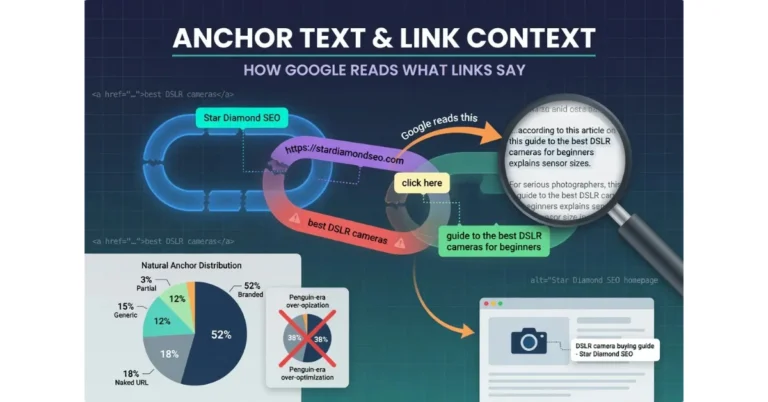
Topical relevance narrows the prospect pool. If your site is in a broad niche like marketing or technology, thousands of potential linking sites exist. If your site is in a narrow niche like industrial HVAC maintenance or veterinary ophthalmology, the number of relevant sites is much smaller. A smaller prospect pool means more effort per placement, which means higher cost per link. Anchor text constraints add another layer: earning a placement with specific anchor text on a specific page requires more negotiation than accepting whatever the host site offers.
Geographic targeting increases cost for local campaigns. A local link building agency targeting placements from sites in a specific city or region is working with a dramatically smaller prospect pool than a national campaign. The per-link cost for locally relevant placements can be two to three times higher than national placements because the supply of relevant local sites is limited.
Paying for Backlinks: The Risk and Reality
Google’s guidelines explicitly prohibit buying or selling links that pass PageRank. This has been the stated policy since the early days of link-based ranking. The practical reality is more nuanced than the policy suggests.
The entire link building services industry operates in the space between Google’s stated policy and its enforcement capabilities. When a business pays an agency $3,000 per month for a link building campaign, the agency is being paid to earn links through outreach, content creation, and relationship building. The links are not “bought” in the sense that the agency is paying the linking site directly. They are earned through labor and placed through editorial acceptance. This distinction matters because the links produced through legitimate outreach processes carry the editorial signals Google’s systems reward.
Where the risk becomes real is when the payment goes directly to the linking site for placement without editorial review. Paying a site $50 to insert a link into an existing article is a paid link. Paying an agency to write a guest post that a site’s editor reviews and accepts is an earned link facilitated by a service provider. The line between these two models is where most pricing and risk conversations should focus.
The practical test is editorial independence. Did the linking site evaluate the content and decide it was worth publishing on its own merits? Or did the linking site publish the content because it was paid to, regardless of quality or relevance? Links that pass the editorial independence test carry authority. Links that fail it carry risk that compounds with every additional placement in the same pattern.
Agency vs Freelancer vs Marketplace Pricing
The provider type determines both the price range and the nature of the product you receive.
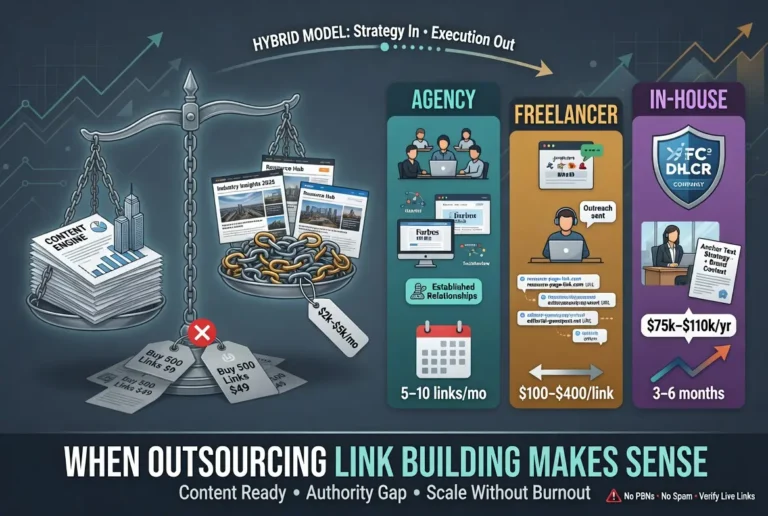
The best link building agencies charge retainers of $2,000 to $5,000 per month or per-link prices of $200 to $500 for mid-tier placements. The premium covers team overhead, tool subscriptions, established publisher relationships, quality control processes, and reporting infrastructure. The advantage is consistency and scale. The risk is that the agency delegates your account to junior staff while the senior team focuses on closing new clients. Ask who builds your links specifically. Get names.
Experienced freelancers charge $100 to $400 per link, which is competitive with agency per-link pricing. The margin is similar because the freelancer’s lower overhead is offset by lower volume capacity. A freelancer handling 8 clients simultaneously can dedicate 2 to 4 hours per week to your campaign. That is enough for 3 to 6 quality placements per month. If you need 15 links per month, a solo freelancer cannot sustain that output at quality.
Marketplace platforms (Fiverr, specialized link marketplaces) offer links at $15 to $100 per placement. The pricing is possible because the platforms aggregate demand across hundreds of buyers and route it to databases of sites that accept paid placements at scale. The per-link cost is low. The per-result cost is typically infinite because the links produce no ranking movement. There are exceptions. Some marketplace sellers have genuine relationships with real sites and produce legitimate placements at competitive prices. They are the minority, and identifying them requires the same due diligence you would apply to any provider: ask for specific links, visit the pages, verify the sites are real.
Enterprise Link Building: Why It Costs More
Enterprise link building services target companies with large websites competing nationally or internationally for high-value keywords. The pricing starts at $5,000 per month and scales to $15,000 or more. The premium is not markup. It reflects four factors that make enterprise campaigns genuinely more expensive to execute.
The target publications are harder to access. Enterprise campaigns target placements on sites like Forbes, Inc., industry-specific publications with national readership, and major media outlets. Earning a placement on these sites requires established editorial relationships, content that meets publication-level standards, and pitch processes that can take weeks per placement. The per-link cost reflects the labor and relationship capital required.
The keyword targets are more competitive. Enterprise campaigns target keywords where the top-ranking pages have hundreds of referring domains from authoritative sources. Closing that gap requires more links per month at higher quality than a local or small business campaign. The volume and quality requirements compound the cost.
The coordination overhead is higher. Enterprise campaigns involve multiple stakeholders: the SEO team, the content team, legal review, brand guidelines compliance, and executive approval on messaging. Every placement requires coordination across these functions, which adds time and labor that smaller campaigns avoid entirely.
The reporting requirements are more granular. Enterprise clients require detailed attribution analysis connecting link acquisition to ranking movement to traffic to revenue. The reporting infrastructure required to produce this analysis at the enterprise level is more sophisticated and more expensive to maintain than the monthly summary reports sufficient for smaller campaigns.
How to Set a Link Building Budget
The link building budget should follow from the competitive gap, not from an arbitrary number or an industry benchmark.
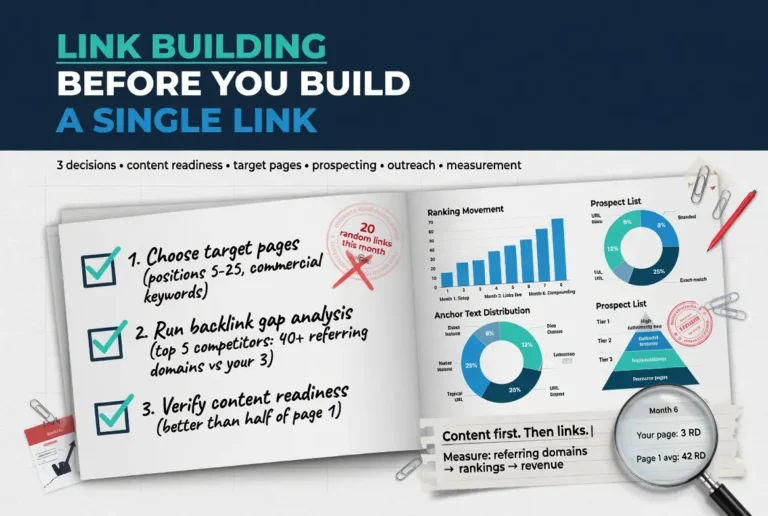
Start with the target keywords. Identify the 3 to 5 most commercially valuable keywords your site should rank for. Pull the backlink profiles of the top five ranking pages for each keyword. Count referring domains to each page. Average them. That average is your target. The gap between your current referring domain count and that target, multiplied by the cost per quality link, gives you the total investment required to close the gap.
Distribute that investment over a timeline. A page that needs 30 additional referring domains to compete does not need all 30 in one month. Sustained acquisition of 5 to 10 links per month over three to six months produces a more natural profile and distributes the cost. At $200 to $400 per link, that is $1,000 to $4,000 per month for a focused campaign targeting one to three pages.
Budget for the content that supports the campaign. If your link building campaign relies on guest posting, someone needs to write the guest posts. If it relies on digital PR, someone needs to produce the newsworthy content. If it relies on resource page outreach, the target page on your site needs to be genuinely resource-worthy. The content costs are separate from the link placement costs and should be accounted for in the budget.
Set a review checkpoint at month three. Compare the links acquired, the cost incurred, and the ranking movement observed. If the links are landing and rankings are moving, continue. If the links are landing and rankings are static, diagnose whether the problem is link quality, content competitiveness, or targeting. If the links are not landing at the expected rate, the provider or the outreach approach needs adjustment. The budget conversation at month three should be informed by data, not faith.
Measuring Link Building ROI
The return on link building investment is calculated the same way as any marketing investment: revenue generated divided by cost incurred. The challenge is attribution, because link building affects rankings, rankings affect traffic, and traffic affects revenue through a chain of causation that plays out over months rather than days.
The practical measurement approach works in three layers. First, track referring domains to each target page monthly. This confirms that the links you are paying for actually exist and persist. Second, track ranking positions on target keywords for each page receiving links. This connects the input (links) to the intermediate output (rankings). Third, track organic traffic and conversions on the target pages. This connects the intermediate output to the terminal output (revenue).
The timeline for ROI calculation is six months minimum. Links acquired in month one may not produce detectable ranking movement until month three or four. Ranking improvements in month four may not produce significant traffic increases until month five or six. Evaluating link building ROI at month two is evaluating a seed before it sprouts. The investment horizon should match the production timeline.
The metric that separates productive link building from expensive link building is cost per ranking position gained on commercially valuable keywords. If you spent $6,000 over three months and moved a page from position 12 to position 3 for a keyword that generates $8,000 per month in attributed revenue, the ROI is clear and compounding. If you spent $6,000 and the page moved from position 12 to position 11, either the campaign needs more time, the links need better quality, or the link building outsourcing partner needs replacement.
FAQ
How much does link building cost per month?
Most small to midsize businesses spend $1,000 to $5,000 per month on link building, which produces 5 to 15 quality links per month depending on the price tier and provider type. Enterprise campaigns targeting high-authority publications typically cost $5,000 to $15,000 per month. The budget should be set based on the competitive backlink gap for your target keywords, not an industry average.
How much does a single backlink cost?
Per-link pricing ranges from $15 on marketplace platforms to $2,000 or more for placements on major editorial publications. The effective range for links that produce measurable ranking impact is $150 to $500 per placement from topically relevant sites with genuine traffic and editorial standards. Links priced below $50 rarely pass enough authority to affect rankings.
What is the difference between link building packages?
Link building packages bundle a defined number of links at specific quality tiers into a single price. Starter packages typically include 5 links from mid-authority sites for $1,000 to $1,500. Growth packages include 10 to 15 links for $2,500 to $4,000. Premium packages target high-authority placements at $5,000 or more. The quality distinction between packages should be evaluated by site traffic and editorial standards, not just domain rating thresholds.
Is paying for backlinks against Google’s guidelines?
Google’s guidelines prohibit buying or selling links that pass PageRank. In practice, the distinction centers on editorial independence. Links earned through outreach and guest posting where the host site editorially reviews and accepts the content are treated differently than links placed through direct payment without editorial review. The risk increases when payments go directly to linking sites for placement without genuine editorial evaluation of the content.
What is the cheapest effective link building option?
The most cost-effective link building approach for small businesses is focused outreach to topically relevant sites in your industry, producing 3 to 5 quality placements per month at $100 to $300 per link. Freelance link builders with genuine publisher relationships can deliver at this price point. The cheapest option on paper, marketplace links at $15 to $50, is typically the most expensive in practice because the links produce no ranking impact.
How do I know if I am overpaying for link building?
Compare the links you receive against their actual metrics: visit the linking pages, check the site’s organic traffic, evaluate whether the site has a real audience and editorial standards. If you are paying $300 per link and the linking sites have minimal traffic, no genuine editorial presence, and exist primarily to host outbound links, you are overpaying for a low-quality product. The price should reflect the quality and authority of the placement, not just the existence of a link.
How long before link building shows ROI?
Most link building campaigns require three to six months to produce measurable ranking improvements and six to twelve months to demonstrate clear revenue attribution. The timeline depends on the competitive gap, the quality of links acquired, and the competitiveness of the target keywords. Link building ROI should be evaluated at the six-month mark against ranking movement on target keywords, not at month two when the links have not had time to be fully processed.