
SEO Pricing Package Guide: Models, Costs, What You Get
AI Summary
What is an SEO pricing package? An SEO pricing package is a bundled set of search engine optimization services sold at a defined price point, typically structured as a monthly retainer, hourly rate, project fee, or performance agreement. The package defines what work gets done, how often, and what the client should expect in return.
What it is and who it is for: This article is for business owners evaluating SEO proposals and trying to figure out what a fair price looks like before they sign anything. It breaks down the four pricing models, what each budget tier actually buys in terms of real labor hours and deliverables, and the specific questions that separate a legitimate proposal from an expensive template.
The rule: The price of an SEO package is not determined by a menu. It is determined by the scope of work required to close the gap between where your site is and where it needs to be. Any provider quoting a price before understanding that gap is selling a template, not a strategy.
What SEO Pricing Actually Looks Like in 2026
Most businesses in the United States pay between $1,500 and $5,000 per month for SEO services that produce measurable results. That range has held roughly steady for the last three years, even as AI tools have compressed the labor required for certain tasks. The floor moved up because cheap SEO stopped working. The ceiling stayed put because the strategic work that actually moves rankings hasn’t gotten cheaper to produce.
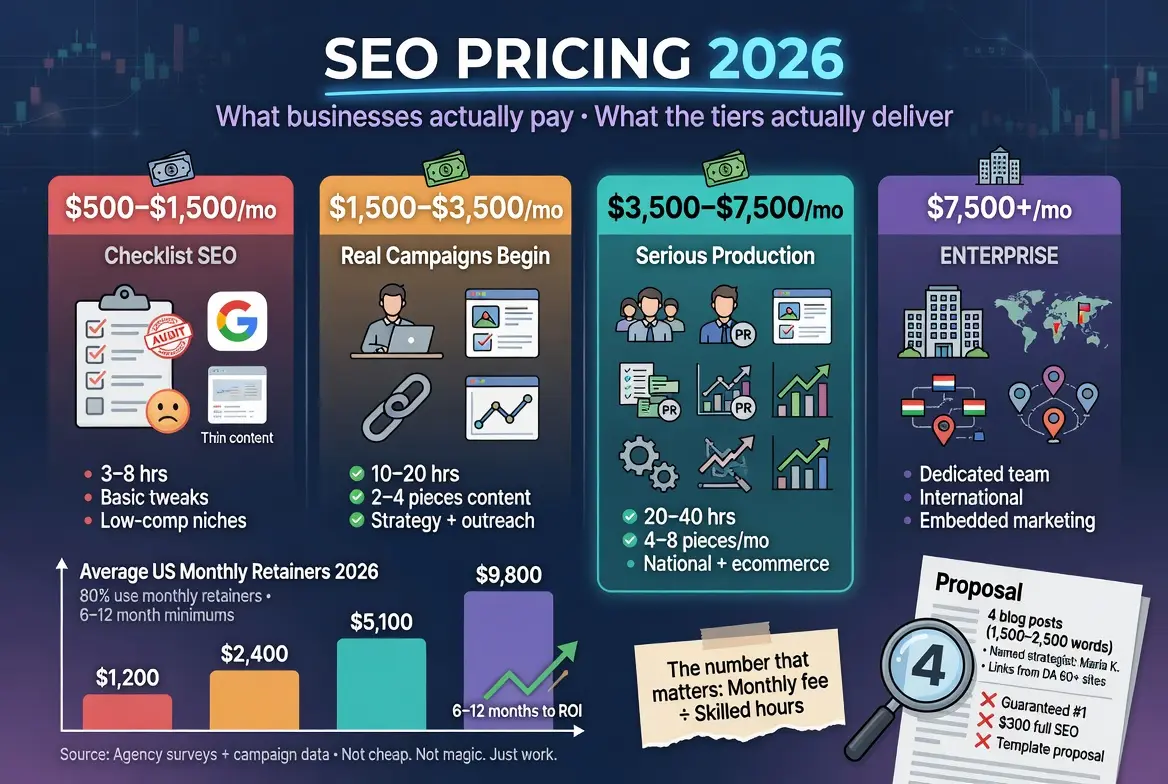
Below $1,500 per month, you are buying a checklist. Someone runs an automated audit, adjusts a few title tags, maybe publishes a thin blog post. The work looks like SEO on paper. It does not produce the sustained ranking improvements that generate revenue. Above $5,000 per month, you are typically paying for broader scope: more competitive markets, more content production, aggressive link acquisition, or multi-location campaigns. Enterprise engagements routinely exceed $10,000 per month because the sites are larger, the competition is fiercer, and the coordination costs are real.
The number that matters is not the monthly fee. It is the monthly fee divided by the hours of skilled labor applied to your account. A $3,000 retainer where an experienced strategist spends 20 hours on your site is a fundamentally different product than a $3,000 retainer where a junior coordinator spends 5 hours and automates the rest. Both get called “full service SEO.” Both show up on a proposal looking professional. The difference only becomes visible in the results six months later.
The Four Pricing Models
SEO providers price their work using four models, and most will offer at least two of them depending on the engagement.
Monthly Retainer
The most common model. Roughly 80% of SEO agencies price on a monthly retainer basis. You pay a fixed amount each month for an ongoing engagement that includes a defined scope of work: technical optimization, content production, link building, reporting, and strategy. The retainer model works because SEO is cumulative. Rankings build over months. Content compounds. Authority grows with sustained effort. A monthly retainer aligns the incentive structure with how search engines evaluate websites, which is continuously, not once.
Retainers typically require a minimum commitment of six months, sometimes twelve. This is not a lock-in tactic from good providers. It is an honest acknowledgment that SEO takes time to produce meaningful results, and evaluating a campaign at month two is like judging a garden by the first sprout.
Hourly Rate
SEO consultants and smaller agencies commonly charge hourly, with rates ranging from $100 to $300 per hour in 2026. This model works well for defined, bounded tasks: a technical audit, a consultation on site architecture, a content strategy session, training for an internal team. It does not work particularly well for ongoing SEO campaigns because the administrative overhead of tracking hours creates friction that doesn’t serve either party.
Hourly billing makes sense when you have an internal team handling execution and you need an outside expert for strategic direction. You are buying the thinking, not the doing.
Project-Based
A fixed price for a defined deliverable. Site audit and recommendations: $2,000 to $7,500. Website migration with SEO preservation: $3,000 to $15,000. Content strategy development: $1,500 to $5,000. The scope is clear, the timeline is finite, and the deliverable is concrete.
Project-based pricing is the right model when you know exactly what you need, when you need it once rather than on an ongoing basis, and when the deliverable can be clearly defined before work begins. It is the wrong model for sustained ranking growth because SEO is not a project with an end date. It is an ongoing operation.
Performance-Based
The provider gets paid when specific metrics are hit: rankings achieved, traffic milestones reached, leads generated. This sounds appealing in theory. In practice, it creates problems that most business owners don’t anticipate until they’re in the middle of the engagement.
Performance-based SEO incentivizes the provider to target the easiest wins, not the most valuable ones. A keyword with 50 monthly searches and zero competition is trivial to rank for and commercially worthless. But it counts as a “ranking achieved” in a performance contract. The provider who earns nothing until results appear is also the provider most tempted to use aggressive tactics that produce short-term gains and long-term risk. There are legitimate hybrid models where a base retainer combines with performance bonuses tied to meaningful business outcomes. Those can work. Pure pay-for-rankings contracts rarely do.
Monthly Retainers: What the Tiers Buy
Since retainers are how most SEO gets sold, it is worth breaking down what different price points actually purchase in terms of real work.
$500 to $1,500 Per Month
At this level, the provider is allocating roughly 3 to 8 hours per month to your account. That is enough for basic Google Business Profile optimization, some on-page adjustments, light keyword tracking, and a monthly report. It is not enough for meaningful content production, link building, or the kind of strategic work that moves rankings in competitive markets. This tier works for very small local businesses in low-competition niches where a few targeted optimizations can produce results. For anyone else, it is maintenance at best.
$1,500 to $3,500 Per Month
This is where real SEO campaigns begin. The provider is spending 10 to 20 hours per month on your account, which buys a proper technical foundation, keyword strategy, 2 to 4 pieces of optimized content, basic link building through outreach or digital PR, ongoing technical monitoring, and reporting that connects to business outcomes. For small to midsize businesses in moderately competitive markets, this tier represents the sweet spot where investment starts producing compounding returns.
$3,500 to $7,500 Per Month
Serious production. The provider is allocating 20 to 40 hours per month across a team: strategist, content producer, technical specialist, link builder. Content volume increases to 4 to 8 pieces per month. Link acquisition becomes more aggressive and targeted. Technical SEO gets granular. Reporting moves from “here’s what we did” to “here’s what it means for revenue.” This tier serves businesses competing at the national level, ecommerce operations, multi-location companies, and any market where the first page of Google is occupied by well-funded competitors.
$7,500 and Above
Enterprise SEO services where the scope expands to include large-scale content operations, international targeting, advanced technical architecture, integration with paid media and CRM systems, and dedicated account teams. The work at this level is closer to an embedded marketing department than a service subscription. Companies at this tier are typically generating enough revenue from organic search that the SEO budget represents a small percentage of the return.
What Drives the Cost Up or Down
The gap between a $1,500 engagement and a $7,500 engagement is not markup. It is scope. Several factors determine where on the range a legitimate provider will price their work.
Competition intensity is the biggest driver. A dentist in a small town and a dentist in Chicago are buying different products even if the service description looks identical. The Chicago dentist is competing against dozens of well-optimized practices with years of content and link authority. Closing that gap requires more content, more links, more technical precision, and more time. That costs more because it is more work.
Site condition matters. A site with clean technical foundations, existing content, and some authority is cheaper to optimize than a site built on a platform Google can barely crawl, with no content, no links, and no history. The audit reveals the gap. The gap determines the scope. The scope determines the price.
Content needs vary enormously. Some businesses need 2 blog posts per month. Some need 8 blog posts, 4 service pages, a resource hub, and ongoing content refreshes. Content production is labor-intensive even with AI assistance, because the editorial layer that makes AI content rank requires human expertise, industry knowledge, and strategic intent. The volume and quality of content required directly affects the price.
Geographic scope changes the equation. Local SEO for one city is simpler than regional, which is simpler than national, which is simpler than international. Each expansion adds keyword research, content production, link building targets, and in the case of international SEO, technical complexity around hreflang and localized content.
SEO Provider Types and What They Charge
The type of provider you hire affects both the price and the nature of the work you receive.
SEO agencies charge a median retainer of roughly $3,200 per month according to survey data from Ahrefs. You are paying for a team: strategist, content writer, technical specialist, link builder, project manager. The advantage is breadth of capability. The risk is that your account gets handed to a junior team member while the senior strategist who sold you the engagement moves on to closing the next deal. Ask who actually touches your account monthly. Get names.
Freelance SEO consultants charge a median of roughly $1,350 per month. You are paying for one person’s expertise applied directly to your site. The advantage is focus and accountability. The risk is bandwidth. A solo consultant who takes on too many clients delivers shallow work to all of them. Ask how many active clients they manage simultaneously.
An affordable SEO consultant or mid-tier agency retainer often delivers more capability for less total cost unless you have enough work to keep a full-time person fully utilized. The full evaluation framework for comparing providers is covered in the guide on choosing the best SEO company.How to Read an SEO Proposal
This is the part most pricing guides skip because the people writing them are the ones sending the proposals.
A good SEO proposal starts with a diagnosis, not a price. The provider should have looked at your site, your competitors, and your market before quoting. If the proposal arrives without an audit or at least a preliminary analysis, the price is disconnected from the work required. It is a menu price, not a strategic investment.
Look for specificity in the deliverables section. “Content creation” means nothing. “Four blog posts per month targeting keywords from the approved strategy, each 1,500 to 2,500 words, with internal linking, schema markup, and on-page optimization” means something. The more specific the deliverables, the more accountable the provider is willing to be.
Check whether the proposal names the team. Who is the strategist? Who writes the content? Who handles technical issues? Who builds links? If the proposal describes capabilities without naming people, you may be buying a capability that gets outsourced to whoever is available that month.
Look for what is excluded. No SEO engagement covers everything. A proposal that lists what is not included is more honest than one that implies everything is covered. Common exclusions that matter: paid advertising management, web development beyond minor on-page changes, social media management, content for platforms other than the website. Knowing what falls outside the scope prevents surprises at month three.
Actually, let me correct something. I said look for what is excluded. That is the second thing to check. The first thing to check is whether the proposal addresses your specific situation or whether it reads like a template with your company name inserted. A template proposal is a template engagement. The work will be generic because the strategy is generic.
Pricing Red Flags
Guaranteed rankings. No legitimate SEO provider guarantees specific ranking positions because no one controls Google’s algorithm. A provider who guarantees page one is either lying or planning to target keywords so obscure that ranking for them means nothing commercially.
Prices far below market rate. If a US-based provider quotes $300 per month for full-service SEO, the math does not work. At $300 per month, after overhead, the provider is spending perhaps 1 to 2 hours on your account. One hour of SEO per month is not a campaign. It is a line item on an invoice.
Long contracts with no exit clause. Six-month minimums are reasonable. Twelve-month contracts with heavy early termination penalties and no performance benchmarks are not protecting the client. They are protecting the provider from accountability.
Vague reporting. If the provider describes reporting as “monthly analytics updates” without specifying what metrics, what format, and what business outcomes are tracked, the reports will be dashboards that look busy and say nothing. Reporting should connect the work to results, and the proposal should describe how.
Proprietary methods they cannot explain. Legitimate SEO is not proprietary. The principles are public knowledge. The value an SEO provider brings is the expertise to apply those principles effectively, the labor to execute consistently, and the experience to prioritize correctly. If a provider cannot explain their approach in plain language, they either do not have one or it involves tactics they do not want documented.
What a Good SEO Package Actually Includes
A legitimate SEO pricing package at the $2,000 to $5,000 per month level should include the following components, though the depth and volume of each varies by retainer size.
Technical SEO monitoring and fixes. Crawl error resolution, indexation management, Core Web Vitals optimization, site speed improvements, mobile usability corrections, and schema markup implementation or updates. This is not a one-time audit. It is ongoing maintenance because technical issues recur as sites grow and change.
Keyword research and strategy. Not a static document delivered in month one and never updated. Keyword strategy should evolve as content gets published, rankings shift, and new opportunities emerge from the data. The research should map keywords to pages, classify search intent, and prioritize based on commercial value and competitive difficulty.
Content production. Blog posts, service page optimization, landing pages, or resource content depending on the strategy. The content should target specific keywords, serve defined search intents, and link to related pages through a deliberate internal linking architecture. Every piece should be written by someone who understands the topic or edited by someone who does. AI-assisted content is fine when it goes through a genuine editorial process. AI content published without expert oversight is a liability.
Link building. Earning backlinks from relevant, authoritative websites through outreach, digital PR, guest contributions, or content that attracts links naturally. The provider should be able to show you where links come from and explain why those sources matter. Link quantity without link quality is noise.
Reporting and communication. Monthly reports that show ranking changes, traffic trends, content performance, links earned, technical health, and the connection between SEO activity and business outcomes. Regular communication beyond the monthly report: availability for questions, proactive alerts about algorithm changes or site issues, and honest assessment of what is working and what is not.
The ROI Question
SEO is one of the few marketing channels where the asset you build continues producing returns after you stop paying for it. A blog post that ranks on page one drives traffic for years. A service page optimized for the right keyword generates leads every month. The links earned during an SEO campaign continue passing authority long after the campaign ends. That compounding nature is why businesses that invest in organic SEO consistently report higher ROI than those who rely exclusively on paid channels.
The honest answer on timeline is that most SEO campaigns take three to six months to show observable movement and six to twelve months to produce significant results. I haven’t seen reliable data on exactly how long it takes for every market and every starting point, because the variables are too numerous. A brand-new site in a competitive niche takes longer than an established site in a less competitive one. What I can say from watching a lot of campaigns play out is that the ones that fail usually fail because the budget was too small for the scope, the strategy was generic, or the client and provider stopped communicating around month four.
The ROI calculation for SEO is straightforward in concept. Take the organic traffic your site generates, multiply by your conversion rate, multiply by your average customer value. Compare that number to the monthly SEO investment. If the SEO is working, the revenue generated from organic search exceeds the cost by a margin that grows over time as content and authority compound. If you are six months in and the numbers do not connect, either the strategy needs adjustment or the provider needs replacement.
FAQ
How much does an SEO pricing package cost per month?
Most SEO pricing packages cost between $1,500 and $5,000 per month for small to midsize businesses. Local SEO packages often start around $500 to $1,500 per month, while enterprise and national campaigns typically range from $5,000 to $15,000 or more per month. The price depends on the scope of work, competitive landscape, and the provider’s experience level.
What is the most common SEO pricing model?
Monthly retainers are the most common SEO pricing model, used by approximately 80% of agencies. The retainer structure aligns with how SEO works as an ongoing process rather than a one-time project, and it provides predictable costs for the client and predictable revenue for the provider.
What should be included in an SEO package?
A comprehensive SEO package should include technical SEO monitoring and fixes, keyword research and strategy, content production targeting specific search queries, link building from relevant authoritative sources, and monthly reporting that connects the work to business outcomes like leads, calls, or revenue.
Is cheap SEO worth it?
SEO services priced below $500 per month rarely produce meaningful results. At that price point, the provider is allocating 1 to 3 hours per month to your account, which is not enough for the sustained technical, content, and link building work that drives ranking improvements. Cheap SEO is often more expensive in the long run because it delays results and sometimes causes damage that costs more to repair.
How long does it take for SEO to show results?
Most SEO campaigns produce observable ranking movement within three to six months and significant business impact between six and twelve months. The timeline depends on the site’s starting authority, the competitiveness of the target keywords, the volume of work being done, and the quality of the strategy. SEO is a compounding investment that builds value over time rather than producing immediate returns.
Should I hire an SEO agency or a freelancer?
Agencies offer broader capability through a team of specialists but charge higher rates, with a median retainer around $3,200 per month. Freelance consultants provide focused individual expertise at a lower median cost of roughly $1,350 per month but are limited by one person’s bandwidth. The right choice depends on the complexity of your needs, your budget, and whether you need a full team or targeted strategic guidance.
What is performance-based SEO pricing?
Performance-based SEO ties the provider’s compensation to achieving specific results like ranking positions or traffic milestones. While appealing in theory, this model incentivizes targeting easy low-value keywords rather than commercially important ones, and it can push providers toward aggressive tactics that produce short-term gains with long-term risk. Hybrid models combining a base retainer with performance bonuses are generally safer than pure performance contracts.