Link Building Outsourcing: Agency vs Freelancer vs In-House
AI Summary
What is link building outsourcing? Link building outsourcing is the practice of hiring an external provider, whether an agency, freelancer, or managed service, to acquire backlinks on behalf of your website rather than handling link acquisition with internal resources. The provider manages prospecting, outreach, content creation, and placement while you retain strategic direction over targets, anchor text, and quality standards.
What it is and who it is for: This article is for business owners and marketing managers evaluating whether to outsource their link building, keep it in-house, or run a hybrid model. It covers the real costs, the capabilities of each provider type, the quality indicators that separate legitimate link building from manufactured metrics, and the management overhead most outsourcing guides conveniently omit.
The rule: Outsourcing link building does not outsource accountability. The links that land on your backlink profile affect your site regardless of who built them. A cheap vendor who places links on irrelevant sites creates risk you own and they walk away from. The provider you choose is a reflection of the standard you are willing to accept.
When Outsourcing Link Building Makes Sense
Link building is the most labor-intensive component of SEO. It requires prospecting for relevant sites, crafting outreach that gets responses, creating or coordinating content that earns placement, negotiating terms, tracking results, and evaluating whether the links acquired are actually moving the metrics that matter. A single high-quality link placement can take 5 to 15 hours of work from initial prospect identification to live link. That math is why most businesses outsource the function rather than staffing it internally.
The decision to outsource is not primarily about capability. Most competent marketing teams could learn link building. The decision is about opportunity cost. The hours spent prospecting and sending outreach emails are hours not spent on content production, technical optimization, or the strategic work that directs the entire SEO operation. Link building is skilled labor, but it is also repetitive labor once the systems are established. That combination makes it a natural candidate for external delegation.
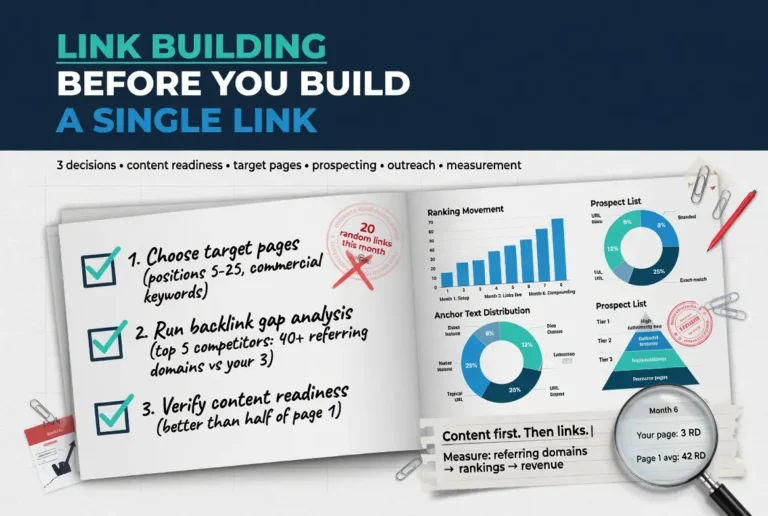
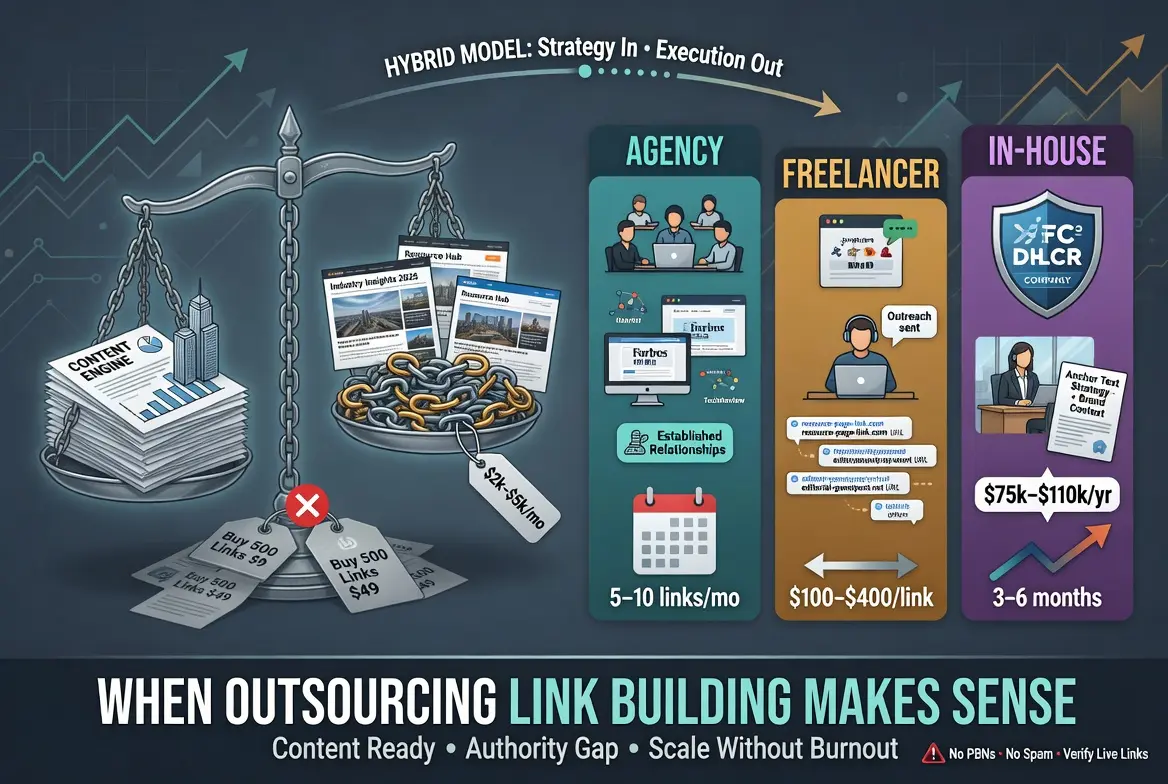
Outsourcing makes the most sense in three situations. First, when you have a content engine producing rankable pages but lack the authority signals to push them onto page one. The content is ready. The links are the bottleneck. Second, when you need to scale link acquisition beyond what your current team can handle without sacrificing quality on their primary responsibilities. Third, when you are entering a competitive niche where the sites currently ranking have substantial backlink profiles and you need to close the authority gap faster than organic link attraction alone will produce.
Outsourcing does not make sense when you have no content worth linking to. Links to thin pages waste money twice: the cost of the link itself and the missed opportunity to direct that authority toward a page that could actually rank. Build the content first. Then build the links.
The Three Models: Agency, Freelancer, In-House
The link building outsourcing market offers three distinct provider types, each with different cost structures, capability profiles, and failure modes. Understanding what each one actually delivers, rather than what each one claims to deliver, is the first step toward making a decision that produces results rather than invoices.
Agencies bring teams, established publisher relationships, and systematized processes. They manage the entire workflow from strategy through reporting. The best agencies produce consistently high-quality placements because they have spent years building relationships with real editorial sites. The worst agencies operate link farms disguised as managed services, placing links on sites they own or control and charging premium prices for worthless placements.
Freelancers bring individual expertise at lower cost with higher variability. A skilled freelance link builder with genuine industry relationships can outperform mid-tier agencies on a per-link basis because the overhead is lower and the attention is more focused. An unskilled freelancer with a Fiverr profile and a database of low-quality sites will produce links that range from useless to actively harmful. The variance between the best and worst freelancers is wider than the variance between the best and worst agencies.
In-house link building provides maximum control and alignment with your broader SEO strategy but requires the highest fixed investment. The team knows your brand, your content, and your competitive landscape intimately. They also cost salary, benefits, tools, training, and management overhead every month regardless of output.
What Link Building Agencies Actually Deliver
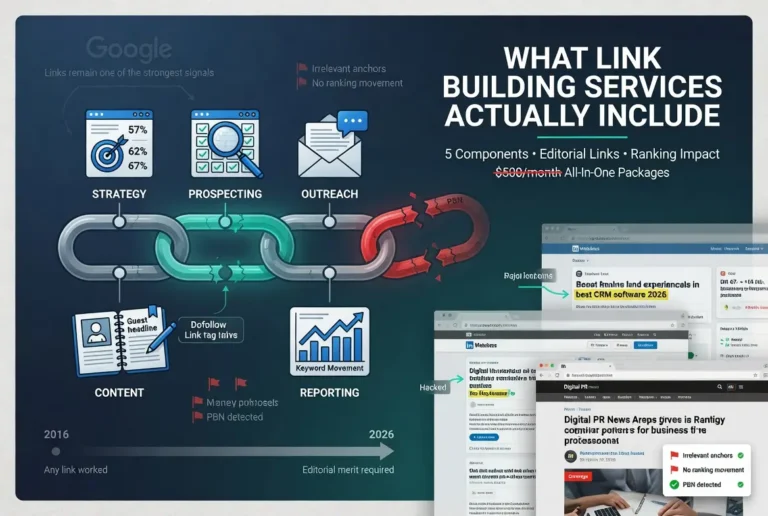
A legitimate link building service from an established agency typically includes prospect research and site vetting, outreach management, content creation for guest posts or resource placements, anchor text strategy, placement tracking, and monthly reporting on links acquired with quality metrics for each one.
The agency model works through established publisher relationships. The best link building agencies have spent years cultivating connections with editors, site owners, and content managers across specific industries. Those relationships mean faster turnaround, higher acceptance rates, and access to placements that cold outreach alone cannot secure. When an agency says they can place links on sites with genuine editorial standards, the relationship network is what makes that claim credible or hollow.
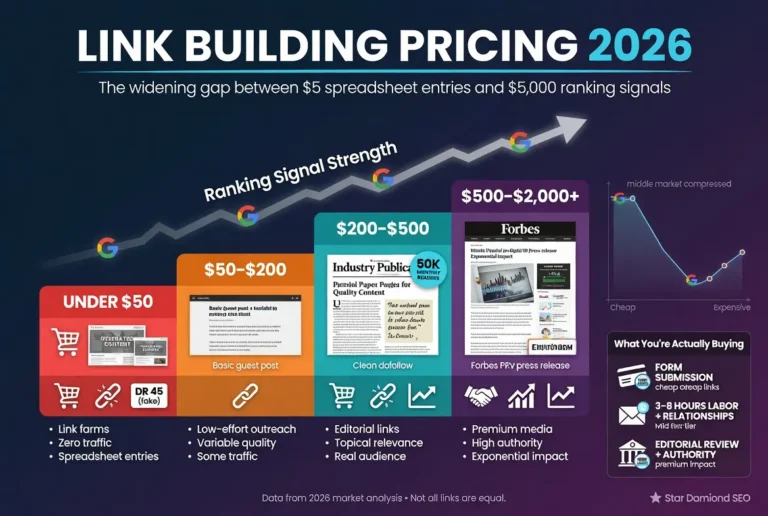
Agency pricing for link building runs a wide range. Retainer-based models typically start at $2,000 to $3,000 per month for a baseline campaign producing 5 to 10 links. Per-link pricing ranges from $150 to $500 for mid-tier placements and $500 to $1,500 for placements on high-authority editorial sites. Enterprise link building services targeting major publications can exceed $2,000 per placement.
The quality indicator that matters most is whether the agency can show you specific links they have built for other clients. Not screenshots of reports. Actual URLs. Pages you can visit, verify as real editorial sites with real traffic, and confirm that the link exists in a context that makes editorial sense. An agency that cannot produce specific examples is either not building the kind of links they describe or not building links at all.
The Freelancer Reality
Freelance link builders operate across a spectrum so wide that treating them as a single category is misleading. At one end, you have experienced professionals who left agencies to work independently, bringing their relationship networks and process knowledge with them. At the other end, you have people selling “500 backlinks for $50” on marketplace platforms using automated tools that produce links Google’s systems will either ignore or penalize.
The experienced freelancer charges $50 to $150 per hour or $100 to $400 per link, depending on the difficulty of the placement and the authority of the target site. They typically manage 5 to 10 clients simultaneously, which means your account gets 2 to 5 hours of focused attention per week at most. The quality of links from a good freelancer can match or exceed agency output because the individual doing the work is the same person you are communicating with. There is no handoff to junior staff. There is no account manager buffer between you and the person sending the outreach emails.
The commodity freelancer charges $5 to $25 per link and produces volume through databases of sites that accept paid placements regardless of relevance. These sites exist primarily as link placement vehicles. They have no real audience, no editorial standards, and no organic traffic. The links they host are functionally invisible to Google at best and actively harmful at worst. The per-link cost is low. The per-result cost is infinite because the result is zero.
The evaluation challenge with freelancers is that both types present similarly during the hiring process. Both will describe their work as “white hat.” Both will promise quality placements. Both will show you examples that look reasonable on the surface. The differentiator is specificity. Ask for five recent links they built, visit the pages, and evaluate whether the linking site is a real publication with real content and real traffic. That ten-minute check eliminates 80% of the risk.
Building In-House: When the Math Works
In-house link building means hiring one or more people whose primary role is acquiring backlinks for your site. The advantages are significant: complete strategic alignment, full control over tactics and quality standards, deep familiarity with your brand and content, and no per-link markup. The link builder sits in the same meetings, reads the same analytics, and understands the competitive landscape at a level no external provider can match.
The cost is equally significant. A competent link building specialist in the US earns $55,000 to $85,000 per year. Add benefits, tools (Ahrefs or SEMrush alone runs $100 to $400 per month), training, and management overhead, and the fully loaded cost reaches $75,000 to $110,000 annually. That is $6,250 to $9,200 per month before the first link is built.
The math works when the volume of link building justifies a full-time position. If your SEO strategy requires 15 to 25 quality links per month across multiple content clusters, an in-house specialist produces those links at a lower per-unit cost than outsourcing once they are trained and ramped up. If your needs are 5 to 10 links per month, paying a full-time salary for a position that operates at half capacity is more expensive than outsourcing the same output.
The ramp-up period is the hidden cost. A new hire needs 3 to 6 months to build the publisher relationships, develop the outreach templates, learn the prospecting criteria, and reach consistent output. During that period, you are paying full salary for partial productivity. An agency or experienced freelancer produces from month one because they bring their infrastructure with them.
The Hybrid Model Most Operators Miss
The most effective link building operations in 2026 are not purely outsourced or purely in-house. They are hybrid models where strategic direction stays internal and execution is distributed based on the type of link being pursued.
The hybrid model works like this. Internal team members handle relationship-based link building: industry partnerships, co-marketing opportunities, speaking engagements, data-driven content that attracts links organically, and direct outreach to high-value editorial targets where the brand relationship matters. These are the links that require brand knowledge, strategic context, and long-term relationship management that no external provider can replicate.
External providers handle the scalable, process-driven link building: guest post placements on mid-tier publications, resource page outreach, broken link building campaigns, and the kind of systematic outreach that benefits from established publisher networks and dedicated volume. These are the links where the process matters more than the brand relationship and where an external team’s existing infrastructure produces better results per hour than building the capability internally.
The strategic direction, including target page priorities, anchor text distribution, quality standards, and prohibited tactics, stays with the internal team. The external provider executes within those parameters and reports results for internal review. This division preserves control while leveraging external capability where it produces the highest return.
How to Evaluate a Link Building Provider
The evaluation criteria that separate legitimate link building providers from vendors selling manufactured metrics are specific and verifiable.
Ask to see live links they have built in the last 90 days. Not a portfolio document. Actual URLs. Visit the linking pages. Check whether the site has real content, real traffic (you can estimate this through Ahrefs or SimilarWeb), and an editorial presence that suggests the link was placed through genuine outreach rather than payment to a site that exists solely to host paid links. If the linking sites look like content farms, the links are content farm links regardless of what the provider calls them.
Ask about their prospecting criteria. How do they identify target sites? What minimum standards do they apply for domain authority, traffic, topical relevance, and editorial quality? A provider who prospects by filtering a database for sites above a domain authority threshold and nothing else is building links based on a single metric that is itself easily manipulated. Legitimate prospecting evaluates traffic, content quality, audience relevance, and editorial independence.
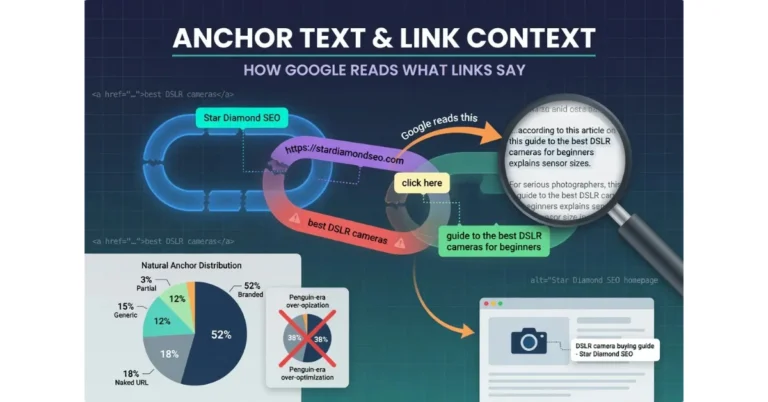
Ask how they handle anchor text distribution. A provider who builds every link with exact-match anchor text is creating an unnatural link profile that Google’s systems are specifically designed to detect. Natural backlink profiles contain a mix of branded anchors, natural language anchors, URL anchors, and topically relevant phrases. The provider should have a strategy for maintaining this distribution across the links they build.
Ask what happens when a link gets removed. Links placed through guest posts or outreach occasionally get taken down when sites change ownership, redesign, or audit their outbound links. A provider with a link monitoring system and a replacement policy demonstrates operational maturity. A provider who does not track link persistence is selling placements, not results. For the complete evaluation framework covering methods, quality indicators, and provider selection across all service types, see the full link building services guide.What Link Building Outsourcing Costs
The cost of outsourced link building varies by provider type, link quality, and engagement structure. Understanding the price ranges helps calibrate expectations and identify outliers in both directions.
Agency retainers for managed link building campaigns typically run $2,000 to $5,000 per month for small to midsize businesses, producing 5 to 15 links per month depending on the quality tier. Enterprise campaigns targeting high-authority placements run $5,000 to $15,000 per month. Per-link pricing from agencies ranges from $150 for mid-tier placements to $1,500 or more for links from major publications with genuine editorial gatekeeping.
Experienced freelancers charge $100 to $400 per link for quality placements, which makes them competitive with agency per-link pricing while offering more direct communication and flexibility. The tradeoff is that freelancers typically lack the scale to produce high volume consistently. If you need 20 links per month, a solo freelancer will struggle to maintain quality at that output.
Marketplace services offering links at $10 to $50 per link are selling a fundamentally different product. The links exist on paper. They appear in backlink analysis tools. But they come from sites with no real traffic, no editorial standards, and no audience. Paying for backlinks at this price point is paying for a number in a report, not a ranking signal. The cost savings are illusory because the links produce no measurable impact on rankings.
The metric that matters is cost per ranking improvement, not cost per link. Ten links at $200 each that push a commercial page from position 8 to position 3 represent a $2,000 investment that produces ongoing revenue. Fifty links at $20 each that produce no ranking movement represent a $1,000 waste. The cheaper option is more expensive in every way that matters.
Managing Outsourced Link Building
Outsourcing the execution does not mean outsourcing the oversight. The links that land on your backlink profile affect your site’s standing with Google regardless of who built them. Managing the relationship requires active involvement in strategy, regular quality review, and clear communication about standards.
Set explicit quality parameters before the engagement begins. Define the minimum domain rating or traffic threshold for target sites. Specify the types of sites that are acceptable (editorial publications, industry blogs, resource sites) and the types that are not (link farms, PBNs, directories with no editorial standards, sites in unrelated industries). Document the anchor text distribution you expect. Put it in writing. Ambiguity in quality standards produces ambiguous quality.
Review every link placement, at least for the first three months. Visit the linking page. Read the content. Evaluate whether the placement looks natural, whether the linking site is something you would be comfortable associating your brand with, and whether the link appears in an editorial context that makes sense. This review takes 2 to 3 minutes per link. It is the single most effective quality control mechanism available.
Track link persistence. A link that disappears after 60 days provided 60 days of value, not the ongoing authority signal you paid for. Monitor your backlink profile monthly through Ahrefs or a similar tool to verify that placements remain live. If a provider’s links are regularly disappearing, the placements were likely on sites that audit and remove paid links, which means the provider is placing links on sites that do not want them there.
Connect link building to ranking outcomes. The purpose of link building is to improve rankings on commercially valuable keywords. Track the correlation between links acquired and ranking movement on target pages. If you are acquiring 10 links per month and the target pages are not moving, either the links are not passing authority, the links are pointing to the wrong pages, or the content on those pages is not competitive enough to rank regardless of link support. The link building provider should be engaged in this analysis, not insulated from it.
Links That Hurt More Than They Help
Not all links are assets. Some are liabilities. Understanding the difference protects your site from the kind of backlink profile damage that takes months to identify and longer to repair.
Links from private blog networks are the most common form of harmful link building sold through outsourced services. PBNs are networks of websites created specifically to host outbound links. They have no real audience, no organic traffic, and no editorial purpose. Google has explicitly stated that PBN links violate their guidelines, and the systems designed to detect them have improved substantially since 2023. A provider who uses PBNs is selling you a ticking clock.
Links from topically irrelevant sites provide minimal value even when the sites themselves are legitimate. A link from a cooking blog to an SEO services page sends a confusing topical signal. Google’s systems evaluate the relevance of the linking site to the linked content as part of the authority assessment. Relevance is not optional. It is a component of how link authority is calculated.
Links with over-optimized anchor text create an unnatural pattern that Google’s systems specifically target. If 60% of your backlinks use the exact-match anchor text “best link building services,” that distribution does not occur naturally and Google’s algorithms know it. The result can be a ranking penalty on the exact keyword you were trying to boost. Proper link attribute usage and natural anchor text variation are not stylistic preferences. They are protective measures against algorithmic penalties.
Links acquired through schemes that violate Google’s guidelines, including link exchanges, paid links without proper disclosure and trust signals, and links embedded in widgets or templates designed to scale placement artificially, carry risk that compounds over time. The links may produce short-term ranking movement. The risk they create grows with every additional link in the same pattern. When Google’s systems identify the pattern, the correction is applied to the entire set, not individual links.
FAQ
Should I outsource link building or do it in-house?
Outsource when your link building needs are below 15 links per month and you lack existing publisher relationships. Build in-house when the volume justifies a full-time position and you need tight strategic alignment between link building and your broader content operation. Many businesses use a hybrid model where strategic direction stays internal and process-driven execution is outsourced.
How much does outsourced link building cost?
Agency retainers for managed link building typically run $2,000 to $5,000 per month producing 5 to 15 quality links. Per-link pricing ranges from $150 for mid-tier placements to $1,500 or more for high-authority editorial sites. Experienced freelancers charge $100 to $400 per link. Services offering links below $50 are selling placements on sites with no real traffic or editorial standards.
How do I know if outsourced links are good quality?
Visit the linking page and evaluate the site. Quality links appear on sites with real traffic, genuine editorial content, topical relevance to your business, and an audience that actually reads the content. If the linking site looks like it exists primarily to host outbound links, the placement is low quality regardless of the domain authority number attached to it.
What is the difference between a link building agency and a freelancer?
Agencies offer team-level capability with established publisher relationships and systematized processes, typically at higher cost. Freelancers offer individual expertise with more direct communication and lower overhead, but are limited in scale by one person’s bandwidth. The best freelancers can match agency quality on a per-link basis. The risk of low quality is higher with freelancers because the variance between providers is wider.
How many links do I need per month?
The number depends on your competitive landscape, not a universal formula. Evaluate the backlink profiles of the pages currently ranking for your target keywords. If the top results have 50 referring domains and your page has 5, you need sustained link acquisition to close that gap. Most small to midsize businesses see meaningful results from 5 to 15 quality links per month targeted at their highest-priority pages.
Can outsourced link building get my site penalized?
Yes. Links from private blog networks, link farms, irrelevant sites, and schemes that violate Google’s guidelines can result in ranking penalties applied to your site. The links affect your backlink profile regardless of who built them. Vetting the provider’s methods, reviewing every placement, and maintaining clear quality standards are essential to preventing outsourced link building from creating risk rather than value.
What should I look for in a link building provider?
Ask to see live links they have built in the last 90 days and visit the linking pages to verify quality. Evaluate their prospecting criteria, anchor text strategy, link monitoring process, and replacement policy for removed links. The provider should be able to show specific examples of their work and explain their approach in language that demonstrates operational sophistication rather than marketing claims.