How to Run a Link Building Campaign That Works
AI Summary
What is a link building campaign? A link building campaign is a structured, time-bound effort to acquire backlinks from external websites to specific pages on your site. The campaign defines which pages receive links, which sites are targeted for placement, what outreach methods are used, and how results are measured against ranking objectives.
What it is and who it is for: This article is for SEO practitioners, marketing managers, and business owners who need to plan and execute a link building campaign that connects link acquisition to actual ranking improvements. It covers campaign planning, prospecting, outreach execution, content strategy for earning links, and the measurement framework that tells you whether the campaign is working or burning budget.
The rule: A link building campaign that measures success by links acquired is measuring the wrong thing. The metric that matters is ranking movement on the target pages. Links are the input. Rankings are the output. If the input is not producing the output, the campaign needs diagnosis, not more links.
Before You Build a Single Link
Most link building campaigns fail before the first outreach email is sent. They fail in the planning phase, or more accurately, in the absence of one. Someone decides the site needs more backlinks, a target number gets set (20 links this month), and the team starts sending emails to anyone who might say yes. The links accumulate. The rankings do not move. Three months later, someone asks whether the campaign is working and nobody can answer the question because nobody defined what “working” meant before it started.
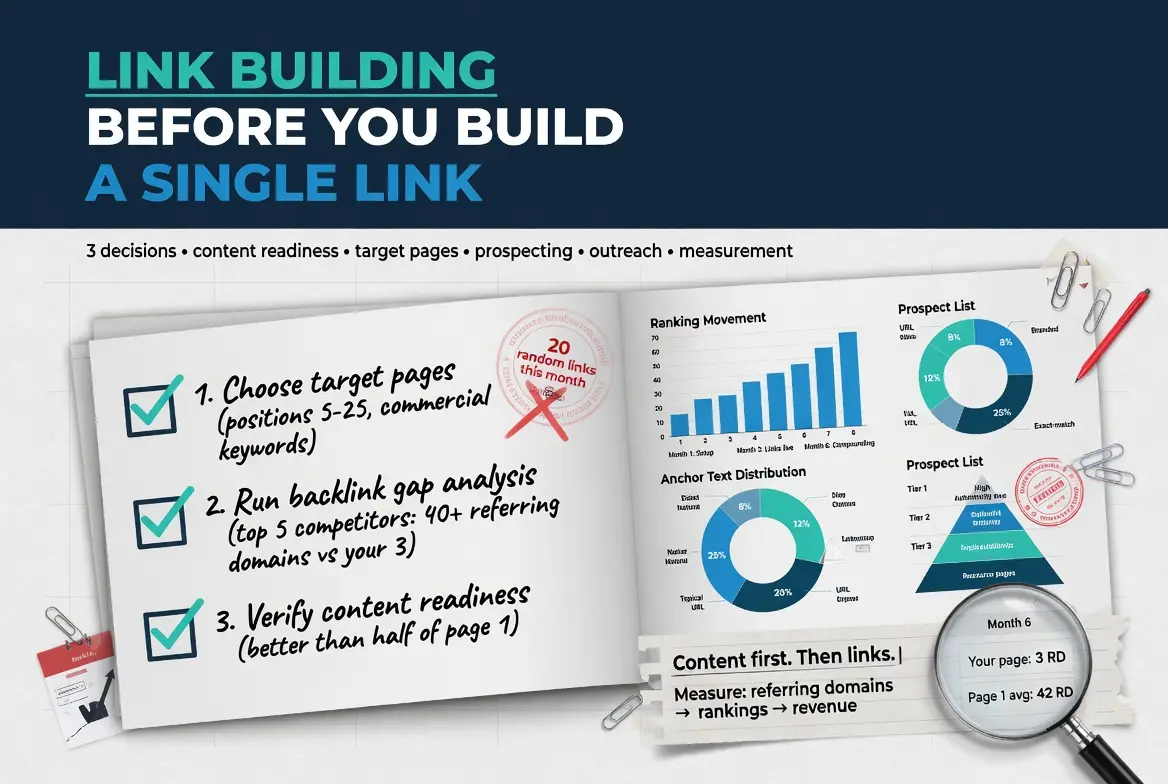
A link building campaign that produces results starts with three decisions made before any prospecting begins. First, which specific pages on your site need link support and why. Second, what the competitive backlink gap looks like for those pages. Third, what ranking movement you expect the campaign to produce and on what timeline. These decisions turn a vague initiative into a measurable operation. Without them, you are collecting links the way some people collect stamps: the collection grows but nothing useful happens.
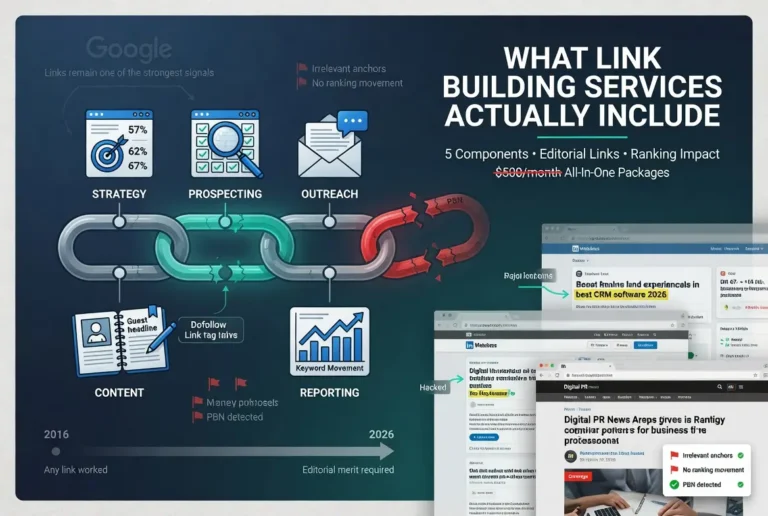
The prerequisite that most guides skip entirely is content readiness. Sending backlinks to a thin page, a page with 300 words of generic content targeting a competitive keyword, wastes the authority those links carry. The page is not competitive enough to rank regardless of how many links point to it. The content must be built to rank before the links are built to push it. If the target page cannot stand on its own merits against what currently occupies page one, fix the page first. Then build the campaign. The comprehensive overview of what link building services include, how they are priced, and how to choose between providers is covered in the companion guide.Choosing the Right Target Pages
Not every page on your site needs link building. The pages that benefit most from a focused campaign share specific characteristics.
They target commercially valuable keywords. A page targeting “best link building services” with 8,600 monthly searches and $11 CPC generates direct revenue when it ranks. A page targeting an informational keyword with 200 monthly searches and no commercial intent generates awareness at best. Both pages might need links. The commercial page should get them first because the return on the link investment is immediate and measurable.
They are competitive but within reach. A page sitting at position 15 for its primary keyword needs a push to reach page one. A page sitting at position 85 probably has content problems that links alone will not solve. The sweet spot for link building campaigns is pages ranking between positions 5 and 25, close enough that additional authority can move them into the positions that generate clicks, but not so far away that the gap suggests deeper problems.
They have strong content that deserves to rank. This is the filter most campaigns skip. The page should be genuinely better than at least half of what currently ranks on page one for the target keyword. Longer is not better. Better is better. More comprehensive, more specific, more useful, more current, better structured, and more credible than the competition. If the content does not meet that standard, improve it before spending money sending authority signals to a page that will not convert those signals into rankings.
Run a backlink gap analysis on your target keyword before the campaign begins. Pull the backlink profiles of the top five ranking pages. Count referring domains, not total backlinks. If the average top-five result has 40 referring domains and your page has 3, you have a concrete gap to close. That gap informs the campaign scope: how many links you need, over what timeline, and at what quality level to be competitive.
Prospecting: Finding Sites Worth Earning a Link From
Prospecting is where the quality of a link building campaign is determined. The sites you target for placement define the authority, relevance, and durability of every link the campaign produces. A campaign built on a strong prospect list produces links that move rankings. A campaign built on a weak prospect list produces links that fill a spreadsheet.
The prospecting criteria that matter are topical relevance, real traffic, editorial independence, and content quality. Topical relevance means the linking site covers subjects related to your content. A link from a marketing blog to an SEO services page carries topical weight that a link from a cooking blog does not, regardless of the domain authority numbers involved. Google’s systems evaluate the topical relationship between the linking site and the linked page as part of how link authority is calculated.
Real traffic means the site has an audience that actually visits and reads the content. You can estimate traffic using Ahrefs, SEMrush, or SimilarWeb. A site with 50,000 monthly organic visitors is a fundamentally different linking partner than a site with 200 monthly visitors and a DR of 45 inflated by its own link building. The traffic test eliminates a large percentage of sites that exist primarily as link placement vehicles.
Editorial independence means the site makes genuine decisions about what it publishes rather than accepting anything accompanied by a payment. Sites with editorial standards produce links that carry more authority because Google’s systems can distinguish between editorially placed links and paid placements on sites that accept everything. The distinction is not perfect, but it is directionally accurate and improving with every algorithm update.
Build your prospect list in tiers. Tier one: 10 to 15 high-authority sites with strong editorial standards where placement is difficult but the link value is substantial. Tier two: 30 to 50 mid-authority sites with relevant audiences where placement is achievable through quality outreach. Tier three: resource pages, directories with editorial review, and niche sites where placement is straightforward but the per-link authority is modest. A balanced campaign draws from all three tiers.
Outreach That Gets Responses
The average response rate for cold link building outreach is somewhere between 3% and 8%, depending on whose data you trust. That means 92% to 97% of outreach emails produce nothing. The campaigns that exceed that average share common characteristics that have nothing to do with email templates and everything to do with relevance and value.
The outreach must explain why linking to your content benefits the recipient’s audience, not why it benefits you. An email that says “I wrote an article about link building and would love a backlink” offers nothing to the recipient. An email that says “your resource page on SEO tools is missing a section on link building metrics, and I have a guide that covers the measurement framework your readers would find useful” offers something specific. The distinction is between asking for a favor and offering a relevant resource.
Personalization means demonstrating that you read the recipient’s content, not inserting their first name into a template. Reference a specific article they published. Mention a point they made that your content expands on. Acknowledge their audience and explain why your resource fits. This takes 5 to 10 minutes per email instead of 30 seconds. The response rate difference makes those minutes the highest-ROI time in the entire campaign.
Follow up. Once. A single follow-up email sent 5 to 7 days after the initial outreach captures responses from people who saw the first email, found it relevant, and forgot to reply. A second follow-up is acceptable. Three or more follow-ups cross the line from persistence to annoyance and damage your sender reputation for future campaigns. The follow-up should add new information or reframe the value proposition, not repeat the original pitch with “just checking in” attached.
Track outreach metrics rigorously. Open rate tells you whether your subject lines are working. Reply rate tells you whether your pitch is resonating. Placement rate tells you whether your content is competitive enough to earn links from the sites you are targeting. If your open rate is strong but your reply rate is low, the pitch needs work. If your reply rate is decent but your placement rate is low, the content is not compelling enough or the prospect list includes sites that are not a genuine fit.
Content Assets That Earn Links
The content you are promoting determines the ceiling of any link building campaign. Some content types consistently earn links at higher rates than others because they provide value that other site owners want to reference.
Original research and data-driven content earns links because the data cannot be found elsewhere. A survey, a study, a dataset, or an analysis that produces original findings gives other writers something to cite. The link is a natural citation, not a placed promotion. Content marketing link building at its most effective produces assets that earn links passively after the initial outreach because the data keeps getting referenced by new publications over time.
Comprehensive guides that serve as definitive resources on a specific topic earn links from writers who need to reference background information. A 3,000-word guide that covers link building metrics more thoroughly than anything else available becomes the default citation when someone mentions the topic in passing. The depth is what makes it linkable. A surface-level overview that covers the same ground as twenty other articles gives nobody a reason to choose yours as the reference.
Tools and calculators earn links because they provide functional value. A free domain authority checker, a keyword density calculator, or a content readability tool gives site owners something to recommend to their audiences. The link is a recommendation, not a favor. Building a useful tool requires development resources, which is why tool-based link building produces durable results: most competitors will not invest in building competing tools.
Visual assets, including original infographics, data visualizations, and diagrams, earn links because they provide embeddable value. A writer covering a complex topic will link to a well-designed diagram that explains it visually rather than attempting to recreate the explanation in text. The visual must be genuinely informative. Decorative infographics with recycled statistics from other sources have been overdone to the point of diminishing returns.
Campaign Tactics and When Each One Works
Different link building tactics serve different campaign objectives. Choosing the right tactic depends on the target page, the competitive landscape, and the resources available.
Guest posting places your content on external sites with a link back to your target page. The tactic works when the external site has a relevant audience and genuine editorial standards. It fails when the “guest post” is placed on a site that accepts paid contributions with no editorial review. The quality of the placement site is the entire differentiator between guest posting that builds authority and guest posting that builds risk. Dofollow links from genuine editorial guest posts carry substantial authority precisely because they require genuine editorial acceptance.
Resource page outreach identifies existing pages that curate links to useful resources on a specific topic. If your content qualifies as a resource worth including, the outreach is straightforward: point the curator to your content and explain why it fits their existing list. Resource page links tend to be durable because the page exists specifically to collect useful links, which means the site owner has no incentive to remove yours unless the content becomes outdated or irrelevant.
Broken link building finds links on external sites that point to pages that no longer exist (404 errors). You contact the site owner, alert them to the broken link, and suggest your relevant content as a replacement. The tactic works because you are solving a problem for the site owner while earning a link. The success rate is modest because many site owners do not maintain their content actively enough to respond. But the links that result are high quality because they replace genuine editorial citations.
Digital PR generates links through newsworthy content: original research, expert commentary on trending topics, data releases, or industry reports. The links come from news publications and industry media that cover the story. Digital PR produces the highest-authority links of any tactic but requires either genuinely newsworthy content or the resources to create it. Not every business has stories worth covering. The ones that do can generate link profiles in months that would take years to build through outreach alone.
Unlinked brand mention reclamation finds instances where your brand, your content, or your data is mentioned on external sites without a link. Outreach to request the addition of a link to an existing mention has the highest success rate of any tactic because the site owner has already demonstrated familiarity with your brand. The limitation is that this tactic only works for brands with existing visibility. New sites with no brand mentions have nothing to reclaim.
Anchor Text Strategy
The anchor text in your backlinks is one of the strongest signals Google uses to understand what the linked page is about. It is also one of the easiest signals to over-optimize, which is why anchor text strategy requires deliberate planning rather than default behavior.
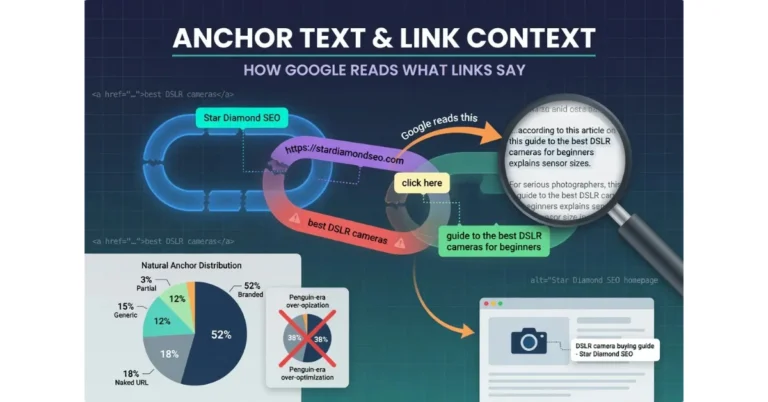
A natural backlink profile contains a distribution of anchor text types. Branded anchors (your company name), natural language anchors (“this guide,” “according to,” “as explained here”), URL anchors (the raw URL), and topically relevant anchors that include keywords without forcing exact-match phrasing. The ratio varies by industry, but a rough benchmark is 30% to 40% branded, 20% to 30% natural language, 10% to 15% URL, and 15% to 25% topically relevant.
The risk emerges when exact-match keyword anchors dominate the profile. If 50% of your backlinks use the anchor text “link building services,” that distribution does not occur in natural linking behavior. Google’s systems are specifically designed to identify and discount or penalize anchor text patterns that suggest manipulation. The correction is applied to the keyword being targeted, which means over-optimization produces the opposite of the intended result on the exact keyword you are trying to rank for.
In a managed campaign, track anchor text distribution across all links acquired. Maintain a log that records every link, its anchor text, and the cumulative distribution. When the campaign has produced 20 links, review the distribution against the natural benchmarks. If any single anchor text phrase represents more than 15% of total links, diversify deliberately in the next phase. This is preventive maintenance, not paranoia. Anchor text penalties are among the most common and most avoidable link building failures.
Campaign Timeline and Pacing
A link building campaign is not a sprint. It operates on a timeline measured in months, not weeks, because the authority signals from new links take time to be crawled, processed, and reflected in rankings.
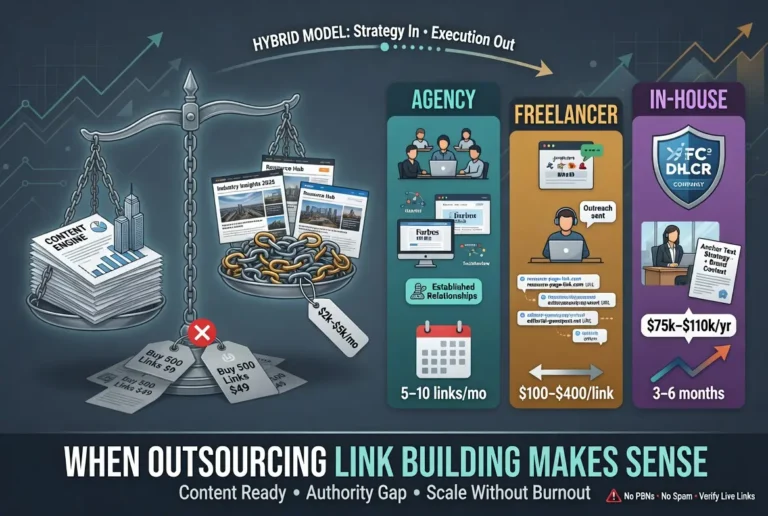
Month one is setup and initial outreach. Build the prospect list. Prepare the outreach sequences. Identify the content assets you will promote. Send the first batch of outreach. Expect minimal placements in month one because the outreach pipeline has not had time to produce responses, negotiations, and live links. If you are outsourcing link building, this is the onboarding phase where the provider learns your targets, standards, and priorities.
Months two and three are production. Outreach is running consistently. Placements are landing. Links are going live. The campaign should produce 5 to 15 quality links per month during this phase, depending on the scope and resources allocated. Ranking movement may begin to appear toward the end of month three, but significant movement typically takes longer.
Months four through six are where the compounding begins. The links from months one through three have been crawled and processed. New links continue landing. The cumulative authority signals push target pages upward if the content is competitive and the links are relevant. This is the evaluation window: compare ranking positions on target keywords before the campaign started and at month six. If the trajectory is positive, the campaign is working. If there is no detectable movement after six months of consistent link acquisition, something in the strategy, the link quality, or the content competitiveness needs diagnosis.
Link velocity matters. Acquiring 30 links in one week and then zero for two months creates an unnatural pattern. Consistent acquisition over time, 5 to 10 links per month sustained over six months, produces a more natural profile than the same total links concentrated into a short burst. Pacing is not just about optics. It reflects the natural pattern of a site earning links through ongoing publication and promotion.
Measuring What Matters
The measurement framework for a link building campaign should connect link acquisition to ranking movement, and ranking movement to business outcomes. Links are the input. Rankings are the intermediate output. Revenue is the terminal output. A campaign that produces links without ranking movement is broken. A campaign that produces ranking movement without revenue is targeting the wrong keywords.
Track these metrics monthly. Referring domains to target pages (not total backlinks; referring domains is the metric that correlates with ranking improvement). Ranking positions on target keywords for each page receiving links. Organic traffic to target pages. Conversions from organic traffic on those pages. Link persistence rate (percentage of placed links that remain live at each monthly check).
The correlation between links and rankings is not linear or immediate. A page might gain 10 referring domains in month two and show no ranking movement until month four. This is normal. Google processes backlink signals on its own schedule, and the impact of new links is evaluated in the context of the overall competitive landscape. Patience is required. But patience without measurement is indistinguishable from waste. Track the numbers even when they are not moving, because the trend over six months tells you whether the campaign is building momentum or producing expensive inertia.
Report on cost per ranking position gained, not just cost per link. If you spent $3,000 to move a page from position 12 to position 4 for a keyword that generates $5,000 per month in attributed revenue, the campaign ROI is clear. If you spent $3,000 and the page moved from position 12 to position 11, either the campaign needs more time, the links need better quality, or the content is not competitive enough to rank regardless of link support. The measurement framework should surface which of those three explanations applies.
When to Adjust and When to Stop
A link building campaign should not run on autopilot. Regular evaluation at defined checkpoints determines whether to continue, adjust, or stop.
Adjust when links are landing but rankings are not moving. This usually indicates one of three problems. The links are not pointing to the right pages. The links are not from relevant enough sources. Or the content on the target page is not competitive enough to convert authority signals into ranking positions. Diagnose which problem applies before acquiring more links. More links applied to the wrong diagnosis do not fix the problem. They amplify the waste.
Adjust when the prospect list is exhausted. Every niche has a finite number of relevant, high-quality sites willing to link to external content. When the tier-one and tier-two prospects have been contacted and the campaign is drawing primarily from tier-three sources, the per-link value is declining. This is the point where the campaign either needs fresh prospecting angles (new industries adjacent to your niche, new content formats that open new placement opportunities) or a pause to let the existing links compound before investing in the next phase.
Stop when the target pages have reached their ranking objectives. A page ranking in positions one through three for its primary keyword does not need additional link building for that keyword. The maintenance requirement drops to monitoring link persistence and replacing any links that disappear. Continued aggressive link building to a page that already ranks well produces diminishing returns and can create an unnaturally concentrated backlink profile that triggers the kind of scrutiny you want to avoid.
Stop when the cost per ranking improvement exceeds the commercial value of the improvement. Moving from position 3 to position 2 on a keyword with 500 monthly searches and a 2% conversion rate produces roughly one additional conversion per month. If that conversion is worth $200 and the link building cost to achieve it is $2,000, the investment does not recover within a reasonable timeframe. Not every position improvement is worth pursuing. The measurement framework should make this calculation explicit.
Actually, let me add one more scenario. Stop when the trust signals on your target page are weak. If the page has no author attribution, no sourcing, no schema markup, and thin content, links are not the bottleneck. The page itself is. Fix the page, then resume the campaign. Sending authority to a page that Google’s quality systems have flagged as low-quality content is pushing water uphill.
FAQ
How many links does a link building campaign need?
The number depends on the competitive gap between your page and the pages currently ranking for your target keyword. Run a backlink gap analysis comparing referring domains to the top five results. If the average competitor has 40 referring domains and your page has 5, the campaign needs to close that gap over time. Most small to midsize campaigns produce 5 to 15 quality links per month sustained over three to six months.
How long does a link building campaign take to show results?
Most campaigns show initial ranking movement between months three and four, with significant impact visible between months four and six. Google processes backlink signals on its own schedule, and the authority from new links takes time to be crawled, evaluated, and reflected in rankings. Campaigns should be evaluated at the six-month mark against ranking movement on target keywords.
What is a good response rate for link building outreach?
The average cold outreach response rate for link building is between 3% and 8%. Campaigns with highly personalized outreach to relevant prospects typically achieve 8% to 15%. Response rate depends on the quality of the prospect list, the relevance of the content being promoted, and the specificity of the outreach pitch. Generic template outreach performs at the low end of the range regardless of volume.
How much does a link building campaign cost?
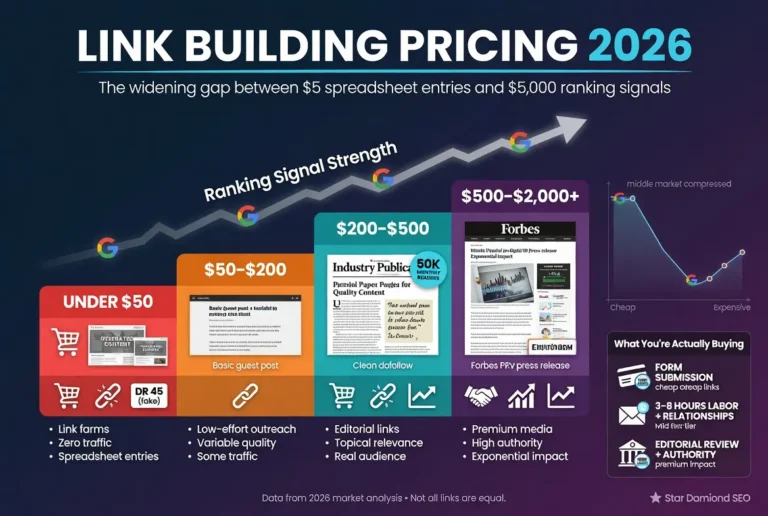
Managed link building campaigns typically cost $2,000 to $5,000 per month for small to midsize businesses, producing 5 to 15 quality links per month. Per-link costs range from $150 for mid-tier placements to $500 or more for high-authority editorial sites. The total campaign cost depends on the competitive gap, the number of target pages, and the quality level required to be competitive.
What is the best link building tactic?
No single tactic works best for every campaign. Guest posting works when target sites have genuine editorial standards. Resource page outreach works when relevant curated pages exist. Digital PR works when you have newsworthy content or data. Broken link building works when competing pages have dead links. The most effective campaigns combine multiple tactics based on the available opportunities in the specific niche.
How do I know if my links are good quality?
Visit the linking page and evaluate the site. Quality links appear on sites with real organic traffic, genuine editorial content, topical relevance to your business, and an audience that reads the content. Check whether the link appears in a natural editorial context. If the linking site looks like it exists primarily to host outbound links or the content surrounding the link is obviously generated to justify the placement, the link is low quality.
Should I stop link building once I reach page one?
Aggressive link building can be reduced once a page reaches positions one through three for its target keyword. Shift to maintenance mode: monitor link persistence, replace any links that disappear, and acquire new links at a reduced pace to maintain the position. The primary investment should shift to other pages that need link support to reach their ranking objectives.