
AI Summary
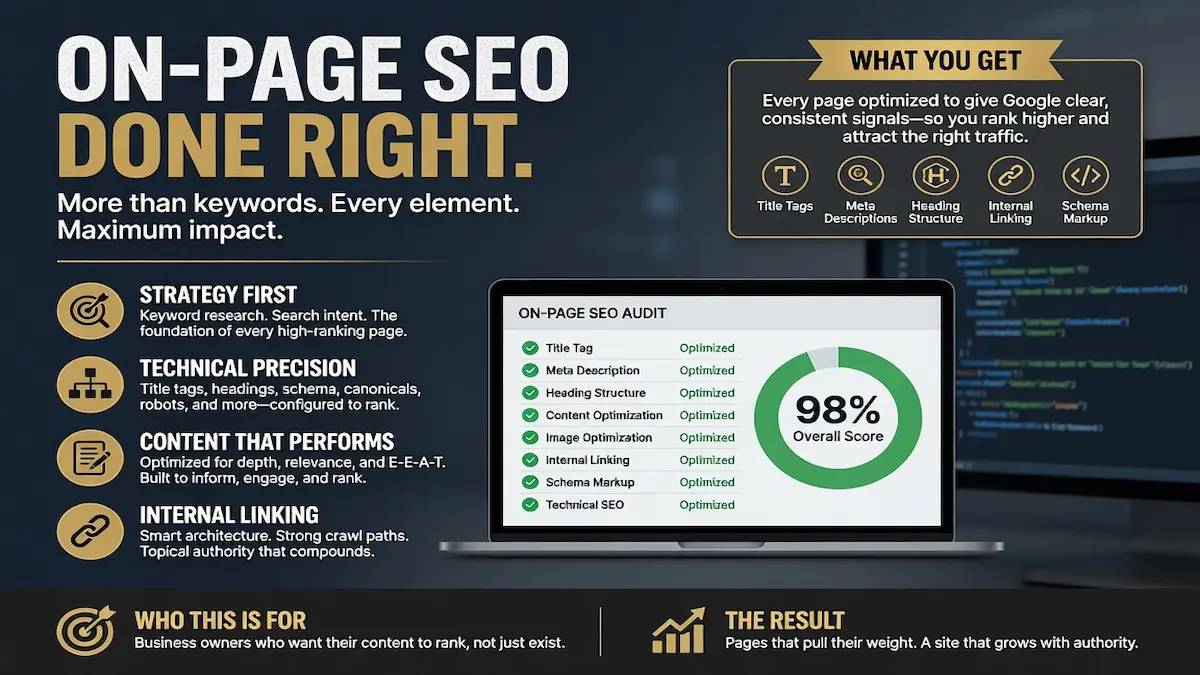
What is On Page Seo? On-page SEO is the optimization of every element on your individual pages that search engines evaluate when deciding where to rank your content.
What it is and who it is for: Built for business owners whose pages exist but underperform because the on-page fundamentals were never set up correctly or were done by someone who did not understand how the elements work together.
The rule: Every element on the page either helps Google understand what it is about or creates confusion. On-page SEO removes the confusion.
The Problem
Most business owners think on-page SEO is adding a keyword to the title tag and calling it done. That is about ten percent of the job. The rest is heading structure, content optimization, internal linking, image optimization, schema markup, canonical tags, meta robots settings, and a dozen other elements that Google evaluates every time it crawls your page.
Get them right and the page has every advantage when Google decides where to rank it. Get them wrong, or skip them entirely, and you are competing with one hand tied behind your back against competitors who did the work.
What We Optimize
The process starts with keyword research and search intent analysis. Knowing the target keyword is step one. Understanding what the person searching that keyword actually wants to find is step two, and it changes everything about how the page gets built.
From there we optimize the URL structure, title tag, meta description, and the heading hierarchy. One clear H1 per page. H2s for major sections. H3s for supporting content under each H2. Each page has its own keyword focus and its own structure. The on-page SEO checklist we use on our own site covers every element.
Content optimization ensures the page covers the topic with the depth that Google’s E-E-A-T standards reward. Then internal linking connects the page to related content across the site, building topical relevance and creating crawl paths that help Google understand how your content fits together.
Image optimization goes beyond compression. Every image gets proper file naming, keyword-relevant alt text, WebP format conversion, lazy loading, responsive sizing, and CDN delivery. Images that are not optimized slow the page down and miss opportunities to signal relevance to Google.
What Most People Skip
The elements that separate a page that ranks from a page that sits at position 40 are usually the ones nobody checks. Missing alt attributes on images. Canonical tags that accidentally point to the wrong URL. Open Graph tags that control how the page appears when shared on social platforms. Structured data and schema markup that help Google display rich results. Meta robots settings that might be blocking pages from indexing without the site owner knowing.
Header hierarchy consistency across the site matters more than most people realize. If every page uses headings differently, Google gets mixed signals about your site structure. Consistency tells Google you know what you are doing.
What You Get
Every page on your site optimized to give Google clear, consistent signals about what the content covers, who it is for, and where it fits in the topical structure of your site. Title tags, meta descriptions, heading structure, content optimization, image optimization, internal linking, schema markup, and every technical on-page element configured correctly.
The work is done page by page, not through a bulk automation tool. Each page gets individual attention because each page targets a different keyword and serves a different purpose. The result is a site where every page pulls its own weight in search instead of a few pages carrying the rest.
Who This Is For
Business owners with existing content that should be ranking better than it is. Your pages have value but the on-page elements were never optimized or were set up by someone who did not understand how they work together. Also for businesses publishing new content clusters that need every page optimized correctly before launch.
If you are not sure whether on-page issues are the bottleneck, start with a business consultation or a site audit to find out what is actually holding the site back.
FAQ
What does on-page SEO include?
Keyword research and search intent analysis, URL optimization, title and meta description optimization, heading structure, content optimization, internal linking, image optimization including alt text and file naming, schema markup, canonical tags, Open Graph tags, and meta robots configuration.
How is this different from content strategy?
Content strategy determines what to publish, when, and how it all connects. On-page SEO optimizes the individual pages once they exist. Content strategy is the plan. On-page SEO is the execution on each page.
Can you optimize existing pages or only new ones?
Both. Optimizing existing pages that were published without proper on-page SEO often produces faster results than publishing new content, because the page already has some authority and indexing history that the optimization can build on.
How long does on-page optimization take per page?
It depends on the page length and current state. A page that needs minor adjustments can be optimized in an hour. A page that needs heading restructure, content expansion, image optimization, and schema markup can take several hours. Quality matters more than speed.
Do you handle image optimization?
Yes. Image optimization includes proper file naming, keyword-relevant alt text, WebP format conversion, compression, lazy loading, responsive sizing, and CDN delivery configuration. Images are often the biggest missed opportunity on most sites.
Will on-page SEO alone improve my rankings?
On-page SEO removes barriers and gives your pages the best chance of ranking for their target keywords. Combined with strong content, solid technical SEO, and a credible backlink profile, on-page optimization is the element that ties everything together.