Does Google Penalize AI Content? What the Data Actually Shows
AI Summary
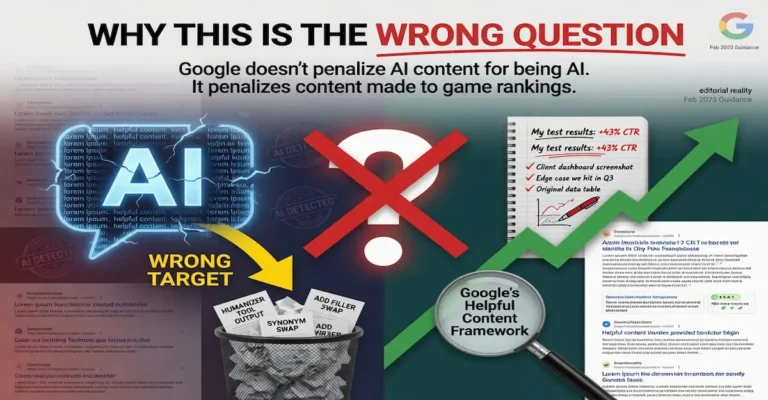
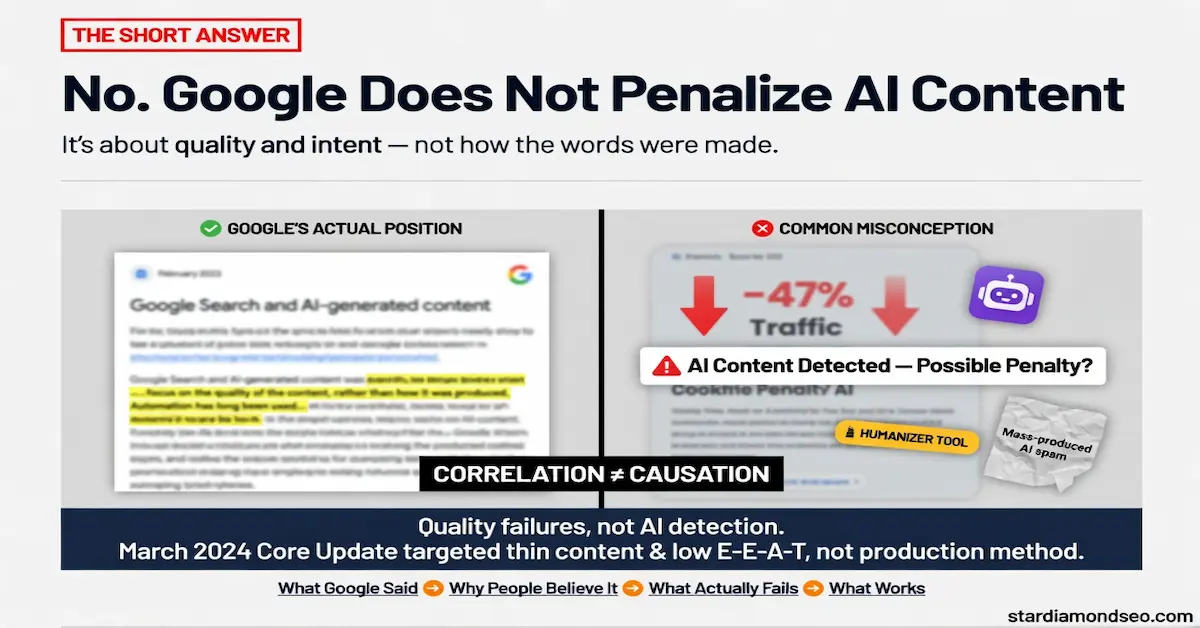
Does Google penalize AI content? No. Google does not penalize content for being AI-produced. Google penalizes content that was created primarily to manipulate search rankings rather than to help people. This evaluation applies identically to AI content and human content. The production method is not the variable being measured. The orientation of the production process is.
What it is and who it is for: This article is for site owners, content producers, and SEO practitioners who have heard that Google penalizes AI content and need to understand what Google actually does, what the ranking data shows, and what causes AI content to fail in search results. The answer is more nuanced than the binary “yes Google penalizes AI” or “no AI is fine” framing that dominates the discussion.
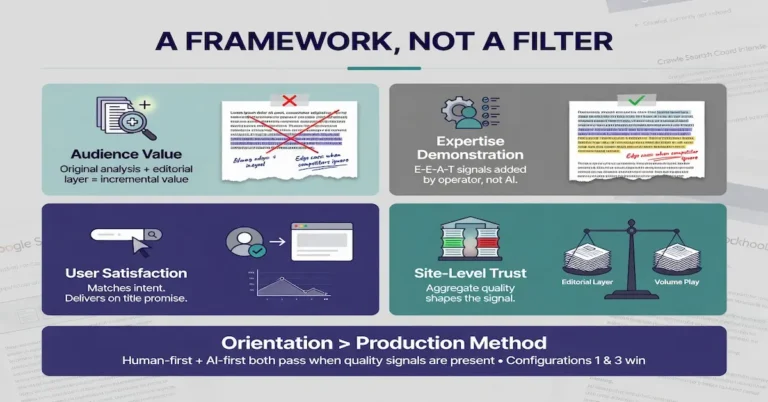
The rule: Google penalizes orientation, not production method. Content produced for people ranks regardless of whether AI was involved. Content produced for search engines fails regardless of whether a human wrote every word. The failures people attribute to AI penalties are almost always caused by quality problems that would exist with or without AI involvement.
The Short Answer
No. Google does not penalize AI content for being AI-produced. Google has said this publicly, repeatedly, and without ambiguity. The February 2023 guidance on AI content states that appropriate use of AI for content production is not against Google’s guidelines. The company’s focus has always been on rewarding high-quality content regardless of how it was produced.
That is the short answer. The long answer is more useful because it explains why so many people believe the opposite, why AI content underperforms in the aggregate data, and what actually causes the failures that operators misattribute to an AI penalty.
What Google Has Said Publicly
Google’s position is documented across multiple official sources and has been consistent since the question first became prominent in 2023.
The February 2023 blog post on AI-generated content is the definitive statement. It says automation, including AI, has long been used to generate content. It says Google’s focus is on the quality of content rather than how it is produced. It says content created primarily for search engine rankings is a violation of guidelines regardless of whether humans or AI wrote it. It says useful content written with AI assistance is not against guidelines.
Google’s Search Liaison Danny Sullivan has reinforced this position in multiple public statements. The message is consistent: Google rewards helpful content and is not concerned with policing whether that content was generated by AI, so long as it meets the same quality standards applied to all content.
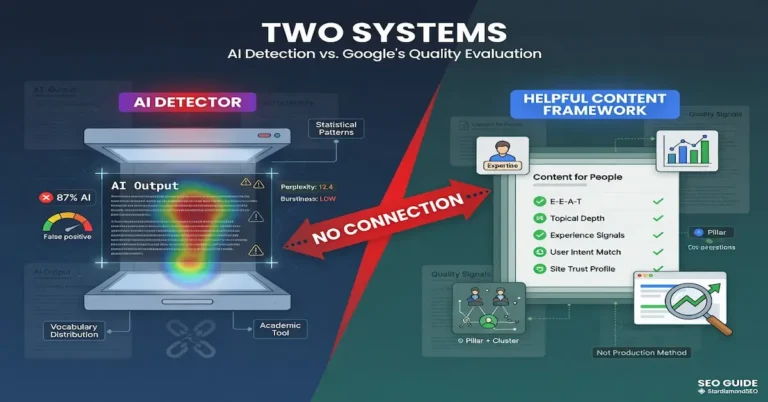
The helpful content guidelines Google publishes do not mention AI detection, AI penalties, or production method evaluation. They describe quality signals that apply to all content: originality, expertise, audience value, and trustworthiness. The omission is telling. If Google evaluated production method, the guidelines that describe what Google evaluates would mention it.
One clarification that matters: Google has said it takes action against content that is created primarily to manipulate rankings, and it has acknowledged that AI makes it easier to produce that kind of content at scale. The action is against the manipulation, not the AI. A human writer producing the same manipulative content would face the same action. The enforcement is orientation-based, not production-method-based.
Why People Believe Google Penalizes AI Content
The belief persists despite Google’s clear statements because the observable data supports it if you do not parse the data carefully. AI content does underperform on average. Sites that adopted AI content production at scale did see ranking declines. The March 2024 core update did deindex sites that relied heavily on AI content. All of these observations are accurate. The conclusion drawn from them is wrong.
Correlation Is Not Causation
AI content underperforms on average because the average AI content is produced without editorial investment. The production method correlates with quality failures in the data because AI makes volume cheap, and cheap volume incentivizes the orientation that fails the helpful content framework. The causation runs through quality, not through production method. Controlling for quality eliminates the performance gap between AI and human content.
Survivor Bias in the Anecdotes
The stories that circulate are about sites that adopted AI content and lost rankings. Nobody writes a blog post about their site that used AI content responsibly and saw no negative impact, because “nothing bad happened” is not a story. The negative anecdotes dominate the conversation and create a perception that AI content reliably causes penalties. The sites that use AI with editorial discipline do not appear in the discussion because their experience is unremarkable.
The March 2024 Update
The March 2024 core update deindexed hundreds of sites, many of which relied on AI-generated content. The update was widely interpreted as an anti-AI action. Google described it as a quality update targeting content that provides poor user experience. The deindexed sites shared characteristics that had nothing to do with AI involvement: thin content, broad topical surfaces with shallow coverage, minimal editorial oversight, and no genuine expertise on the topics covered. These characteristics would fail the quality evaluation regardless of production method. The AI involvement was incidental. The quality failures were causal.
Vendor Marketing
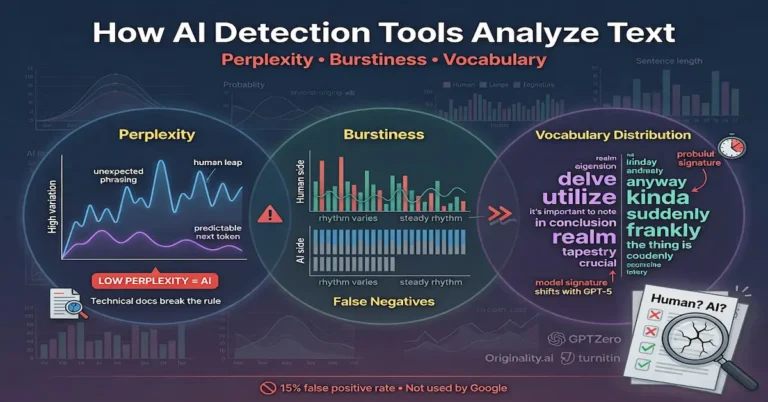
The AI detection tool industry and the AI humanizer tool industry both benefit from the belief that Google penalizes AI content. Detection tools sell fear: “check your content before Google catches it.” Humanizer tools sell the solution to that fear: “make your content undetectable.” Neither product would have a market if operators understood that Google does not evaluate production method. The vendor ecosystem has a financial incentive to perpetuate the misconception, and the marketing is effective because it maps onto the fear operators already feel.
What Actually Causes AI Content to Fail
The failures that operators attribute to AI detection are caused by identifiable quality problems that the helpful content framework specifically targets.
The Volume Play
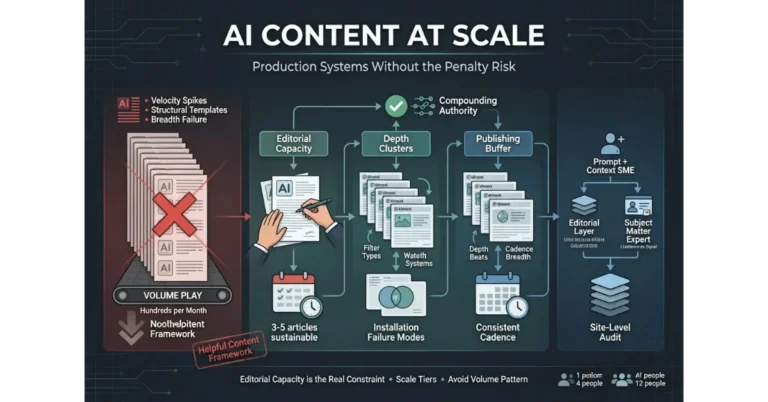
The most common failure. Operators use AI to produce dozens or hundreds of articles per month across broad topical surfaces. Each article is technically competent but lacks original insight, experience signals, and genuine depth. The individual articles may be adequate. The aggregate pattern, high volume, low depth, broad topical spread without demonstrated expertise, triggers the site-level helpful content signal that degrades rankings across the entire domain. The failure is not AI detection. It is the quality profile that mass production creates.
Missing Experience Signals
AI cannot produce Experience signals because AI has no experience. First-person testing, original data, specific anecdotes from actual work, the hedging patterns that reflect genuine uncertainty. These signals must be added by the human operator during the editorial process. Content that lacks them competes at a disadvantage against content that has them, and the disadvantage increases as Google’s systems improve at identifying experience markers.
No Editorial Layer
AI drafts that are published without substantive editing lack the quality indicators that distinguish helpful content from search-engine-targeted content. The editorial layer is where original insight enters, where accuracy gets verified, where the operator’s genuine perspective shapes the content. Without it, the output is a competent synthesis of existing information that adds nothing to the conversation. Google’s systems increasingly identify this pattern because the aggregate profile of unedited AI content is statistically distinguishable from editorially managed content.
Topical Authority Gaps
Operators use AI to produce content on topics they have no genuine expertise in. The content reads as informed but lacks the depth that comes from actual knowledge. Google’s topical authority evaluation compares the site’s coverage against established authorities in the space. A site that suddenly publishes 50 articles on a topic it has never covered before, with no backlinks from the topic’s community and no author credentials in the field, does not build topical authority. It builds a topical surface that the ranking systems evaluate as unearned.
Structural Homogeneity
AI-produced content tends to follow consistent structural patterns: similar heading formats, similar paragraph lengths, similar transition phrases, similar organization. Across a few articles, the consistency is invisible. Across dozens or hundreds, the structural homogeneity becomes a site-level pattern that distinguishes the site from editorially managed publications, which naturally produce varied structures because different topics require different organizational approaches. The homogeneity itself is not penalized. It is a correlate of the quality patterns that are penalized.
What AI Content Strategies Actually Work
The strategies that produce ranking AI content in 2026 share common characteristics that map directly onto what the helpful content framework rewards.
Operator expertise on the topic. The operator uses AI to draft content on subjects they genuinely understand. They can recognize when the AI is wrong, when it is shallow, and when it misses the nuance that someone with real experience would catch. The expertise is the operator’s. The AI handles the labor of turning expertise into prose.
Substantive editorial process. The AI draft is a starting point, not a deliverable. The operator rebuilds it: adding original data, inserting experience signals, correcting inaccuracies, restructuring sections for better flow, and embedding the specific details that only someone who has done the work would include. The editorial process is where the content becomes competitive.
Focused topical depth. The operator builds content clusters on topics they can cover with genuine authority rather than spreading across broad surfaces with thin coverage. Each article deepens the cluster’s topical authority. The depth compounds over time as Google recognizes the site as a legitimate source on the topic.
Quality over quantity. Fewer, better articles outperform higher volume of weaker articles because the site-level helpful content signal rewards consistency of quality over quantity of output. Five articles per month with strong editorial layers build a better quality profile than twenty articles per month with minimal editing.
Full E-E-A-T investment. Author attribution, trust infrastructure, source citations, transparency, and the full stack of signals that Google’s quality framework evaluates. These signals establish the context in which each article is evaluated. Strong site-level E-E-A-T raises the ceiling for every page. Weak E-E-A-T lowers it for every page, including the individually strong ones.
The Bottom Line
Google does not penalize AI content. Google penalizes content that fails the helpful content framework. AI content fails the framework more often than human content on average because AI makes the failure modes cheaper and faster to produce. The penalty is for the failure, not for the AI.
Operators who understand this use AI effectively. They produce content in the configuration where the orientation is correct and the production method is irrelevant. They invest in the editorial layer, the experience signals, the topical depth, and the trust infrastructure that the framework evaluates. Their AI-assisted content ranks because it meets the same quality standard that has always determined rankings.
Operators who misunderstand this waste effort on detection evasion and humanizer tools that address a variable Google is not measuring. Their content continues to fail because the actual failure, quality orientation, goes unaddressed while they optimize for the wrong metric.
The question is not whether Google penalizes AI content. The question is whether your content, however it was produced, meets the quality standard that Google rewards. If it does, the production method does not matter. If it does not, the production method does not save it.
FAQ
Does Google penalize AI generated content?
No. Google does not penalize content for being AI-generated. Google penalizes content that was created primarily to manipulate search rankings rather than to help people. This evaluation applies identically to AI and human content. AI content fails more often on average because AI makes low-quality volume production cheaper, not because Google detects and penalizes AI involvement.
Did the March 2024 Google update target AI content?
Google described the March 2024 core update as a quality update targeting content that provides poor user experience. Many deindexed sites used AI content, but they shared quality characteristics that would fail the evaluation regardless of production method: thin coverage, broad topical surfaces without depth, minimal editorial oversight, and no genuine expertise. The AI involvement was incidental. The quality failures were causal.
Can AI written content rank on Google?
Yes. AI written content that demonstrates original value, genuine expertise, experience signals, and reader-first orientation ranks comparably to human content with the same qualities. The content must pass Google’s helpful content framework, which evaluates quality and orientation, not production method. AI content with a strong editorial layer ranks. AI content without editorial investment does not.
Why does AI content underperform on average?
AI content underperforms on average because the majority of AI content is produced at volume with minimal editorial investment. The production method makes the volume play economically attractive, and the volume play produces content that fails the helpful content framework. When studies control for editorial quality rather than production method, the performance gap between AI and human content closes or disappears.
Does Google use AI detectors to evaluate content?
There is no evidence that Google uses third-party AI detection tools like GPTZero, Originality.ai, or Copyleaks in its ranking systems. Google evaluates content through its own quality signals including E-E-A-T assessment, helpful content framework evaluation, and user engagement patterns. These signals measure content quality dimensions that are more relevant to search quality than binary AI-or-human classification.
What should I do instead of worrying about AI detection?
Focus on the editorial layer that transforms AI drafts into substantive content. Add original insight, experience signals from your own work, accuracy verification, and genuine depth. Build content clusters that demonstrate topical authority. Invest in trust infrastructure including author attribution, editorial standards, and source citations. These are the quality dimensions Google evaluates. Detection evasion addresses a variable Google is not measuring.