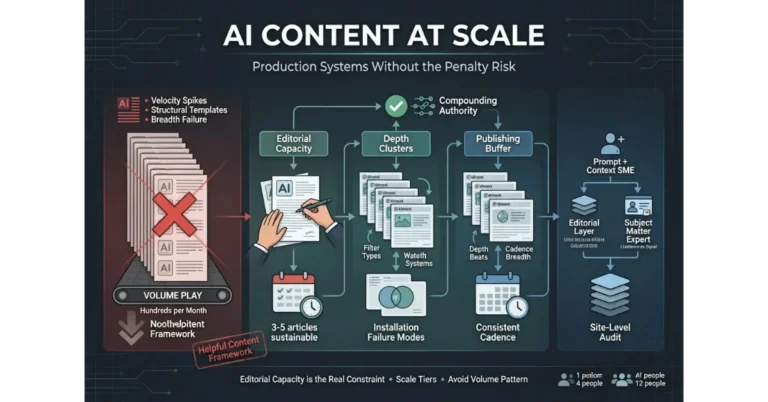
How Can You Make AI Content Undetectable?
AI Summary
What is this article about? This article examines why the question “how do I make AI content undetectable” is the wrong question for anyone trying to rank in Google. The focus on evading detection assumes Google penalizes AI content for being AI-produced. It does not. Google penalizes content that fails the helpful content framework regardless of how it was produced. Making AI content undetectable solves a problem that does not cause ranking failures.
What it is and who it is for: This article is for site owners and content producers who use AI in their writing process and are concerned about detection affecting their rankings. It explains what Google actually evaluates, why detection evasion is wasted effort, and what to focus on instead to produce AI-assisted content that ranks and holds.
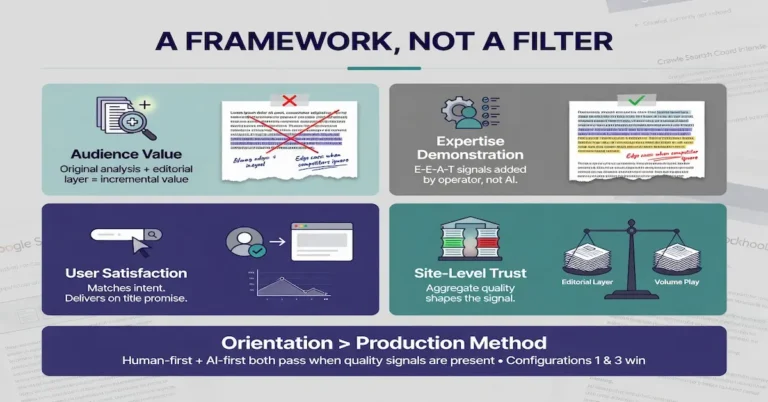
The rule: Google does not evaluate whether content was produced by AI. Google evaluates whether content was produced for people or for search engines. The production method is irrelevant. The orientation is everything. Operators who focus on making AI content undetectable are optimizing for a variable Google is not measuring. Operators who focus on making AI content genuinely useful are optimizing for the variable Google is measuring.
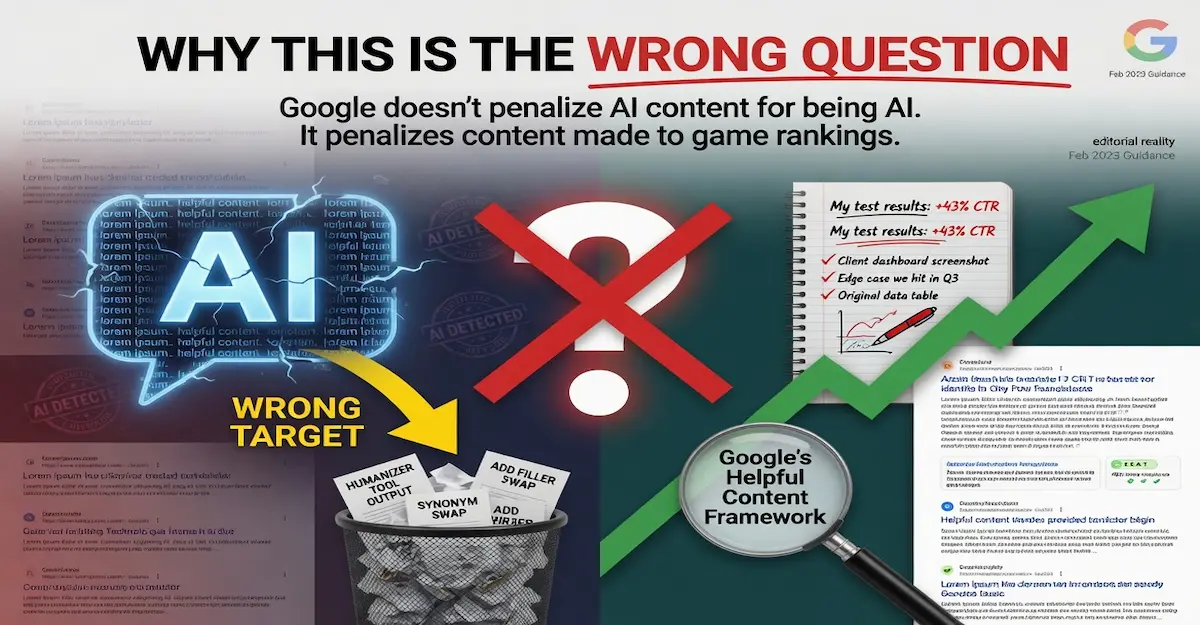
Why This Is the Wrong Question
The question comes from a reasonable place. You use AI to help produce content. You have heard that Google penalizes AI content. You want to protect your site. So you search for ways to make AI content undetectable, and you find an entire industry of humanizer tools, paraphrasing services, and detection evasion techniques designed to help you pass your content through AI detectors without triggering a flag.
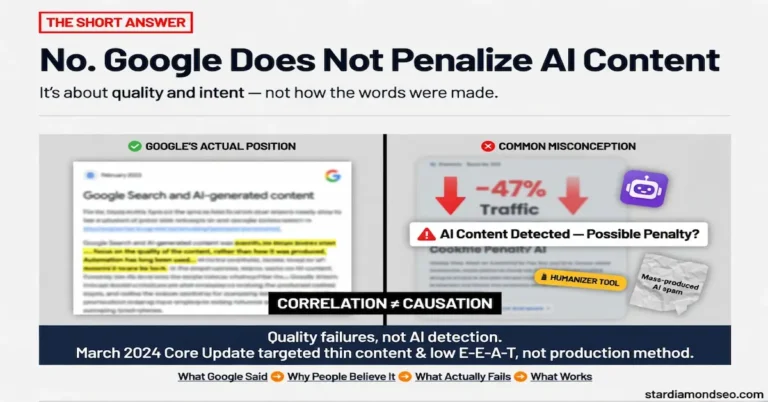
The problem is that the premise is wrong. Google has not said it penalizes AI content for being AI-produced. Google has said, repeatedly and explicitly, that the production method is not what it evaluates. What Google evaluates is whether the content was created primarily for people or primarily to manipulate search rankings. That evaluation applies equally to human content and AI content. The framework does not care who or what produced the writing. It cares about the orientation of the production process.
Making AI content undetectable solves a problem that does not cause ranking failures. The ranking failures people attribute to AI detection are almost always caused by something else entirely: thin content, lack of original insight, missing experience signals, or the volume play where AI is used to mass-produce surface-level coverage across topics the operator has no genuine expertise in. These failures would occur regardless of whether the content was produced by AI or by a human writer with the same orientation.
I have tested this directly. Pages written with heavy AI assistance that demonstrate genuine expertise, include original data, and provide real value to readers rank and hold. Pages written entirely by humans that recite generic information without adding original value underperform. The variable that predicts outcomes is the quality and orientation of the content, not the production method. If the production method were the variable, my AI-assisted pages would fail and they do not.
What Google Has Actually Said
Google’s position on AI content is documented in their February 2023 guidance on AI-generated content. The guidance states that the appropriate use of AI for content production is not against Google’s guidelines, that automation has long been used to generate helpful content, and that Google’s focus has always been on rewarding high-quality content regardless of how it was produced.
The guidance directly addresses the detection question by reframing it. The relevant dimension is not whether the content was produced by AI. The relevant dimension is whether the content was created to help people or created primarily to manipulate search rankings. This is the same dimension the helpful content framework has evaluated since it was introduced in 2022, before the AI content explosion made the question prominent.
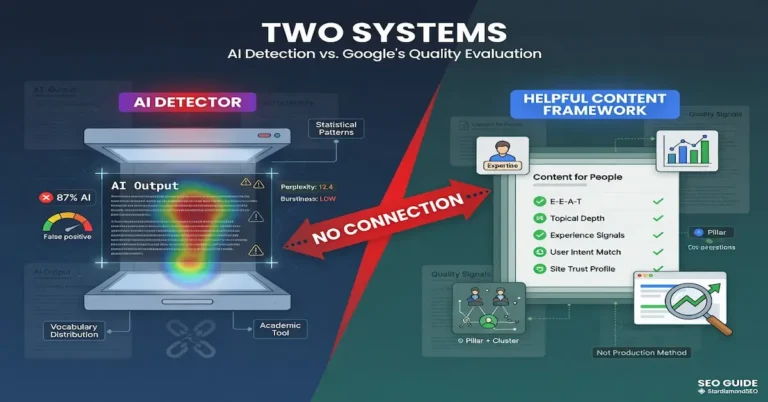
Google has also been clear that it does not use third-party AI detection tools as part of its ranking evaluation. The detection tools that operators worry about, GPTZero, Originality.ai, Copyleaks, are commercial products built for academic and editorial use cases. They are not integrated into Google’s ranking systems. Google’s own systems evaluate content quality through signals that are far more sophisticated than binary AI-or-human classification, and those signals operate on the quality dimensions the framework describes rather than on production method identification.
The Humanizer Tool Trap
An entire category of tools has emerged to solve the detection problem: AI humanizers that rewrite AI-generated text to evade detection. The tools work by introducing surface-level variations that make the statistical patterns of AI-generated text less recognizable to detection algorithms. They swap synonyms, restructure sentences, add filler phrases, and introduce deliberate imperfections that mimic human writing patterns.
The tools accomplish exactly what they promise. The output passes most AI detection tools. The problem is that the output is worse content than the original AI draft. The humanizer does not add depth. It does not add original insight. It does not add experience signals. It does not improve the quality of the information. It adds noise designed to fool a classifier, and the noise degrades readability without improving any of the quality dimensions that Google’s systems actually evaluate.
The operator who runs an AI draft through a humanizer tool has spent time and money to produce content that is less readable than the original draft and no more likely to rank because the quality signals the ranking systems evaluate were not improved by the humanization process. The content passes an AI detector that Google does not use. It still fails the helpful content framework that Google does use. The optimization was directed at the wrong system entirely.
The time spent on humanization would produce better results if spent on the editorial layer that transforms an AI draft into substantive content: adding original perspective, inserting real data and examples, restructuring sections that lack depth, and embedding the experience signals that demonstrate genuine knowledge of the topic.
What AI Detectors Actually Measure (And What They Miss)
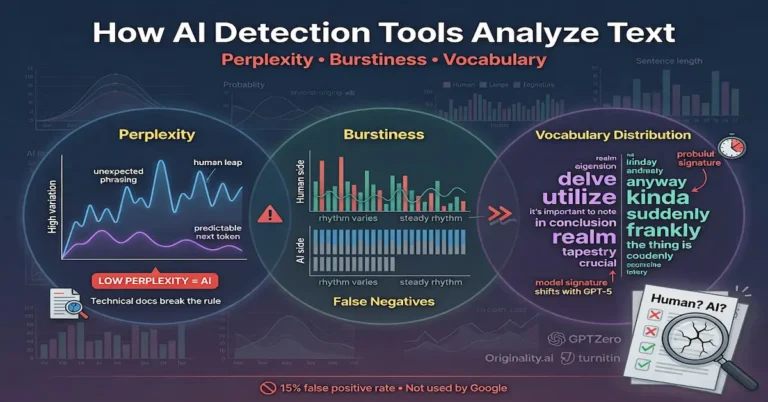
AI detection tools measure statistical patterns in text. They analyze perplexity (how predictable each word is given the preceding words), burstiness (how much variation exists in sentence length and complexity), and vocabulary distribution (whether the word choices match patterns associated with language model output). When these statistical features fall within ranges associated with AI-generated text, the detector flags the content.
The measurement is probabilistic, not definitive. Every major AI detection tool produces false positives on human-written content and false negatives on AI-generated content. The error rates are significant enough that relying on detection results as binary judgments is unreliable. A human essay can be flagged as AI-generated because the writer happened to use predictable sentence structures. An AI draft can pass detection because the model happened to produce more varied output than usual.
More importantly, AI detectors do not measure any of the dimensions that Google evaluates for ranking. They do not measure whether the content provides original insight. They do not measure whether the writer has experience with the topic. They do not measure whether the information is accurate and well-sourced. They do not measure whether the content serves the searcher’s intent better than competing pages. These are the dimensions that determine rankings. The detector measures none of them. Passing the detector and passing Google’s quality evaluation are unrelated achievements.
What Actually Determines Whether AI Content Ranks
The factors that determine whether AI-assisted content ranks are the same factors that determine whether any content ranks. The production method does not add or subtract from the evaluation. The evaluation operates on the content itself.
Original Insight
Does the content say something that the existing pages ranking for this keyword do not say? AI drafts synthesize from existing content. They do not generate original insight because they have no experience to draw original insight from. The editorial layer is where original insight enters the content: the operator’s perspective, their testing results, their specific recommendations based on having tried the alternatives. Content without original insight is a restatement of what already ranks. It has no competitive advantage regardless of who or what produced it.
Experience Signals
The Experience signal in Google’s E-E-A-T framework rewards content that demonstrates first-hand contact with the topic. Specific examples from the operator’s own work. Data from their own campaigns. Screenshots from their own dashboards. Hedging that reflects real uncertainty rather than performed confidence. AI cannot produce these signals because AI has no experience. The operator adds them during the editorial process. Content that lacks experience signals competes at a disadvantage against content that has them, and the disadvantage is the same whether the base draft was AI-generated or human-written.
Depth Relative to Competition
Google evaluates content depth relative to what else ranks for the same query. A 1,500-word article that covers a topic superficially will not outrank a 3,000-word article that covers it exhaustively, regardless of production method. AI makes it easy to produce volume. It does not automatically produce depth. Depth comes from covering subtopics that competitors miss, explaining the why behind the what, engaging with edge cases and exceptions, and providing the level of detail that only someone with working knowledge of the topic would think to include.
Structural Quality
Content structure affects both readability and the signals Google’s systems use to evaluate coverage. Clear heading hierarchies that map to the questions the article answers. Paragraphs that make specific claims rather than generic statements. FAQ sections that target real search queries. Internal links that connect the article to related content on the site. These structural elements serve both human readers and Google’s parsing systems. AI produces competent structure. Great structure requires editorial judgment about what the reader needs and in what order.
Trust Infrastructure
The broader trust signals on the site and the page affect how Google evaluates the content. Author attribution with verifiable credentials. Editorial standards visible through consistent quality across the site. Transparency about the site’s operations and the content’s production process. Source citations that support specific claims. These signals are built into the site and the publishing process, not into individual pieces of content. AI content published on a site with strong trust infrastructure is evaluated differently from AI content published on a site with no trust infrastructure. The infrastructure determines the trust ceiling for every page on the site.
The Right Process for AI-Assisted Content
The process that produces AI-assisted content capable of ranking consistently follows a specific sequence that places the editorial layer where it belongs: at the center of the production process, not as an afterthought bolted onto an AI draft.
The operator defines the target keyword, the search intent, the heading structure, and the key points each section should cover. This strategic layer comes from the operator’s knowledge of the topic and the competitive landscape. AI does not have this knowledge. The operator does.
AI generates a draft based on the operator’s inputs. The draft is scaffolding. It handles the labor of turning an outline into prose. It produces competent coverage that hits the structural markers the outline specified. The draft is not the deliverable. It is the starting point.
The operator rebuilds the draft. They restructure sections that flow poorly. They add depth the AI could not produce because it has no experience with the subject. They remove claims that sound plausible but lack substance. They insert the specific details, examples, data, and perspectives that only someone who understands the topic would include. They add the experience signals the AI cannot generate. They verify the accuracy of every factual claim.
The result is content that is substantively the operator’s work, produced at higher throughput than pure manual writing, with none of the quality compromises that mass-produced AI content exhibits. The content ranks because it meets every quality criterion Google evaluates. The AI involvement is irrelevant to the outcome because the outcome was determined by the editorial layer, not the drafting layer.
This is the process. Not humanizer tools. Not detection evasion. Not worrying about whether an algorithm can identify the production method. The process produces content that ranks because it deserves to rank. That is the only version of “undetectable” that matters.
FAQ
Does Google penalize AI-generated content?
No. Google does not penalize content for being AI-produced. Google penalizes content that was created primarily to manipulate search rankings rather than to help people. This evaluation applies equally to human content and AI content. The production method is not the variable Google measures. The orientation of the production process is.
Do AI humanizer tools help with SEO?
No. AI humanizer tools modify text to evade AI detection algorithms, but Google does not use third-party AI detection tools in its ranking systems. The humanization process degrades readability without improving any of the quality dimensions that Google actually evaluates. The time spent on humanization produces better results when spent on the editorial layer that adds original insight, experience signals, and genuine depth to the content.
Can Google detect AI-written content?
Google’s systems can identify patterns associated with mass-produced AI content, particularly when those patterns appear across an entire site. The detection is not focused on individual articles. It evaluates aggregate signals like publishing velocity, structural homogeneity, absence of experience markers, and surface coverage without depth. These patterns are detectable because they are statistically distinct from how editorial operations produce content.
What makes AI content rank well?
The same factors that make any content rank well: original insight the competing pages do not offer, experience signals demonstrating first-hand knowledge, depth relative to what currently ranks, structural quality that serves both readers and search engines, and trust infrastructure on the site including author attribution, editorial standards, and source citations. AI content that includes these elements through a strong editorial process ranks comparably to human content with the same qualities.
Should I disclose that content was written with AI?
Google does not require disclosure of AI involvement in content production. Disclosure is a transparency choice, not a ranking factor. Some sites disclose AI assistance as part of their editorial transparency. Others do not. Neither approach has a demonstrated impact on rankings. The content quality and the site’s trust infrastructure determine ranking outcomes regardless of whether AI involvement is disclosed.
What is the editorial layer for AI content?
The editorial layer is the process of transforming an AI draft into substantive content by adding original perspective, real data and examples, experience signals from the operator’s own work, accuracy verification, structural improvements, and the depth that only someone with genuine expertise on the topic can provide. The editorial layer is where AI-assisted content becomes competitive. Without it, the AI draft is a commodity that matches thousands of other AI drafts targeting the same keyword.