
AI Summary
What is real estate SEO? Search engine optimization built specifically for real estate agents, brokers, and property companies. It covers the local search strategy, neighborhood content architecture, IDX optimization, and trust signals that determine whether a potential buyer or seller finds you or the agent across town. Real estate search is hyper-local, financially significant, and dominated by portals like Zillow and Realtor.com. SEO is how independent agents compete.
What it is and who it is for: Built for any real estate professional who depends on clients finding them through Google. Whether you sell luxury properties, manage rentals, specialize in commercial real estate, or serve first-time homebuyers, your next client is already searching. The question is whether Google shows them your name or a competitor’s.
The rule: Real estate is a YMYL category. Google classifies property transactions as financial decisions that affect people’s lives and applies its highest quality standards to real estate content. The agents who rank are the ones who demonstrate local expertise through content depth, not the ones who syndicate the same MLS listings as everyone else.
Why Real Estate Agents Need SEO
Every real estate transaction in 2026 starts with a search. Buyers search neighborhoods before they contact an agent. Sellers search agents before they sign a listing agreement. Investors search market data before they make an offer. The agent who appears in those results gets the conversation. The agent who does not appear does not exist to that client.
Most agents rely on referrals, paid leads from Zillow, or Google Ads. Referrals are inconsistent. Zillow leads are shared with multiple agents and come at a premium. Google Ads stop producing the moment the budget runs out. SEO is the channel that builds an asset. A neighborhood page that ranks for “homes in [area]” generates buyer inquiries for years. A Google Business Profile that dominates the local pack produces listing appointments without a per-click cost. The work compounds because every piece of content published, every review earned, and every backlink acquired strengthens the foundation that makes the next ranking easier to achieve.
The economics are straightforward. A single closed transaction produces $5,000 to $30,000 in commission depending on market and price point. A first-page ranking for a high-intent keyword in a mid-size market generates hundreds of monthly impressions from people actively looking to buy, sell, or hire an agent. Even a modest conversion rate produces clients at a cost per acquisition that no paid channel can match over a twelve-month period.
The agents who invest in SEO now are building positions that appreciate as their markets grow. The agents who wait are paying more every year for the same Zillow leads while their competitors accumulate organic visibility they cannot buy.
Three Types of Real Estate Search
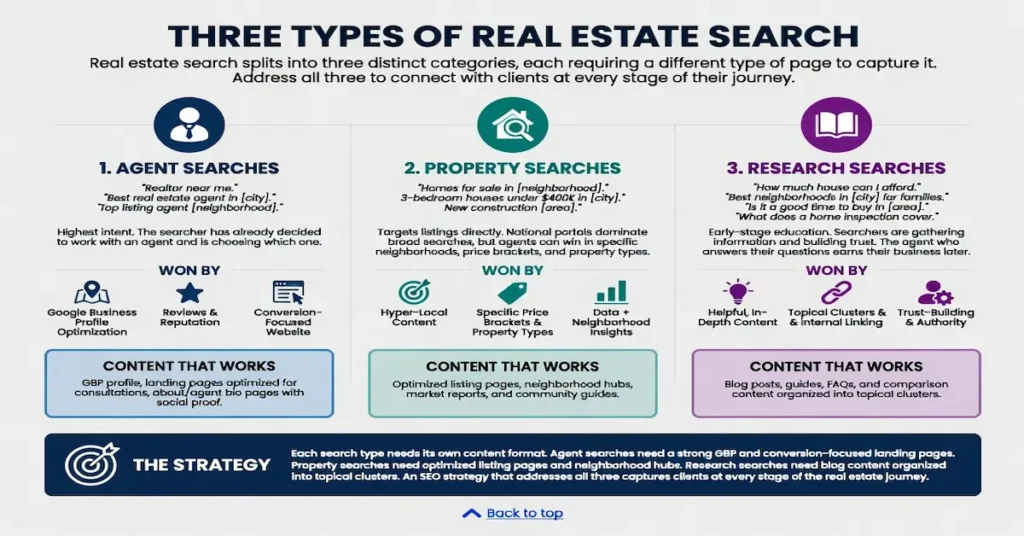
Real estate search splits into three distinct categories, and each one requires a different type of page to capture it. Most agents treat search as one thing and build one type of content. That approach captures a fraction of the available traffic.
Agent searches. “Realtor near me.” “Best real estate agent in [city].” “Top listing agent [neighborhood].” These queries carry the highest intent because the searcher has already decided to work with an agent and is choosing which one. Agent searches are won through Google Business Profile optimization, reviews, and a website that converts visitors into consultations. The local pack captures most of these clicks before organic results even enter the picture.
Property searches. “Homes for sale in [neighborhood].” “3-bedroom houses under $400K in [city].” “New construction [area].” These queries target listings directly. The challenge is that Zillow, Realtor.com, and Redfin dominate these results nationally. An independent agent cannot outrank Zillow for “homes for sale in Miami.” But an agent can outrank Zillow for specific neighborhoods, price brackets, and property types within their market by building hyper-local content that the portals cannot replicate.
Research searches. “How much house can I afford.” “Best neighborhoods in [city] for families.” “Is it a good time to buy in [area].” “What does a home inspection cover.” These queries come from people earlier in the buying or selling process. They are not ready to contact an agent yet, but they are building the knowledge that leads to a transaction. The agent whose content answers these questions earns the trust that converts into a client relationship when the searcher is ready to act.
Each search type needs its own content format. Agent searches need a strong GBP and conversion-focused landing pages. Property searches need optimized listing pages and neighborhood hubs. Research searches need blog content organized into topical clusters. An SEO strategy that addresses all three captures clients at every stage of the real estate journey.
The IDX Problem Nobody Talks About
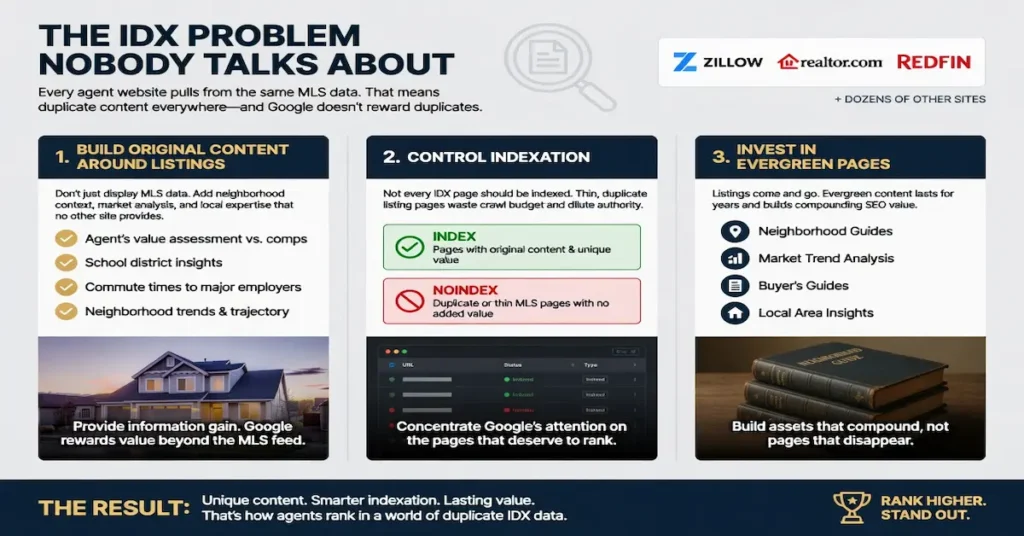
This is the issue that separates real estate SEO from every other industry. Every agent website has access to the same MLS data through IDX (Internet Data Exchange) feeds. That means thousands of agent websites display identical listing information: same descriptions, same photos, same property details, same square footage, same price. Google sees all of it, and Google does not reward duplicate content.
The result is that most IDX listing pages on individual agent websites are functionally invisible in search. Google has already indexed the same listing on Zillow, Realtor.com, Redfin, and dozens of other agent sites. The agent website offers nothing unique, so Google has no reason to surface it.
The agents who rank despite this problem do three things differently.
They build original content around the listings. Instead of displaying raw MLS data, they add neighborhood context, market analysis, and local expertise that no other site provides. A listing page that includes the agent’s assessment of the property’s value relative to recent comparable sales, the school district quality, the commute time to major employers, and the neighborhood’s trajectory provides information gain that the MLS feed alone cannot deliver. Google rewards information that adds value beyond what is already available.
They control indexation. Not every IDX page should be indexed. Thousands of thin listing pages with duplicate MLS data dilute the site’s topical authority and waste crawl budget. The disciplined approach is to index only the pages where the agent has added meaningful original content and noindex the rest. This concentrates Google’s attention on the pages that actually deserve to rank.
They invest in evergreen pages over transient listings. A listing page has a shelf life measured in weeks or months. When the property sells, the page dies. A neighborhood guide, a market trend analysis, or a buyer’s guide to a specific area has a shelf life measured in years. The agents who build their SEO strategy around evergreen content instead of listing pages build compounding assets instead of disposable ones.
Neighborhood Pages That Actually Rank
Neighborhood pages are the highest-value content a real estate agent can build. They target the intersection of location and intent: “living in [neighborhood],” “homes in [area],” “[neighborhood] real estate market.” These are the queries Zillow cannot answer as well as a local agent because Zillow does not live there.
The problem is that most agents build neighborhood pages wrong. They write 300 words of generic copy about how “[Neighborhood] is a wonderful place to live with great schools and friendly people.” Google recognizes this as thin content with no information value. It ranks nowhere because it says nothing.
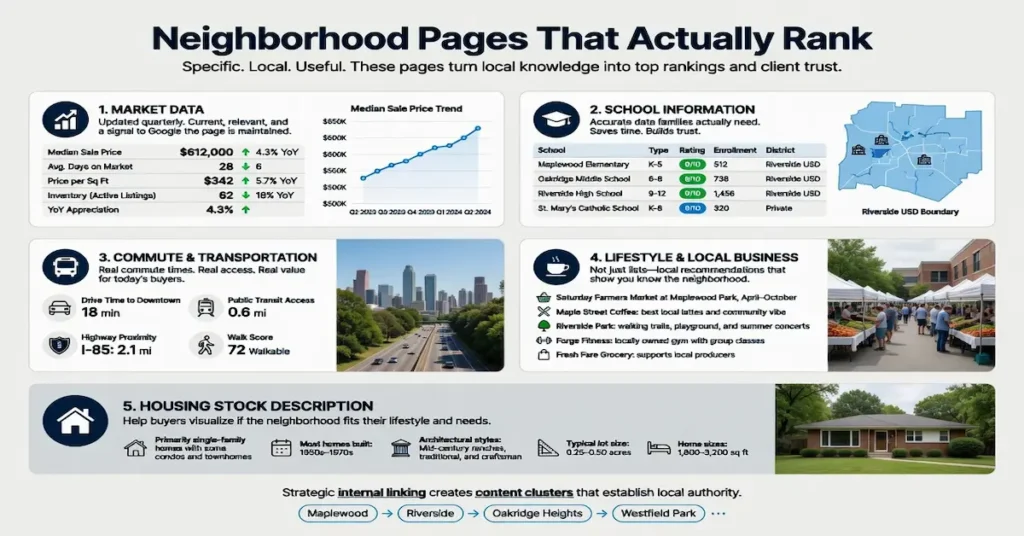
Neighborhood pages that rank provide specific, useful, locally sourced information.
Market data. Median sale price with trend direction. Average days on market. Price per square foot compared to surrounding areas. Inventory levels. Year-over-year appreciation. This data tells a potential buyer or seller whether this neighborhood aligns with their budget and timeline. Updated quarterly, it signals to Google that the page is actively maintained.
School information. School names, ratings, district boundaries, and enrollment figures. For families, school quality is the single biggest factor in neighborhood selection. An agent who provides accurate, current school data saves the buyer hours of research and earns their trust in the process.
Commute and transportation. Drive times to major employment centers. Public transit access. Highway proximity. Walk score. These details matter to every buyer and are rarely included on agent neighborhood pages because they require local knowledge to get right.
Lifestyle and local business. Restaurants, coffee shops, parks, fitness options, grocery stores, entertainment venues. Not a generic list copied from Yelp. Specific recommendations that demonstrate the agent actually knows the area. “The Saturday farmers market at [location] runs April through October” is the kind of detail that signals genuine local expertise.
Housing stock description. What types of homes are available? Primarily single-family or mixed with condos and townhomes? What decade were most homes built? What architectural styles dominate? What is the typical lot size? A buyer searching for mid-century ranches on half-acre lots needs to know whether this neighborhood has them.
Each neighborhood page targets a specific geographic keyword and links to related neighborhood pages, creating a content cluster that demonstrates comprehensive coverage of the agent’s service area. Google reads this cluster as evidence that the agent is an authority on local real estate, not just someone with a website.
Local SEO for Real Estate
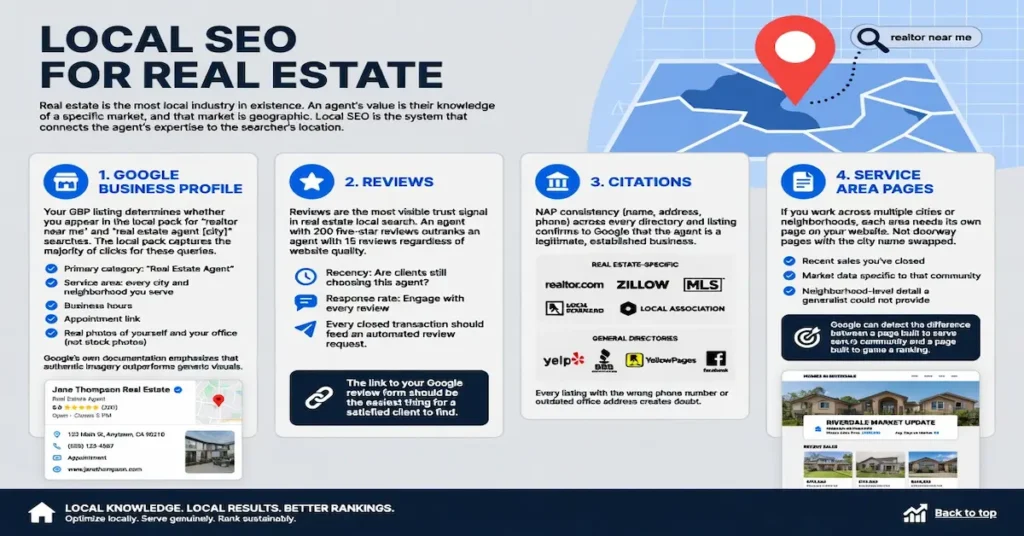
Real estate is the most local industry in existence. An agent’s value is their knowledge of a specific market, and that market is geographic. Local SEO is the system that connects the agent’s expertise to the searcher’s location.
Google Business Profile. Your GBP listing determines whether you appear in the local pack for “realtor near me” and “real estate agent [city]” searches. The local pack captures the majority of clicks for these queries. Complete every field: primary category as “Real Estate Agent,” service area covering every city and neighborhood you serve, business hours, appointment link, and real photos of yourself and your office. Not stock photos. Google’s own documentation emphasizes that authentic imagery outperforms generic visuals.
Reviews. Reviews are the most visible trust signal in real estate local search. An agent with 200 five-star reviews outranks an agent with 15 reviews regardless of website quality. Beyond quantity, Google evaluates review recency (are clients still choosing this agent?) and response rate (does the agent engage with feedback?). Every closed transaction should feed an automated review request. The link to your Google review form should be the easiest thing for a satisfied client to find.
Citations. NAP consistency (name, address, phone) across every directory and listing confirms to Google that the agent is a legitimate, established business. Real estate-specific directories carry additional weight: Realtor.com agent profiles, Zillow agent pages, local MLS member directories, local real estate association sites. General directories (Yelp, BBB, Yellow Pages, Facebook) add diversity. Every listing with the wrong phone number or outdated office address creates doubt.
Service area pages. If you work across multiple cities or neighborhoods, each area needs its own page on your website. Not doorway pages with the city name swapped. Each page should include locally relevant content that demonstrates you actually work in that area: recent sales you have closed there, market data specific to that community, and neighborhood-level detail that a generalist could not provide. Google can detect the difference between a page built to serve a community and a page built to game a ranking.
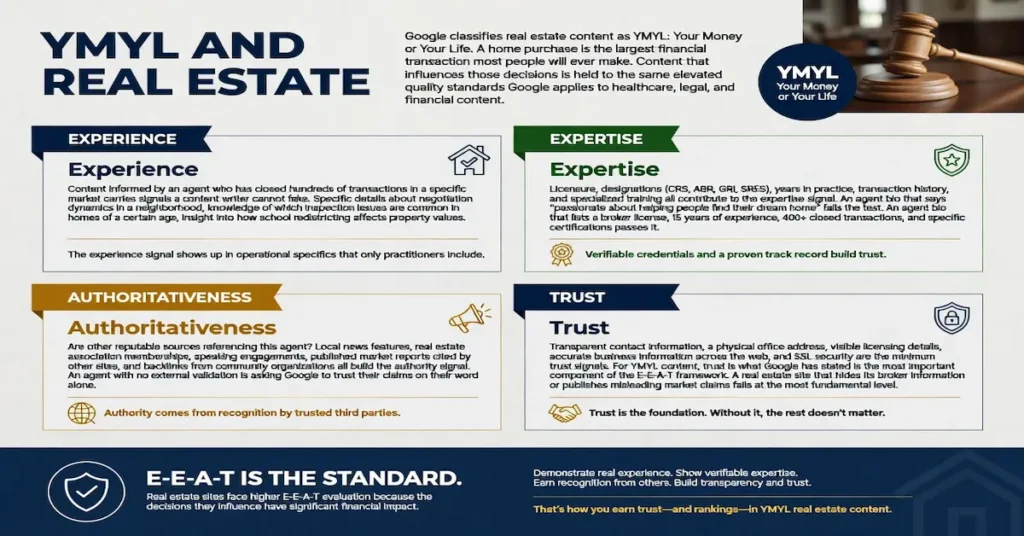
YMYL and Real Estate
Google classifies real estate content as YMYL: Your Money or Your Life. A home purchase is the largest financial transaction most people will ever make. Content that influences those decisions is held to the same elevated quality standards Google applies to healthcare, legal, and financial content.
The practical impact is that real estate sites face a higher E-E-A-T evaluation than sites in non-YMYL categories. Google asks whether the content demonstrates real experience in the local market, whether the agent behind it has verifiable credentials and a track record, whether the site is transparent about who operates it, and whether other authoritative sources reference it.
Experience. Content informed by an agent who has closed hundreds of transactions in a specific market carries signals a content writer cannot fake. Specific details about negotiation dynamics in a neighborhood, knowledge of which inspection issues are common in homes of a certain age, insight into how school redistricting affects property values. The experience signal shows up in operational specifics that only practitioners include.
Expertise. Licensure, designations (CRS, ABR, GRI, SRES), years in practice, transaction history, and specialized training all contribute to the expertise signal. An agent bio that says “passionate about helping people find their dream home” fails the test. An agent bio that lists a broker license, 15 years of experience, 400+ closed transactions, and specific certifications passes it.
Authoritativeness. Are other reputable sources referencing this agent? Local news features, real estate association memberships, speaking engagements, published market reports cited by other sites, and backlinks from community organizations all build the authority signal. An agent with no external validation is asking Google to trust their claims on their word alone.
Trust. Transparent contact information, a physical office address, visible licensing details, accurate business information across the web, and SSL security are the minimum trust signals. For YMYL content, trust is what Google has stated is the most important component of the E-E-A-T framework. A real estate site that hides its broker information or publishes misleading market claims fails at the most fundamental level.
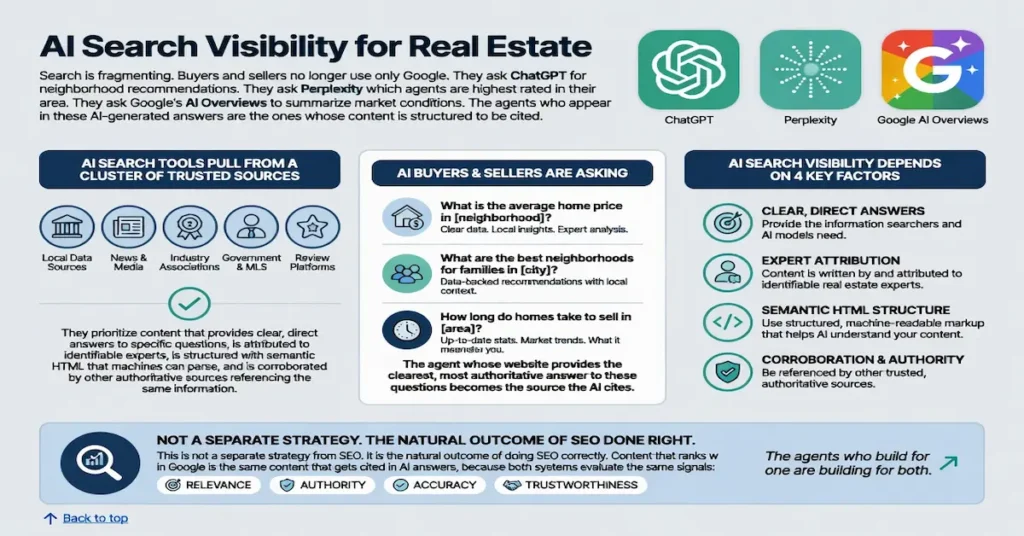
AI Search Visibility for Real Estate
Search is fragmenting. Buyers and sellers no longer use only Google. They ask ChatGPT for neighborhood recommendations. They ask Perplexity which agents are highest rated in their area. They ask Google’s AI Overviews to summarize market conditions. The agents who appear in these AI-generated answers are the ones whose content is structured to be cited.
AI search tools pull from a cluster of trusted sources. They prioritize content that provides clear, direct answers to specific questions, is attributed to identifiable experts, is structured with semantic HTML that machines can parse, and is corroborated by other authoritative sources referencing the same information.
For real estate agents, AI search visibility means building content that answers the questions AI models are trained to respond to. “What is the average home price in [neighborhood]?” “What are the best neighborhoods for families in [city]?” “How long do homes take to sell in [area]?” The agent whose website provides the clearest, most authoritative answer to these questions becomes the source the AI cites.
This is not a separate strategy from SEO. It is the natural outcome of doing SEO correctly. Content that ranks well in Google is the same content that gets cited in AI answers, because both systems evaluate the same signals: relevance, authority, accuracy, and trustworthiness. The agents who build for one are building for both.
How We Build Real Estate SEO Campaigns
Every real estate engagement runs through the 5C Framework: Content, Cadence, Calibration, Crawlability, and Credibility. The framework applies to every industry. How it executes depends on the specific challenges and opportunities in real estate.
Content for real estate means neighborhood pages with genuine local depth, market reports with real data, buyer and seller guides that answer the questions people actually search, and service area pages that demonstrate geographic expertise. Content built from the agent’s transaction experience, not generic real estate advice.
Cadence means consistent publishing that signals to Google the site is actively maintained by someone invested in keeping the information current. Real estate markets shift monthly. An agent site with no new content for six months looks abandoned, and Google treats it accordingly. Monthly market updates, seasonal buyer guides, and fresh neighborhood content maintain the publishing rhythm.
Calibration means matching every page to the search intent behind the keyword. Someone searching “homes in [neighborhood]” wants listings and market data. Someone searching “best real estate agent in [city]” wants credentials and reviews. Someone searching “how to sell my house fast” wants a process explanation. The page format must match what the searcher expects to find.
Crawlability means solving the technical problems that prevent Google from efficiently indexing the site. For real estate sites, this often means managing the IDX page bloat, implementing proper internal linking between neighborhood pages and service pages, ensuring mobile responsiveness on listing galleries, and maintaining site speed despite image-heavy property content.
Credibility means building the external trust signals that YMYL evaluation demands. Backlinks from local news outlets, real estate associations, community organizations, and industry publications. Active review profiles on Google and real estate-specific platforms. Agent authority through professional profiles, schema markup, and consistent business information across the web.
The engagement starts with an SEO site audit that identifies where the agent’s online presence stands across all five components. The audit determines what to fix first, what to build next, and what the realistic timeline looks like based on the competitive landscape in the agent’s specific market.
Start with a business consultation to find out where you stand in local search and what it would take to become the agent Google shows first when your next client searches.
FAQ
How long does real estate SEO take to produce results?
Local keywords with low competition can produce page-one rankings within one to three months. Competitive terms in major metro markets take three to six months. Neighborhood pages in underserved areas can rank within weeks because no other agent has built content for those locations. The timeline depends on the agent’s current online presence, the competitive landscape in their market, and how aggressively content and credibility signals are built.
Can an independent agent compete with Zillow and Realtor.com in search?
Not for broad national terms like “homes for sale.” But for hyper-local terms like “best neighborhoods in [city] for families” or “real estate market in [specific neighborhood],” independent agents routinely outrank the portals. Zillow has scale but lacks local depth. An agent who builds genuine neighborhood expertise into their content competes on a field where local knowledge wins and national coverage cannot follow.
What is the IDX duplicate content problem?
IDX feeds deliver the same MLS listing data to thousands of agent websites. Google sees identical content across all of them and has no reason to rank any individual agent’s listing page over the portals that already dominate. The solution is adding original content around listings, controlling which IDX pages get indexed, and investing in evergreen pages that outlast any single listing.
How important are Google reviews for real estate agents?
Extremely important. Google uses review quantity, quality, recency, and response rate as local ranking signals. Reviews are also the primary trust signal for potential clients evaluating agents online. An agent with a strong review profile outperforms competitors with fewer or lower-rated reviews in local pack placement regardless of website quality or ad spend.
Is real estate considered YMYL by Google?
Yes. Google classifies property transactions as financial decisions that can significantly affect a person’s life. Real estate websites are evaluated against the same elevated E-E-A-T quality standards applied to healthcare and financial content. Content must demonstrate genuine expertise, author credentials must be verifiable, and the site must signal trustworthiness through transparency and accuracy.
Do I need neighborhood pages for every area I serve?
Every area where you actively work and can demonstrate local expertise deserves its own page. The key is original, substantive content for each location. Thin pages with generic descriptions and the city name swapped are detected by Google as doorway pages and can harm rankings. Build neighborhood pages only where you can provide real market data, local knowledge, and genuine insight that a non-local agent could not replicate.
How does AI search affect real estate SEO?
AI search tools like ChatGPT, Perplexity, and Google AI Overviews pull answers from authoritative web sources. Agents whose content provides clear, structured answers to common real estate questions are the ones AI models cite. The strategy for AI visibility is not separate from SEO. It is the natural result of building high-quality, well-structured content with strong authority signals. Agents who rank well in Google are the same agents who get cited in AI-generated answers.