Best SEO Company 2026: How to Choose the Right One
AI Summary
What makes an SEO company the best choice? The best SEO company for any business is the one whose strategic approach, execution depth, and communication standards match the specific needs, competitive landscape, and budget of that business. There is no universal “best.” There is only the right fit evaluated against the right criteria.
What it is and who it is for: This is the complete evaluation guide for business owners who are past the question of whether they need SEO and into the question of who to trust with it. It covers the evaluation framework, the questions that reveal capability versus sales ability, the contract terms that protect you, and the signals that separate providers who produce results from providers who produce reports.
The rule: The best SEO company is not the one with the best website, the most awards, or the lowest price. It is the one that diagnoses before it prescribes, explains its strategy in language you can evaluate, and ties its reporting to the business outcomes you actually care about. Everything else is packaging.
Why Choosing the Right SEO Company Matters More Than It Used To
Five years ago, a mediocre SEO company could produce mediocre results and still show enough movement to justify the retainer. The bar was lower. Content did not need to be particularly good. Links did not need to come from particularly relevant sources. Technical optimization meant fixing the obvious problems and waiting for Google to reward the effort. That era is over.
Google’s quality standards have tightened considerably since the Helpful Content Update cycle began in 2022. The guidelines Google publishes for creating helpful content make the expectation explicit: content must demonstrate real experience, genuine expertise, established authority, and earned trust. The bar is not theoretical. Sites that fail to meet it lose visibility. Sites that meet it compound their advantage over time because every piece of quality content and every legitimate backlink makes the next ranking easier to achieve.
That shift in standards means the gap between a good SEO company and a bad one is wider than it has ever been. A good company builds assets that compound. A bad company burns budget on activity that produces nothing durable. The wrong choice does not just waste money. It wastes time, which in SEO is the resource you cannot buy back. Every month spent with the wrong provider is a month your competitors are building the authority and content depth that makes them harder to displace later.
This guide exists to help you make the right choice the first time. Not by ranking companies or listing “the top 10.” Those lists are paid placements dressed up as editorial. Instead, this guide gives you the evaluation framework, the specific questions, and the decision criteria that let you assess any SEO company against the standards that actually predict results.
The Evaluation Framework
Before comparing proposals, you need a framework for what you are evaluating. Most business owners evaluate SEO companies on three criteria: price, promises, and personality. All three are poor predictors of outcomes. Price tells you what you will spend, not what you will get. Promises tell you what the salesperson is willing to say, not what the team will deliver. Personality tells you whether you enjoy the meeting, not whether the work will move rankings.
A better framework evaluates five things.
Strategic Depth
Does the company diagnose before it prescribes? A company that sends a proposal before looking at your site, your competitors, and your market is selling a template. The best SEO companies start with an audit or at minimum a preliminary analysis that identifies specific gaps between where your site is and where it needs to be. The strategy should follow from the diagnosis, not precede it.
Execution Capability
Can the company actually do what an SEO company needs to do? That means technical optimization, content production, link acquisition, and ongoing analysis. Not as line items on a services page, but as demonstrated capabilities with evidence. Ask for examples. Ask who on their team handles each function. Ask whether the work is done in-house or outsourced. The answer to that last question determines whether you are hiring a company or a middleman.
Track Record
What results has the company produced for businesses similar to yours? Not testimonials. Not “increased traffic 300%.” Specific case studies that show the starting position, the strategy applied, the work done, and the business outcomes produced. Rankings on commercially valuable keywords. Organic traffic that converted into leads or revenue. Timelines that match what they are projecting for your engagement. If the case studies are vague, the results were probably vague too.
Communication Standards
How does the company report on its work and how accessible is the team between reports? Monthly reporting is the minimum. The report should connect SEO activity to business outcomes, not just show charts of ranking movement. Beyond reporting, you should know who your point of contact is, how quickly they respond to questions, and whether they proactively communicate when something important changes, like an algorithm update that affects your site or a technical issue that appeared between scheduled reports.
Alignment With Quality Standards
Does the company understand and implement E-E-A-T signals in the content and optimization it produces? In 2026, this is not optional. Google’s systems evaluate whether content demonstrates real experience, genuine expertise, recognized authority, and earned trust. An SEO company that does not build these signals into its content strategy is operating on a framework that expired two years ago. Ask how they handle author attribution, sourcing, transparency, and the experience signals that separate content written by someone who knows the subject from content generated by someone who researched it for twenty minutes.
What to Look for Before You Talk to Anyone
You can eliminate half the field before a single conversation by checking things that are publicly visible.
Search for the company’s own target keywords. If an SEO company cannot rank its own website for terms like “SEO company” or “SEO services” in their market, that tells you something about their capability. Not every SEO company targets those terms, and a niche-focused agency might deliberately rank for more specific queries. But if the company claims to deliver organic rankings and their own organic presence is thin, the gap between their marketing and their execution is visible before you spend a dollar.
Read their content. Visit their blog. Read two or three articles. Are they genuinely informative or are they surface-level summaries padded to hit a word count? Do they demonstrate the kind of expertise they claim to bring to client work? The content an SEO company publishes on its own site is the best preview of the content they will produce for yours.
Check their technical implementation. Run their URL through Google PageSpeed Insights. Check whether they have schema markup on their pages. Look at their site architecture and internal linking. An SEO company whose own site has poor Core Web Vitals scores, missing schema, and no visible internal linking strategy is not going to implement those things consistently for your site either.
Look at their backlink profile. If you have access to Ahrefs, SEMrush, or a similar tool, pull the SEO company’s domain. Check whether their backlinks come from relevant, authoritative sources or from the kind of low-quality directories and link networks they should know better than to use. The backlink profile of an SEO company is a direct reflection of their link building philosophy. Whatever tactics they use for their own site, they will use for yours.
The Questions That Actually Matter
Most “questions to ask your SEO company” lists are filled with generic queries that any competent salesperson can answer convincingly. The questions that actually reveal capability are the ones that require specific, verifiable answers.
What does your audit process look like and what will it tell us? The answer should describe a structured process that examines technical health, content gaps, competitive positioning, and backlink profile. If the answer is vague or the company skips audits entirely, they are not diagnosing before prescribing.
Who specifically will work on our account? Get names. Not “our team of experts.” Names, roles, and experience levels. The strategist who builds the plan, the person who writes the content, the specialist who handles technical issues, the person who builds links. If the company cannot or will not name the people, the team may not exist yet or may change monthly.
Can you show me examples of links you have built for clients? Not link counts. Actual URLs. You should be able to visit the linking page, see that it is a real site with real content, and verify that the link exists in an editorial context that makes sense. If the company cannot show specific links, their link building is either nonexistent or not the kind they want documented.
What does your content production process look like? The answer should address how topics are selected (tied to keyword strategy, not random), who writes the content (their qualifications and subject matter familiarity), what editorial review looks like, and how AI content tools are used in the process. In 2026, most SEO companies use AI in some capacity. The question is whether they use it as a drafting tool with genuine editorial oversight or as a replacement for actual expertise. The distinction determines whether the content ranks and holds or ranks briefly and disappears.
What happens if the strategy is not working at month six? This question reveals whether the company has a contingency process or whether they plan to blame the algorithm and keep billing. A good answer describes how they diagnose underperformance, what adjustments they make, and at what point they recommend a strategic pivot. A bad answer is “SEO takes time,” which is true but insufficient as a response to underperformance.
What do you not do? The most revealing question on the list. Every SEO company has limitations. The ones who name them are more honest than the ones who imply they do everything. Common legitimate limitations include: we do not manage paid advertising, we do not redesign websites, we do not manage social media, we do not produce video content. Knowing the boundaries prevents scope creep surprises.
Provider Types and When Each One Fits
The SEO industry contains several distinct provider types, and the right one depends on your situation more than their marketing.
Full-service SEO agencies employ teams that cover strategy, content, technical optimization, link building, and reporting. They work best for businesses that need comprehensive, ongoing campaigns and have the budget to support a team-level engagement. The median agency retainer runs around $3,200 per month. The advantage is breadth. The risk is that large agencies spread their senior talent across too many accounts, and the person who sold you the engagement is not the person doing the work.
Boutique SEO firms are smaller operations, typically 5 to 15 people, that focus on specific niches or service areas. They often deliver more senior-level attention per account than large agencies because they take fewer clients. If your business operates in a specific vertical like healthcare, legal, ecommerce, or B2B SaaS, a boutique firm with deep expertise in that vertical will often outperform a generalist agency that has to learn your market from scratch.
Independent SEO consultants are solo practitioners who bring deep individual expertise. They charge a median of roughly $1,350 per month and work best when you have an internal team handling execution and need strategic direction, or when your SEO needs are focused enough that one expert can cover them. The risk is bandwidth. Ask how many active clients they manage. If the number is above 15, the depth of attention each client receives is mathematically limited.
In-house SEO is the right choice when the volume of work justifies a full-time salary. An experienced in-house SEO professional costs $80,000 to $130,000 per year in the US before tools, training, and overhead. That is the equivalent of a $7,000 to $11,000 per month agency retainer. Unless you have enough ongoing SEO work to keep that person fully utilized, an external provider delivers more capability per dollar.
The Pricing Reality
SEO pricing is one of the most common decision factors and one of the least reliable predictors of quality. A detailed breakdown of SEO pricing packages, models, and what each tier actually buys exists as a companion article to this guide. The summary relevant to choosing a company is this.
Most businesses that see measurable results from SEO pay between $1,500 and $5,000 per month. Below that range, the math does not support enough skilled labor hours to produce sustained improvement. Above that range, the additional investment buys broader scope, not necessarily better execution. The $2,000 to $4,000 range is where the majority of small and midsize businesses find the balance between investment and return.
The price should follow the diagnosis. Any company quoting a number before understanding your site, your market, and your competitive landscape is pricing from a menu, not from an assessment. A menu price means a menu strategy, which means the same playbook applied to every client regardless of what each client actually needs.
Be skeptical of prices dramatically below market rate. An SEO engagement priced at $300 per month provides roughly 1 to 2 hours of work after the provider covers their own overhead. One hour of SEO per month is not a campaign. It is a billing arrangement.
Be equally skeptical of prices dramatically above market rate unless the scope clearly justifies the investment. A $15,000 per month engagement is appropriate for a large ecommerce site competing nationally across hundreds of product categories. It is not appropriate for a local business targeting one city.
Red Flags That Should End the Conversation
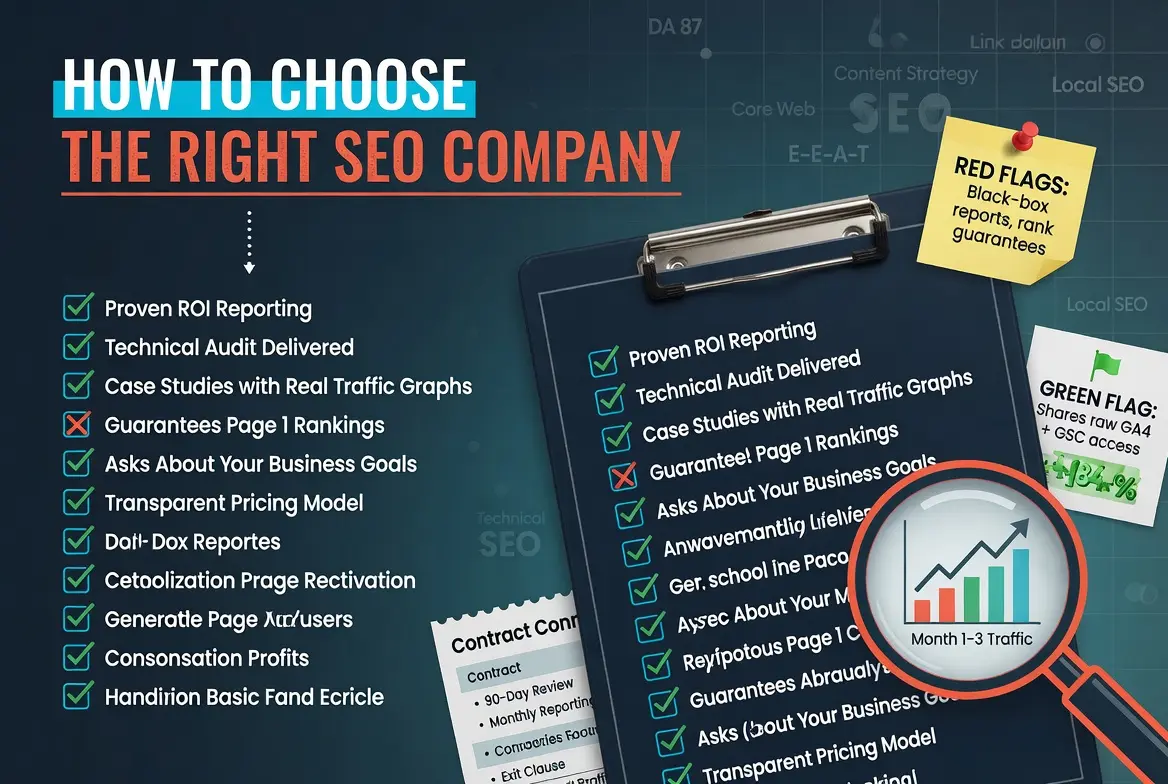
Guaranteed rankings. No one controls Google’s algorithm. Anyone guaranteeing specific positions is either lying or planning to target keywords so insignificant that ranking for them proves nothing. Google’s own documentation on hiring an SEO explicitly warns against providers who guarantee rankings.
Proprietary methods they cannot explain. SEO is not proprietary. The principles are publicly documented, extensively studied, and widely understood among competent practitioners. The value an SEO company provides is the expertise to apply those principles effectively, not secret techniques nobody else knows. If a company cannot explain their approach clearly, they either do not have one or it involves tactics they do not want on the record.
No case studies or unwillingness to share references. Every experienced SEO company has produced results for someone. If they cannot or will not show evidence, either the results do not exist or they are not the kind the company wants you to examine closely.
Emphasis on vanity metrics. If the sales conversation centers on “impressions,” “reach,” or keyword rankings on terms you have never heard of, the company is selling metrics that look good in reports and mean nothing for your business. The metrics that matter are organic traffic to commercially important pages, conversions from organic visitors, and revenue attributable to organic search.
Pressure to sign immediately. SEO is a long-term investment. Any company pressuring you to commit before you have had time to evaluate is more interested in closing the sale than in building a partnership. Legitimate providers welcome comparison shopping because they know their work holds up against it.
Green Flags That Signal Real Capability
They ask more questions than they answer in the first conversation. A company that spends the initial call asking about your business, your customers, your competitive landscape, and your goals is gathering the information needed to build a real strategy. A company that spends the initial call presenting a slide deck is selling a package.
They show you their own SEO performance. A company willing to share their own ranking data, traffic trends, and content performance is demonstrating transparency and confidence. If they can do it for themselves, that is the strongest possible evidence they can do it for you.
They name specific people. When a company tells you “Sarah handles content strategy, she has eight years of experience in healthcare SEO” instead of “our team of content specialists,” they are showing you accountability. Named individuals can be evaluated. Anonymous teams cannot.
They are honest about limitations. “We are strong at content and technical SEO, but we outsource link building to a partner we have worked with for four years” is a more trustworthy statement than “we do everything in-house” from a company with six employees. Honesty about limitations signals maturity. Claiming to do everything signals either dishonesty or a lack of self-awareness, neither of which you want in a long-term partner.
They discuss trust signals and quality standards without being prompted. If a company brings up E-E-A-T, content quality frameworks, and Google’s quality evaluator guidelines in the sales conversation, they are operating on a current understanding of how search works. If those topics never come up, the company may be working from an outdated playbook.
Contract Terms That Protect You
The contract is where the relationship is defined, not in the sales call. Read it before you sign it.
Term length should be reasonable. Six-month initial terms are standard and appropriate because SEO takes time to produce results. Twelve-month terms are common and acceptable if they include performance review checkpoints. Anything longer than twelve months should have a clear exit clause tied to performance benchmarks. You should not be contractually obligated to continue paying a company that is not producing results.
The scope of work should be specific. “SEO services” is not a scope. “Monthly technical audit and fix implementation, 4 blog posts targeting approved keywords, link building campaign targeting 8 to 12 placements per month, monthly performance report with keyword rankings, organic traffic, and lead attribution” is a scope. The more specific the contract, the more accountable the provider.
Ownership of work product should be addressed. You should own the content produced for your site, the data generated from your campaigns, and full access to any accounts created on your behalf (Google Search Console, Google Analytics, Google Business Profile). If the contract gives the SEO company ownership of content or locks you out of your own analytics, that is not a partnership. That is leverage.
Reporting requirements should be defined. What metrics are reported, how often, in what format, and by when. If the contract does not specify reporting obligations, the company has no contractual obligation to tell you what they did with your money each month.
Termination terms should be fair. A 30-day written notice to terminate after the initial term is standard. Early termination fees during the initial commitment period are reasonable if they are proportional, typically one to two months of the retainer, not the balance of the entire contract.
What the First 90 Days Should Look Like
The first 90 days of an SEO engagement are diagnostic and foundational. If a company promises visible ranking improvements in this window, they are either targeting keywords with no competition or setting expectations they cannot meet.
Month one should produce a comprehensive audit and a strategic plan. The audit identifies the technical issues, content gaps, competitive positioning, and backlink profile. The strategic plan translates those findings into a prioritized roadmap: what gets fixed first, what content gets created, what keywords get targeted, and what the timeline looks like for each phase. By the end of month one, you should understand exactly what the company plans to do and why, in enough detail to evaluate whether the plan makes sense.
Month two is execution. Technical issues identified in the audit start getting resolved. The first round of optimized content goes into production. Keyword targeting begins informing on-page adjustments. Link building outreach starts. This is the month where the plan turns into activity, and the activity should be visible on your site. Pages should be changing. New content should be appearing. Technical fixes should be verifiable in Google Search Console.
Month three is the first meaningful progress check. Keyword rankings should be starting to move, even if the movement is incremental. Technical health metrics should show improvement. The first pieces of content should be indexed and beginning to accumulate impressions. The monthly report should show that the work done in months one and two is producing early signals that the strategy is working.
Actually, I want to qualify that. “Early signals” does not mean page one rankings. It means directional movement. Keywords moving from position 80 to position 40. Impressions increasing for target queries. Crawl errors decreasing. Indexed pages increasing. The trajectory matters more than the position at month three. If the trajectory is positive, the strategy is likely sound. If there is no detectable movement at all after three months of active work, something in the strategy, the execution, or the competitive assessment needs revisiting.
Making the Final Decision
After evaluating providers against the framework, asking the right questions, checking the red and green flags, and reviewing contract terms, the decision should be clearer than it was when you started. But clarity does not mean certainty. You are making a decision about a long-term business relationship based on evidence and judgment, not guarantees.
Choose the company that diagnosed before prescribing. Choose the one that named specific people, showed specific results, and explained their approach in language you could follow. Choose the one whose questions in the sales conversation were better than their answers, because that means they were trying to understand your situation rather than close the sale.
If two providers are close on capability and communication, choose the one with deeper experience in your specific market or industry. Generic SEO knowledge gets you generic results. Industry-specific knowledge gets you a strategist who already knows the keywords, the competitors, the content gaps, and the link opportunities in your space. That head start is worth more than a lower monthly rate.
Do not choose on price alone. The cheapest option is almost never the best value in SEO because the work that actually moves rankings requires skilled labor that costs real money. A $1,500 retainer that produces $15,000 in monthly revenue is infinitely more valuable than a $500 retainer that produces nothing. The return on investment, not the line item, is the number that matters.
And once you choose, commit. Give the company the runway they need. Evaluate honestly at the agreed checkpoints. Communicate openly about what is working and what is not. The best SEO relationships are partnerships where both sides are invested in the outcome. The best SEO company for your business is the one you can build that partnership with. In 2026, that partnership should include understanding how your brand appears not just in Google’s organic results but across the AI search platforms where buyers increasingly start their research.
FAQ
How do I find the best SEO company for my business?
Start by evaluating their own organic presence, reading their content, and checking their technical implementation. Then assess strategic depth, execution capability, track record, communication standards, and alignment with current quality standards like E-E-A-T. The best SEO company for your business is the one whose approach, expertise, and communication style match your specific needs and competitive landscape.
What should I look for in an SEO company before hiring?
Look for a company that conducts a thorough audit before proposing a strategy, names specific team members who will work on your account, provides verifiable case studies with business outcomes, explains their approach in plain language, and demonstrates current knowledge of Google’s quality standards including E-E-A-T signals.
How much should I pay for a good SEO company?
Most businesses that see measurable results from SEO invest between $1,500 and $5,000 per month. The right budget depends on your competitive landscape, site condition, and scope of work needed. The price should follow a diagnosis of your specific situation, not a menu of preset packages.
What are the red flags when hiring an SEO company?
Major red flags include guaranteed rankings, proprietary methods the company cannot explain, no case studies or references, emphasis on vanity metrics like impressions over business outcomes, prices dramatically below market rate, and pressure to sign a contract immediately without time to evaluate.
How long should I commit to an SEO company?
A six-month initial commitment is standard and reasonable because SEO takes time to produce results. Twelve-month terms are acceptable if they include performance review checkpoints and fair termination terms. Avoid contracts longer than twelve months without clear exit clauses tied to performance benchmarks.
Should I hire an SEO agency or a freelance consultant?
Agencies offer team-level capability across strategy, content, technical SEO, and link building, making them appropriate for comprehensive campaigns. Freelance consultants provide focused individual expertise at a lower cost and work best for strategic guidance or targeted projects. The right choice depends on the complexity of your needs and whether you have internal resources to handle execution.
What results should I expect from an SEO company in the first 90 days?
The first 90 days should produce a comprehensive audit and strategic plan in month one, visible execution on your site in month two, and early directional signals in month three such as keyword movement, increasing impressions, improved technical health, and indexed content. Page one rankings within 90 days are not a realistic expectation for most competitive markets.
What questions should I ask an SEO company before hiring?
Ask about their audit process, who specifically will work on your account, examples of links they have built for clients, their content production process including how they use AI tools, what happens if the strategy underperforms at month six, and what services they do not provide. The specificity of the answers reveals more than the polish of the presentation.