
AI Summary
What is healthcare SEO? Search engine optimization built specifically for medical practices, clinics, and healthcare providers. Google classifies healthcare content as YMYL (Your Money or Your Life) and evaluates it against its highest quality standards. Healthcare SEO is the discipline of meeting those standards while building the local visibility, content authority, and trust signals that drive patient acquisition through search.
What it is and who it is for: Built for any healthcare provider that depends on new patients finding them through Google. Primary care physicians, chiropractors, therapists, surgeons, dentists, veterinarians, dermatologists, optometrists, and medical spas all compete in the same YMYL environment with the same elevated standards. The practices that understand those standards win. The ones that ignore them wonder why their website generates zero calls.
The rule: Google does not trust healthcare websites by default. Trust is earned through clinical expertise in the content, credentials behind the author, and signals from the rest of the web confirming that real patients and real professionals consider you an authority. No shortcut survives YMYL scrutiny.
Why Healthcare SEO Is Different
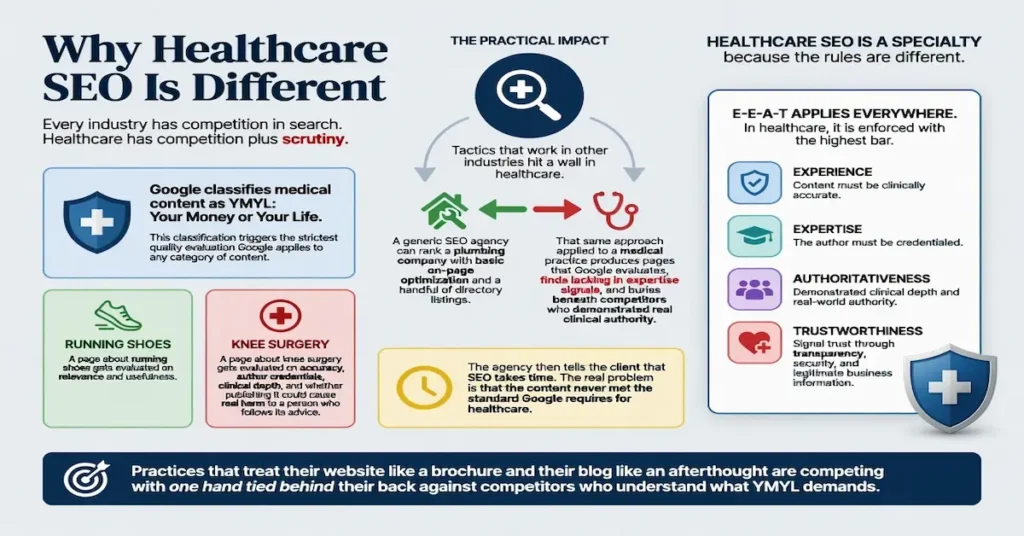
Every industry has competition in search. Healthcare has competition plus scrutiny. Google classifies medical content as YMYL: Your Money or Your Life. This classification triggers the strictest quality evaluation Google applies to any category of content. A page about running shoes gets evaluated on relevance and usefulness. A page about knee surgery gets evaluated on accuracy, author credentials, clinical depth, and whether publishing it could cause real harm to a person who follows its advice.
The practical impact is that tactics that work in other industries hit a wall in healthcare. A generic SEO agency can rank a plumbing company with basic on-page optimization and a handful of directory listings. That same approach applied to a medical practice produces pages that Google evaluates, finds lacking in expertise signals, and buries beneath competitors who demonstrated real clinical authority. The agency then tells the client that SEO takes time. The real problem is that the content never met the standard Google requires for healthcare.
Healthcare SEO is a specialty because the rules are different. The E-E-A-T framework applies everywhere, but in healthcare it is enforced with the highest bar. The content must be clinically accurate. The author must be credentialed. The site must signal trustworthiness through transparency, security, and legitimate business information. Practices that treat their website like a brochure and their blog like an afterthought are competing with one hand tied behind their back against competitors who understand what YMYL demands.
What Google Expects From Healthcare Websites
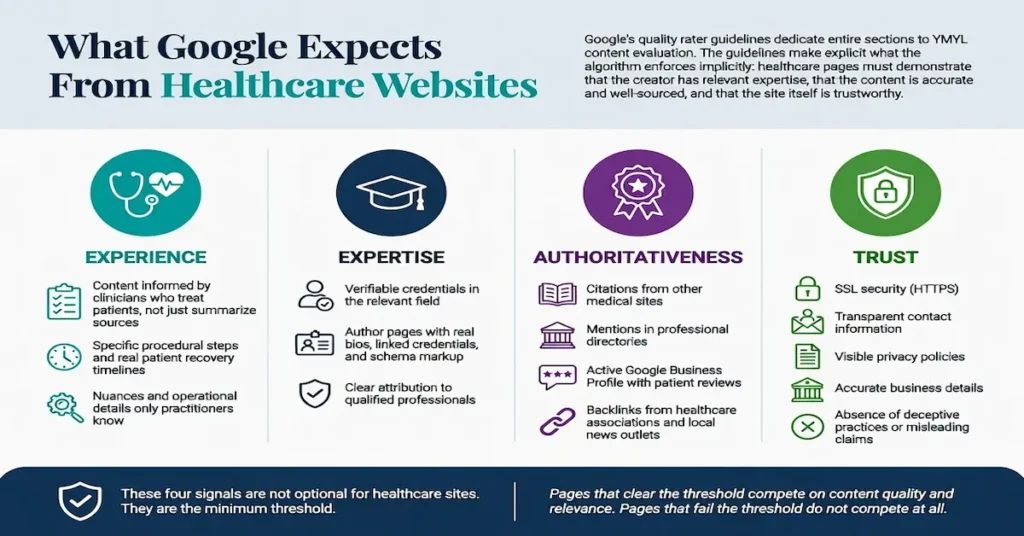
Google’s quality rater guidelines dedicate entire sections to YMYL content evaluation. The guidelines make explicit what the algorithm enforces implicitly: healthcare pages must demonstrate that the creator has relevant expertise, that the content is accurate and well-sourced, and that the site itself is trustworthy.
Experience. Google rewards content created by people who have direct, first-hand involvement with the subject. For healthcare, this means content informed by clinicians who treat patients, not copywriters who summarize WebMD. The experience signal shows up in operational details that only practitioners would know to include: specific procedural steps, recovery timelines based on real patient outcomes, and nuances that generic health content glosses over.
Expertise. The person behind the content must have verifiable credentials in the relevant field. A blog post about dental implant recovery carries more weight when it is attributed to a licensed dentist with twenty years of implant experience than when it is written by “the marketing team.” Author pages with real bios, linked credentials, and schema markup tell Google exactly who is responsible for the information and whether they are qualified to provide it.
Authoritativeness. The site must be recognized as an authority in its space. In healthcare, authority signals include citations from other medical sites, mentions in professional directories, active Google Business Profiles with patient reviews, and backlinks from healthcare associations and local news outlets. A site with no external validation is asking Google to trust it based on its own claims. Google does not.
Trust. Google has stated explicitly that Trust is the most important component of E-E-A-T. For healthcare sites, trust is evaluated through SSL security, transparent contact information, visible privacy policies, accurate business details, and the absence of deceptive practices. A healthcare site that hides its physical address, omits provider credentials, or publishes misleading health claims fails the trust evaluation regardless of how well the content is written.
These four signals are not optional for healthcare sites. They are the minimum threshold. Pages that clear the threshold compete on content quality and relevance. Pages that fail the threshold do not compete at all.
Local Search in Healthcare
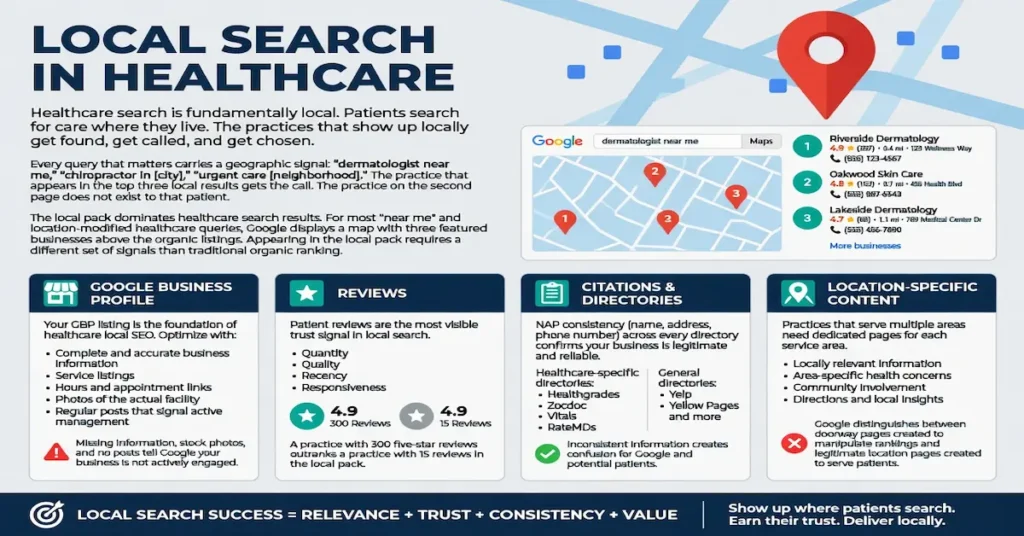
Healthcare search is fundamentally local. Patients do not search for a doctor 500 miles away. Every query that matters carries a geographic signal: “dermatologist near me,” “chiropractor in [city],” “urgent care [neighborhood].” The practice that appears in the top three local results gets the call. The practice on the second page does not exist to that patient.
The local pack dominates healthcare search results. For most “near me” and location-modified healthcare queries, Google displays a map with three featured businesses above the organic listings. Appearing in the local pack requires a different set of signals than traditional organic ranking.
Google Business Profile. Your GBP listing is the foundation of healthcare local SEO. Complete and accurate business information, service listings, hours, appointment links, photos of the actual facility, and regular posts that signal active management. A GBP listing with missing information, stock photos, and no posts tells Google the business is not actively engaged with its online presence.
Reviews. Patient reviews are the most visible trust signal in local search. A practice with 300 five-star reviews outranks a practice with 15 reviews in the local pack even if the second practice has a better website. Google uses review quantity, quality, recency, and the practice’s responsiveness to reviews as ranking signals. An active review management strategy is not optional for healthcare practices competing in local search.
Citations and directories. NAP consistency (name, address, phone number) across every directory and listing confirms to Google that the business is legitimate and that its information is reliable. Healthcare-specific directories like Healthgrades, Zocdoc, Vitals, and RateMDs carry additional weight because they are industry-relevant. General directories like Yelp and Yellow Pages add diversity. Inconsistent information across listings creates confusion for both Google and potential patients.
Location-specific content. Practices that serve multiple areas need dedicated pages for each service area. Not duplicate pages with the city name swapped. Pages with locally relevant information, area-specific health concerns, community involvement, and directions that demonstrate genuine knowledge of the area. Google distinguishes between doorway pages created to manipulate local rankings and legitimate location pages created to serve patients in those areas.
SEO by Specialty
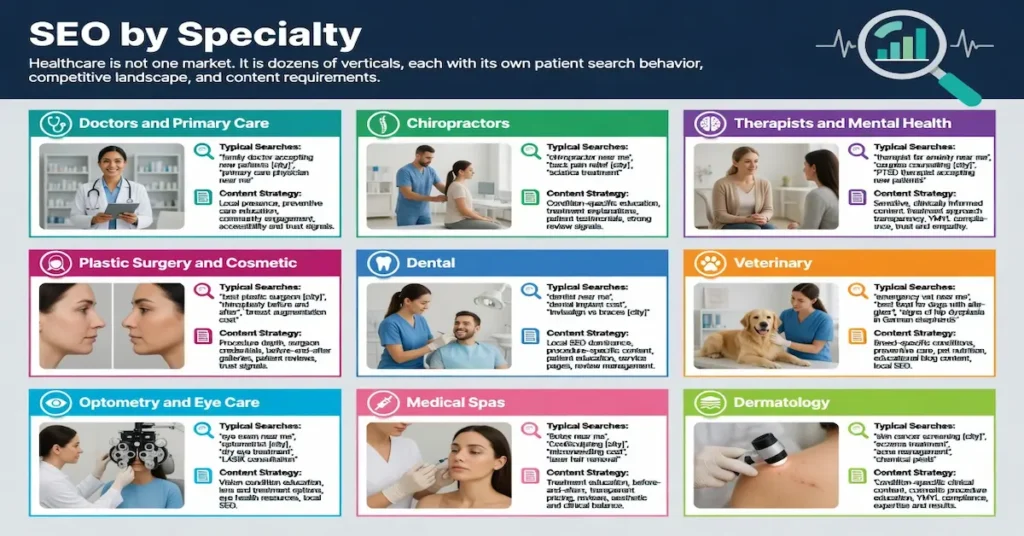
Healthcare is not one market. It is dozens of verticals, each with its own patient search behavior, competitive landscape, and content requirements. A strategy that works for a chiropractor does not directly transfer to a plastic surgeon. The search intent is different, the patient journey is different, and the content that demonstrates expertise looks different for every specialty.
Doctors and Primary Care
Primary care physicians compete on trust and proximity. Patients searching for a family doctor or general practitioner want someone nearby with good reviews and availability. The search queries are location-heavy: “family doctor accepting new patients [city],” “primary care physician near me.” The content strategy focuses on community presence, preventive care education, and establishing the practice as the first call for non-emergency health concerns. Primary care SEO is won through local signals and consistent content that positions the practice as an accessible, trustworthy resource.
Chiropractors
Chiropractic SEO is one of the most active healthcare search verticals. Patients search with high intent: “chiropractor near me” carries strong booking intent because chiropractic care is often sought for acute pain. The competitive landscape is aggressive because chiropractors have embraced digital marketing earlier than most healthcare specialties. Winning in chiropractic SEO requires differentiating through content depth, patient education about specific conditions and treatment approaches, and a strong review profile that signals patient satisfaction.
Therapists and Mental Health
Mental health search is growing faster than almost any other healthcare vertical. Stigma reduction and insurance expansion have driven more patients to search for therapists online. The queries are deeply personal: “therapist for anxiety near me,” “couples counseling [city],” “PTSD therapist accepting new patients.” The content must be sensitive, clinically informed, and transparent about treatment approaches. Mental health SEO also requires careful attention to YMYL standards because Google holds mental health content to the same scrutiny as physical health content.
Plastic Surgery and Cosmetic
Cosmetic surgery SEO is a high-value, high-competition vertical. Patient lifetime value is among the highest in healthcare, which means the practices that rank well generate significant revenue per conversion. The search behavior is research-heavy: patients compare surgeons, review before-and-after galleries, and read about procedures extensively before booking a consultation. Content strategy for plastic surgery practices centers on procedure-specific depth, surgeon credentials, visual proof of results, and trust signals that reassure patients making high-stakes decisions about their appearance.
Dental
Dental SEO combines local search dominance with procedure-specific content. Patients search for both routine care (“dentist near me,” “dental cleaning [city]”) and specific procedures (“dental implant cost,” “invisalign vs braces”). The competitive landscape varies dramatically by market. A dental practice in a small city may rank with basic optimization. A practice in a major metro competes against dozens of practices investing heavily in SEO, PPC, and content marketing simultaneously.
Veterinary
Veterinary SEO follows the same local search patterns as human healthcare but with different content opportunities. Pet owners search with urgency (“emergency vet near me”) and with research intent (“best food for dogs with allergies,” “signs of hip dysplasia in German shepherds”). Veterinary practices that publish educational content about breed-specific conditions, preventive care, and pet nutrition build topical authority that drives both organic traffic and patient trust.
Optometry and Eye Care
Eye care search spans routine (“eye exam near me,” “optometrist [city]”) and condition-specific (“dry eye treatment,” “LASIK consultation”) queries. The competitive field is smaller than dental or chiropractic, which creates opportunity for practices willing to invest in content. Optometry SEO benefits from educational content about vision conditions, lens options, and eye health that positions the practice as more than a place to get a prescription filled.
Medical Spas
Medical spa SEO sits at the intersection of healthcare and cosmetic services. Patients search for specific treatments (“Botox near me,” “CoolSculpting [city],” “microneedling cost”) with high commercial intent. The content needs to balance clinical accuracy with the aesthetic appeal that medspa clients expect. Reviews, before-and-after content, and transparent pricing information are particularly important because medspa services are elective and patients compare multiple providers before booking.
Dermatology
Dermatology search covers both medical (skin cancer screening, eczema treatment, acne management) and cosmetic (chemical peels, laser treatments, anti-aging procedures) intent. The YMYL standard applies heavily to medical dermatology content, while cosmetic dermatology content competes with medspa and plastic surgery providers for many of the same queries. Dermatology SEO benefits from condition-specific content that demonstrates clinical expertise on the medical side while capturing the commercial intent of cosmetic searches.
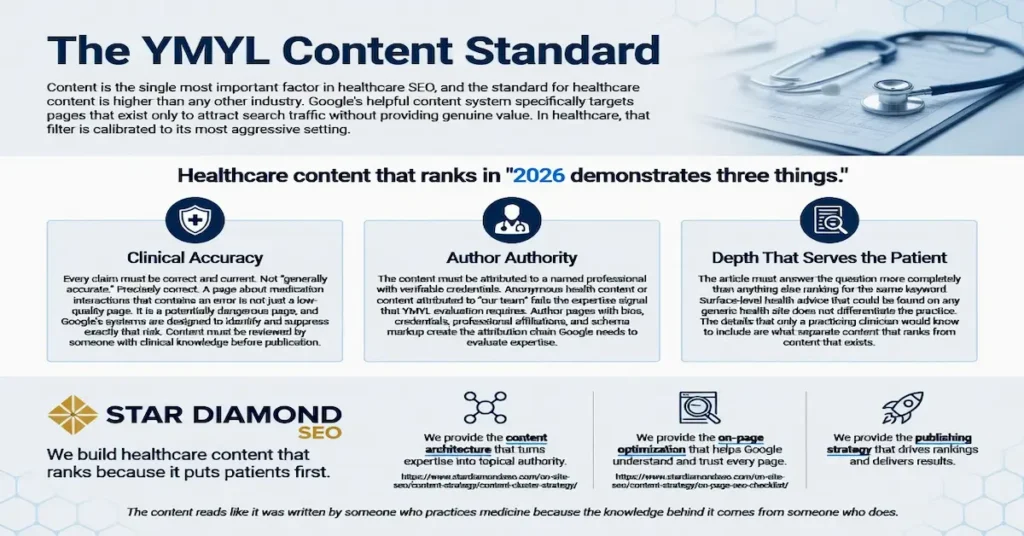
The YMYL Content Standard
Content is the single most important factor in healthcare SEO, and the standard for healthcare content is higher than any other industry. Google’s helpful content system specifically targets pages that exist only to attract search traffic without providing genuine value. In healthcare, that filter is calibrated to its most aggressive setting.
Healthcare content that ranks in 2026 demonstrates three things.
Clinical accuracy. Every claim must be correct and current. Not “generally accurate.” Precisely correct. A page about medication interactions that contains an error is not just a low-quality page. It is a potentially dangerous page, and Google’s systems are designed to identify and suppress exactly that risk. Content must be reviewed by someone with clinical knowledge before publication.
Author authority. The content must be attributed to a named professional with verifiable credentials. Anonymous health content or content attributed to “our team” fails the expertise signal that YMYL evaluation requires. Author pages with bios, credentials, professional affiliations, and schema markup create the attribution chain Google needs to evaluate expertise.
Depth that serves the patient. The article must answer the question more completely than anything else ranking for the same keyword. Surface-level health advice that could be found on any generic health site does not differentiate the practice. The details that only a practicing clinician would know to include are what separate content that ranks from content that exists.
Star Diamond SEO builds healthcare content using the practice’s clinical knowledge as the source material. The clinician provides the expertise. We provide the content architecture, on-page optimization, and publishing strategy that turns that expertise into rankings. The content reads like it was written by someone who practices medicine because the knowledge behind it comes from someone who does.
How We Build Healthcare SEO Campaigns
Every healthcare engagement runs through the 5C Framework: Content, Cadence, Calibration, Crawlability, and Credibility. The framework is the same for every client. How it applies depends on the specialty, the market, and the current state of the practice’s online presence.
Content for healthcare means building the clinical depth that YMYL evaluation rewards. Service pages that explain procedures with practitioner-level detail. Blog content organized into clusters that demonstrate comprehensive topical authority. Patient education resources that answer the questions people search before they book.
Cadence means a publishing rhythm the practice can sustain. Not twenty articles dumped in month one and nothing for six months after. A consistent schedule that signals to Google the site is actively maintained by people who are invested in keeping the information current. Healthcare content goes stale faster than most industries because treatment standards evolve, insurance policies change, and new procedures emerge.
Calibration means every page is optimized to match what patients actually search for. Search intent in healthcare varies dramatically by keyword. Someone searching “knee pain causes” wants education. Someone searching “orthopedic surgeon near me” wants to book. The page format, content depth, and calls to action must match the intent behind the query.
Crawlability means the technical foundation is solid. Healthcare sites built on outdated platforms, loaded with unoptimized images, and lacking proper internal linking give Google no reason to crawl frequently. Technical SEO for healthcare covers site speed, mobile responsiveness, schema markup for medical practices, and the crawl architecture that ensures every important page is discoverable.
Credibility means building the external trust signals that YMYL evaluation demands. Backlinks from healthcare directories, medical associations, local news coverage, and industry publications. Author authority through professional profiles and schema markup. Review acquisition strategies that build the social proof patients rely on and Google uses as a ranking signal.
The engagement starts with an SEO site audit that identifies where the practice stands across all five components. The audit determines what to fix first, what to build next, and what the realistic timeline looks like based on the competitive landscape in the practice’s market.
Start with a business consultation to find out where your practice stands and what it would take to own the search results your patients are using to find care.
FAQ
What is YMYL and why does it affect healthcare SEO?
YMYL stands for Your Money or Your Life. Google applies this classification to any content that could affect a person’s health, safety, or financial wellbeing. Healthcare websites fall under YMYL automatically, which means Google evaluates them against its strictest quality standards. Content must demonstrate clinical expertise, author credentials must be verifiable, and the site must signal trustworthiness through transparency and accuracy.
How long does healthcare SEO take to produce results?
Low-competition local keywords can produce page-one rankings within one to three months. Competitive terms in larger markets take three to six months. The timeline depends on the practice’s current site authority, the competitive landscape in the local market, and how aggressively content is published and credibility signals are built.
Why do most healthcare websites fail to rank?
Most healthcare websites publish generic content without clinical depth, lack author attribution with verifiable credentials, and have no strategy for building the external trust signals Google requires for YMYL content. The site may look professional, but Google evaluates what is behind the design: who wrote the content, whether they are qualified, and whether the rest of the web confirms that the practice is a legitimate authority.
Do healthcare practices need a blog?
Yes. A blog targeting patient search queries builds the topical authority Google needs to see before ranking service pages for competitive keywords. Patients search questions before they book appointments. A practice that answers those questions with clinical depth earns both patient trust and Google’s recognition as an authoritative source in its specialty.
How important are Google reviews for healthcare SEO?
Extremely important. Google uses review quantity, quality, recency, and the practice’s responsiveness as ranking signals in local search results. Reviews are also the most visible trust signal to potential patients evaluating providers. A practice with a strong review profile outperforms competitors with fewer or lower-rated reviews in local pack placement regardless of website quality.
Is healthcare SEO different for each medical specialty?
Yes. Each specialty has different patient search behavior, competitive dynamics, and content requirements. A chiropractor competes on acute pain keywords with high booking intent. A therapist competes on sensitive personal queries that require careful content tone. A plastic surgeon competes on research-heavy cosmetic queries where patients compare providers extensively before booking. The SEO strategy must account for these differences or it underperforms.
Can a healthcare practice do SEO without an agency?
Basic optimizations like Google Business Profile management, review responses, and simple content updates can be handled in-house. Technical SEO, content strategy, schema markup, YMYL-compliant content production, and credibility building require specialized knowledge that most practices do not have on staff. The practices that compete at the highest level in healthcare search work with professionals who understand both SEO and the YMYL standards that apply to medical content.