What are Dental SEO Services?
AI Summary
What are dental SEO services? The complete search visibility strategy for dental practices covering technical SEO, content architecture, local search optimization, credibility building, and the YMYL compliance standards that Google requires before ranking any healthcare website. Not a package of blog posts. A system that turns search visibility into booked appointments.
What it is and who it is for: Built for dental practices that depend on new patients finding them through Google. Whether you are a general dentist, orthodontist, cosmetic dentist, pediatric dentist, or oral surgeon, your next patient is searching right now. Dental SEO determines whether they find you or the practice down the street.
The rule: Dental websites operate under YMYL scrutiny. Google holds healthcare content to its highest standard. The practices that rank are the ones that prove clinical expertise through content, earn trust through external signals, and build technical foundations that let Google crawl and index every page efficiently. No shortcut survives that level of evaluation.
Why Dental Practices Need SEO
Every new patient a dental practice acquires starts with a search. “Dentist near me.” “Best dentist in [city].” “Emergency dental [neighborhood].” The practice that appears in the top three results for those queries gets the call. The practice on page two does not exist to that patient.
Most dental practices rely on referrals or Google Ads. Referrals are unpredictable. Google Ads stop delivering patients the moment the budget runs out. SEO is the third option most practices overlook because the results take time. But it is the only channel that compounds. A dental practice that ranks organically for twenty high-intent keywords in its service area receives a steady flow of new patient inquiries without paying per click. That flow does not stop when the ad budget ends. It grows as the site builds authority.
The math is straightforward. A single new patient is worth $1,000 to $3,000 in lifetime value to most dental practices. A first-page ranking for “dentist near me” in a mid-size city generates hundreds of impressions per month. Even a conservative conversion rate produces patients at a cost per acquisition that paid advertising cannot match over time.
Dental SEO is not a luxury for large practices with marketing budgets. It is the infrastructure that every dental practice needs to compete for the patients who are already searching.
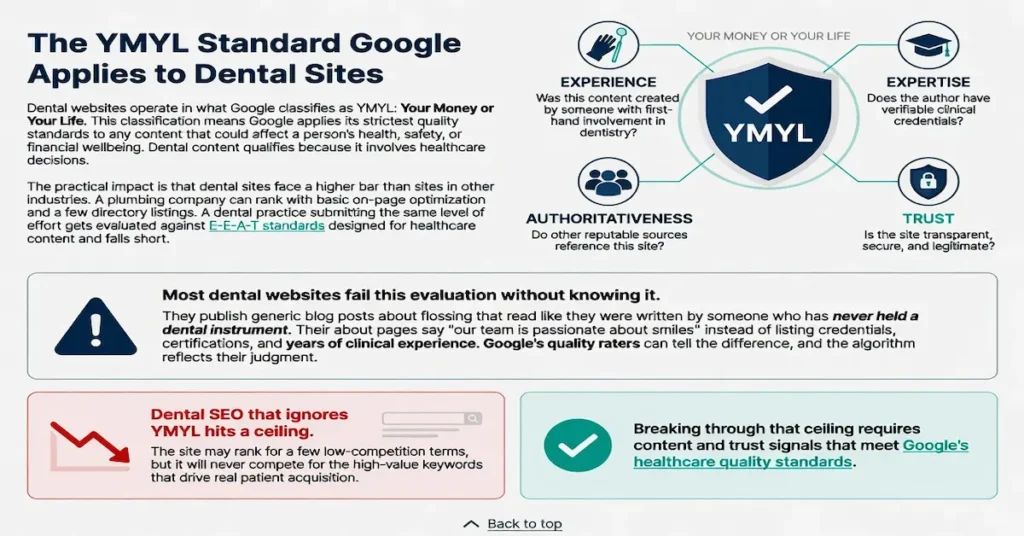
The YMYL Standard Google Applies to Dental Sites
Dental websites operate in what Google classifies as YMYL: Your Money or Your Life. This classification means Google applies its strictest quality standards to any content that could affect a person’s health, safety, or financial wellbeing. Dental content qualifies because it involves healthcare decisions.
The practical impact is that dental sites face a higher bar than sites in other industries. A plumbing company can rank with basic on-page optimization and a few directory listings. A dental practice submitting the same level of effort gets evaluated against E-E-A-T standards designed for healthcare content and falls short.
Google evaluates four signals on every dental page. Experience: was this content created by someone with first-hand involvement in dentistry? Expertise: does the author have verifiable clinical credentials? Authoritativeness: do other reputable sources reference this site? Trust: is the site transparent, secure, and legitimate?
Most dental websites fail this evaluation without knowing it. They publish generic blog posts about flossing that read like they were written by someone who has never held a dental instrument. Their about pages say “our team is passionate about smiles” instead of listing credentials, certifications, and years of clinical experience. Google’s quality raters can tell the difference, and the algorithm reflects their judgment.
Dental SEO that ignores YMYL hits a ceiling. The site may rank for a few low-competition terms, but it will never compete for the high-value keywords that drive real patient acquisition. Breaking through that ceiling requires content and trust signals that meet Google’s healthcare quality standards.
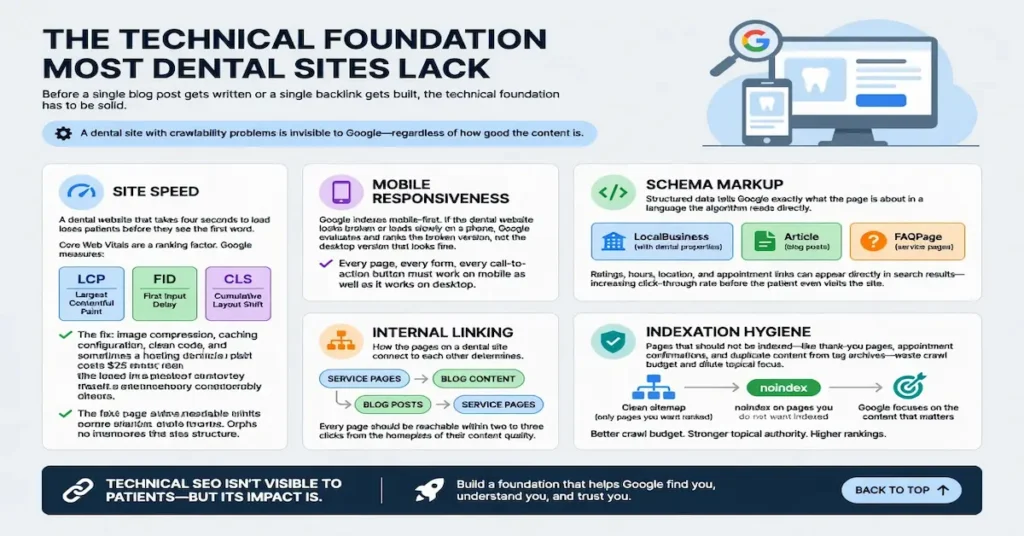
The Technical Foundation Most Dental Sites Lack
Before a single blog post gets written or a single backlink gets built, the technical foundation has to be solid. A dental site with crawlability problems is invisible to Google regardless of how good the content is.
Site speed. A dental website that takes four seconds to load loses patients before they see the first word. Core Web Vitals are a ranking factor. Google measures Largest Contentful Paint, First Input Delay, and Cumulative Layout Shift on every page. Dental sites built on outdated platforms with unoptimized images and bloated plugins fail these metrics consistently. The fix involves image compression, caching configuration, clean code, and sometimes a hosting upgrade that costs $25 more per month but produces measurably faster load times.
Mobile responsiveness. Google indexes mobile-first. If the dental website looks broken or loads slowly on a phone, Google evaluates and ranks the broken version, not the desktop version that looks fine. Every page, every form, every call-to-action button must work on mobile as well as it works on desktop.
Schema markup. Structured data tells Google exactly what the page is about in a language the algorithm reads directly. For dental practices, LocalBusiness schema with dental-specific properties, Article schema on blog posts, and FAQPage schema on service pages all create opportunities for rich results in search. A dental practice page with properly implemented schema can display ratings, hours, location, and appointment links directly in the search result, which increases click-through rate before the patient even visits the site.
Internal linking. How the pages on a dental site connect to each other determines how Google crawls and understands the site structure. Service pages should link to related blog content. Blog posts should link back to service pages. Every page should be reachable within two to three clicks from the homepage. Orphan pages with no internal links are invisible to Google’s crawler regardless of their content quality.
Indexation hygiene. Pages that should not be indexed, like thank-you pages, appointment confirmation screens, and duplicate content generated by tag archives, waste crawl budget and dilute the site’s topical focus. A clean sitemap containing only the pages you want ranked, combined with proper noindex directives on the pages you do not, keeps Google focused on the content that matters.
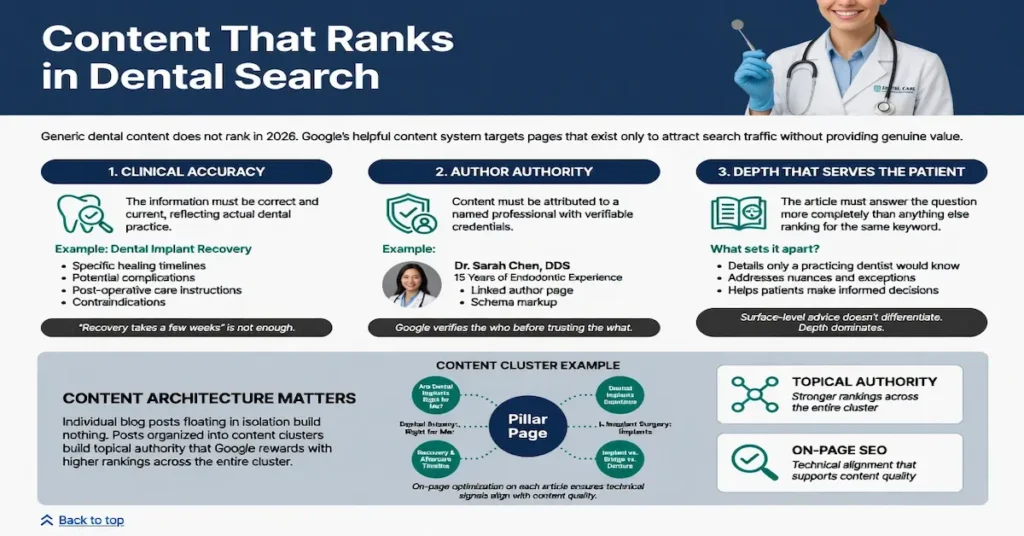
Content That Ranks in Dental Search
Generic dental content does not rank in 2026. Google’s helpful content system specifically targets pages that exist only to attract search traffic without providing genuine value. A 500-word article about “the importance of brushing your teeth” written by a content mill does not pass that filter.
Content that ranks in the dental YMYL category demonstrates three things.
Clinical accuracy. The information must be correct and current, reflecting actual dental practice rather than surface-level health advice. A page about dental implant recovery that includes specific healing timelines, potential complications, post-operative care instructions, and contraindications carries the clinical depth that Google’s quality systems recognize. A page that says “recovery takes a few weeks” does not.
Author authority. Content must be attributed to a named professional with verifiable credentials. A blog post about root canal procedures attributed to “Dr. Sarah Chen, DDS, 15 years of endodontic experience” with a linked author page and schema markup outperforms the same content attributed to “the marketing team.” Google needs to verify who wrote healthcare content before it trusts the content enough to rank it.
Depth that serves the patient. The article must answer the question more completely than anything else ranking for the same keyword. Surface-level health advice that could be found on any generic health site does not differentiate the practice. The details that only a practicing dentist would know to include are what separate content that ranks from content that sits at position 40 indefinitely.
Content architecture matters as much as content quality. Individual blog posts floating in isolation build nothing. Posts organized into content clusters around specific topics (dental implants, cosmetic dentistry, pediatric care, emergency dental) build topical authority that Google rewards with higher rankings across the entire cluster. The on-page optimization on each article ensures the technical signals align with the content quality.
Local Visibility: The Map Pack and Beyond
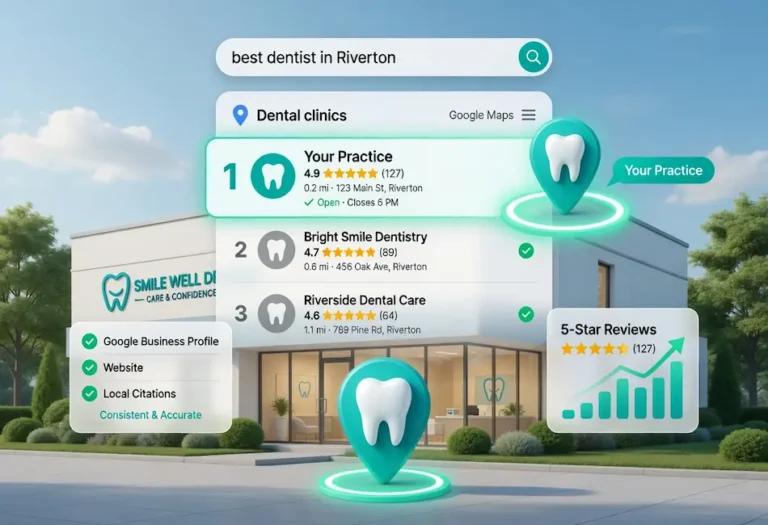
Dental search is fundamentally local. Nobody drives an hour for a teeth cleaning. Every query that matters carries a geographic signal, either explicitly or through Google resolving the searcher’s physical location. The local pack, the map section displaying three featured businesses above organic results, captures the majority of clicks for dental searches.
Ranking in the local pack requires a different set of signals than traditional organic ranking. Google Business Profile optimization, review quantity and quality, citation consistency across directories, and locally relevant content all feed into local pack placement.
Our local SEO guide for dentists covers the complete local strategy: GBP optimization, review acquisition systems, citation building, and the local content approach that ties geographic relevance to clinical authority. Local visibility is where most dental patients make their first decision, and the practices that own the local pack own the patient flow.
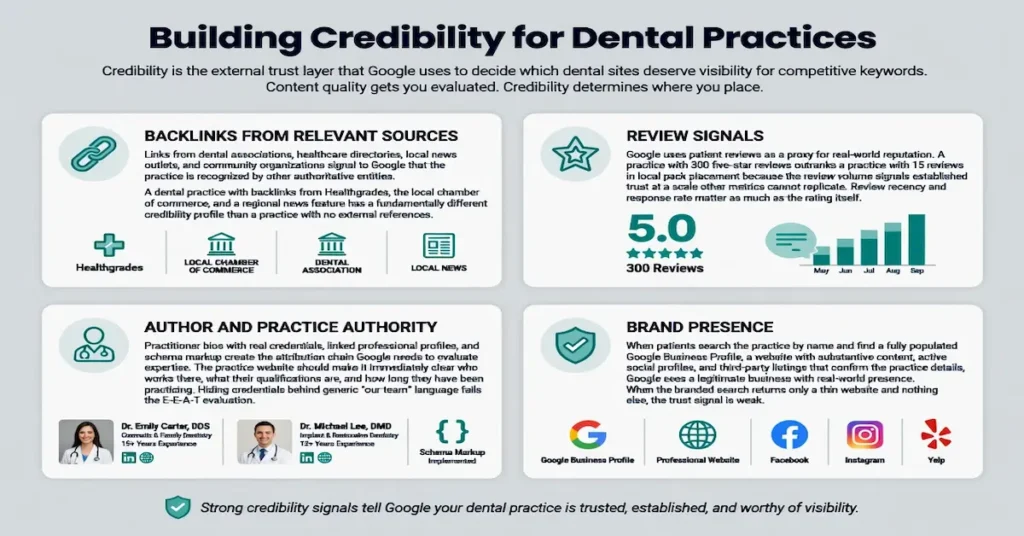
Building Credibility for Dental Practices
Credibility is the external trust layer that Google uses to decide which dental sites deserve visibility for competitive keywords. Content quality gets you evaluated. Credibility determines where you place.
Backlinks from relevant sources. Links from dental associations, healthcare directories, local news outlets, and community organizations signal to Google that the practice is recognized by other authoritative entities. A dental practice with backlinks from Healthgrades, the local chamber of commerce, and a regional news feature has a fundamentally different credibility profile than a practice with no external references.
Review signals. Google uses patient reviews as a proxy for real-world reputation. A practice with 300 five-star reviews outranks a practice with 15 reviews in local pack placement because the review volume signals established trust at a scale other metrics cannot replicate. Review recency and response rate matter as much as the rating itself.
Author and practice authority. Practitioner bios with real credentials, linked professional profiles, and schema markup create the attribution chain Google needs to evaluate expertise. The practice website should make it immediately clear who works there, what their qualifications are, and how long they have been practicing. Hiding credentials behind generic “our team” language fails the E-E-A-T evaluation.
Brand presence. When patients search the practice by name and find a fully populated Google Business Profile, a website with substantive content, active social profiles, and third-party listings that confirm the practice details, Google sees a legitimate business with real-world presence. When the branded search returns only a thin website and nothing else, the trust signal is weak.
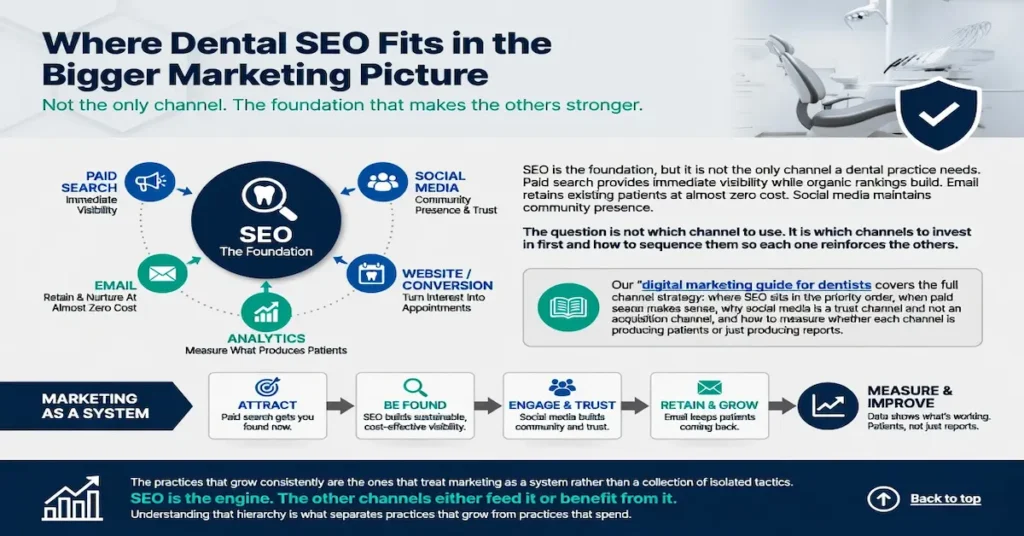
Where Dental SEO Fits in the Bigger Marketing Picture
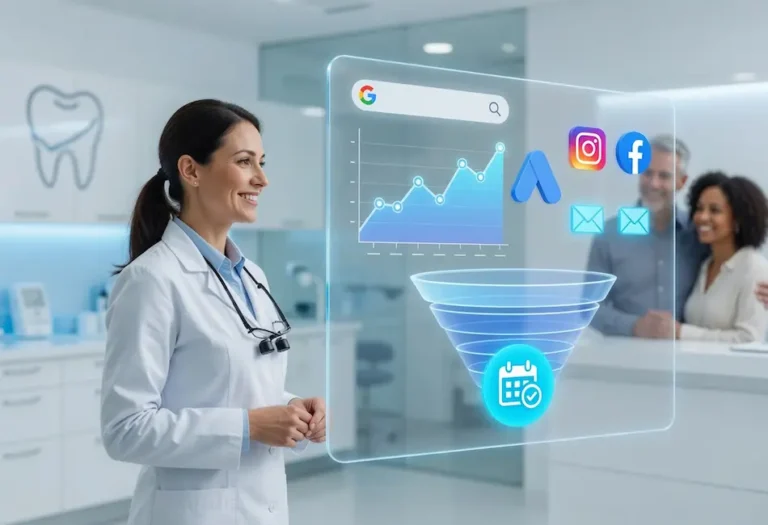
SEO is the foundation, but it is not the only channel a dental practice needs. Paid search provides immediate visibility while organic rankings build. Email retains existing patients at almost zero cost. Social media maintains community presence. The question is not which channel to use. It is which channels to invest in first and how to sequence them so each one reinforces the others.
Our digital marketing guide for dentists covers the full channel strategy: where SEO sits in the priority order, when paid search makes sense, why social media is a trust channel and not an acquisition channel, and how to measure whether each channel is producing patients or just producing reports.
The practices that grow consistently are the ones that treat marketing as a system rather than a collection of isolated tactics. SEO is the engine. The other channels either feed it or benefit from it. Understanding that hierarchy is what separates practices that grow from practices that spend.
What You Get
A complete dental SEO strategy built through the 5C Framework: content that demonstrates clinical expertise, cadence that maintains publishing consistency, calibration that aligns every page with patient search intent, crawlability that ensures Google can find and index every page, and credibility signals that build the external trust YMYL evaluation demands.
Every engagement starts with an SEO site audit that identifies where the practice stands across all five components. The audit determines priority order: what to fix first, what to build next, and what the realistic timeline looks like based on the competitive landscape in your specific market.
Start with a business consultation to find out where your practice stands and what it would take to own the search results your patients are using to find care.
FAQ
How long does dental SEO take to show results?
Low-competition local keywords can produce page-one rankings within one to three months. Competitive terms in larger metro markets take three to six months. The timeline depends on the practice’s current site authority, the competitive landscape in the service area, and how aggressively content is published and credibility signals are built.
How much do dental SEO services cost?
Dental SEO services typically range from $1,500 to $5,000 per month depending on market size, competitive intensity, and scope of work. Smaller markets with fewer competing practices require less investment than major metro areas where multiple practices are actively investing in SEO and paid search simultaneously.
Why is dental SEO different from regular SEO?
Dental websites fall under Google’s YMYL classification, which means they are evaluated against the highest quality standards in search. Content must demonstrate real clinical expertise, authors must have verifiable credentials, and the site must signal trustworthiness through transparency and accuracy. Generic SEO tactics that work for other industries hit a ceiling in healthcare because they cannot meet these standards.
Do I need a blog for my dental practice website?
Yes. A blog targeting patient search queries builds the topical authority Google needs to see before ranking service pages for competitive keywords. Patients search questions before they book appointments. A practice that answers those questions with clinical depth earns both patient trust and Google’s recognition as an authoritative source in the dental space.
How important are Google reviews for dental SEO?
Extremely important. Google uses review quantity, quality, and recency as ranking signals in local search results. Reviews are also the most visible trust signal to potential patients evaluating providers. A practice with a strong review profile outperforms competitors with fewer or lower-rated reviews in local pack placement regardless of website quality.
What is the difference between dental SEO and dental PPC?
SEO builds organic rankings that compound over time and produce patients without a per-click cost. PPC buys immediate visibility through Google Ads at a direct cost per click that recurs with every patient acquired. SEO is the long-term asset. PPC is the short-term accelerant. The best dental marketing strategies use both in sequence, with PPC generating patients and data while SEO builds the foundation that reduces paid dependence over time.
Can I do dental SEO myself?
Basic optimizations like Google Business Profile management and review responses can be handled in-house. Technical SEO, content strategy, schema markup, YMYL-compliant content production, and credibility building require specialized knowledge that most dental practices do not have on staff. The practices that compete at the highest level in local search work with professionals who understand both SEO and the healthcare quality standards Google applies to dental content.