Local SEO for Dentists: How to Rank in Your Service Area
AI Summary
What is local SEO for dentists? The strategy that determines whether your practice appears in the map pack and local organic results when patients in your area search for a dentist. It covers Google Business Profile optimization, review management, citation building, and the local content signals that tell Google your practice is the most relevant result for searchers nearby.
What it is and who it is for: Built for dental practices that depend on patients within a geographic service area. Your next patient is searching “dentist near me” right now. Local SEO is what determines whether they find you or the practice two miles down the road.
The rule: Local search is won in the details. The practice with the most complete profile, the most consistent citations, the strongest reviews, and the most locally relevant content wins the local pack. There is no shortcut that replaces doing all four.
Why Local SEO Matters for Dental Practices
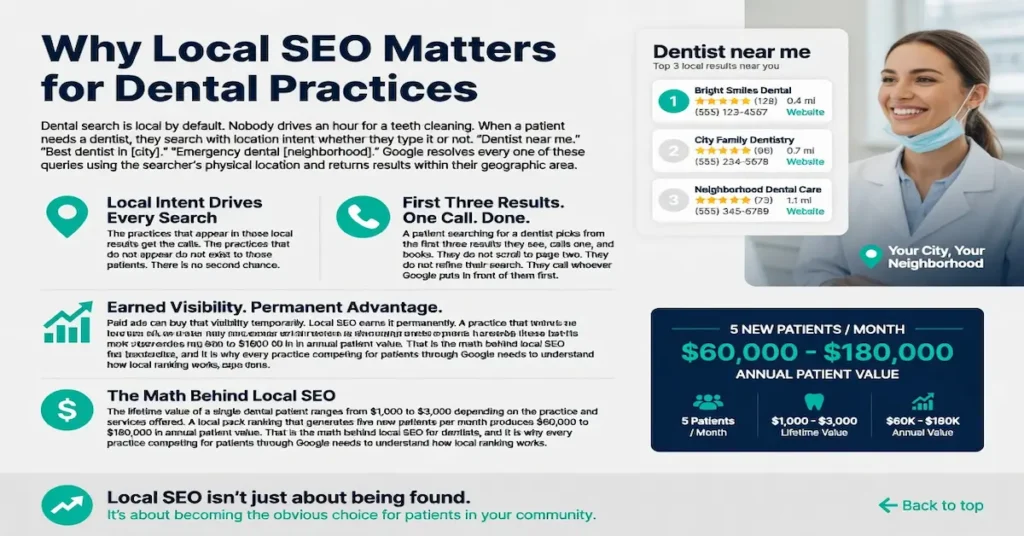
Dental search is local by default. Nobody drives an hour for a teeth cleaning. When a patient needs a dentist, they search with location intent whether they type it or not. “Dentist near me.” “Best dentist in [city].” “Emergency dental [neighborhood].” Google resolves every one of these queries using the searcher’s physical location and returns results within their geographic area.
The practices that appear in those local results get the calls. The practices that do not appear do not exist to those patients. There is no second chance. A patient searching for a dentist picks from the first three results they see, calls one, and books. They do not scroll to page two. They do not refine their search. They call whoever Google puts in front of them first.
Paid ads can buy that visibility temporarily. Local SEO earns it permanently. A practice that ranks in the local pack for its primary service keywords receives a steady flow of patient inquiries without paying per click. That flow compounds as the practice builds more reviews, publishes more locally relevant content, and strengthens the signals that keep it in the top positions.
The lifetime value of a single dental patient ranges from $1,000 to $3,000 depending on the practice and services offered. A local pack ranking that generates five new patients per month produces $60,000 to $180,000 in annual patient value. That is the math behind local SEO for dentists, and it is why every practice competing for patients through Google needs to understand how local ranking works.
The Local Pack: Where Patients Actually Click
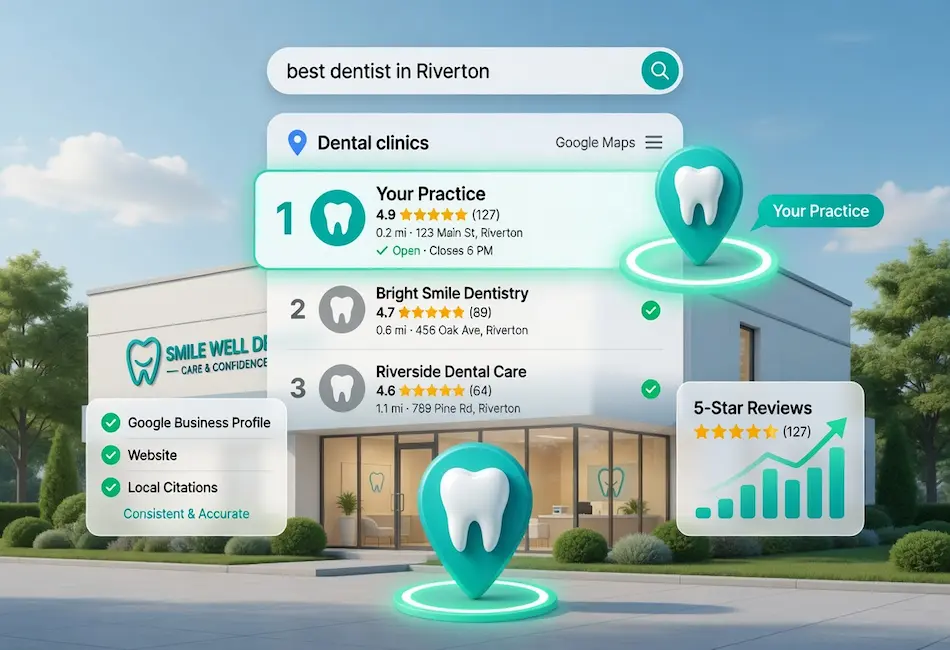
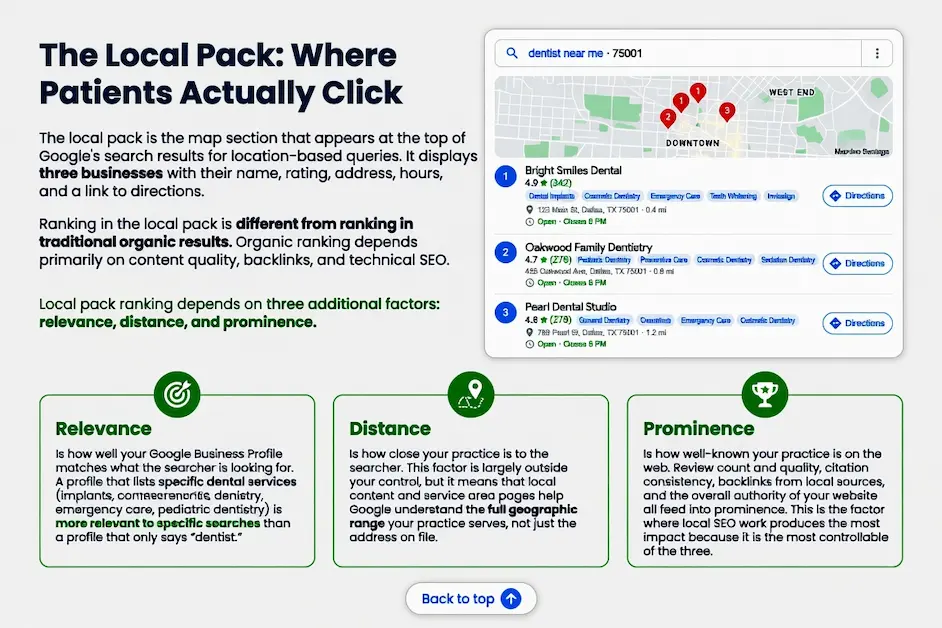
The local pack is the map section that appears at the top of Google’s search results for location-based queries. It displays three businesses with their name, rating, address, hours, and a link to directions. For dental searches, the local pack captures the majority of clicks because it gives patients everything they need to make a decision without scrolling further: which practices are nearby, how other patients rated them, and how to get there.
Ranking in the local pack is different from ranking in traditional organic results. Organic ranking depends primarily on content quality, backlinks, and technical SEO. Local pack ranking depends on three additional factors: relevance, distance, and prominence.
Relevance is how well your Google Business Profile matches what the searcher is looking for. A profile that lists specific dental services (implants, cosmetic dentistry, emergency care, pediatric dentistry) is more relevant to specific searches than a profile that only says “dentist.”
Distance is how close your practice is to the searcher. This factor is largely outside your control, but it means that local content and service area pages help Google understand the full geographic range your practice serves, not just the address on file.
Prominence is how well-known your practice is on the web. Review count and quality, citation consistency, backlinks from local sources, and the overall authority of your website all feed into prominence. This is the factor where local SEO work produces the most impact because it is the most controllable of the three.
Reviews: The Trust Signal That Ranks
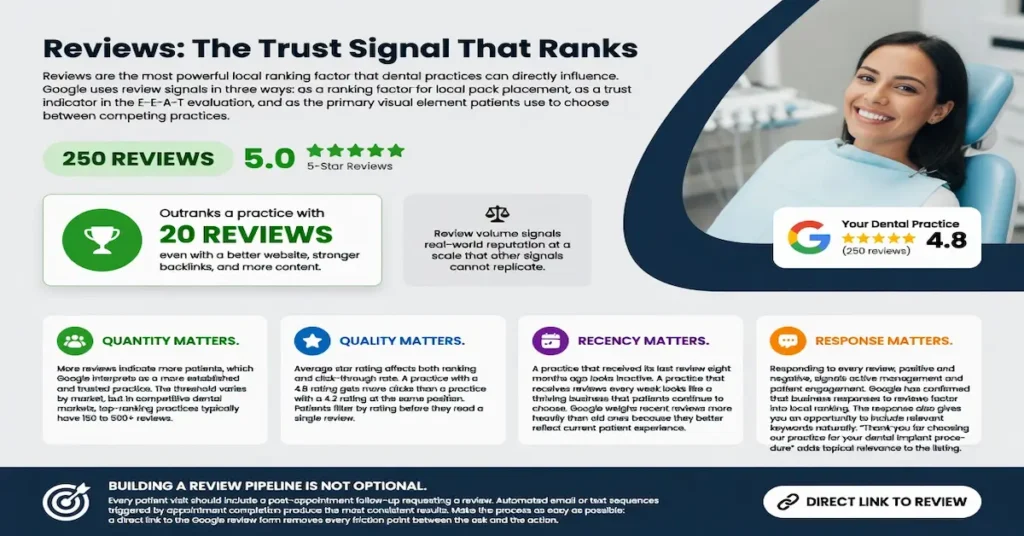
Reviews are the most powerful local ranking factor that dental practices can directly influence. Google uses review signals in three ways: as a ranking factor for local pack placement, as a trust indicator in the E-E-A-T evaluation, and as the primary visual element patients use to choose between competing practices.
A practice with 250 five-star reviews outranks a practice with 20 reviews in the local pack even if the second practice has a better website, stronger backlinks, and more content. Review volume signals real-world reputation at a scale that other signals cannot replicate.
Quantity matters. More reviews indicate more patients, which Google interprets as a more established and trusted practice. The threshold varies by market, but in competitive dental markets, top-ranking practices typically have 150 to 500+ reviews.
Quality matters. Average star rating affects both ranking and click-through rate. A practice with a 4.8 rating gets more clicks than a practice with a 4.2 rating at the same position. Patients filter by rating before they read a single review.
Recency matters. A practice that received its last review eight months ago looks inactive. A practice that receives reviews every week looks like a thriving business that patients continue to choose. Google weighs recent reviews more heavily than old ones because they better reflect current patient experience.
Response matters. Responding to every review, positive and negative, signals active management and patient engagement. Google has confirmed that business responses to reviews factor into local ranking. The response also gives you an opportunity to include relevant keywords naturally: “Thank you for choosing our practice for your dental implant procedure” adds topical relevance to the listing.
Building a review pipeline is not optional. Every patient visit should include a post-appointment follow-up requesting a review. Automated email or text sequences triggered by appointment completion produce the most consistent results. Make the process as easy as possible: a direct link to the Google review form removes every friction point between the ask and the action.
Citations and Directory Consistency
A citation is any online mention of your practice’s name, address, and phone number. Citations appear on directories, social platforms, healthcare aggregators, and local business listings. Google cross-references citations across the web to verify that your practice information is accurate and consistent. Inconsistencies create doubt about legitimacy.
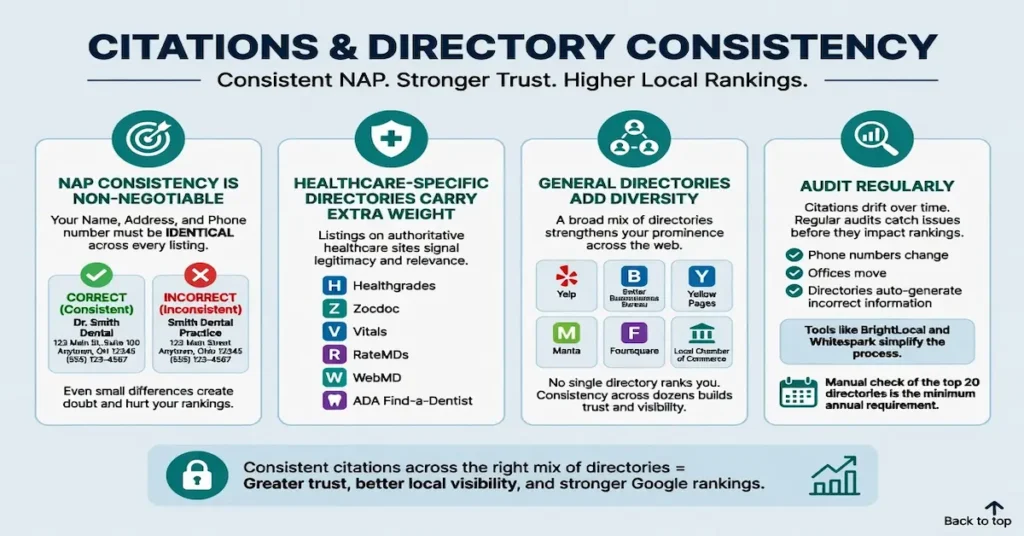
NAP consistency is non-negotiable. Your name, address, and phone number must be identical across every listing. Not “mostly the same.” Identical. “123 Main St” on your website and “123 Main Street” on Yelp is an inconsistency. “Dr. Smith Dental” on your GBP and “Smith Dental Practice” on Healthgrades is an inconsistency. Google treats these as signals of unreliable information, and unreliable information suppresses local rankings.
Healthcare-specific directories carry extra weight. Healthgrades, Zocdoc, Vitals, RateMDs, WebMD, and the ADA Find-a-Dentist directory are industry-relevant citations that Google recognizes as authoritative sources for dental practice information. Being listed on these platforms signals that the practice is a legitimate healthcare provider, not just a business with a website.
General directories add diversity. Yelp, Yellow Pages, Better Business Bureau, Manta, Foursquare, and local chamber of commerce directories round out the citation profile. No single directory drives ranking on its own. The cumulative effect of consistent information across dozens of sources is what builds the prominence signal Google uses for local pack placement.
Audit regularly. Citations drift over time. A phone number changes. An office moves. A directory auto-generates a listing with incorrect information. Regular citation audits catch inconsistencies before they accumulate into a ranking problem. Tools like BrightLocal and Whitespark simplify the audit process, but a manual check of the top 20 directories is the minimum annual requirement.
Local Content That Drives Rankings
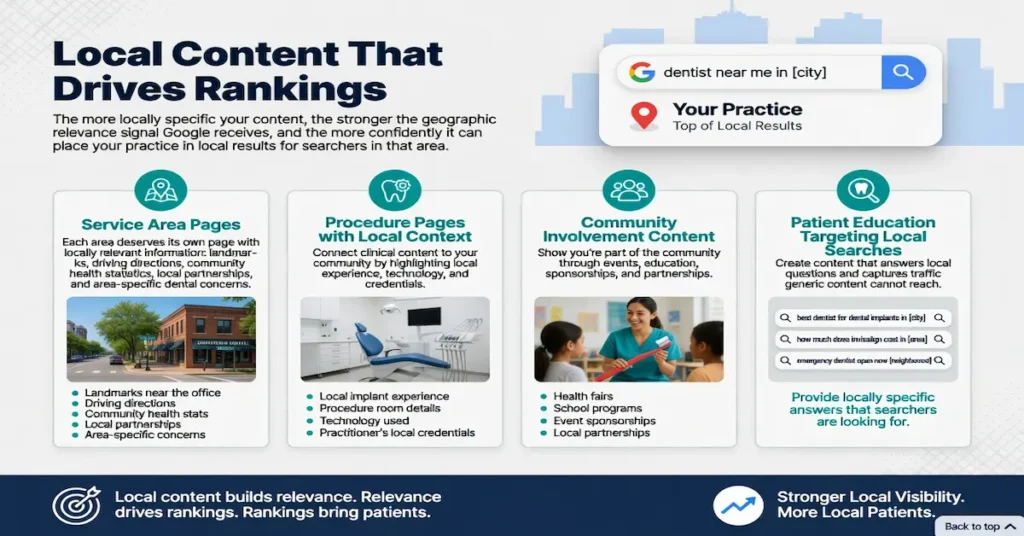
Local content is what separates a dental practice that ranks for “dentist near me” from one that ranks for “dentist near me in [specific city].” The more locally specific your content is, the stronger the geographic relevance signal Google receives, and the more confidently it can place your practice in local results for searchers in that area.
Service area pages. If your practice draws patients from multiple cities or neighborhoods, each area deserves its own page. Not duplicate content with the city name swapped. Each page should include locally relevant information: landmarks near the office, driving directions from that area, community health statistics, local partnerships or sponsorships, and area-specific dental concerns if they exist. Google can detect doorway pages created solely to manipulate local rankings. Legitimate location pages serve patients by providing information specific to their community.
Procedure pages with local context. A page about dental implants that mentions the practice’s specific experience with implant cases in the local market carries more local relevance than a generic page about implants. Including details about the procedure room, the specific technology used at the practice, and the practitioner’s local credentials connects the clinical content to the geographic signal.
Community involvement content. Blog posts about local health fairs, school dental education programs, sponsorship of community events, and partnerships with local organizations build local topical relevance while demonstrating that the practice is an active participant in its community. These signals are subtle but cumulative, and they differentiate a practice that happens to be located in an area from a practice that is part of that area.
Patient education targeting local searches. Patients search for dental information with local modifiers: “best dentist for dental implants in [city],” “how much does invisalign cost in [area],” “emergency dentist open now [neighborhood].” Content that targets these queries with locally specific answers captures traffic that generic dental content cannot reach.
What You Get
A complete local SEO strategy for your dental practice covering Google Business Profile optimization, review acquisition and management systems, citation building and consistency audits, local content strategy, and the technical foundation that ties it all together.
Every engagement starts with an audit of your current local presence: where your GBP stands, what your review profile looks like, how consistent your citations are, and where the gaps exist relative to the practices currently ranking above you. The audit determines the priority order so every dollar of effort goes toward the actions that move rankings first.
This service is part of our dental SEO services and connects to the broader healthcare SEO strategy through the 5C Framework. Local SEO is the visibility layer. The content, technical foundation, and credibility signals built through the full framework are what keep the practice in those positions once earned.
Start with a business consultation to find out where your practice stands in local search and what it would take to own the top positions in your market.
FAQ
How long does local SEO take for a dental practice?
Google Business Profile optimizations can produce visible changes in local pack placement within two to four weeks. Citation building and review acquisition take one to three months to accumulate enough signals to affect ranking. A comprehensive local SEO strategy typically produces consistent local pack visibility within three to six months depending on the competitive landscape in your market.
How many Google reviews does a dental practice need to rank?
There is no fixed number because it depends on what your competitors have. In most markets, practices ranking in the local pack have between 150 and 500 reviews. The goal is not a specific count but a review profile that matches or exceeds the top-ranking practices in your service area in quantity, quality, and recency.
What is NAP consistency and why does it matter?
NAP stands for name, address, and phone number. NAP consistency means your practice information is identical across every online listing, directory, and platform. Inconsistencies create doubt about the legitimacy of your business information, and Google suppresses local rankings for businesses with conflicting data across the web.
Do I need separate pages for each city I serve?
If your practice draws patients from multiple cities or neighborhoods, dedicated pages for each service area strengthen your local relevance for searches in those locations. Each page must contain unique, locally relevant content. Duplicate pages with only the city name swapped are detected by Google as doorway pages and can harm rankings rather than help them.
How important are healthcare directories compared to general directories?
Healthcare-specific directories like Healthgrades, Zocdoc, and Vitals carry additional weight because they signal to Google that your practice is a verified healthcare provider. General directories like Yelp and Yellow Pages add citation diversity. Both types are important. Healthcare directories build industry relevance while general directories build the broad citation profile that supports local pack prominence.
Can I rank in the local pack without a physical office?
Google requires a physical location or a clearly defined service area for local pack eligibility. Dental practices operating from a verified office address are eligible. Practices using virtual offices, PO boxes, or residential addresses that are not open to patients during stated hours risk suspension of their Google Business Profile listing.