Digital Marketing for Dentists: The Complete Strategy Guide
AI Summary
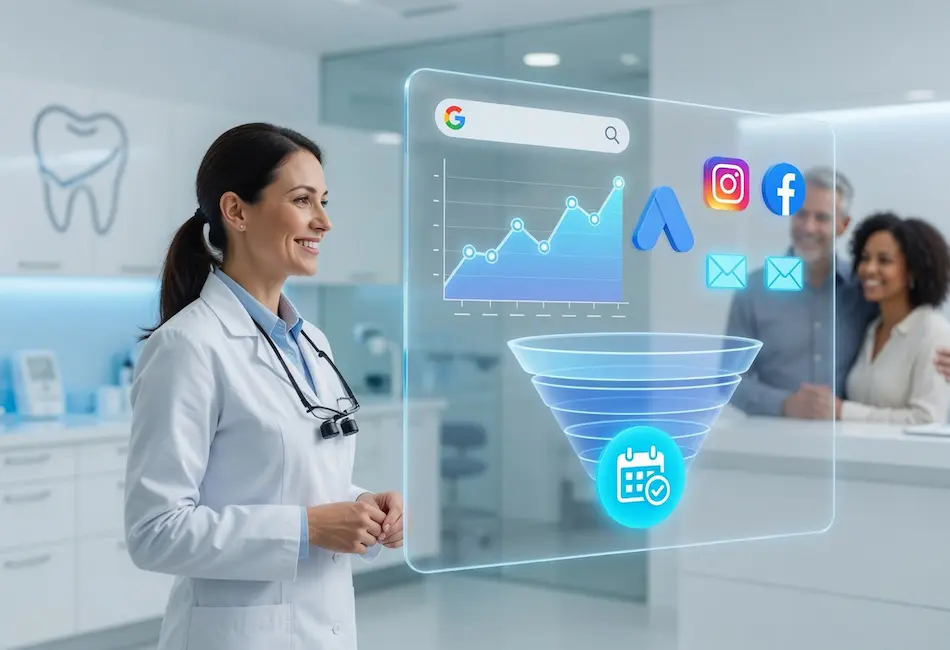
What is digital marketing for dentists? The full spectrum of online channels a dental practice uses to attract, convert, and retain patients. It includes SEO for organic visibility, paid search for immediate traffic, social media for community presence, email for patient retention, and the analytics that tie each channel to actual appointment bookings.
What it is and who it is for: Built for dental practice owners who know they need an online presence but are overwhelmed by the number of channels, vendors, and tactics competing for their budget. This page cuts through the noise and shows which channels produce patients and which ones produce invoices.
The rule: Every marketing dollar a dental practice spends should trace back to a booked appointment. If the channel cannot demonstrate that connection, it is not marketing. It is expense.
Why Dental Practices Need Digital Marketing
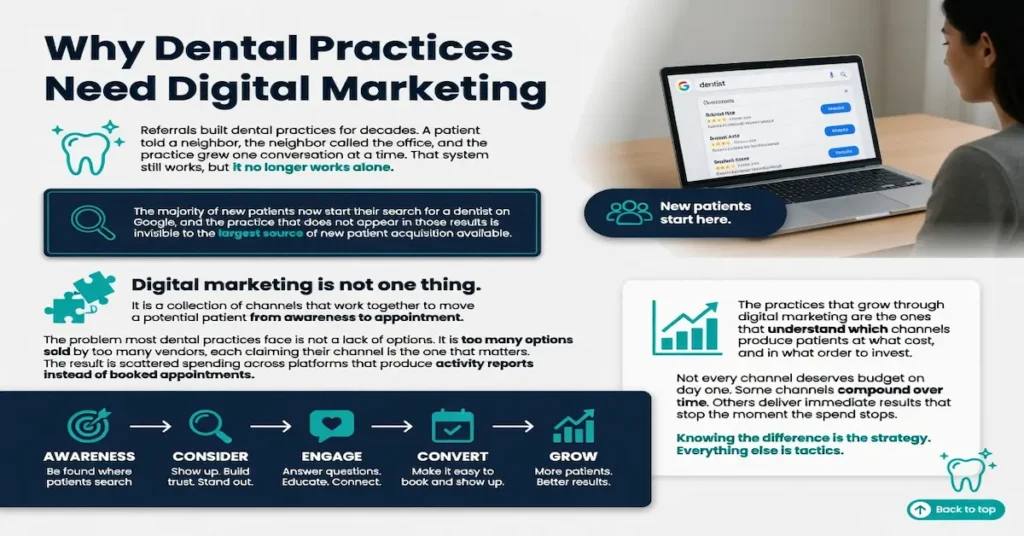
Referrals built dental practices for decades. A patient told a neighbor, the neighbor called the office, and the practice grew one conversation at a time. That system still works, but it no longer works alone. The majority of new patients now start their search for a dentist on Google, and the practice that does not appear in those results is invisible to the largest source of new patient acquisition available.
Digital marketing is not one thing. It is a collection of channels that work together to move a potential patient from awareness to appointment. The problem most dental practices face is not a lack of options. It is too many options sold by too many vendors, each claiming their channel is the one that matters. The result is scattered spending across platforms that produce activity reports instead of booked appointments.
The practices that grow through digital marketing are the ones that understand which channels produce patients at what cost, and in what order to invest. Not every channel deserves budget on day one. Some channels compound over time. Others deliver immediate results that stop the moment the spend stops. Knowing the difference is the strategy. Everything else is tactics.
SEO: The Foundation That Compounds
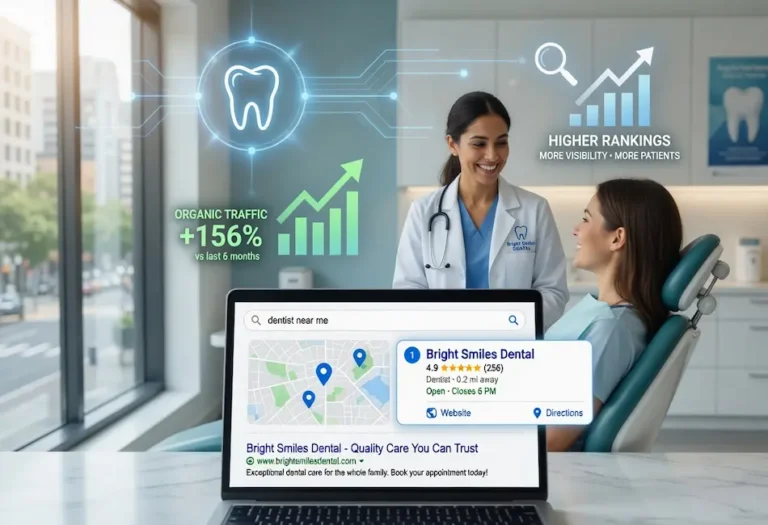
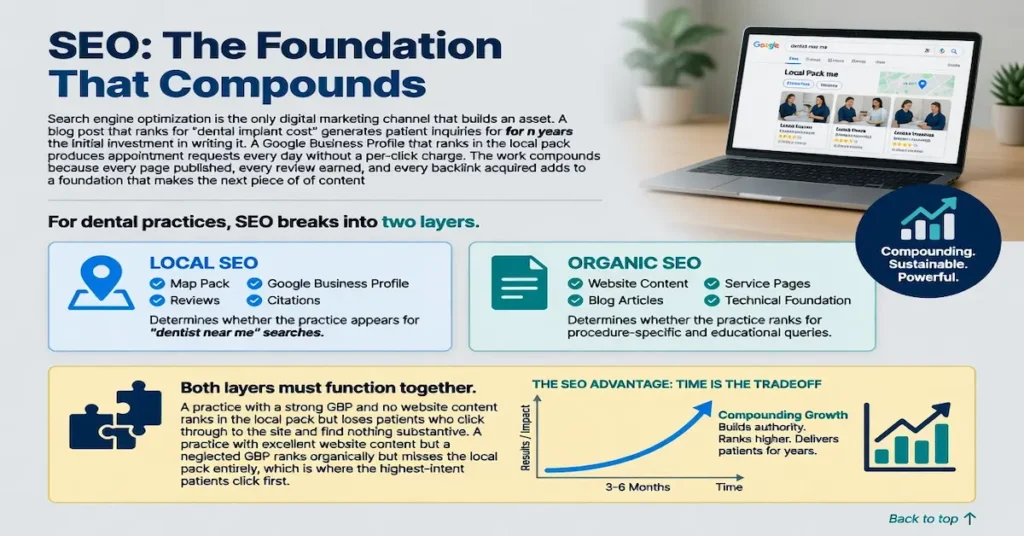
Search engine optimization is the only digital marketing channel that builds an asset. A blog post that ranks for “dental implant cost” generates patient inquiries for years after the initial investment in writing it. A Google Business Profile that ranks in the local pack produces appointment requests every day without a per-click charge. The work compounds because every page published, every review earned, and every backlink acquired adds to a foundation that makes the next piece of content easier to rank.
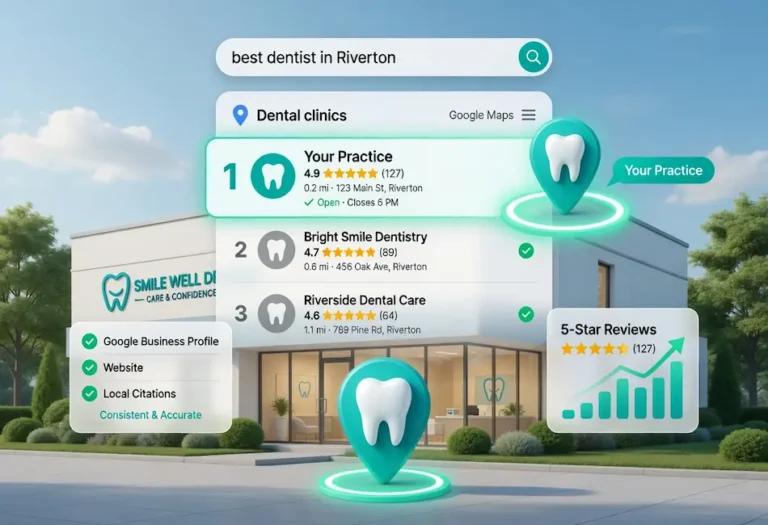
For dental practices, SEO breaks into two layers. Local SEO covers the map pack, Google Business Profile, reviews, and citations that determine whether the practice appears for “dentist near me” searches. Organic SEO covers the website content, service pages, blog articles, and technical foundation that determine whether the practice ranks for procedure-specific and educational queries.
Both layers must function together. A practice with a strong GBP and no website content ranks in the local pack but loses patients who click through to the site and find nothing substantive. A practice with excellent website content but a neglected GBP ranks organically but misses the local pack entirely, which is where the highest-intent patients click first.
The tradeoff with SEO is time. Results take three to six months to materialize for competitive keywords. But the return curve is unlike any other channel: it starts slow, then accelerates as authority builds, and continues producing long after the initial investment. No other dental marketing channel offers that compounding trajectory.
Paid Search: Immediate Visibility at a Cost
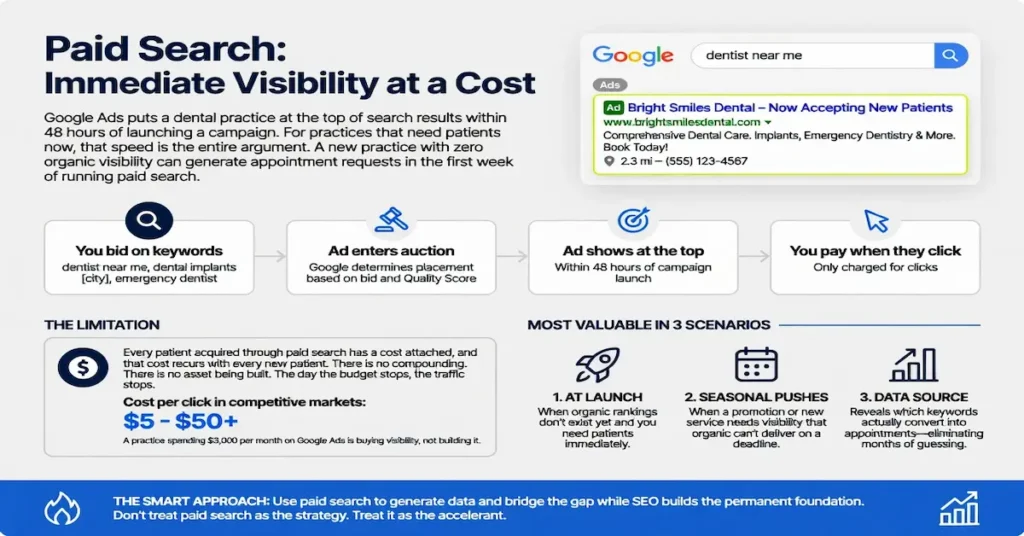
Google Ads puts a dental practice at the top of search results within 48 hours of launching a campaign. For practices that need patients now, that speed is the entire argument. A new practice with zero organic visibility can generate appointment requests in the first week of running paid search.
The model is straightforward. You bid on keywords like “dentist near me,” “dental implants [city],” or “emergency dentist.” When a patient searches that term, your ad enters an auction. Google determines placement based on your bid amount and quality score, which reflects how relevant your ad and landing page are to the search query. You pay only when someone clicks.
The limitation is equally straightforward. Every patient acquired through paid search has a cost attached, and that cost recurs with every new patient. There is no compounding. There is no asset being built. The day the budget stops, the traffic stops. For dental keywords in competitive markets, cost per click ranges from $5 to $50 depending on the procedure and location. A practice spending $3,000 per month on Google Ads is buying visibility, not building it.
Paid search is most valuable in three scenarios. At launch, when organic rankings do not exist yet and the practice needs patients immediately. During seasonal pushes, when a specific promotion or new service needs visibility that organic rankings cannot deliver on a deadline. And as a data source, because paid campaigns reveal which keywords actually convert into appointments within weeks, which eliminates months of guessing in the organic content strategy.
The smartest dental practices use paid search to generate data and bridge the gap while SEO builds the permanent foundation. They do not treat paid search as the strategy. They treat it as the accelerant.
Social Media: Community Presence, Not Patient Acquisition
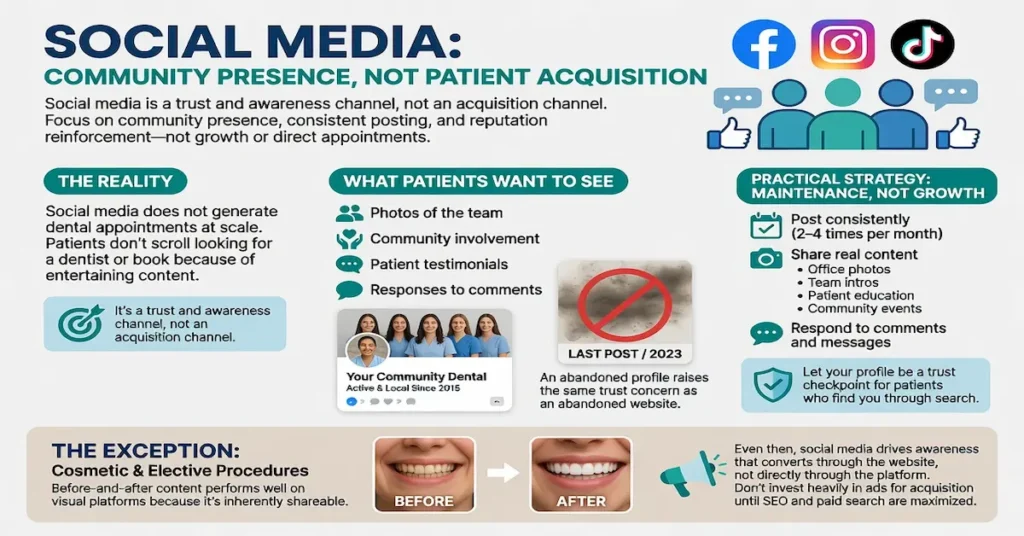
Social media does not generate dental appointments at scale. That statement will frustrate every social media agency selling packages to dental practices, but the data supports it. Patients do not scroll Instagram looking for a dentist. They do not book cleanings because a TikTok video was entertaining. Social media is a trust and awareness channel, not an acquisition channel.
Where social media earns its place in dental marketing is community presence and reputation reinforcement. A patient who finds a dental practice through Google and then checks the practice’s Facebook page wants to see a real, active business: photos of the team, posts about community involvement, patient testimonials, and responses to comments. An abandoned social profile with the last post from 2023 raises the same trust concern as an abandoned website.
The practical social media strategy for most dental practices is maintenance, not growth. Post consistently (two to four times per month), share real content (office photos, team introductions, patient education, community events), respond to comments and messages, and let the profile serve as a trust checkpoint for patients who find the practice through search. Do not invest significant budget into social media advertising for patient acquisition unless the practice has already maximized its return from SEO and paid search.
The exception is practices offering cosmetic or elective procedures. Cosmetic dentistry, teeth whitening, and smile makeover content performs well on visual platforms because the before-and-after format is inherently shareable. Even then, social media drives awareness that converts through the website, not directly through the platform.
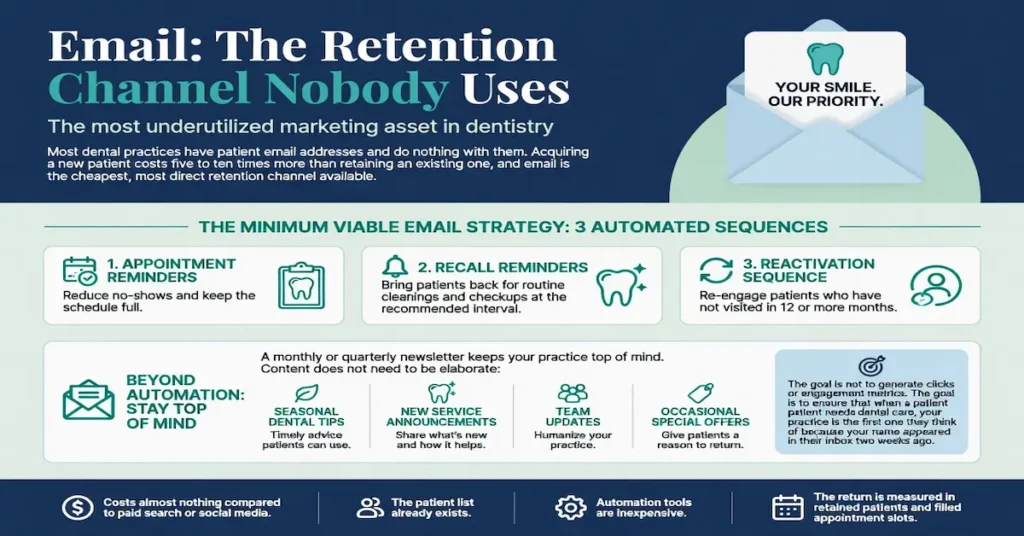
Email: The Retention Channel Nobody Uses
Most dental practices have patient email addresses and do nothing with them. This is the most underutilized marketing asset in dentistry. Acquiring a new patient costs five to ten times more than retaining an existing one, and email is the cheapest, most direct retention channel available.
The minimum viable email strategy for a dental practice is three automated sequences. Appointment reminders that reduce no-shows and keep the schedule full. Recall reminders that bring patients back for routine cleanings and checkups at the recommended interval. And a reactivation sequence for patients who have not visited in 12 or more months.
Beyond automation, a monthly or quarterly newsletter keeps the practice top of mind. Content does not need to be elaborate: seasonal dental tips, new service announcements, team updates, and the occasional special offer. The goal is not to generate clicks or engagement metrics. The goal is to ensure that when a patient needs dental care, your practice is the first one they think of because your name appeared in their inbox two weeks ago.
Email marketing costs almost nothing compared to paid search or social media advertising. The patient list already exists. The automation tools are inexpensive. The return is measured in retained patients and filled appointment slots, not impressions or click-through rates.
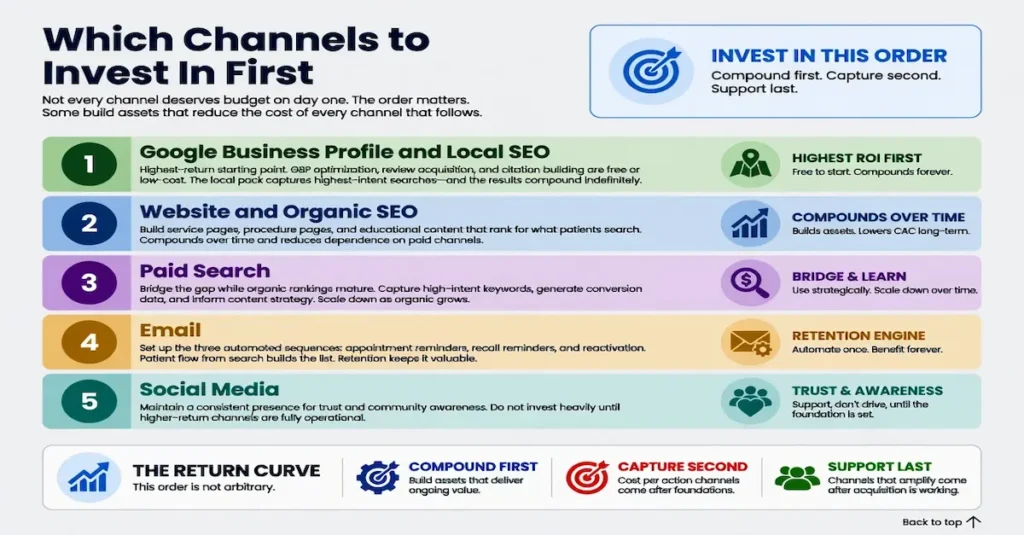
Which Channels to Invest In First
Not every channel deserves budget on day one. The order matters because some channels build assets that reduce the cost of every channel that follows, while others consume budget without compounding.
First: Google Business Profile and local SEO. This is the highest-return starting point for any dental practice. GBP optimization is free. Review acquisition is free. Citation building is low-cost. The local pack captures the highest-intent patient searches, and the work you put into local SEO today continues producing results indefinitely.
Second: Website and organic SEO. Service pages, procedure pages, and educational content that targets the keywords patients search before booking. This investment compounds over time and reduces dependence on paid channels as organic rankings build.
Third: Paid search. Use it to bridge the gap while organic rankings mature, to capture high-intent keywords where organic competition is fierce, and to generate conversion data that informs the organic content strategy. Scale paid spend down as organic visibility increases.
Fourth: Email. Set up the three automated sequences (appointment reminders, recall reminders, reactivation) once organic and local visibility are established. The patient flow from search creates the email list that the retention system maintains.
Fifth: Social media. Maintain a consistent presence for trust and community awareness. Do not invest heavily until the higher-return channels are fully operational.
This order is not arbitrary. It follows the return curve: the channels that compound go first, the channels that cost per action go second, and the channels that support rather than drive acquisition go last.
Measuring What Actually Matters
The only metric that matters for dental marketing is booked appointments. Every other metric is either a leading indicator or a vanity number. The distinction determines whether the practice is making data-driven decisions or just reading dashboards.
Leading indicators worth tracking: Organic search impressions and positions in Google Search Console show whether SEO is progressing. Click-through rate on paid ads shows whether the ad copy resonates. Website traffic from organic and paid sources shows whether visibility is translating into visits. Phone call tracking shows how many calls each channel generates.
Vanity metrics to ignore: Social media follower counts, page likes, impression counts without context, and any metric that cannot be connected to a patient walking through the door. A dental practice with 10,000 Instagram followers and zero patients from social media has a vanity problem, not a marketing strategy.
The connection that matters: Every marketing channel should trace to a conversion action. For dental practices, conversion actions are phone calls, appointment form submissions, and direction requests. Call tracking with unique phone numbers per channel, form submission tracking through analytics, and GBP insights that show direction requests and call clicks are the tools that connect marketing spend to actual patients.
Any marketing vendor who cannot show this connection is selling activity, not results. Ask for the patient acquisition cost per channel. If they cannot provide it, the measurement infrastructure does not exist, and you are spending blind.
What You Get
A digital marketing strategy built around the channels that produce dental patients, prioritized by return and sequenced for compounding growth. Not a package of disconnected services. A system where each channel reinforces the others and the measurement infrastructure connects every dollar spent to appointments booked.
This service is part of our dental SEO services and sits within the broader healthcare SEO strategy. The digital marketing layer works on top of the SEO foundation. Without that foundation, paid search and social media are renting visibility that disappears when the budget runs out. With it, every channel produces more at lower cost because the organic presence is doing the heavy lifting.
Start with a business consultation to find out which channels deserve your budget first and which ones are consuming it without producing patients.
FAQ
How much should a dental practice spend on digital marketing?
Most dental practices investing effectively in digital marketing spend between $2,000 and $5,000 per month across all channels combined. The split between SEO, paid search, and other channels depends on the practice’s current online visibility, competitive market, and whether it needs immediate patients or is building for long-term growth. New practices typically allocate more toward paid search initially and shift budget toward SEO as organic rankings build.
Which is better for dentists, SEO or Google Ads?
Both serve different purposes. Google Ads delivers immediate visibility at a recurring cost per click. SEO takes longer but builds a compounding asset that produces patients without per-click charges. The best strategy uses Google Ads to generate patients and data in the short term while SEO builds the organic foundation that reduces paid dependence over time. They are sequential, not competing.
Does social media actually bring in dental patients?
Not at scale for most practices. Social media is a trust and community presence channel, not a patient acquisition channel. Patients find dentists through Google, not Instagram. Social media earns its place by reinforcing trust when a potential patient checks your profile after finding you in search results. Invest in it for maintenance, not as a primary growth driver.
How do I know if my dental marketing is working?
Track booked appointments by channel. Every marketing channel should connect to a conversion action: phone calls, appointment form submissions, or direction requests. Call tracking with unique numbers per channel and form submission tracking through analytics provide the data needed to calculate patient acquisition cost per channel. Any vendor who cannot show this connection is selling activity, not results.
Should a dental practice do email marketing?
Yes. Email is the cheapest retention channel available and most dental practices ignore it entirely. At minimum, set up three automated sequences: appointment reminders to reduce no-shows, recall reminders to bring patients back for routine care, and a reactivation sequence for patients who have not visited in twelve or more months. The patient list already exists. The cost is negligible. The return is measured in retained patients and filled schedules.
What is the first thing a dental practice should do for digital marketing?
Optimize the Google Business Profile. It is free, it produces the highest-intent patient visibility through the local pack, and the work compounds immediately. Complete every field, add real photos, list every service, and start building a review pipeline. Everything else in digital marketing works better when the GBP foundation is solid.