Link Building Services: Costs, Methods, How to Choose
AI Summary
What are link building services? A link building service manages the process of acquiring backlinks from external websites to pages on your site. Legitimate services include five components: strategic planning, prospecting, outreach, content creation, and reporting. The quality of each component determines whether the service produces ranking improvements or spreadsheet entries.
What it is and who it is for: This guide covers what link building services include, how legitimate providers operate, what the methods cost, and how to evaluate a provider before hiring. It is for business owners and marketing leaders who are considering outsourcing link building and need to distinguish between providers that produce results and providers that produce risk.
The rule: The metric that matters is not cost per link. It is cost per ranking improvement on commercially valuable keywords. Expensive links that move rankings are cheaper than cheap links that do nothing, because the expensive links generate revenue and the cheap links generate spreadsheet entries.
What Link Building Services Actually Include
A link building service manages the process of acquiring backlinks from external websites to pages on your site. That single sentence describes the function. What the function contains varies so dramatically between providers that two services operating under the same description can deliver products with no overlap in quality, methodology, or impact on rankings.
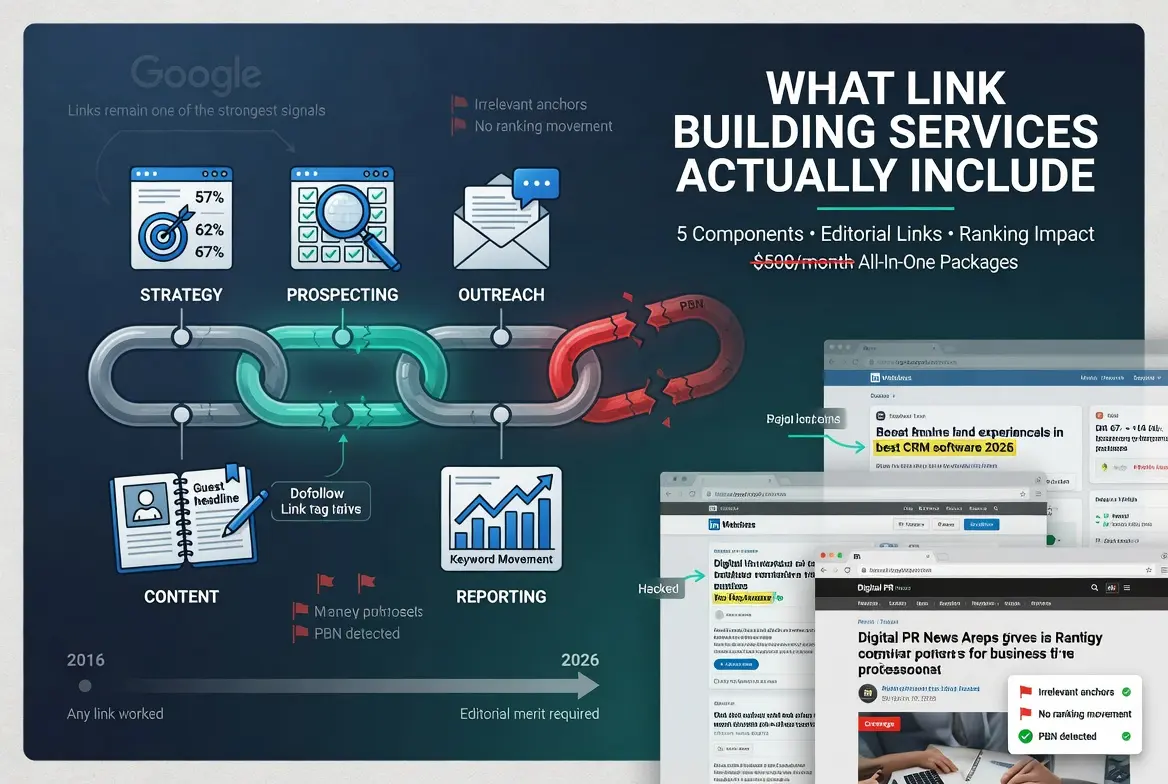
At the operational level, a legitimate link building service includes five components. Strategic planning determines which pages on your site receive links, what anchor text distribution to maintain, and what types of sites to target for placement. Prospecting identifies specific sites that meet the quality criteria and have audiences relevant to your content. Outreach contacts site owners, editors, or content managers with a pitch that earns placement through editorial merit rather than payment alone. Content creation produces the guest posts, resource contributions, or data-driven assets that justify the placement. Reporting documents the links acquired, the sites they appeared on, the anchor text used, and the ranking impact observed.
Each component requires different skills. Strategy requires SEO knowledge and competitive analysis capability. Prospecting requires research discipline and quality judgment. Outreach requires communication skill and persistence. Content creation requires writing ability and subject matter understanding. Reporting requires analytical capability and honesty about what the numbers show. A provider who excels at all five is rare. A provider who claims to excel at all five while charging $500 per month is not rare. They are lying.
The services that produce measurable ranking improvements are the ones where every component operates at quality. A strong strategy with weak outreach produces a plan nobody executes. Strong outreach with weak prospecting produces placements on sites that do not matter. Strong placements with weak reporting produces results nobody can verify or learn from. The chain is only as strong as the weakest component.
Why Links Still Determine Who Ranks
Every year since 2015, someone has published an article declaring that backlinks are declining as a ranking factor. Every year since 2015, the correlation studies, the ranking experiments, and the observable behavior of Google’s ranking algorithm have confirmed that links remain one of the strongest signals in the ranking system. The reason is structural, not historical.
Google’s ranking system needs external validation signals to evaluate whether a page deserves visibility. The content on the page tells Google what the page is about. The technical implementation tells Google whether the page is accessible and well-built. But neither the content nor the technical implementation tells Google whether anyone else on the internet considers the page valuable enough to reference. Links provide that signal. When a site with its own audience, authority, and editorial standards links to your page, it is telling Google that your content was worth citing. That citation carries weight precisely because the linking site had the choice not to link and chose to do so anyway. In the 5C Framework, this external validation layer is what the Credibility discipline is built to develop systematically.
The quality threshold for links that carry ranking weight has risen continuously. In 2016, a link from almost any site with a pulse provided some benefit. In 2026, Google’s systems evaluate the authority of the linking site, the topical relevance between the linking site and the linked page, the editorial context of the placement, and the naturalness of the anchor text. Links that fail these evaluations are discounted or ignored. Links that pass them remain among the most powerful ranking signals available. This is why link building services exist: earning the links that pass Google’s quality evaluation requires systematic effort that most businesses cannot sustain internally.
The Methods Legitimate Providers Use
The link building methods that produce durable ranking improvements share a common characteristic: they earn placement through editorial merit. The linking site publishes the content or adds the link because the content provides value to their audience, not solely because money changed hands. The distinction is not always clean, but the providers operating on the right side of it produce links that withstand algorithm updates, while the providers operating on the wrong side produce links that create escalating risk with every placement.
Guest Posting
The provider writes an article for publication on an external site, with a dofollow link back to your target page embedded in the content. The article passes through the host site’s editorial review process before publication. The quality of the placement depends entirely on the quality of the host site and the rigor of its editorial standards. A guest post on a site that reviews every submission and rejects most of them carries different authority than a guest post on a site that publishes everything submitted with a fee attached.
Digital PR
The provider creates newsworthy content, original research, data analysis, expert commentary, or trend reports, and pitches it to journalists and editors at publications that cover the relevant beat. The links come from news coverage of the content rather than from placed articles. Digital PR produces the highest-authority links of any method because the linking sites are major publications with large audiences and strong editorial independence. The cost and difficulty are correspondingly higher.
Resource Page Outreach
The provider identifies existing pages on external sites that curate links to useful resources on a specific topic. If your content qualifies as a resource worth including, the outreach asks the curator to add your link to their existing list. These links tend to be durable because the hosting page exists specifically to collect valuable references. The volume is limited because relevant resource pages are finite in any niche.
Broken Link Building
The provider finds links on external sites that point to pages that no longer exist. They contact the site owner, alert them to the broken link, and suggest your relevant content as a replacement. The method is editorially sound because you are solving a problem for the site owner while earning a placement. Success rates are modest because many site owners do not actively maintain their content. The links that result are high quality because they replace genuine editorial citations.
Unlinked Mention Reclamation
The provider monitors the web for mentions of your brand, your content, or your data that do not include a link. Outreach to the mentioning site requests the addition of a link to the existing mention. This method has the highest success rate of any outreach approach because the site has already demonstrated familiarity with your brand. The limitation is that it only works for brands with existing visibility.
Content-Driven Link Attraction
The provider creates linkable assets, comprehensive guides, original data, visual resources, tools, or templates, designed to attract links naturally as other writers discover and reference them. This method is slower than outreach-based approaches but produces the most natural link profiles because the links are earned without direct solicitation. The content investment is front-loaded. The link returns compound over months and years as the asset accumulates references organically.
What Separates Good Services From Bad Ones
The observable differences between link building services that produce rankings and those that produce spreadsheets are specific enough to evaluate before spending money.
Good services show their work. They can produce specific URLs of links they have built for other clients. You can visit those pages, verify the linking site is real, evaluate the content quality, and confirm the link exists in a context that makes editorial sense. Bad services show aggregated metrics: “we built 200 links last quarter with an average DR of 45.” The aggregation hides the reality that most of those links are on sites you would not want associated with your brand if you saw them individually.
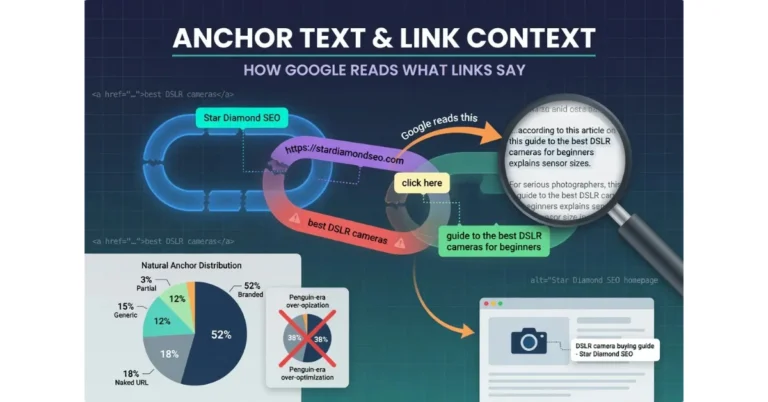
Good services discuss anchor text strategy proactively. They understand that anchor text distribution affects both ranking potential and penalty risk. They maintain a log of every anchor used across the campaign and adjust the distribution based on what the profile needs, not what the client requested. Bad services use whatever anchor text the client asks for without evaluating whether the cumulative pattern looks natural. Over-optimized anchor text is one of the most common and most avoidable link building failures.
Good services define quality standards before the engagement begins. They specify minimum thresholds for site traffic, editorial independence, and topical relevance. They explain what types of sites they will not place links on and why. Bad services define quality by a single metric, usually domain rating, because a single number is easy to hit and hard for the client to verify as meaningful. A DR 50 site with no traffic and no editorial standards is not a quality placement regardless of the number attached to it.
Good services connect link building to ranking outcomes. They track which pages received links, how those pages moved in rankings for target keywords, and what the business impact of that movement was. Bad services report on links acquired and stop there. The link count goes up. Whether the rankings follow is treated as someone else’s problem.
What Link Building Services Cost
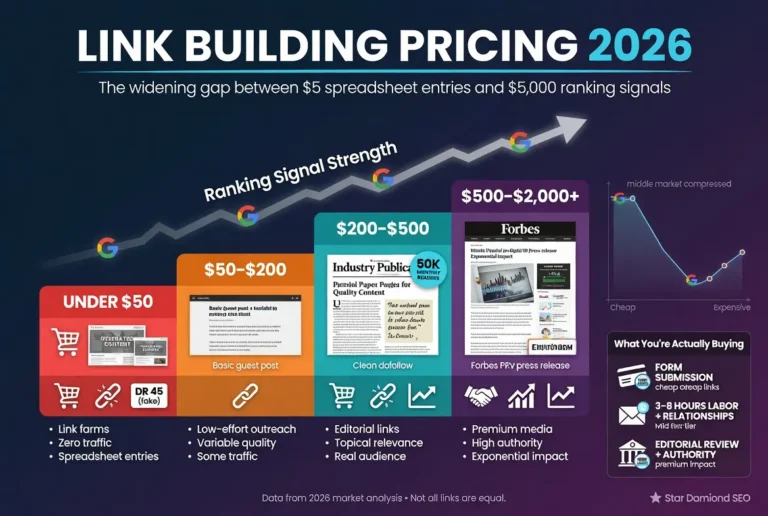
The pricing landscape for link building in 2026 reflects the quality bifurcation of the market. The detailed pricing breakdown by tier, model, and provider type is covered in the companion pricing guide. The summary relevant to evaluating services is this.
Managed link building campaigns from agencies cost $2,000 to $5,000 per month for small to midsize businesses, producing 5 to 15 quality links per month. Enterprise campaigns run $5,000 to $15,000. Per-link pricing ranges from $150 for mid-tier placements to $500 or more for high-authority editorial sites. Premium placements on major publications can exceed $1,000 per link.
Freelance link builders charge $100 to $400 per link for quality placements. Marketplace platforms offer links at $15 to $100 per placement, with quality that varies from occasionally legitimate to consistently worthless.
The metric that matters is not cost per link. It is cost per ranking improvement on commercially valuable keywords. Expensive links that move rankings are cheaper than cheap links that do nothing, because the expensive links generate revenue and the cheap links generate spreadsheet entries. Every pricing conversation should resolve to this calculation.
Agencies, Freelancers, and Managed Platforms
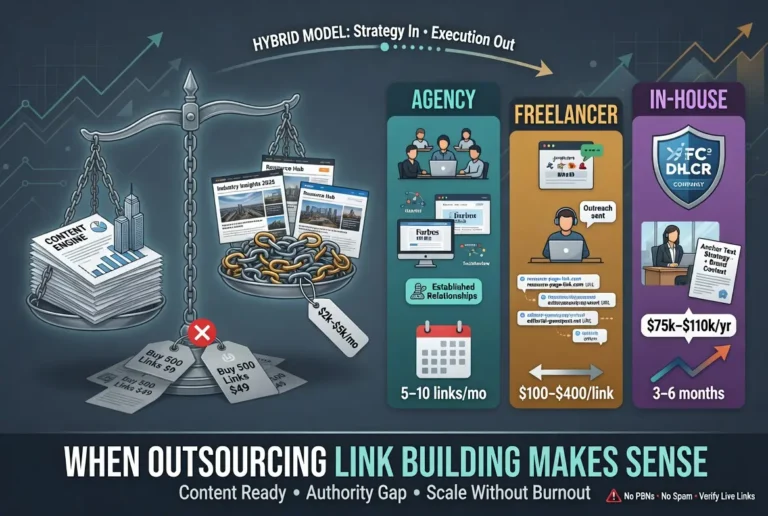
The three provider types serve different needs, operate at different price points, and carry different risk profiles. The detailed comparison is covered in the link building outsourcing guide. The summary for the service evaluation context is this.
Agencies bring teams, established publisher relationships, and systematized processes. They manage strategy through execution. The best agencies produce consistently because their processes are refined across hundreds of client campaigns. The worst agencies are resellers who outsource the actual work to freelancers or offshore teams while maintaining the agency markup. Ask who touches your account. Ask where the links come from. Ask for specifics, not capabilities.
Freelancers bring individual expertise at lower cost with higher variability. A skilled freelancer with genuine publisher relationships outperforms mid-tier agencies on a per-link basis. An unskilled freelancer with a database of low-quality sites produces links that range from useless to harmful. The evaluation criteria are the same: show me links you have built, let me visit the pages, let me verify the quality.
Managed platforms aggregate link building at scale through technology-enabled workflows. Some operate as marketplaces connecting buyers with link opportunities. Others operate as full-service platforms with internal teams, proprietary publisher networks, and quality control processes. The best platforms combine agency-level quality with technology-enabled pricing. The worst are link farms with a dashboard.
How to Evaluate a Link Building Service Before Hiring
The evaluation process that protects your investment takes less time than reading the proposal and tells you more than anything in it.
Ask for five links they built in the last 90 days. Not a case study. Not a report. Five URLs. Visit each page. Read the content surrounding the link. Check the linking site’s traffic in Ahrefs or SimilarWeb. Evaluate whether the site has a real audience, genuine editorial content, and topical relevance to the linked page. This ten-minute exercise eliminates 80% of the risk in hiring a link building service. Providers who cannot produce specific recent examples are either not building the kind of links they describe or not building links at all.
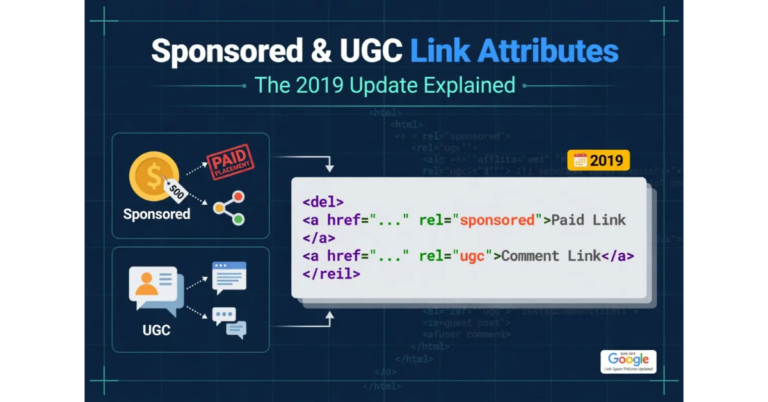
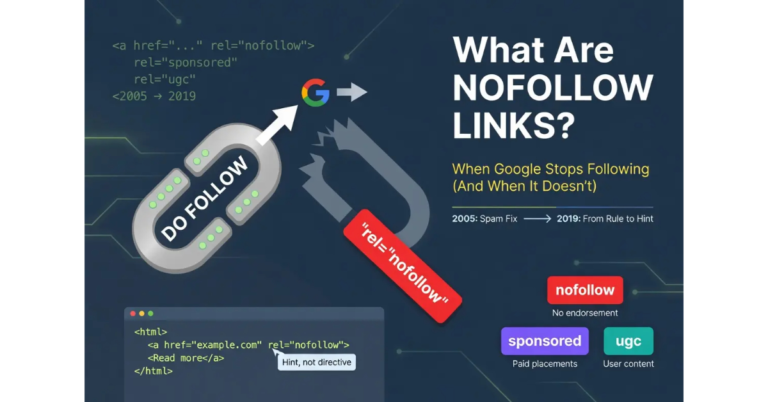
Ask how they handle link attributes. A provider who builds exclusively dofollow links and considers nofollow links worthless has an incomplete understanding of how modern link profiles work. Natural link profiles contain a mix of dofollow, nofollow, and UGC or sponsored attributes. A provider who understands this nuance demonstrates technical sophistication that correlates with overall service quality.
Ask about their prospecting criteria beyond domain rating. What traffic thresholds do they apply? How do they evaluate editorial independence? How do they assess topical relevance? A provider whose prospecting starts and ends with “DR 40+” is using a single metric that is easily gamed and weakly correlated with actual link authority.
Ask about their link monitoring and replacement policy. Links occasionally get removed when sites change ownership, redesign, or audit their outbound links. A provider who monitors link persistence and replaces removed links demonstrates operational maturity. A provider who builds and forgets is selling placements, not outcomes.
Ask for a sample report. Evaluate whether the report connects link acquisition to ranking movement on target keywords. A report that shows links built without showing ranking impact is a production log, not a performance report. The distinction tells you whether the provider measures success by effort or by results.
What to Monitor After You Hire
Hiring the service does not end the evaluation. It shifts the evaluation from prospective to ongoing.
Review every link placement for at least the first three months. Visit the page. Read the content. Verify the link is live and in context. Confirm the linking site is something you are comfortable associating your brand with. This review takes 2 to 3 minutes per link and is the single most effective quality control mechanism available. After three months, if the quality has been consistent, you can shift to spot-checking a percentage of placements rather than reviewing every one.
Track ranking movement on target keywords monthly. The links should produce detectable movement within three to six months. If the movement is positive, the service is working. If there is no movement after six months of consistent link acquisition, either the link quality is insufficient, the target pages need content improvements, or the competitive gap is larger than estimated. The service provider should be engaged in diagnosing the cause, not insulated from the question.
Monitor your backlink profile for links you did not request. Some providers build links to client sites as part of their own link exchange networks, placing links from your site to other clients or from other clients to you without disclosure. Check your referring domain list monthly for sites you do not recognize and did not approve. Unauthorized link building creates risk you did not agree to carry.
Track link persistence quarterly. Pull your referring domains and compare against the links reported by the provider. If a significant percentage of placed links have disappeared, the provider is placing links on sites that actively remove paid or guest-posted content. The links provided temporary authority rather than the durable signal you paid for.
Red Flags That Should End the Engagement
Certain patterns, once identified, should terminate the relationship rather than prompt a conversation about improvement.
Links from private blog networks. PBNs are networks of sites created specifically to host outbound links. They have no real audience, no organic traffic, and no editorial purpose. Google has stated explicitly that PBN links violate their guidelines, and the detection systems have improved substantially. A provider using PBNs is selling you a liability disguised as an asset. There is no conversation to have. End the engagement.
Links from sites in unrelated industries. A link from a pet care blog to your SaaS company’s pricing page is not a relevant placement. It is a placement of convenience from a site that accepts anything. One or two irrelevant placements in a campaign are imperfect outreach. Ten or more suggest the provider does not differentiate between relevant sites and available sites.
Anchor text distribution that triggers concern. If 40% or more of your acquired links use exact-match keyword anchor text, the provider is building a pattern that Google’s systems are specifically designed to identify and penalize. This is not a quality issue to discuss. It is a risk that requires immediate correction and potentially a new provider.
Inability to produce specific link examples on request. If you ask “show me five links you built for us this month” and the provider cannot produce the URLs within 24 hours, either the links do not exist, the links exist on sites the provider does not want you to see, or the provider does not track their own work. None of these explanations is acceptable.
Reporting that never connects to rankings or business outcomes. If every monthly report shows links built and nothing else, the provider is documenting activity rather than measuring impact. Activity without accountability is how bad link building services sustain client relationships long enough to collect retainer payments that never produce returns.
Building a Link Strategy That Compounds
The link building services that produce the strongest long-term results are the ones embedded in a broader SEO strategy rather than operating as a standalone function.
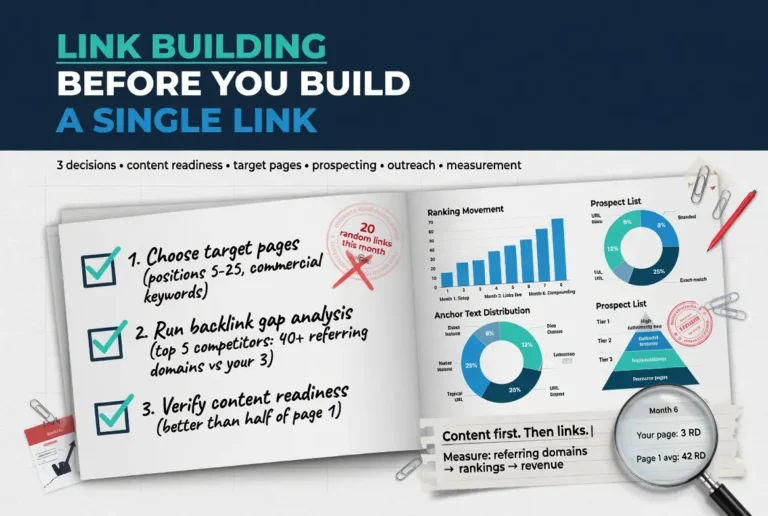
Links should point to pages that deserve to rank. This means the content on those pages needs to be competitive with what currently occupies page one for the target keyword before link building begins. Sending authority signals to a thin page wastes the investment. The content must be built first. Every target page should meet the quality standards on the on-page SEO checklist before a single link dollar is spent pushing it. The link building campaign then pushes competitive content into positions it could not reach on content quality alone.
The link strategy should align with the site’s content cluster strategy. Pages within the same topical cluster should receive coordinated link building that strengthens the entire cluster, not just individual pages. A link to the pillar page of a cluster strengthens every supporting page in that cluster through internal link architecture. A link to a supporting page strengthens both the page itself and the pillar above it. The link strategy should account for these relationships rather than treating each page as an isolated target.
Diversification across link types, anchor text patterns, and linking site profiles builds a resilient backlink profile that withstands algorithm updates. A profile built entirely on guest posts from one publisher tier is fragile. A profile built across guest posts, resource pages, editorial citations, brand mentions, and organically attracted links is robust. The best link building services build toward the second profile, even though it requires more varied tactics and higher operational complexity.
The compounding effect is real and measurable. A site that builds 10 quality links per month for twelve months does not simply have 120 more links at the end of the year. It has a domain authority profile that makes every subsequent piece of content rank faster, every subsequent link easier to earn, and every subsequent competitor harder to displace. The first link is the hardest. The hundredth link benefits from the ninety-nine that came before it. Link building services that understand this compounding dynamic build strategies designed for long-term authority accumulation rather than short-term metric inflation.
The E-E-A-T signals that support link building extend beyond the links themselves. Author attribution, transparency infrastructure, source citation, and genuine subject matter expertise on the linked pages all contribute to how Google evaluates the authority signals those links carry. A link to a page with strong E-E-A-T signals receives full credit. A link to a page with weak E-E-A-T signals receives discounted credit. The trust signals the page demonstrates determine the ceiling on what the links can achieve. The link building service and the content operation should be working toward the same quality standard.
The same link authority that drives organic rankings now influences whether AI platforms consider your domain trustworthy enough to cite in generated responses. Building links compounds across both layers of search visibility simultaneously.
FAQ
What do link building services include?
A legitimate link building service includes five components: strategic planning that determines which pages receive links and what anchor text distribution to maintain, prospecting that identifies quality sites for placement, outreach that earns editorial placement through merit, content creation that justifies the placement, and reporting that documents results and connects link acquisition to ranking movement.
How much do link building services cost?
Managed campaigns from agencies cost $2,000 to $5,000 per month for small to midsize businesses, producing 5 to 15 quality links per month. Per-link pricing ranges from $150 for mid-tier placements to $500 or more for high-authority editorial sites. Freelancers charge $100 to $400 per link. The metric that matters is cost per ranking improvement on commercially valuable keywords, not cost per link.
Are backlinks still important for SEO in 2026?
Yes. Links remain one of the strongest signals in Google’s ranking system because they provide external validation that no other signal replicates. The quality threshold has risen continuously, and links that fail Google’s evaluation of authority, relevance, and editorial context are discounted or ignored. Links that pass the evaluation remain among the most powerful ranking signals available.
How do I evaluate a link building service before hiring?
Ask for five specific URLs of links they built in the last 90 days. Visit each page, verify the linking site has real traffic and editorial content, and confirm the link exists in context that makes editorial sense. This ten-minute exercise eliminates 80% of the risk. Also ask about their anchor text strategy, prospecting criteria beyond domain rating, and whether their reporting connects link acquisition to ranking outcomes.
What is the difference between good and bad link building?
Good link building earns placement through editorial merit on sites with real audiences, genuine editorial standards, and topical relevance to the linked page. Bad link building places links on sites that accept anything for a fee, regardless of relevance, audience, or editorial quality. The difference is observable by visiting the linking pages and evaluating whether the placement makes editorial sense.
What are the red flags that a link building service is harmful?
Links from private blog networks, placements on sites in unrelated industries, anchor text distribution where 40% or more uses exact-match keywords, inability to produce specific link examples on request, and reporting that never connects link acquisition to ranking or business outcomes. Any of these patterns should terminate the engagement rather than prompt a conversation about improvement.
How long does it take for link building to affect rankings?
Quality links should produce detectable ranking movement within three to six months. If there is no movement after six months of consistent acquisition, either the link quality is insufficient, the target pages need content improvements, or the competitive gap is larger than estimated. The compounding effect means each subsequent link benefits from every link that came before it, so the impact accelerates over time.