Best AI Search Visibility Tools Compared (2026)
AI Summary
What are AI search visibility tools? AI search visibility tools are software platforms that track how a brand appears in AI-generated search responses across platforms like Google AI Overviews, ChatGPT, Perplexity, Gemini, and Copilot. They measure citation frequency, competitive positioning, sentiment, and historical trends that traditional rank trackers and analytics platforms cannot capture.
What it is and who it is for: This article is for SEO practitioners and marketing managers evaluating which AI visibility tracking tool fits their budget, team size, and platform coverage needs. It compares the tool categories, what each type actually measures versus what it claims to measure, and where the gaps are that no current tool covers well.
The rule: No single tool tracks everything across every platform with full historical depth and competitive benchmarking at a price that works for every team. The right tool depends on which AI platforms your audience uses, how many keywords you need to monitor, and whether you need standalone AI tracking or integration with your existing SEO workflow.
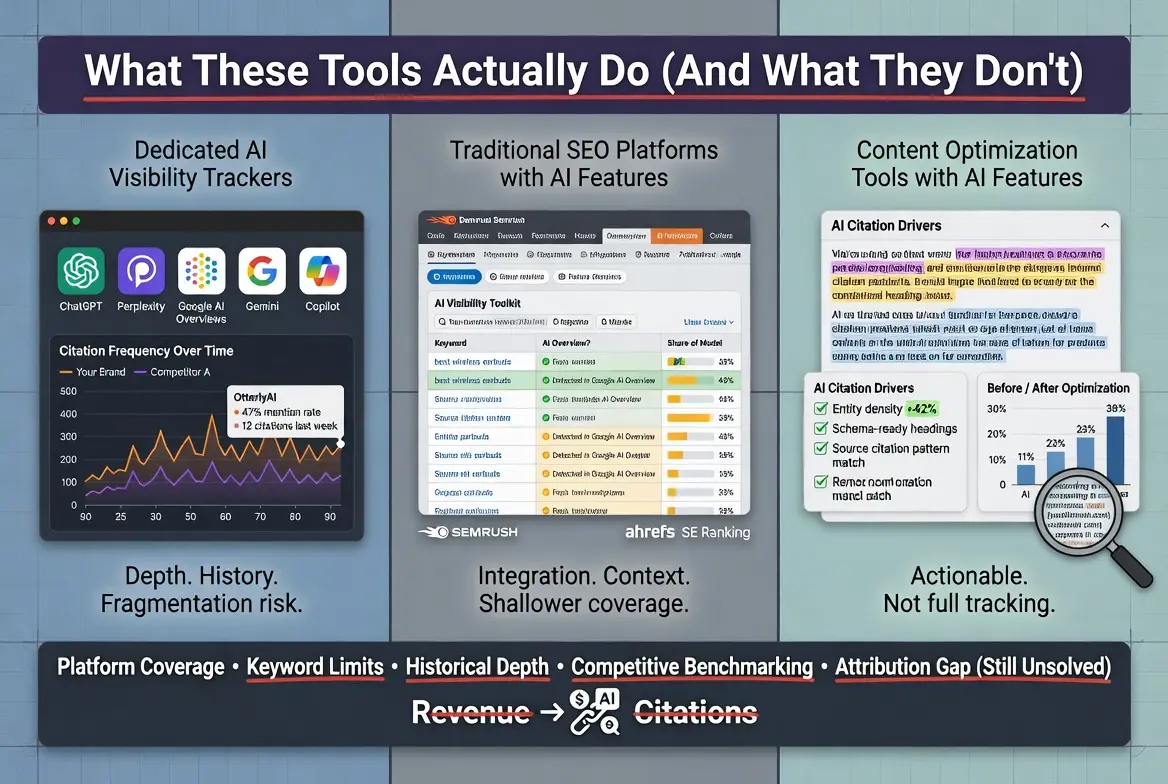
What These Tools Actually Do (And What They Don’t)
Every AI search visibility tool makes the same core promise: we track how your brand appears in AI-generated search results. The differences are in which platforms they monitor, how deeply they analyze the results, whether they store historical data, and how much they charge. Some differences are meaningful. Some are marketing.
What all of them do at a baseline level is run queries against AI platforms and record whether your brand or domain appears in the response. That core function is table stakes. The value beyond that baseline comes from how many platforms they cover, how frequently they sample, whether they provide competitive benchmarking, and whether the historical data goes deep enough to identify real trends versus noise.
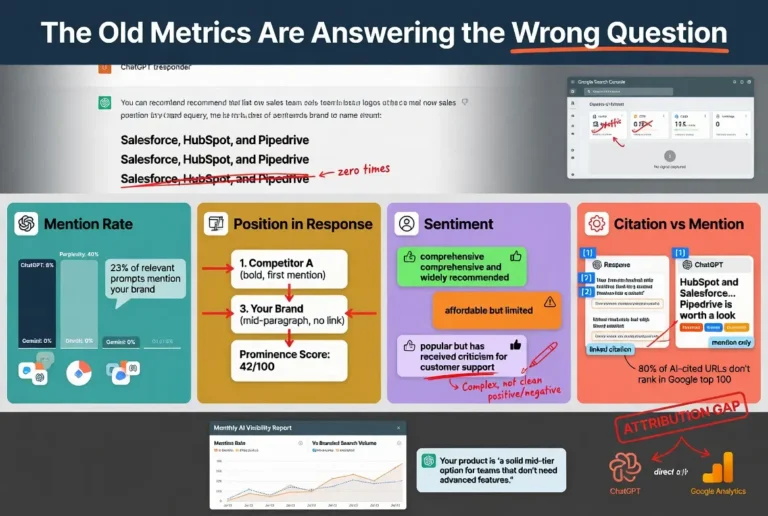
What none of them do well yet is attribution. No tool in this category can tell you how much revenue your AI citations generated. The attribution gap between AI visibility and business impact is a measurement infrastructure problem, not a tool feature that someone forgot to build. Any vendor claiming direct AI-to-revenue attribution is overpromising relative to what the data can support in 2026.
The Three Tool Categories
The market has settled into three categories. They overlap at the edges but the core positioning is distinct enough that choosing starts with knowing which category fits your situation.
Dedicated AI Visibility Trackers
Purpose-built platforms designed from scratch to monitor brand visibility across AI-generated responses. OtterlyAI, Profound, Peec AI, and several newer entrants live here. These tools typically cover multiple AI platforms (ChatGPT, Perplexity, Google AI Overviews, Gemini, Copilot), track citation frequency and competitive share of model, store historical data, and provide some form of optimization recommendations.
The advantage is depth. These tools were engineered for the specific problem of measuring AI visibility, not retrofitted onto a rank tracker. The competitive benchmarking tends to be more granular than what bolt-on features offer. The historical trending is usually richer because the tool was built around the concept of tracking AI citations over time.
The limitation is that they are another tool in your stack. Another login, another dashboard, another cost. If you already run Ahrefs or Semrush for SEO, a dedicated AI tracker means managing data across two platforms that do not talk to each other unless you manually connect them. For smaller teams, that fragmentation is a real operational cost beyond the subscription price.
Pricing ranges from free tiers with limited keyword tracking to $100 to $300 per month for mid-tier plans. Enterprise pricing goes higher. Most offer a trial or limited free version that lets you validate the data before committing.
Traditional SEO Platforms with AI Features
Semrush, SE Ranking, and Ahrefs have all added AI visibility tracking as features within their existing platforms. Semrush has gone furthest with a dedicated AI Visibility Toolkit that tracks mentions across multiple platforms. SE Ranking built a standalone AI Search Toolkit. Ahrefs has added AI Overview detection within its rank tracking.
The advantage is integration. If you already use one of these platforms for keyword tracking, backlink analysis, and competitive research, having AI visibility data in the same environment eliminates the context-switching problem. You can correlate organic ranking changes with AI citation changes in one dashboard. For teams that live inside Semrush or SE Ranking daily, this is a significant workflow benefit.
The limitation is depth. Bolt-on AI features rarely match the depth of purpose-built tools. Ahrefs’ AI Overview detection tells you whether an AI Overview appeared for a keyword but does not provide the citation-level detail or multi-platform coverage that a dedicated tracker offers. Semrush’s AI Toolkit is more comprehensive but still newer and less mature than tools that have been building AI visibility features exclusively for the last two years.
Pricing for the AI features is typically included in existing subscription plans or available as an add-on. Semrush plans start at $139 per month. SE Ranking starts lower. The AI features usually require mid-tier or higher plans.
Content Optimization Tools with AI Visibility Features
Tools like Surfer and Thruuu that approach AI visibility from the content creation side rather than the monitoring side. Instead of primarily tracking citations after the fact, they analyze what content characteristics drive AI citations and help you structure content for AI extraction. Some provide basic citation tracking, but the core value is research and optimization guidance rather than ongoing monitoring.
The advantage is actionability. Knowing you are not cited is useful. Knowing why you are not cited and what to change is more useful. These tools close the gap between monitoring and doing something about what the monitoring reveals.
The limitation is that they are not full tracking solutions. If you need historical citation data, competitive benchmarking, and multi-platform monitoring, a content research tool alone will not cover it. They complement a tracker. They do not replace one.
What to Evaluate Before Buying
The vendor landscape is crowded enough that feature comparison charts do not differentiate as clearly as they should. Most tools claim multi-platform coverage, competitive benchmarking, and historical tracking. The differences that actually affect your experience show up in the details.
Platform Coverage
Which AI platforms does the tool actually monitor? “Multi-platform” can mean six platforms or two, depending on the vendor. The platforms that matter for your business depend on where your audience asks questions. If your buyers use ChatGPT heavily, a tool that only tracks Google AI Overviews misses the surface that matters most. Check the specific platform list, not the marketing claim. And verify that the coverage is real-time monitoring, not a periodic snapshot. Some tools check platforms daily. Some check weekly. Some only check on demand. The frequency determines how quickly you see changes.
Keyword Limits
Most tools tier their pricing by the number of tracked keywords or prompts. Free tiers typically cap at 5 to 25 keywords. Mid-tier plans allow 50 to 200. Enterprise plans go higher. The right number depends on how many commercial keywords your business competes on. A local service business might need 15. An e-commerce brand might need 500. Paying for a plan with 200 keyword slots when you need 30 wastes money. Paying for 25 when you need 100 cripples the data.
Historical Data Depth
How far back does the tool store citation data? Some tools retain 30 days. Some retain 90 days or more. Some retain data indefinitely. The depth matters because AI citation trends emerge over months, not days. A tool that only shows you the last 30 days cannot help you identify seasonal patterns, correlate citation changes with model updates, or demonstrate progress to leadership over a quarterly reporting cycle. Ask about retention before you commit, because discovering the limitation three months in wastes the first three months of data you thought you were building.
Competitive Benchmarking
Can you track how your competitors appear in the same AI responses? Competitive context is where AI visibility data becomes strategic rather than just diagnostic. Knowing your citation rate is 25 percent tells you something. Knowing it is 25 percent while a competitor’s is 60 percent tells you something more urgent. Not all tools provide competitor tracking at every tier. Some require enterprise plans for competitive data. Verify what is included at your budget level.
Data Verification
Can you independently verify what the tool reports? Run the same query on the same platform and check whether the result matches the tool’s data. Transparent tools show you the actual AI response alongside their analysis. Opaque tools show scores and metrics without the underlying response. Transparency builds trust. Opacity should raise questions about methodology.
When Manual Tracking Beats Paid Tools
A tool is a labor multiplier. It is only worth the cost when the labor it replaces exceeds the subscription price.
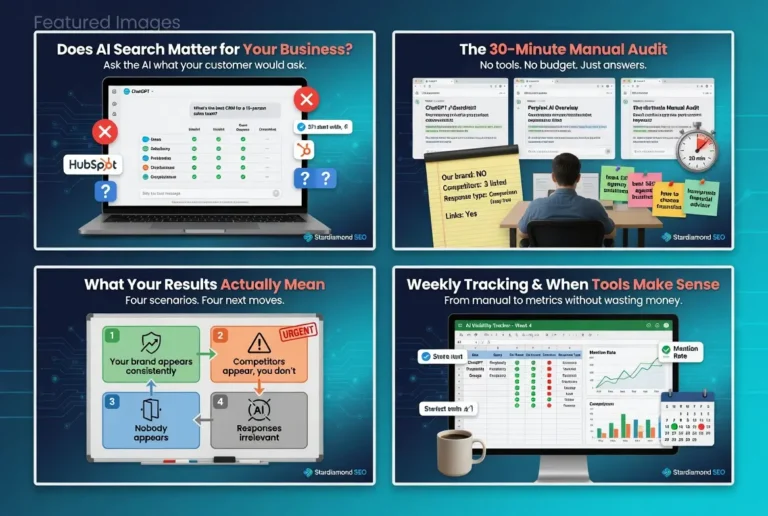
For a business tracking five to ten keywords across two or three platforms, manual checking takes 30 minutes per week. That is roughly two hours per month. No tracking tool at $100+ per month is worth the investment at that scale. The manual data is less comprehensive, less historical, and less automated, but it is sufficient for determining whether AI visibility matters for your business and whether you are gaining or losing ground.
The crossover point where paid tools justify their cost arrives when three things converge: you are tracking enough keywords that manual checking exceeds two hours per week, you need historical trend data to identify patterns and report to stakeholders, and you need competitive benchmarking that manual checking cannot efficiently provide. Most small businesses hit that crossover between 20 and 50 tracked keywords. Below 20, manual works. Above 50, the manual approach breaks down.
I have seen teams buy tools before validating that AI search matters for their market. A 30-minute manual audit should always come before any purchase decision. If the manual audit reveals zero AI activity in your category, there is nothing to track and the tool produces an empty dashboard you pay for monthly.
Integration with Your Existing SEO Workflow
The most common failure mode for AI visibility tracking is not the tool itself. It is the tool sitting disconnected from the workflow where SEO decisions get made. A dedicated tracker that produces excellent data is useless if nobody checks it because it lives in a separate dashboard from the one the team uses daily.
For teams embedded in Semrush or SE Ranking, using the platform’s built-in AI features eliminates this problem. The AI data lives where the SEO data lives. Correlation happens naturally because the keyword lists, ranking data, and AI citation data share the same interface.
For teams using dedicated AI trackers alongside separate SEO platforms, the integration question becomes operational: who checks the AI tracker, how often, and how does the data flow into the reporting and prioritization process? The answer needs to be explicit. “We’ll check it when we have time” means nobody checks it. A specific cadence (weekly review of citation trends, monthly competitive snapshot) built into the existing team rhythm keeps the data connected to decisions.
Some dedicated trackers offer API access or export functionality that lets you pull AI visibility data into custom dashboards alongside your organic data. If your team already runs a consolidated reporting dashboard, the API route can be the cleanest integration path. It requires some technical setup but eliminates the “two dashboards” problem permanently.
What No Current Tool Does Well
Revenue attribution. I keep coming back to this because it is the biggest gap in the category. Every tool can tell you that your brand was mentioned in 34 percent of relevant AI responses. No tool can tell you how much pipeline or revenue that 34 percent generated. The workarounds (branded search correlation, self-reported attribution surveys, referral traffic from AI platforms that do provide links) are directional, not definitive. The tool that solves attribution first will dominate the category. Nobody has solved it yet.
Cross-platform normalization. Each AI platform formats responses differently, cites differently, and updates on different schedules. Comparing your “visibility score” on ChatGPT against your “visibility score” on Perplexity is comparing two different measurement methodologies as if they are the same metric. Tools present cross-platform data in unified dashboards, which is visually clean and analytically misleading. The platforms are not comparable on a single scale. That does not mean cross-platform data is useless. It means interpreting it requires understanding that a 40 percent mention rate on ChatGPT and a 40 percent mention rate on Perplexity represent very different things in terms of how many users see your brand and what they do afterward.
Causal analysis. Why did your citation rate change? Was it a model update, new competitor content, a change in your own content, a shift in retrieval weighting? The tools show the what. None reliably explain the why. Vendors who claim their tool explains why citations changed are selling a hypothesis engine, which can be useful, but it is not the same thing as a diagnostic tool. The honest version is: we can show you correlations between your content changes and citation changes. The dishonest version is: we know why ChatGPT stopped recommending you. Nobody outside OpenAI knows that with certainty, and even they probably have limited visibility into the emergent behavior of their own model.
Choosing Based on What You Actually Need
Solo operator or small business, under $200/month budget: use your existing rank tracker’s AI Overview detection feature (most now include this) plus manual weekly checks on ChatGPT and Perplexity. Add a dedicated tracker only after manual monitoring confirms AI search is active in your market and the manual labor exceeds two hours per week.
Agency or mid-size in-house team, $200 to $500/month budget: a dedicated AI visibility tracker (OtterlyAI, Profound, or similar) for multi-platform coverage and competitive benchmarking, paired with your existing SEO platform for organic data. Or Semrush’s AI Visibility Toolkit if you are already in the Semrush ecosystem and want to avoid tool fragmentation.
Enterprise, $500+/month budget: enterprise tier of a dedicated tracker with API access for dashboard integration, or the enterprise AI offering from your existing SEO platform (Semrush Enterprise AIO, seoClarity, BrightEdge). The deciding factor at this level is usually integration requirements and multi-brand/multi-region support rather than feature coverage.
In every case, start with the gap analysis before the tool. Know which keywords matter, which platforms your audience uses, and whether AI search is active in your market. The tool amplifies what you already understand. It does not substitute for understanding.
FAQ
What is the best AI search visibility tool in 2026?
There is no single best tool for every team. Dedicated AI visibility trackers like OtterlyAI and Profound offer the deepest multi-platform citation tracking. Traditional SEO platforms like Semrush and SE Ranking offer AI visibility features integrated into existing SEO workflows. The best choice depends on your budget, how many keywords you track, which AI platforms your audience uses, and whether you need a standalone tool or integration with your existing SEO stack.
What can AI search visibility tools show me that I can’t check manually?
Historical citation trends over weeks and months, competitive share of model benchmarking across multiple platforms, citation stability patterns showing which of your citations are durable versus volatile, and automated alerting when your citation status changes on high-value keywords. Manual checks provide snapshots. Tools provide the trend data and competitive context that snapshots miss.
Are there free AI search visibility tools?
Semrush offers a free AI Search Visibility Checker that provides a one-time snapshot of your brand’s AI presence. Several dedicated trackers offer free tiers with limited keyword tracking, typically 5 to 25 keywords. Free tiers are useful for validating whether AI visibility tracking is relevant for your market but lack the historical depth and competitive benchmarking needed for ongoing optimization.
Do I need a separate AI visibility tool if I already use Ahrefs or Semrush?
It depends on how deep your AI visibility needs are. Ahrefs provides basic AI Overview detection. Semrush provides a more comprehensive AI Visibility Toolkit with multi-platform tracking. If Semrush’s built-in features cover your needs, a separate tool adds fragmentation without proportional benefit. If you need deeper multi-platform coverage, historical granularity, or competitive citation analysis that your current platform does not offer, a dedicated tracker fills that gap.
How much do AI search visibility tools cost?
Free tiers with limited tracking are available from several vendors. Mid-tier dedicated trackers typically cost $50 to $150 per month for 50 to 200 tracked keywords. Semrush plans that include AI visibility features start at $139 per month. Enterprise-tier tools with full multi-platform coverage, API access, and unlimited keywords range from $300 to $500+ per month.
What is the biggest gap in current AI visibility tools?
Revenue attribution. Every tool can measure how often your brand is cited in AI responses. No tool can reliably measure how much revenue those citations generate because most AI interactions do not produce a trackable click. The gap between visibility measurement and business impact measurement is the defining limitation of the entire category in 2026.