AI Search Visibility Metrics: The Numbers That Actually Matter
AI Summary
What are AI search visibility metrics? AI search visibility metrics measure how often, how prominently, and in what context a brand appears in AI-generated responses across platforms like ChatGPT, Google AI Overviews, Perplexity, and Gemini. They replace traditional ranking position as the primary indicator of search visibility in AI-mediated discovery.
What it is and who it is for: This article is for marketing managers and SEO practitioners who need to measure AI search performance and report it to leadership in terms that connect to business outcomes. It covers which metrics matter, which ones are vendor noise, and how to build a reporting framework that survives the question “so what does this mean for revenue?”
The rule: The metrics that matter in AI search measure presence and influence, not clicks and sessions. A brand can be highly visible in AI responses and generate zero trackable clicks. The measurement framework has to account for the gap between visibility and attribution, or the reporting will always undercount the value AI search delivers.
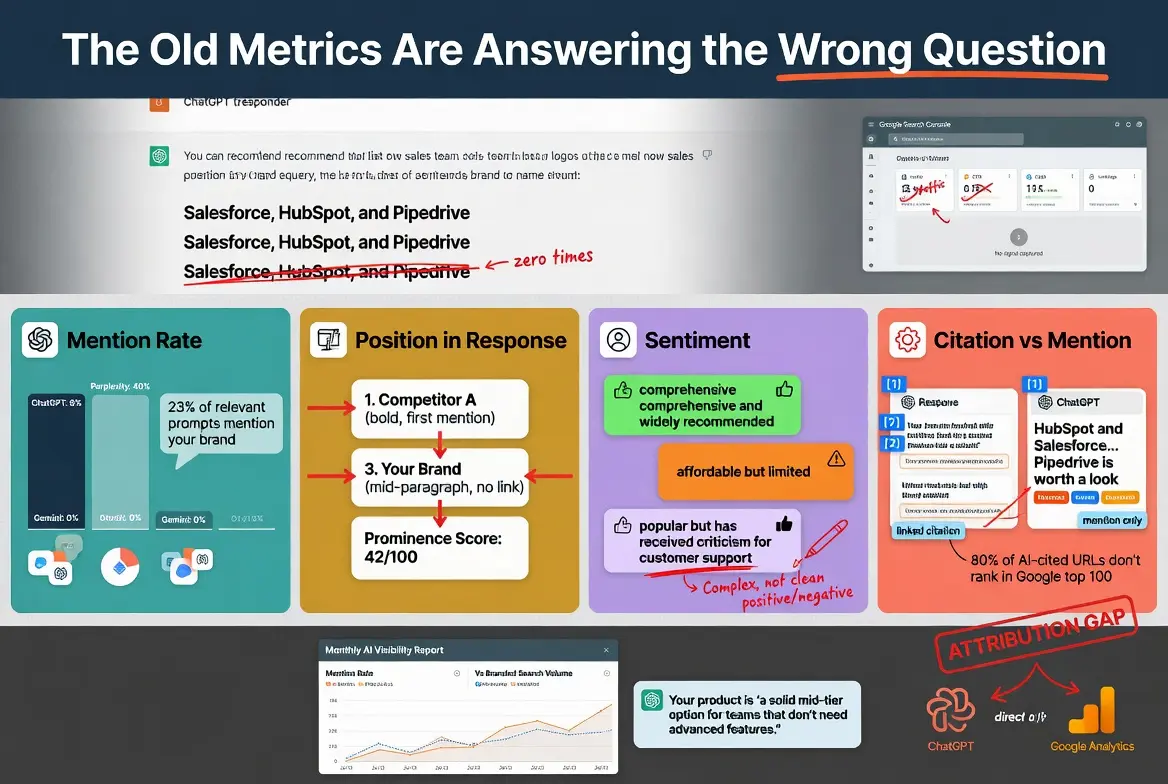
The Old Metrics Are Answering the Wrong Question
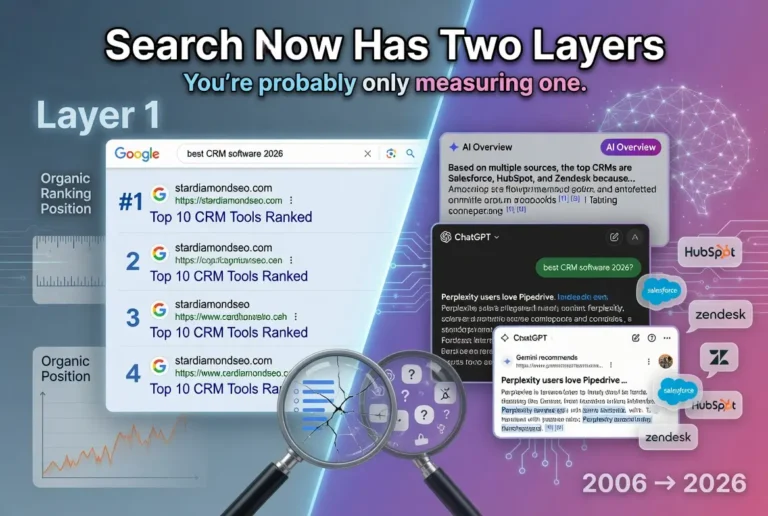
Rankings, traffic, click-through rate. For twenty years those three numbers told you whether SEO was working. They still matter for traditional organic search, and they probably will for a while. But when someone asks ChatGPT which CRM to use for a 15-person sales team and the response mentions your competitor three times and you zero times, none of those metrics captured what just happened. No impression was logged. No click was lost. No ranking moved. The prospect just crossed you off a list you never knew you were on.
That is the measurement problem with AI search. The event that matters, your brand being present or absent when a buyer asks a question, happens inside someone else’s interface and produces no signal your analytics can see. Google Search Console cannot tell you that Perplexity cited your competitor’s pricing page in a response about your category. Ahrefs cannot tell you that Gemini recommended three alternatives to your product when someone asked about your product by name. The tools that built modern SEO measurement were designed for a system where visibility meant appearing in a list of ten links. AI search replaced the list with a conversation, and the conversation does not send data back to your dashboard.
The first thing I had to unlearn when working on this problem was that “we are not getting traffic from AI” means “AI search does not matter for us.” It often means the opposite. The traffic is invisible because the journey starts in ChatGPT, the user searches your brand name on Google afterward, and Google gets the attribution. Or the user types your URL directly and analytics calls it “direct.” The AI platform gets no credit in either scenario, and the marketing team concludes AI search is irrelevant because the numbers say so. The numbers are lying by omission.
The AI search visibility guide covers the full strategic framework for earning presence in AI-generated responses. This article focuses specifically on how to measure that presence and what the numbers actually mean.
The Four Metrics That Actually Tell You Something
Every vendor in this space has their own metric names, their own dashboards, their own way of slicing the data to make their platform look essential. I have watched the vocabulary multiply over the last year and most of it is the same four ideas wearing different labels. Here is what you actually need to track, stripped of the branding.
Mention Rate
The percentage of relevant AI prompts where your brand appears anywhere in the response. If you test 100 queries that matter to your business and your brand shows up in 23 of the responses, your mention rate is 23 percent. This is the foundation. Everything else is context on top of this number.
Mention rate needs to be tracked per platform because the numbers diverge wildly. A brand with a 40 percent mention rate on Perplexity might have 8 percent on ChatGPT and zero on Gemini. Each platform retrieves and synthesizes differently. Aggregating into a single number hides the platforms where you are completely invisible, which is usually where the most urgent work needs to happen.
Position in Response
Where in the AI-generated answer your brand appears. First mention, second paragraph, buried in a footnote-style citation. This matters because AI responses have a reading hierarchy just like search results do. The first brand mentioned in a recommendation list gets treated as the default by most readers. Being third in a list of five is not the same as being first, even though both count as a “mention.”
Position tracking is harder to standardize than mention rate because AI responses are not structured like search results. There is no universal “position 1” in a conversational answer. What most tracking platforms do is assign a prominence score based on where in the response your brand appears, whether it is linked or just named, and whether it is the subject of a recommendation or mentioned in passing. The scoring varies by tool. What matters is tracking the trend for your brand on your key queries over time, not comparing your score against a competitor using a different tool’s scale.
Sentiment
How the AI describes your brand when it mentions you. This one tends to get treated as a soft metric, the kind of thing you mention on slide twelve of the quarterly deck. I think that undervalues it. A brand that ChatGPT consistently describes as “affordable but limited” occupies a different competitive position than one described as “comprehensive and widely recommended,” even if both have identical mention rates. The framing shapes how the buyer perceives you before they ever visit your site.
Sentiment tracking in AI search is still rough. The tools that attempt it use their own classification models to label AI responses as positive, neutral, or negative. Those classifications are imperfect. A response that says “Brand X is popular but has received criticism for customer support” is not cleanly positive or negative. It is complex, which is usually what reality looks like. The value is not in the label. It is in reading the actual AI responses about your brand regularly enough to know how you are being described and whether that description is changing.
Citation versus Mention
A citation is a linked reference to your URL. A mention is your brand name appearing in the response text without a link. Both matter but they do different things. Citations drive measurable referral traffic (small amounts, but trackable). Mentions build brand association without producing any click signal at all. Perplexity tends to cite with links. ChatGPT frequently mentions without linking. Google AI Overviews do both depending on the query.
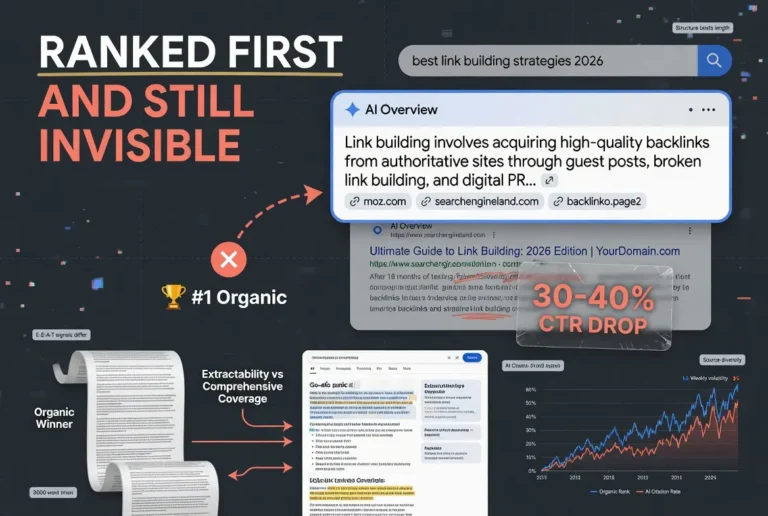
One finding that shifted how I think about this: roughly 80 percent of URLs cited by major AI platforms do not rank in Google’s top 100 for the original query. AI visibility and organic rankings operate on largely independent signal sets. A page can rank first on Google and be invisible in AI responses. A page that Google buries on page four can be the primary source ChatGPT relies on. Tracking only one system gives you at best half the picture of how your content is performing in search broadly.
Separating Real Metrics from Vendor Noise
The AI visibility tool market exploded in the last eighteen months and every vendor is coining terminology. “AI Visibility Score.” “Citation Authority Index.” “Generative Share of Voice.” “Brand Resonance Metric.” Some of these are useful repackaging of the four core metrics. Some of them are proprietary scores designed to make you dependent on one platform’s dashboard.
The test I use: can you reproduce the metric independently? If a vendor tells you your “AI Visibility Score” is 47, can you verify that by running the same queries on the same platforms and checking the responses yourself? If yes, the metric is transparent and the tool is saving you labor. If no, the metric exists inside a black box and you are trusting their methodology without being able to validate it. That does not make the tool useless, but it does mean you should understand what you are actually buying.
The metrics that survive vendor churn will be the ones tied to observable events. Your brand appeared in this response or it did not. It was linked or it was not. It was mentioned first or third. The AI described it positively or critically. Those are verifiable. Composite scores that blend multiple signals into a single number using proprietary weighting are convenient for reporting but opaque for decision-making. Convenient and opaque is how you end up optimizing for a number that does not connect to revenue.
Why the Metrics Look Different on Every Platform
One of the genuinely surprising things I learned working through this data is how differently each AI platform behaves with citations and mentions. It is not small variation. The platforms are structurally different in ways that change what you measure and how you interpret it.
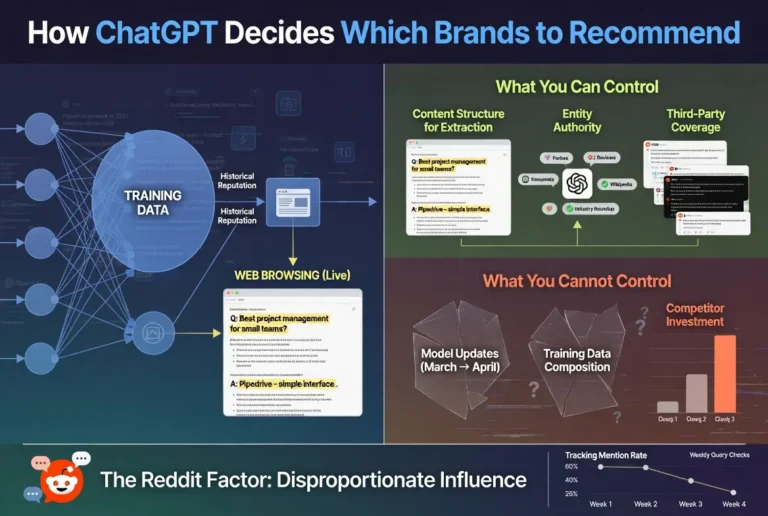
ChatGPT mentions brands frequently but links to them rarely. When someone asks ChatGPT for a recommendation, the response often reads like a knowledgeable friend giving advice: three brands mentioned, zero links. The user gets the recommendation, searches one of those names on Google, and the entire AI-initiated journey gets attributed to organic search. ChatGPT gets no credit in any analytics platform. If you only track citations with links, ChatGPT looks like it barely matters. If you track mentions, the picture changes dramatically. Understanding how ChatGPT handles SEO changes how you approach the platform strategically.
Perplexity operates more like a search engine with inline citations. Every response includes numbered source links. The citation-to-mention ratio is healthier than any other platform, meaning when Perplexity names your brand, it usually links to you too. Conversion rates from Perplexity referral traffic tend to be notably higher than from traditional organic search, possibly because users arriving from Perplexity have already read a synthesized answer and are further along in their decision process.
Google AI Overviews sit in a middle ground. They pull from indexed web pages and display citation links alongside the generated text, but only appear on roughly a third of queries. AI Overviews lean toward brand domains more heavily than other platforms, with close to 60 percent of citations going to recognized brand sites. That brand preference matters for E-E-A-T signals because it means established authority compounds faster in AI Overviews than on platforms where newer or smaller sources get cited more readily. The AI Overview tracker monitors when and where these summaries appear for your target queries.
How AI Search Visibility Connects to Traditional SEO
AI search visibility does not replace traditional SEO. It runs alongside it, and the two systems share inputs even though they produce different outputs. Understanding how Google search works gives you the foundation for understanding where AI search diverges.
The shared inputs are content quality, E-E-A-T signals, topical authority, and structured data. A page with strong expertise signals, clear heading structure, and comprehensive coverage of a topic is more likely to be cited by AI platforms and more likely to rank in traditional search. The optimization work is not duplicated. It serves both channels simultaneously.
Where they diverge is in how authority is assessed. Google uses backlinks as a primary authority signal. AI platforms use a combination of source credibility, content freshness, and how well the content answers the specific question posed. A page with zero backlinks but excellent, clearly structured, question-answering content can be cited heavily by ChatGPT while sitting on page five of Google. The credibility discipline in the 5C Framework addresses both signals because backlink authority and content credibility are complementary, not competing.
The practical implication is that on-page optimization serves both traditional and AI search. Clear headings, FAQ sections with schema markup, concise answer blocks at the top of articles, and structured content that AI systems can parse and extract all improve both your organic rankings and your AI citation probability. The calibration discipline treats this dual optimization as a core requirement for any page targeting competitive queries.
Tools for Tracking AI Search Visibility
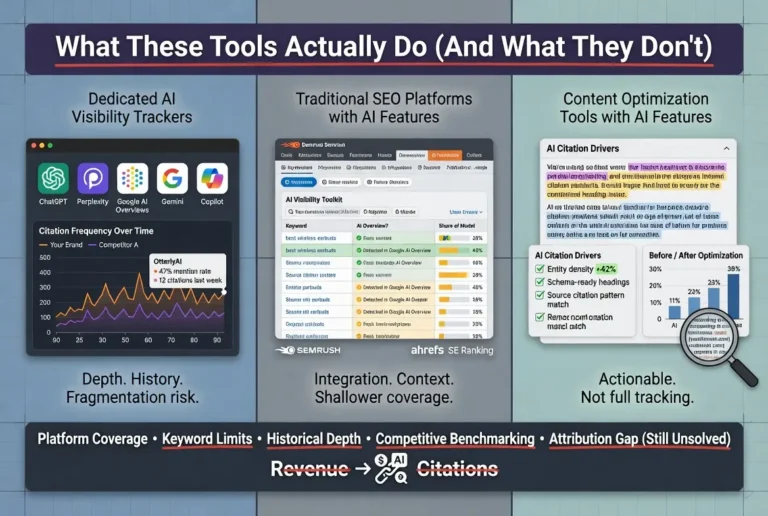
The AI search visibility tools landscape is evolving rapidly. The major categories of tools available include dedicated AI visibility platforms, extensions to existing SEO tools, and manual tracking approaches.
Dedicated platforms like Profound, Peec AI, Otterly, and Goodie AI focus exclusively on tracking brand mentions and citations across AI platforms. They automate the query testing process, track mention rate over time, and provide competitive comparisons. The value proposition is labor savings: they run thousands of queries across multiple platforms and aggregate the results, which would take hours to do manually.
Existing SEO tool suites are adding AI visibility features. Ahrefs, Semrush, and BrightEdge have all introduced AI-related metrics. These integrations are convenient because they sit inside tools most SEO teams already use, but the features are newer and less developed than the dedicated platforms.
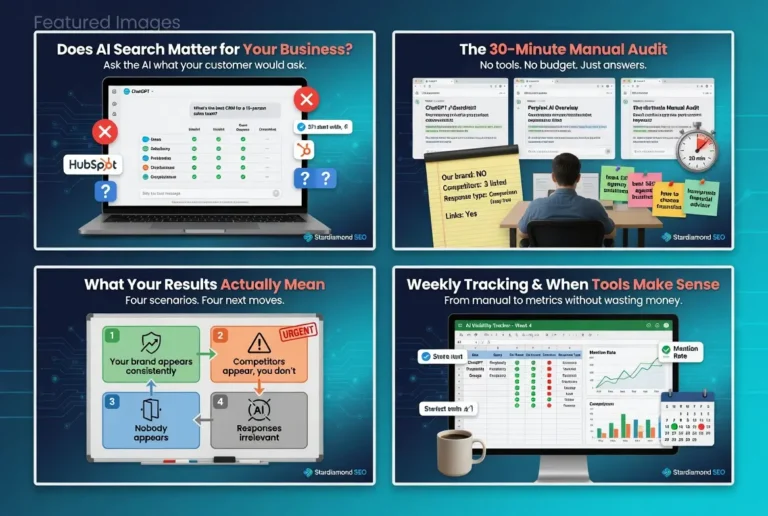
Manual tracking is where most organizations should start. Query your five highest-value keywords on ChatGPT, Perplexity, and Google weekly. Record mentions, citations, competitors, and sentiment in a spreadsheet. This costs nothing, takes 30 minutes per week, and gives you the baseline data you need to evaluate whether a paid tool is worth the investment. Do not buy a tool before you know whether AI search is active in your category.
Building Content That Gets Cited by AI
The content characteristics that increase AI citation probability overlap with but are not identical to the characteristics that improve traditional rankings. AI systems prefer content that directly answers questions, provides structured information, and comes from sources with clear authority signals.
The SEO writing approach that serves AI citation prioritizes three structural elements. First, clear question-and-answer formatting where the H2 or H3 poses the question and the first paragraph answers it directly. AI systems scanning for extractable answers find this format easier to parse than content that buries the answer in the fourth paragraph after three paragraphs of context.
Second, summary blocks at the top of articles that provide a concise overview of the page’s key points. The AI Summary format used across Star Diamond SEO content was designed specifically for this purpose: a structured block that answers “what is this,” “who is it for,” and “what is the takeaway” in a format AI systems can extract cleanly.
Third, content cluster architecture that demonstrates topical authority. AI platforms are more likely to cite sources that cover a topic comprehensively across multiple pages than sources with a single isolated article. A site with a content pillar surrounded by supporting articles on related subtopics signals to AI systems that the source has depth on the topic, which increases the likelihood of citation.
The editorial layer between content creation and publication is critical for AI visibility because AI systems are increasingly capable of detecting content that lacks genuine expertise. Content that reads like assembled information without original perspective is less likely to be cited than content that demonstrates first-hand experience and offers insights the reader cannot find in other sources.
AI Search Visibility by Industry
AI search visibility matters differently across industries, and YMYL verticals face unique dynamics because AI platforms apply additional caution when generating responses about health, finance, and legal topics.
In healthcare, AI platforms are cautious about making specific medical recommendations but actively cite authoritative medical sources. Healthcare providers with strong authoritativeness signals and clinician-authored content are more likely to be cited than providers with marketing-written content. The measurement focus for healthcare should weight citation tracking over mention tracking because AI platforms tend to link to medical sources rather than just naming them.
In dental, AI platforms frequently answer questions about procedures, costs, and what to expect. Dental practices with comprehensive content that addresses patient questions directly are being cited in AI responses for queries like “how much do dental implants cost” and “what to expect during a root canal.” Practices without this content are invisible in those responses regardless of their local pack ranking.
Law firm visibility in AI search is growing as users increasingly ask AI platforms for guidance on legal processes. “Do I need a lawyer for a DUI” and “how does the divorce process work” are queries where AI platforms cite legal content extensively. The firms whose content is cited are establishing brand recognition before the prospect ever searches for a lawyer by name.
In real estate, AI platforms answer questions about market conditions, buying processes, and neighborhood comparisons. Agents and brokerages with localized, data-driven content are being cited. Those without it are losing mindshare to competitors whose content AI platforms trust enough to reference.
The measurement approach should be industry-specific. Track the queries your prospective clients actually ask AI platforms, not generic industry terms. A dental practice should track “dental implant cost [city]” and “best dentist for nervous patients,” not “dental SEO.” The queries that matter for visibility metrics are the ones your patients type into ChatGPT, not the ones you target for Google rankings.
Reporting to Leadership Without Losing Them
This is where most AI visibility conversations break down. The metrics are new. The attribution is incomplete. The connection to revenue is indirect. And the person you are presenting to wants to know one thing: is this worth the money we are spending on it?
The framework that works in my experience has three layers, and you present them in order.
First layer: presence. Are we showing up when buyers ask AI about our category? Show the mention rate across platforms for your top ten commercial queries. If the number is zero, the conversation is about why. If the number is above zero, the conversation is about competitive position. This layer takes sixty seconds to present and establishes whether AI search is relevant to the business at all. Most leadership teams have not seen this data before and the simple “we appear in X percent of AI responses for queries our buyers ask” is enough to justify continued attention.
Second layer: competitive context. How do we compare to competitors in AI responses? Share of model data, meaning the percentage of relevant AI responses that mention your brand versus each competitor. This reframes AI visibility from an abstract concept into a competitive positioning metric that leadership already understands from other channels.
Third layer: business correlation. This is where you have to be honest about what you can and cannot prove. Direct attribution from AI search to revenue is weak right now. What you can show is correlation: branded search volume trends alongside AI mention rate trends. If your AI mentions increased 40 percent over three months and branded search volume increased 25 percent over the same period, the correlation is not proof of causation but it is a stronger signal than most marketing channels can provide at this stage. Present it as a correlation, not a proof. Leadership respects intellectual honesty more than inflated claims.
What you do not do is lead with the metrics themselves. Start with the business question (are buyers finding us when they use AI to research), show the answer in competitive terms, and save the metric vocabulary for the appendix.
The Attribution Gap Is Real and It Is Not Getting Fixed Soon
When ChatGPT recommends your brand, there is no reliable way to trace that recommendation through to a conversion. The user might search your name on Google (attributed to organic), type your URL (attributed to direct), click a retargeting ad (attributed to paid), or tell a colleague who visits your site (attributed to nothing). The AI touchpoint that started the whole sequence is invisible in every standard attribution model.
The workarounds people are using right now include self-reported attribution surveys on signup or demo forms (“how did you hear about us?”), monitoring branded search volume for correlation with AI mention trends, tracking referral traffic from AI platforms where they do provide links (Perplexity is the most reliable here), and watching for upticks in content engagement patterns that correlate with increased AI visibility.
None of these are precise. All of them are directional. The honest answer is that AI search measurement in 2026 is where social media measurement was in 2010: everyone knows it matters, nobody can prove exactly how much, and the companies that invest early will have the data advantage when the attribution infrastructure eventually catches up. That is not a satisfying answer. I have not found a better one that is also true.
What to Measure First If You Are Starting From Zero
If your organization has done nothing with AI search measurement yet, the temptation is to buy a tool and start tracking everything. That usually produces a dashboard nobody looks at after the first month because the data has no context and no connection to anything the team is already doing.
Start smaller. Pick your five highest-value commercial keywords. The ones tied to revenue, not the ones with the biggest search volume. Manually query those five keywords on ChatGPT, Perplexity, and Google (checking for AI Overviews). Record whether your brand appears. Record which competitors appear. Do this once a week for four weeks.
After four weeks you will know three things. Whether AI search is surfacing your category at all. Whether your brand or your competitors are being cited. Whether the results are stable or volatile. That is enough information to decide whether AI visibility tracking deserves budget and tooling, or whether your market has not shifted far enough into AI-mediated discovery to justify the investment yet.
If the manual audit shows your competitors appearing and you absent, the case for measurement tooling is immediate. If nobody in your category appears in AI responses, the case is weaker for tracking but potentially strong for being first to optimize, since AI platforms will eventually cite someone and the brands with the best trust signals and most extractable content will be first in line.
I would not spend money on a dedicated tracking tool until the manual audit confirms AI search is active in your category. Spending money to confirm that no AI platform mentions anyone in your vertical is not measurement. It is paying for an empty dashboard.
Metrics That Sound Important but Do Not Matter Yet
AI referral conversion rate. In theory this tells you how valuable AI-referred visitors are compared to other channels. In practice, the sample sizes are too small for most businesses to draw any conclusion. A brand getting 30 visits per month from Perplexity cannot meaningfully calculate a conversion rate from that channel. The number will swing from 0 to 20 percent month over month based on a handful of conversions. Report it if you have the volume. Ignore it if you do not.
“AI search traffic” as a standalone metric. Same problem. Most AI interactions do not produce a click. The traffic you can see from AI referrals is a fraction of the total influence. Treating AI referral traffic as the primary metric for AI search performance is like measuring a billboard campaign by counting the people who pulled over to take a photo of the billboard. The impact is in the exposure, not the click.
Composite “AI readiness scores” from tool vendors. These score your content on factors like structure, schema markup, and entity clarity, then produce a single number that implies your content is or is not optimized for AI. The underlying factors are real. The composite score is arbitrary. Your schema markup could be perfect and your content could still be invisible to ChatGPT because ChatGPT does not use schema markup in its retrieval. A score that blends relevant and irrelevant signals into one number is not a metric. It is a sales tool.
Building a Reporting Cadence That Sticks
Monthly is the right frequency for most teams. AI responses change faster than organic rankings but slower than paid media. Weekly monitoring catches volatility. Monthly reporting captures trends. The distinction matters because reporting volatility to leadership creates anxiety without actionable insight (“our mention rate dropped 15 percent this week” usually means the AI model shifted, not that something broke), while monthly trends show whether your overall trajectory is improving.
The report itself needs four sections and nothing more. Mention rate by platform with month-over-month trend. Competitive share of model with month-over-month comparison. Sentiment summary (what are the AI platforms actually saying about us, in plain language, not a score). And the correlation section: branded search performance and direct traffic trends alongside AI visibility trends. That is the full picture. Everything else is appendix material for the team that needs to go deeper.
One thing I would add that most reporting frameworks miss: include the actual AI responses. Not all of them. Three to five representative responses per month, screenshotted or quoted, showing exactly what the AI said about your brand when a buyer asked. Reading the actual language the AI uses to describe your brand is more impactful for a leadership audience than any chart or score. It makes the abstract concrete. When a CEO reads that ChatGPT described their product as “a solid mid-tier option for teams that do not need advanced features” the conversation about investing in AI visibility becomes very specific very quickly.
The SEO knowledge base covers additional topics across every discipline. The full range of SEO services at Star Diamond SEO includes AI search visibility as a core offering alongside traditional SEO. Contact us to discuss your brand’s presence in AI-generated search results.
FAQ
What are AI search visibility metrics?
AI search visibility metrics measure whether your brand appears when users ask AI platforms like ChatGPT, Perplexity, Gemini, and Google AI Overviews about topics relevant to your business. The four core metrics are mention rate (how often you appear), position in response (where in the answer you appear), sentiment (how the AI describes you), and citation versus mention (whether you get a link or just a name drop).
How do I measure AI search visibility?
Start by manually querying your five highest-value commercial keywords on ChatGPT, Perplexity, and Google (checking for AI Overviews). Record whether your brand appears, which competitors appear, and how the AI describes each brand. Do this weekly for four weeks to establish a baseline. If the data shows your category is active in AI search, invest in a dedicated tracking tool to automate the process at scale.
Which AI search visibility tool is best?
No single tool is best for every use case. Dedicated platforms like Profound, Peec AI, and Otterly focus exclusively on AI visibility tracking. Existing SEO suites like Ahrefs and Semrush are adding AI visibility features. The best tool depends on your scale, budget, and whether you need AI-only tracking or integration with your existing SEO workflow. Start with manual tracking before committing to a paid tool.
Does AI search visibility affect traditional SEO rankings?
Not directly. AI visibility and organic rankings operate on largely independent signal sets. However, the content investments that improve AI visibility (structured content, E-E-A-T signals, comprehensive topical coverage) also improve traditional organic rankings. Increased AI mentions can also drive branded search volume, which is a positive signal for traditional SEO.
How often should I track AI search visibility metrics?
Monitor weekly for operational awareness. Report monthly for strategic decision-making. Weekly tracking catches sudden changes in how AI platforms cite your brand. Monthly reporting captures the trends that leadership needs to see. Avoid reporting weekly volatility to leadership because AI model updates cause fluctuations that do not reflect real changes in your competitive position.
Why does my brand appear on one AI platform but not another?
Each AI platform retrieves and synthesizes information differently. ChatGPT, Perplexity, Gemini, and Google AI Overviews use different training data, different retrieval methods, and different citation policies. A brand with strong presence on Perplexity (which favors linked citations) may be invisible on ChatGPT (which favors unlocked mentions from training data). Track each platform separately and optimize for the platforms where your buyers are active.