How to Track Brand Visibility in AI Search
AI Summary
What is AI brand visibility tracking? AI brand visibility tracking is the process of monitoring whether, how often, and in what context your brand appears in AI-generated responses across platforms like ChatGPT, Google AI Overviews, Perplexity, and Gemini. It answers the question traditional analytics cannot: is your brand part of the conversation when buyers ask AI for recommendations?
What it is and who it is for: This article is for business owners and marketing managers who suspect AI search might matter for their market but are not sure where to start. It covers how to determine whether AI visibility is relevant to your business, what to check manually before buying any tools, and how to build a tracking approach that scales from zero budget to dedicated tooling.
The rule: Do not buy a tracking tool before you know there is something to track. A 30-minute manual audit of your top keywords across three AI platforms will tell you whether your brand, your competitors, or nobody in your category is showing up in AI responses. That answer determines everything that comes after it.
How to Know If AI Search Matters for Your Business
Before you track anything, you need to answer a simpler question: are people in your market using AI to research what you sell?
Not every industry has shifted. A local plumber in Fort Wayne is not losing leads to ChatGPT recommendations right now. A B2B SaaS company selling CRM software almost certainly is. The difference is whether the buying decision involves research that AI platforms can meaningfully assist with. Complex purchases, comparison shopping, professional services, anything where a buyer would previously have read ten blog posts before making a decision. Those are the categories where AI is already mediating discovery.
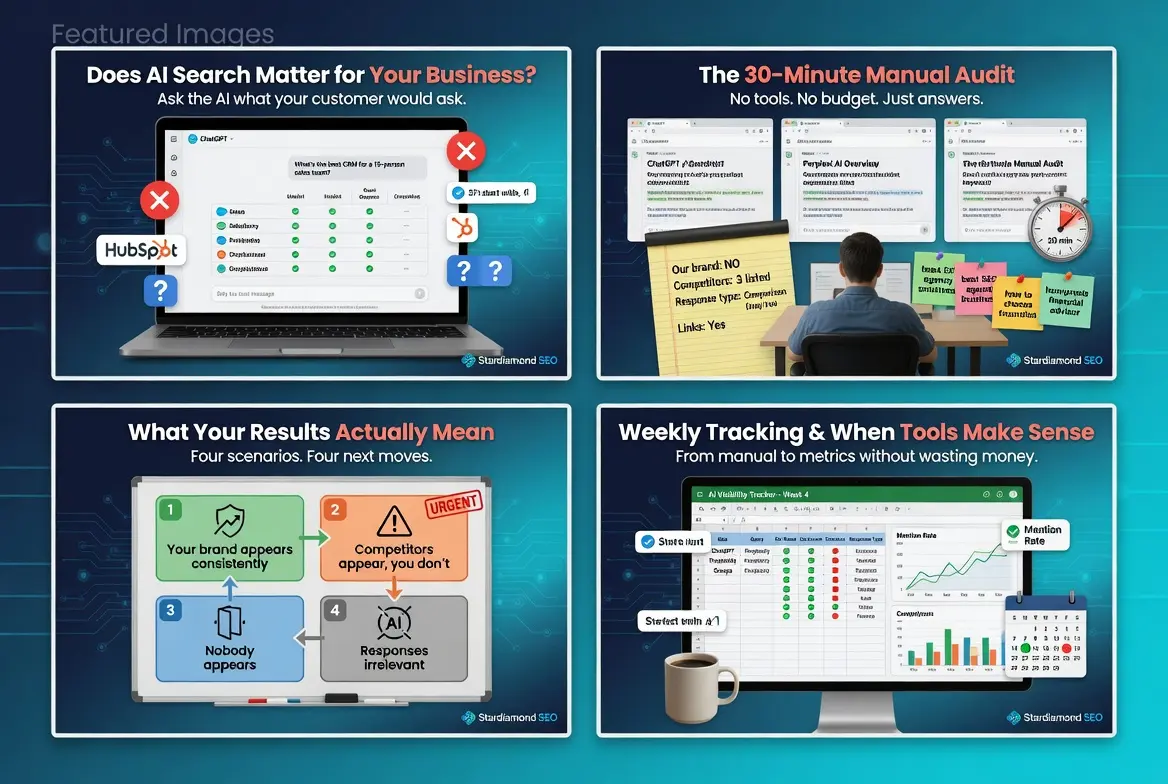
The fastest way to find out is to ask the AI yourself. Open ChatGPT. Type the question your best customer would ask before finding you. “What’s the best CRM for a 15-person sales team?” “Which SEO agencies actually deliver results?” “What should I look for in a financial advisor?” Read what comes back. If the response names your competitors and not you, AI search matters for your business right now. If the response is generic and names nobody, the opportunity is open but unoccupied. If the response is irrelevant or unhelpful for your category, AI search has not reached your market yet.
I have watched business owners skip this step entirely. They read an article about AI visibility, bought a $150/month tracking tool, connected it to their domain, and discovered that zero AI platforms mention anyone in their vertical. Three months of empty dashboards later, they cancelled and concluded AI search was overhyped. It wasn’t overhyped for their category. It just wasn’t relevant yet, and a five-minute manual check would have told them that before they spent a dollar.
The 30-Minute Manual Audit
This is the starting point for every business. No tools required. No budget required. Just a browser, three AI platforms, and your top keywords.
Pick your five most commercially important keywords. Not the highest volume. The ones that represent someone ready to buy what you sell. For an SEO agency, that might be “best SEO company for small business” or “SEO agency that actually works.” For a software company, it might be “best [category] software for [use case].” For a service provider, it might be “how to choose a [your service].”
Run each keyword as a natural question on three platforms: ChatGPT, Perplexity, and Google (checking whether an AI Overview appears). Record four things for each query on each platform. Did your brand appear? Which competitors appeared? Was the response a recommendation, a comparison, or a general explanation? Did the AI link to any sources or just mention names?
That is fifteen queries total. It takes about 30 minutes. When you finish, you have a baseline that answers three questions. Is AI search active in my category? Am I visible or invisible? Who is winning the space I should occupy?
One thing to watch for: AI responses are not deterministic. The same query can produce different results on different days, sometimes even in different sessions on the same day. A single check is a snapshot, not a census. If your audit shows your brand appearing in some responses, do the same check a week later. If you are consistently present, the signal is real. If you appeared once and disappeared, the citation is unstable and the underlying optimization work is not complete.
Reading What the Results Tell You
The audit produces one of four scenarios, and each one leads somewhere different.
Your brand appears consistently
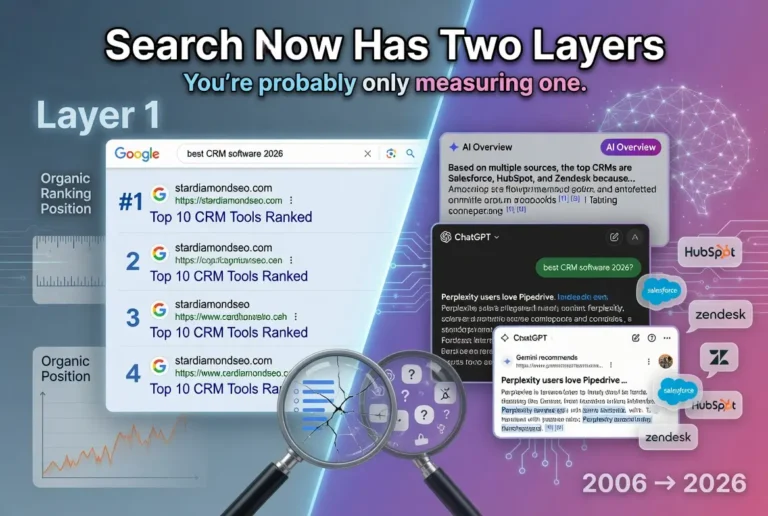
You are already visible. The question shifts from “does this matter” to “how do we protect and expand this position.” This is where an AI search visibility metrics framework becomes worth building, because you have something to measure and something to lose. Competitive tracking matters here. You need to know who else appears alongside you and whether your share of the conversation is growing or shrinking.
Your competitors appear but you do not
The most urgent scenario. AI search is active in your category and your competitors have claimed the space. Every AI response that recommends them and omits you is a buyer who crossed you off the list before visiting your site. The tracking question is secondary to the optimization question: what do your competitors’ cited pages have that yours lack? Usually it comes down to content structure, E-E-A-T signals, and entity authority that AI systems can recognize and extract from.
Nobody in your category appears
The AI platforms are not citing anyone for your keywords yet. This is either an indication that your market has not shifted into AI-mediated discovery or that the opportunity is wide open for whoever optimizes first. The difference depends on the category. If the queries you tested returned generic, unhelpful responses with no brand names, the platforms have not built useful knowledge in your vertical yet. If the responses were helpful but cited no specific brands, the first business to structure its content for AI extraction will likely become the default citation.
AI responses are irrelevant to your category
Some verticals are not being served by AI search in any useful way yet. Highly local services, niche B2B categories with small addressable markets, industries where the buying process is relationship-driven rather than research-driven. If the AI responses to your keywords are generic or off-topic, AI search tracking is not worth investing in right now. Check again in six months. The platforms are expanding what they cover continuously.
Building a Weekly Tracking Habit
If the audit showed that AI search is active in your category, the next step is not buying a tool. It is repeating the audit weekly until you have a month of data. Four data points beats one data point. You start seeing patterns: which platforms cite you consistently versus occasionally, which competitors are stable versus fluctuating, whether the AI responses are getting more or less specific over time.
The spreadsheet for this is simple. Columns: date, query, platform, your brand appeared (yes/no), competitors that appeared (names), response type (recommendation/comparison/explanation), linked or mentioned only. One row per query per platform per week. At ten keywords across three platforms, that is 30 rows per week. Manageable without automation.
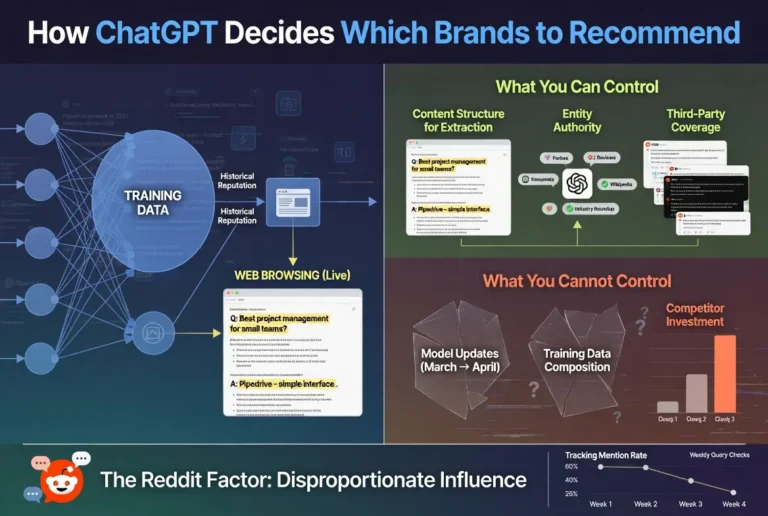
What you learn from the weekly cadence that the single audit misses: volatility. Some brands appear in ChatGPT one week and disappear the next because the model was updated or the retrieval pulled different sources. Other brands are locked in across every check because their content is deeply embedded in the training data or consistently surfaces through the platform’s web browsing. The distinction matters because stable visibility is defensible. Volatile visibility means your optimization is not durable yet.
After four weeks, you have enough data to make a real decision about whether to invest in automated tracking. If your category shows consistent AI activity, your competitors are present, and the weekly check is consuming time you would rather spend on optimization, the tool pays for itself in labor savings. If the data shows minimal AI activity or no competitive presence, you just saved yourself $150 to $400 per month.
When a Tracking Tool Makes Sense
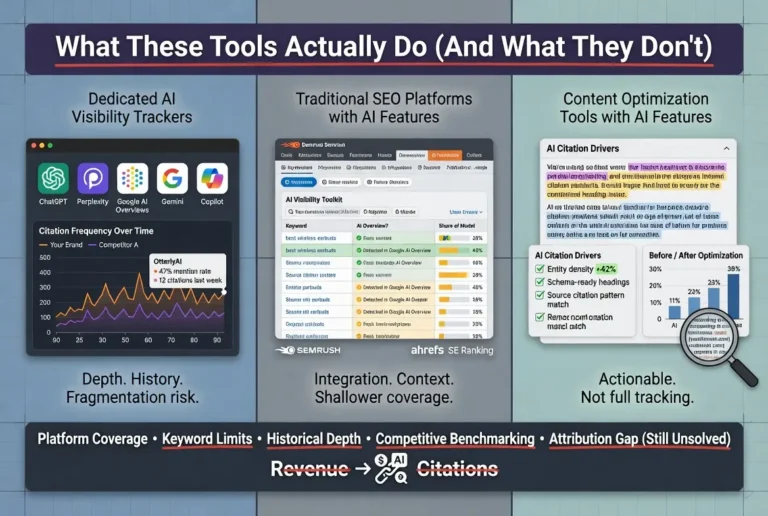
Automated AI brand visibility tools solve a scaling problem. Manual tracking works for five to ten keywords across three platforms. It stops working at twenty keywords, five platforms, and weekly sampling with historical comparison. The labor exceeds the value of the data somewhere around the two-hour-per-week mark. That is when a tool earns its cost.
The tool categories break down by what they prioritize. Some are purpose-built AI visibility trackers that monitor mentions and citations across multiple platforms, store historical data, and provide competitive benchmarking. Some are traditional SEO platforms that have added AI Overview detection as a feature within their existing keyword tracking. Some are content research tools that analyze what characteristics drive AI citations and help you structure content for extraction.
What to evaluate before buying: does the tool cover the platforms where your audience actually asks questions? If your buyers use ChatGPT and the tool only tracks Google AI Overviews, it is tracking the wrong surface. Does the tool store historical data so you can see trends over time? A tool that shows you today’s snapshot without last month’s comparison is a monitoring tool, not a tracking tool. Does the tool distinguish between citations (linked) and mentions (named without a link)? Both matter but they measure different things, and a tool that conflates them is hiding useful detail.
And honestly, does the tool show you data you can verify? If you can take the same query, run it on the same platform, and confirm what the tool reported, the methodology is transparent. If the tool produces scores and metrics you cannot reproduce independently, you are trusting a black box. That is not always wrong, but it is always worth knowing.
What to Track Once You Are Running
Once you have a system in place, whether manual or automated, the tracking cadence settles into a rhythm that produces actionable data without drowning you in noise.
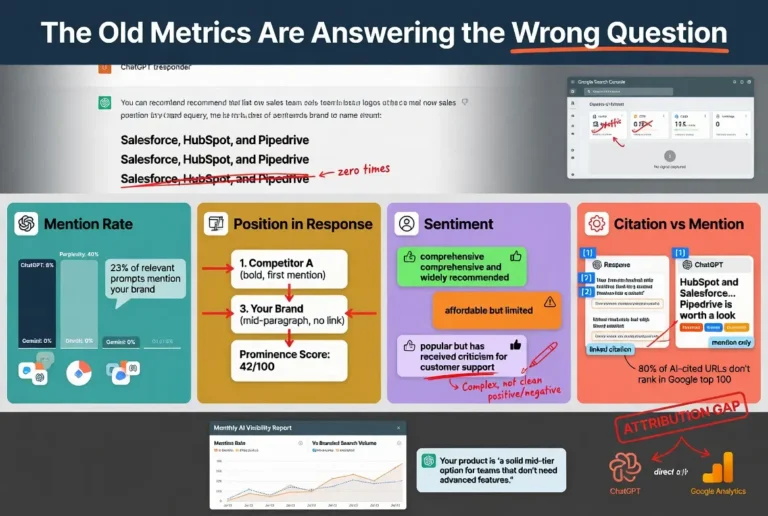
Weekly: mention rate per platform for your top commercial keywords. This is the heartbeat metric. Up is good, down needs investigation, stable means your position is holding.
Monthly: competitive share of model. How often you appear versus each competitor across all tracked queries. This is the metric that tells leadership whether you are gaining or losing ground. Report it in the same format you would report market share: percentages with month-over-month comparison.
Monthly: sentiment review. Read five to ten actual AI responses about your brand. Not the sentiment score from the tool. The actual words the AI used. This catches framing problems that scores miss. “Affordable but limited” has a neutral sentiment score but a devastating competitive implication. The only way to catch that is to read the response.
Quarterly: gap analysis. Which queries trigger AI responses in your category where you are completely absent? These are the content opportunities. Each gap represents a question buyers are asking where the AI has no reason to mention you because your site does not have content that answers it in a format the AI can extract.
The tracking is not the point. The optimization that the tracking informs is the point. A perfect dashboard showing declining visibility is worse than a rough spreadsheet showing the same decline if the spreadsheet leads to action and the dashboard leads to a meeting about the dashboard.
Do Brand Mentions Actually Impact Anything?
This is the question I kept circling back to. A brand mention in a ChatGPT response produces no click, no referral session, no trackable event. So does it matter?
The evidence is indirect but accumulating. Research from early 2026 showed that 37 percent of consumers now start searches with AI rather than Google, but 85 percent still cross-reference through traditional search before converting. That journey, AI first then Google second, means the AI mention plants the seed and Google gets the conversion credit. The brand that ChatGPT mentioned becomes the brand the user searches for. Branded search volume is the closest proxy for measuring that effect.
What I cannot tell you with confidence is how large this effect is for any given business. The correlation between AI mentions and branded search increases exists in the aggregate data. Whether it exists for your specific brand, in your specific category, at your specific scale, is something you can only determine by tracking both and looking for the pattern. Some categories show strong correlation. Others show none. The honest answer is that the measurement infrastructure is still catching up to the reality, and anyone claiming precise attribution from AI mentions to revenue is selling something the data does not yet support.
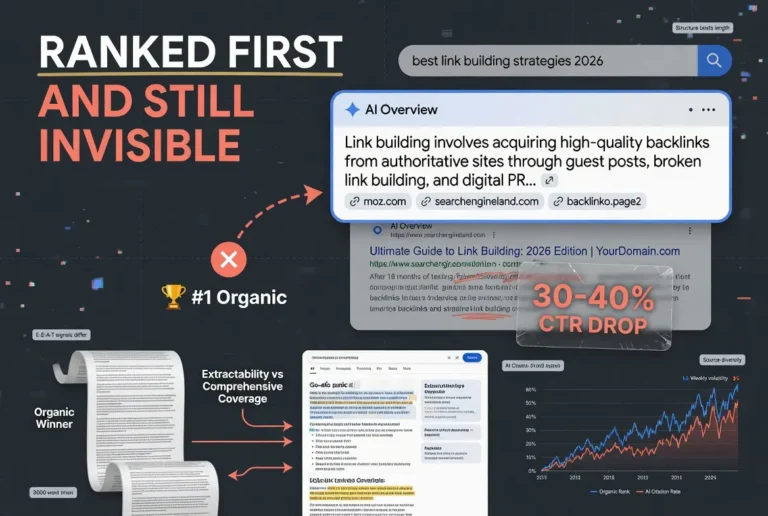
What I can say: being absent is measurably worse than being present. When a buyer asks AI for a recommendation and your competitor is named and you are not, the competitor has an advantage that no amount of organic ranking can fully offset. The buyer already has a shortlist before they ever open Google. You are either on it or you are not.
Three Mistakes That Waste Time and Money
Tracking everything before tracking what matters. A tool that monitors 200 prompts across six platforms produces overwhelming data for a team that has not identified its ten most important commercial queries. Start with the queries tied to revenue. Expand only after you have established baselines and identified actionable patterns on the core set.
Treating volatility as signal. AI responses fluctuate. A brand that appeared on Monday and disappeared on Wednesday did not necessarily lose anything. The AI model may have updated, the retrieval may have pulled from different sources, or the platform may be A/B testing response formats. Weekly and monthly trends reveal real movement. Daily changes are noise unless the change is dramatic and sustained.
Optimizing for the dashboard instead of the buyer. I have seen teams restructure content to improve their AI visibility score on a tracking tool without asking whether the changes made the content better for the person who actually reads it. The tools measure what the AI sees. The AI cites what serves the user. If your optimization makes the content less useful to humans in order to make it more extractable by machines, you are solving the wrong problem. The content that AI systems consistently cite is content that genuinely answers questions well. That has not changed from traditional trust signal optimization and it is not going to.
FAQ
How do I know if AI search matters for my business?
Ask ChatGPT, Perplexity, and Google the questions your buyers would ask before purchasing. If the AI responses name your competitors, AI search is already affecting your market. If the responses are generic with no brand names, the opportunity is open but unoccupied. If the responses are irrelevant to your category, AI search has not reached your vertical yet.
Can I track AI brand visibility without buying a tool?
Yes. Run your top five commercial keywords as natural questions on ChatGPT, Perplexity, and Google once per week. Record which brands appear, whether they are linked or just mentioned, and how the AI frames each one. This takes about 30 minutes per week and provides enough data to determine whether dedicated tooling is justified for your market.
How often should I check AI brand visibility?
Weekly monitoring catches volatility patterns. Monthly reporting captures trends. Daily checks produce noise because AI responses fluctuate between sessions without indicating meaningful change. The right frequency depends on how competitive your category is in AI search and how actively you are optimizing for AI visibility.
Why does my brand appear on one AI platform but not another?
Each AI platform uses different retrieval systems, different source preferences, and different training data. ChatGPT, Perplexity, Google AI Overviews, and Gemini evaluate and cite sources through independent mechanisms. A brand can be the top recommendation on Perplexity and completely absent from ChatGPT because the platforms are structurally different, not just algorithmically different.
Do AI brand mentions without links actually matter?
Yes. Research shows 37 percent of consumers start searches with AI but 85 percent cross-reference through traditional search before converting. When ChatGPT mentions your brand without linking, the user often searches your name on Google next. The AI mention generates the branded search, but Google gets the attribution credit. Tracking branded search volume alongside AI mention rates reveals the correlation.
When should I invest in an AI brand visibility tracking tool?
When manual tracking confirms that AI search is active in your category and the weekly audit exceeds two hours of labor. At that point, the tool pays for itself in time savings. Do not buy a tool before confirming there is something to track. A manual audit of five keywords across three platforms takes 30 minutes and prevents spending $150 to $400 per month on an empty dashboard.