AI Search Visibility: How to Get Your Brand Cited by AI
AI Summary
What is AI search visibility? AI search visibility is the measure of how often, how prominently, and in what context a brand appears in AI-generated responses across platforms like ChatGPT, Google AI Overviews, Perplexity, Gemini, and Copilot. It represents a layer of search visibility that exists independently of traditional organic rankings and is not captured by any standard SEO tool.
What it is and who it is for: This guide is for business owners, marketing leaders, and SEO practitioners who need to understand how AI search is changing brand discovery and what to do about it. It covers how AI platforms decide which brands to cite, why traditional SEO measurement misses the AI layer entirely, and how to build a brand presence that AI systems treat as worth recommending.
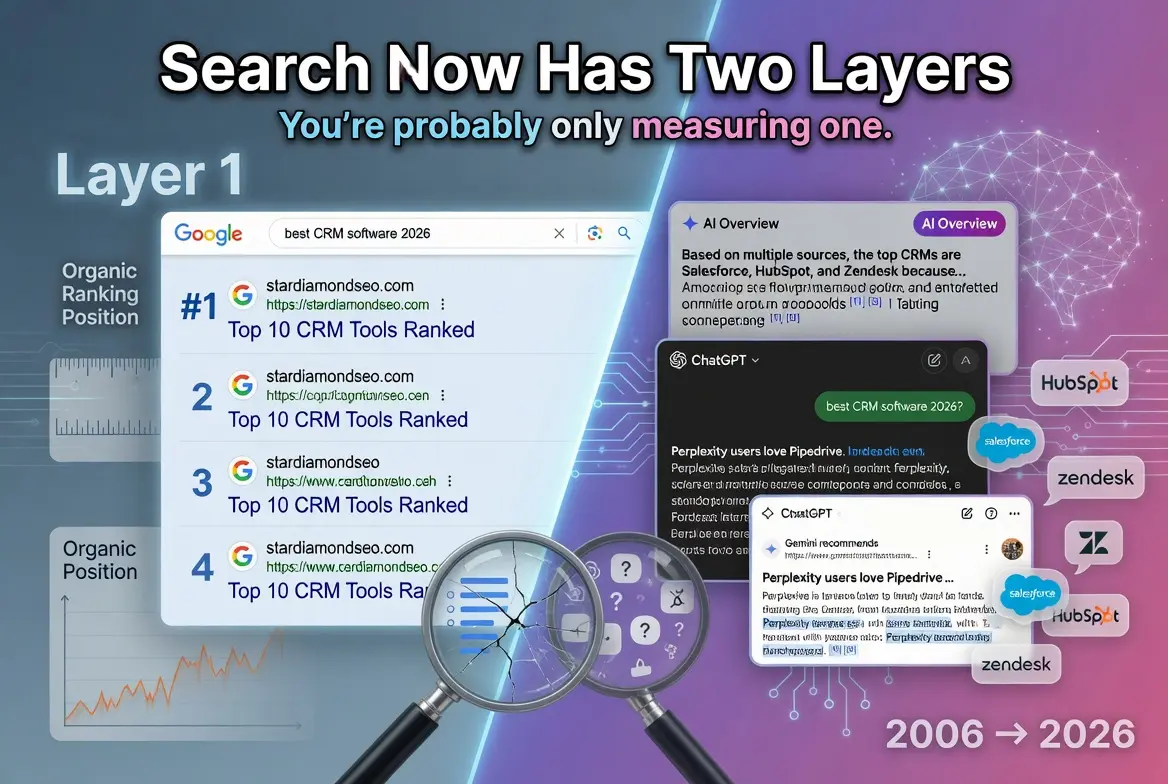
The rule: AI search visibility is not a replacement for SEO. It is a second layer of search visibility that operates on overlapping but distinct signals. A brand can rank first on Google and be invisible to ChatGPT. A brand that ChatGPT recommends consistently might not rank at all. The businesses that win in 2026 and beyond will be the ones that measure and optimize both layers, not the ones that assume one automatically covers the other.
Search Now Has Two Layers and You Are Probably Only Measuring One
For twenty years, search visibility meant one thing: where does your site appear in Google’s organic results? You tracked rankings, monitored traffic, optimized pages, and measured progress through a feedback loop that was imperfect but functional. Position went up, traffic followed, revenue reflected it eventually. The tools, the workflows, the entire measurement infrastructure was built around this single layer.
That layer still exists. It still matters. It will probably matter for years to come. But sometime around 2024, a second layer started forming on top of it. AI-generated responses began answering search queries directly, inside the search interface, before the user ever scrolled to the organic results. Google AI Overviews. ChatGPT with web browsing. Perplexity. Gemini. Copilot. Each platform synthesizing answers from web sources and presenting them as conversational responses with or without citation links.
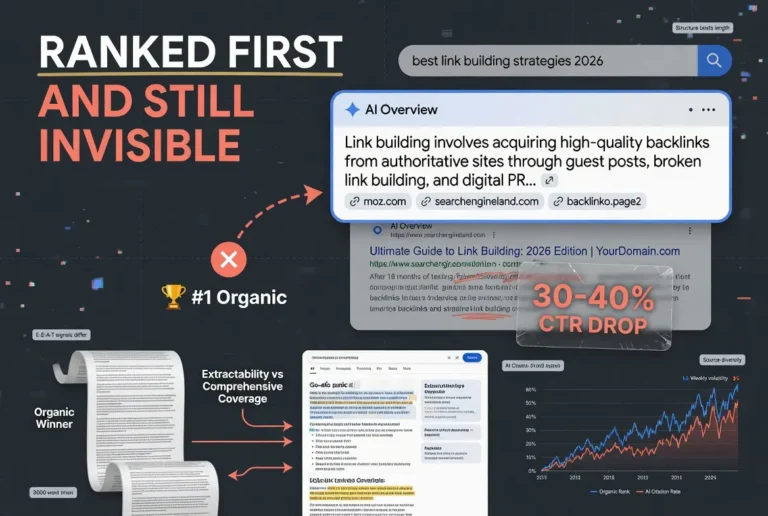
The second layer operates on different logic than the first. Different content gets surfaced. Different signals matter. Different brands win. A site ranking first on Google for a commercial keyword can be completely absent from the AI Overview that sits above that ranking. A brand that ChatGPT recommends consistently might not rank in Google’s top 100 for the same query. The two layers are not interchangeable. They are not automatically correlated. And measuring one tells you little about your performance on the other.
I did not take this seriously enough at first. I assumed that strong organic rankings would naturally produce AI visibility because the signals should overlap. For some pages that turned out to be true. For others, including pages with years of ranking history and strong backlink profiles, the AI platforms cited entirely different sources. The gap was wider than I expected, and it took tracking both layers simultaneously to understand how wide it actually was.
This guide covers the second layer. What AI search visibility is, how it works, how to measure it, how to optimize for it, and where the limits of current knowledge sit. The first layer, traditional SEO, is not going away. But if you are only measuring and optimizing the first layer in 2026, you are flying half-blind in a market that has already moved.
How AI Platforms Decide Which Brands to Cite
Each AI platform has its own retrieval and generation process, but the broad strokes are consistent enough to describe as a category. When a user asks an AI platform a question, the system does some combination of retrieving relevant web content, consulting its embedded training knowledge, and synthesizing a response that attempts to answer the question accurately and helpfully. The brands and sources that appear in that response were selected through a process that is fundamentally different from how Google selects organic rankings.
Google’s organic algorithm evaluates pages. It asks: which page best satisfies this query? The answer is a ranked list of URLs. AI platforms evaluate information. They ask: what is the best answer to this question, and which sources should I draw from to construct it? The answer is a synthesized response that may cite multiple sources, a single source, or no source at all.
That distinction changes what matters for visibility. In organic search, being the best page wins. In AI search, being the most useful source for a specific claim within a synthesized answer wins. A page that is comprehensively authoritative on a topic might rank first on Google but get passed over by an AI platform that found a more extractable answer on a narrower, more focused page. Comprehensiveness wins rankings. Extractability wins citations.
Training Data and Embedded Knowledge
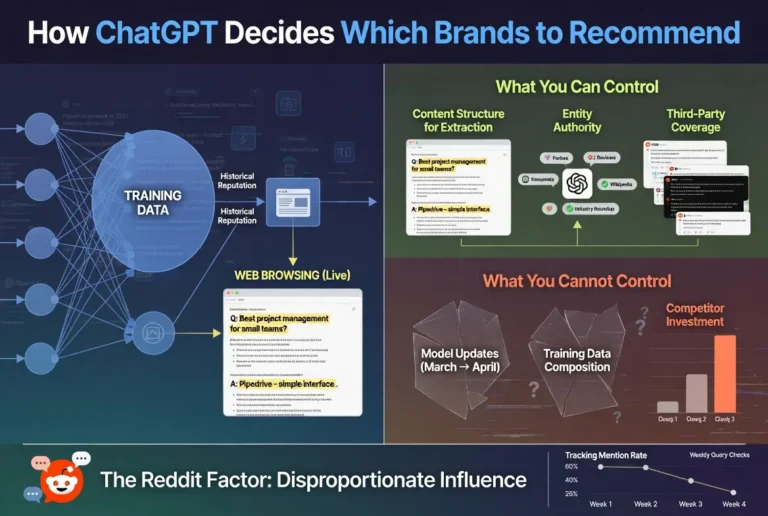
Large language models are trained on massive datasets of web content. Brands that were widely discussed, reviewed, and cited across high-quality sources during the training period become part of the model’s embedded knowledge. When a user asks ChatGPT for a recommendation, part of the response draws from this embedded knowledge, not from a live web search. This creates a momentum effect: established brands with years of third-party coverage have an embedded advantage that newer brands cannot shortcut.
Live Retrieval
Most AI platforms now supplement embedded knowledge with live web retrieval. ChatGPT browses the web. Perplexity searches it for every query. Google AI Overviews pull from the indexed web. The live retrieval layer favors content that is current, well-structured, factually clear, and published on domains the platform considers authoritative. This is the layer that newer brands can influence most directly, because it evaluates content as it exists today rather than as it existed during training.
Source Authority and Trust
AI platforms do not cite randomly. They select sources they evaluate as trustworthy for the specific claim being made. The signals that establish trust overlap significantly with what Google calls E-E-A-T: expertise, experience, authoritativeness, and trustworthiness. Author credentials, editorial standards, third-party citations, consistent brand mentions across independent sources. These signals were built for Google’s quality evaluation, but they translate directly to AI platform source selection because the underlying question is the same: is this source reliable enough to cite?
Why Every Platform Is Different
One of the mistakes I see most often is treating “AI search” as a single channel. It is not. Each platform retrieves, evaluates, and cites differently enough that your visibility on one tells you almost nothing about your visibility on another.
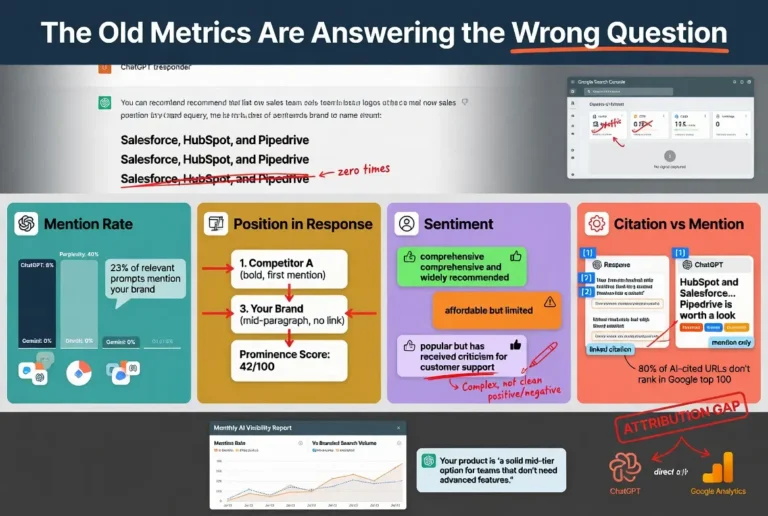
ChatGPT mentions brands frequently but links to them rarely. A typical recommendation response names several brands conversationally without providing URLs. The user gets the recommendation, searches one of those brand names on Google, and Google gets the attribution credit. ChatGPT’s influence on the buyer journey is real but almost entirely invisible in analytics because the traffic it generates arrives through other channels.
Perplexity operates as a search engine with AI-generated answers. Every response includes numbered source citations with links. When Perplexity cites your brand, users can click through directly. Referral traffic from Perplexity tends to convert at higher rates than traditional organic traffic, likely because users arriving from Perplexity have already read a synthesized answer and are further along in their decision process.
Google AI Overviews sit inside Google Search itself, making them the highest-volume AI search surface. They pull from Google’s index and display citation links alongside the generated text. AI Overview citations lean heavily toward recognized brand domains, with established authority compounding faster than on other platforms. But ranking well organically does not guarantee citation in the AI Overview. The gap between organic rankings and AI Overview citations is one of the most commonly misunderstood aspects of AI search visibility.
Gemini and Copilot add additional surfaces with their own retrieval behaviors. The practical implication is that a comprehensive AI search visibility strategy monitors multiple platforms, not just the one that is easiest to track or most familiar. Where your audience asks questions is where your visibility needs to be measured.
Measuring AI Search Visibility
Traditional SEO measurement tools cannot capture AI search visibility. Google Search Console does not show whether an AI Overview appeared for a query. Ahrefs does not track ChatGPT mentions. Google Analytics does not attribute traffic to AI-initiated discovery journeys. The measurement infrastructure that modern SEO relies on was built for a world where visibility meant appearing in a list of blue links. That world still exists, but it is no longer the complete picture.
The metrics that matter for AI search visibility are different from traditional SEO metrics. Mention rate replaces ranking position as the primary visibility indicator. Share of model replaces share of voice as the competitive positioning metric. Citation quality, sentiment, and platform coverage provide the context that transforms a mention count into an actionable strategic picture.
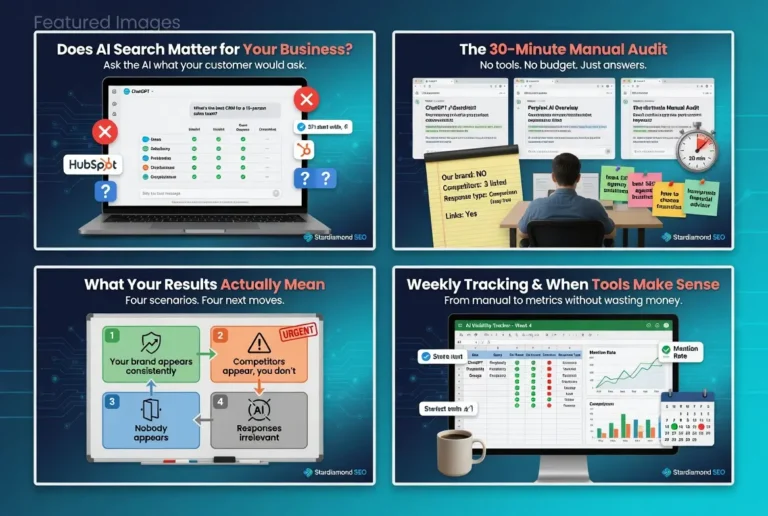
Measurement starts with a manual audit. Pick your five to ten most commercially important keywords. Query them on ChatGPT, Perplexity, and Google (checking for AI Overviews). Record whether your brand appears. Record which competitors appear. Do this weekly for four weeks. That baseline tells you whether AI search is active in your market, whether you are visible or invisible, and who is winning the space you should occupy.
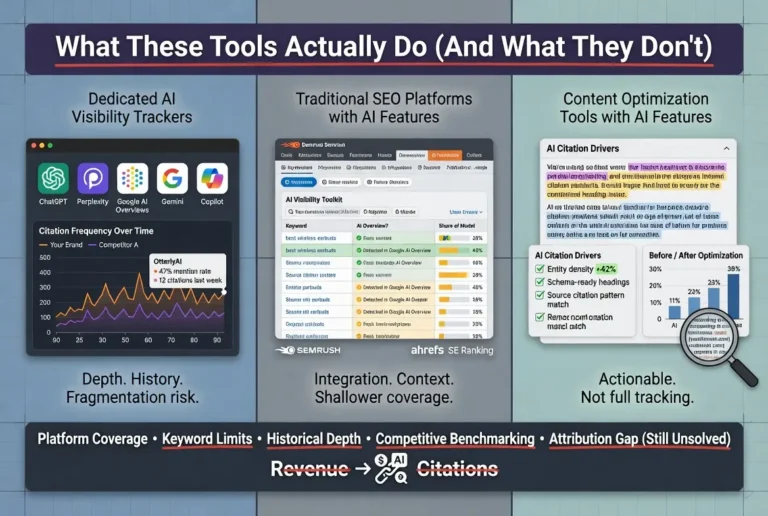
If the audit confirms AI search is relevant, the measurement scales through dedicated tracking tools that automate the sampling, store historical data, and provide competitive benchmarking. The tool landscape is young and crowded. The evaluation criteria that matter most are platform coverage, historical data depth, competitive benchmarking, and whether the data is transparent enough to verify independently.
Building a Brand That AI Recommends
There is no meta tag for AI search. No keyword density formula. No shortcut that reliably forces a language model to cite your brand. The optimization that works is building the kind of online presence that a well-informed human would cite as a trusted source, because that is what the models are trained to approximate.
Content Structure for Extraction
AI platforms need content they can extract clean answers from. Pages organized with descriptive headings, concise paragraphs that make specific claims, FAQ sections with direct answers, and definition-style openings get cited more frequently than pages that cover the same material in dense, unstructured prose. This is not about dumbing content down. It is about making the useful information findable by a system that is scanning for relevance, not reading for pleasure.
Entity Authority
AI platforms need to recognize your brand as a legitimate entity in your category before they will recommend you. Entity recognition comes from consistent mentions across authoritative independent sources: industry publications, review sites, professional directories, community discussions. A brand that exists only on its own website is invisible to AI training processes. A brand discussed across dozens of independent sources becomes part of the model’s knowledge about the category.
Third-Party Coverage
Some of the most effective AI visibility work happens off your own website. Getting reviewed, getting included in industry comparisons, getting discussed in communities where your audience participates. Reddit discussions, for example, carry disproportionate weight in both ChatGPT’s training data and Perplexity’s citations. Authentic participation in relevant communities builds the kind of presence AI platforms weight as recommendation-worthy.
Content Architecture
A single page cannot cover every question an AI platform might be asked about your category. A content cluster built around a topic creates multiple extraction points for AI systems. Each page in the cluster answers specific questions with clear, direct content. The cluster as a whole signals topical depth and authority. AI platforms that evaluate your domain for a recommendation consider the breadth and quality of your coverage, not just the single page that matches the query.
E-E-A-T Signal Building
The signals that Google uses to evaluate expertise, experience, authoritativeness, and trustworthiness are the same signals that make a brand recognizable and citable by AI platforms. Author profiles with verifiable credentials. Bylined content in third-party publications. Citations of your content by other authoritative sources. Consistent brand presence across the web. Building authority signals for Google simultaneously builds them for every AI platform. The investment compounds across both layers of search visibility.
The Attribution Problem Nobody Has Solved
This is the section I wish I could skip because the answer is unsatisfying, but skipping it would be dishonest.
When ChatGPT recommends your brand, there is no reliable way to trace that recommendation through to a sale. The user might search your name on Google (attributed to organic search). They might type your URL directly (attributed to direct). They might click a retargeting ad later (attributed to paid). The AI touchpoint that started the entire sequence is invisible in every standard attribution model.
The workarounds are all directional rather than definitive. Self-reported attribution surveys (“how did you hear about us?”). Branded search volume correlation with AI mention trends. Referral traffic from platforms that do provide links (primarily Perplexity). Upticks in direct traffic that correlate with increased AI visibility. None are precise. All provide signal.
The honest framing is that AI search measurement in 2026 is where social media measurement was in 2010. Everyone knows it influences buying decisions. Nobody can prove exactly how much. The companies that invest early will have the data advantage when the attribution infrastructure eventually catches up. That is not a satisfying answer for a quarterly review with leadership, and I do not have a better one that is also true.
What I can say with confidence: being absent is measurably worse than being present. When a buyer asks AI for a recommendation and your competitor is named and you are not, the competitor has an advantage that no amount of organic ranking can fully offset. The buyer has a shortlist before they ever open Google. You are either on it or you are not.
AI Search Visibility Is Not a Replacement for SEO
I want to be explicit about this because the vendor ecosystem has an incentive to position AI visibility as the new SEO, which implies the old SEO is obsolete. It is not.
Organic search still drives the majority of trackable web traffic for most businesses. The click-through path from Google’s organic results to your site to a conversion is intact, measurable, and optimizable with decades of accumulated methodology. AI search currently operates alongside that path, sometimes feeding into it (a ChatGPT mention that leads to a branded Google search), sometimes competing with it (an AI Overview that answers the query without a click), but not replacing it.
The relationship between the two layers is additive, not substitutive. Strong organic rankings build the authority and content depth that AI platforms evaluate when selecting sources to cite. Strong AI visibility builds the brand awareness and trust signals that improve organic click-through rates. The two layers reinforce each other when both are actively managed. They compete with each other when one is optimized and the other is ignored.
The practical implication is that AI search visibility does not require a new team or a separate budget. It requires extending the existing SEO workflow to include AI-specific measurement and the content structure adjustments that improve AI extractability. The foundation, authoritative content on topics relevant to your business, built on genuine expertise and supported by third-party validation, serves both layers simultaneously.
Getting Started: The First 30 Days
Week one: run the manual audit. Five to ten commercial keywords across ChatGPT, Perplexity, and Google. Record who appears, who doesn’t, and how the AI describes each brand. This takes 30 minutes and establishes whether AI search is relevant for your business.
Week two: repeat the audit. Compare results to week one. Note which citations were stable and which changed. This reveals volatility patterns and distinguishes durable visibility from one-time appearances.
Week three: analyze the content gap. For every query where competitors appear and you don’t, look at what their cited pages have that yours lack. Usually it comes down to content structure (extractable answers under descriptive headings), entity authority (third-party mentions and coverage), or content existence (they have a page that answers the question directly and you don’t). Identify the three highest-priority gaps.
Week four: start closing the gaps. Create or restructure content to address the top three opportunities. Add FAQ sections with real questions from search data. Restructure existing pages so that key answers are under descriptive headings rather than buried in long paragraphs. Identify opportunities for third-party coverage that would strengthen your entity authority.
After 30 days you will have a baseline measurement, competitive context, a prioritized gap list, and initial optimization in progress. You will also have enough data to decide whether automated tracking is worth the investment for your market or whether manual monitoring is sufficient at your current scale.
What Comes Next
AI search is not finished changing. The platforms update their models regularly. New surfaces emerge. The balance between embedded training knowledge and live retrieval shifts with each update. What works today will need adjustment tomorrow, not because the fundamentals change (authority, trust, extractability) but because the specific mechanisms that evaluate those fundamentals will evolve.
The brands that will do best over the next two to three years are the ones building foundational authority rather than chasing platform-specific tactics. Training data changes. Retrieval algorithms change. The specific page that gets cited today might not get cited after the next model update. What persists is genuine expertise demonstrated through depth and accuracy, widespread brand recognition built through legitimate third-party coverage, and content that answers real questions clearly and directly.
That sounds like what SEO has always been at its best, which is not a coincidence. The models are trained to approximate what a well-informed, trustworthy human would recommend. Building the kind of brand that a well-informed human would actually recommend is the strategy that survives every algorithm update, every model change, and every platform shift. It was true for Google in 2010. It is true for AI search in 2026. I do not expect that to change.
FAQ
What is AI search visibility?
AI search visibility measures how often, how prominently, and in what context your brand appears in AI-generated responses across platforms like ChatGPT, Google AI Overviews, Perplexity, Gemini, and Copilot. It represents a layer of search visibility that operates independently of traditional organic rankings and requires its own measurement and optimization approach.
Is AI search visibility just another SEO buzzword?
No. AI search visibility reflects a structural change in how buyers discover brands. Studies show 37 percent of consumers now start research with AI platforms rather than Google. AI Overviews appear on roughly 30 to 40 percent of Google searches and reduce organic click-through rates by 30 to 40 percent on queries where they appear. The impact on traffic, brand awareness, and competitive positioning is measurable even though direct revenue attribution remains difficult.
How do I know if AI search visibility matters for my business?
Ask ChatGPT, Perplexity, and Google the questions your buyers would ask before purchasing. If the AI responses name competitors in your category, AI search is already affecting your market. If the responses are generic with no brand names, the opportunity is open. If the responses are irrelevant to your category, AI search has not reached your vertical yet. A 30-minute manual audit answers this question definitively.
Can I improve AI search visibility without buying new tools?
Yes. Structure your content so key answers appear under descriptive headings rather than buried in long paragraphs. Build FAQ sections targeting real search queries. Strengthen your third-party coverage through reviews, industry comparisons, and authentic community participation. Manual weekly tracking of five to ten commercial keywords across three AI platforms provides enough measurement data to guide optimization without any tool subscription.
Does strong SEO automatically produce strong AI search visibility?
Not automatically. The signals overlap but the priorities differ. Organic rankings reward comprehensive page-level authority. AI citations reward extractable, direct answers from sources the platform trusts. A page can rank first on Google and be absent from the AI Overview above it. Strong SEO provides the foundation that AI platforms evaluate, but content structure and third-party coverage adjustments are usually needed to convert that foundation into consistent AI citations.
How long does it take to improve AI search visibility?
Content structure improvements can affect AI citations within weeks for platforms that use live web retrieval. Changes to entity authority and third-party coverage take months because they depend on building sustained brand presence across independent sources. Training-data-level recognition changes on AI platform update timelines, not yours. The fastest path to results is optimizing existing high-authority content for AI extractability while building third-party coverage in parallel.
What is the difference between AI search visibility and GEO?
Generative engine optimization (GEO) is the practice of optimizing content and brand presence for AI-generated search results. AI search visibility is the measurement of how your brand performs in those results. GEO is what you do. AI search visibility is what you measure. Both are necessary because optimization without measurement is guessing, and measurement without optimization is watching.