Why We Don’t Write Meta Descriptions (And What Google Pulls)
AI Summary
Why skip meta descriptions? Google rewrites meta descriptions on the majority of search results, pulling text directly from page content that it determines is more relevant to the specific query than the static meta description the site operator wrote. Building structured content that gives Google better raw material to pull from produces more effective SERP snippets than hand-crafting 160-character summaries that Google will likely replace anyway.
What it is and who it is for: This article is for SEO practitioners, content managers, and business owners who spend time writing and optimizing meta descriptions as part of their on-page SEO process. It explains why that time is better spent on content structure, why Google’s automated snippet selection often outperforms hand-written descriptions, and what to build on the page so Google has high-quality text to select from.
The rule: Control what you can control. You cannot control what Google displays as your snippet. You can control the quality, structure, and clarity of the content Google selects from. Build pages with clean opening paragraphs, structured AI summary blocks, and clear heading hierarchy, and Google will assemble better snippets than any 160-character field could contain.
The Conventional Wisdom and Why We Ignore It
Every on-page SEO checklist includes the same instruction: write a compelling meta description under 160 characters that includes your target keyword and gives the searcher a reason to click. The advice has been repeated so consistently for so long that questioning it feels like questioning whether title tags matter. But the advice is built on an assumption that stopped being true years ago, and most SEO practitioners have not updated their process to reflect the change.
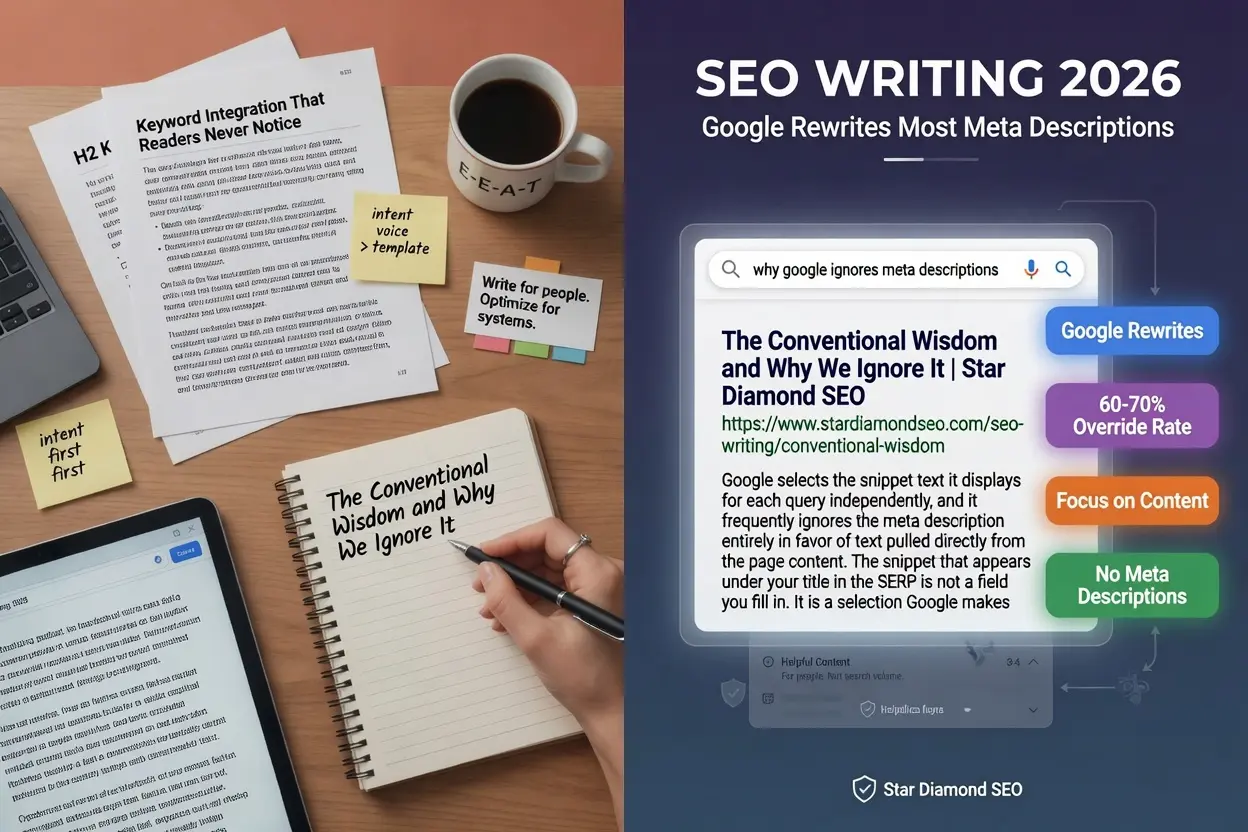
The assumption is that the meta description you write is the text Google will display in the search results. It is not. Google selects the snippet text it displays for each query independently, and it frequently ignores the meta description entirely in favor of text pulled directly from the page content. The snippet that appears under your title in the SERP is not a field you fill in. It is a selection Google makes from your page based on what it determines is most relevant to the specific query the searcher typed.
Star Diamond SEO does not write meta descriptions. We do not fill in the meta description field in RankMath. We do not optimize for RankMath’s SEO score, which penalizes pages without meta descriptions. We use RankMath exclusively for schema markup and sitemap generation. Everything else in the plugin’s scoring system optimizes for a checklist, not for rankings. The distinction matters because following the checklist produces pages that score well in a plugin and rank the same as pages that ignore it.
Google Rewrites Most Meta Descriptions Anyway
Google’s own documentation confirms that the search engine generates snippets dynamically based on the query. The meta description is one input. The page content is another. Google selects whichever source produces a snippet that best matches the specific search query. Since a single page can rank for dozens or hundreds of different queries, a static 160-character meta description cannot possibly be the most relevant snippet for every variation.
Studies on snippet rewriting rates have consistently found that Google replaces meta descriptions on 60% to 70% of search results. Some analyses put the number higher. The exact percentage varies by industry, query type, and content format, but the pattern is consistent: Google rewrites more meta descriptions than it keeps. The meta description you spent five minutes crafting has a better-than-even chance of never being shown to anyone.
The rewriting is not random. Google’s snippet selection algorithm evaluates which text on the page best answers the specific query the searcher typed. For a page targeting “what is a content pillar,” the meta description might say “Learn what content pillars are and how to build one.” But if someone searches “how to structure a content pillar for SEO,” Google may pull a sentence from the body that more directly addresses structuring rather than defining. The dynamic selection produces more relevant snippets than any static description could for the full range of queries a page receives.
The implication is straightforward. The time spent writing meta descriptions is time spent optimizing an input that Google overrides more often than it uses. The time would be better spent on the content Google actually selects from.
What Google Actually Pulls From Your Page
When Google generates a snippet, it draws from several content zones on the page. Understanding which zones Google prefers helps you build pages that produce better snippets passively rather than trying to predict what Google will display and pre-writing it in a meta field.
The first paragraph is the most common source for informational queries. Google frequently pulls the opening sentences of an article as the snippet because they typically contain the most concise answer to the query. A first paragraph that clearly defines the topic and states the core thesis produces strong snippets across multiple query variations without any meta description optimization.
Heading text combined with the paragraph immediately following it is a common pattern for queries that match a specific section of the article. If someone searches “how to integrate keywords in seo writing” and your page has an H2 that reads “Keyword Integration That Readers Never Notice” followed by a paragraph explaining the approach, Google may display that heading-paragraph combination as the snippet. This is why descriptive headings that accurately label their sections matter for snippet quality, not just for readability.
Structured summary blocks at the top of the page are increasingly selected by Google’s snippet algorithm because they contain concentrated, clearly labeled information. A styled div at the top of the article that defines the topic, identifies the audience, and states the core takeaway gives Google three distinct text blocks to select from, each one formatted as a complete, self-contained answer to a different type of query about the same topic.
FAQ sections are pulled for question-based queries. When a searcher types a question that matches an H3 in your FAQ section, Google often displays the question and the first sentence of the answer as the snippet. This is why FAQ questions should target real search queries and answers should lead with the most direct response rather than preamble.
The AI Summary Block: Giving Google Better Material
Every article on Star Diamond SEO includes a styled AI Summary block at the top of the page, immediately below the meta comment block. The block contains three labeled sections: a definition of the topic, an explanation of who the content is for and why it matters, and a statement of the core takeaway or operating principle. The block is not decorative. It is engineered to give Google’s snippet selection algorithm the highest-quality raw material available on the page.
The structure works because each section answers a different query type. The definition paragraph answers “what is [topic]” queries. The audience paragraph answers “who needs [topic]” and “why does [topic] matter” queries. The rule paragraph answers “how does [topic] work” and “what is the main point of [topic]” queries. Three paragraphs cover the three most common query patterns for any informational topic. Google selects whichever paragraph best matches the specific search.
The result is that Google pulls snippet text from the AI Summary block on a significant percentage of queries for our pages. The snippets are more informative, more specific, and more compelling than any 160-character meta description could be because they are full paragraphs written to communicate, not character-limited fields written to satisfy a plugin score.
The block also serves readers directly. A visitor who lands on the page gets an immediate summary of what the article covers, who it is for, and what the core takeaway is. They can decide in ten seconds whether the article is relevant to their question. This reduces bounce rate for irrelevant visits and increases engagement for relevant ones, both of which are user experience signals that correlate with sustained ranking performance.
What Our SERP Snippets Actually Look Like
The proof is in the search results. Here is what Google chose to display for Star Diamond SEO pages when no meta description was provided.
For the Crawlability page, Google selected: “Crawlability is the most boring of the five Cs and the one that quietly destroys the most sites.” That sentence came from the body content. No meta description could have matched the personality and specificity of that snippet. It communicates both what the page covers and the voice behind it. A hand-written meta description would have produced something generic like “Learn about crawlability and why it matters for SEO.” Google chose better.
For the Cadence page, Google selected: “What works is rhythm. Consistent, predictable publishing on a schedule Google can pattern-match against.” Again pulled from the content, not from a meta field. The snippet communicates the concept, the mechanism, and the benefit in two sentences. It reads like a person talking, not like an SEO field optimized for a plugin.
For the AI Content Creation Guide, Google pulled from the AI Summary block: “What is AI content creation for SEO? AI content creation is the practice of using large language models to assist with writing content…” The definition paragraph became the snippet for definitional queries. The block worked exactly as designed.
In every case, Google assembled a more effective snippet from the page content than a hand-written meta description would have produced. The content was written to be clear, specific, and informative for readers. Google’s snippet algorithm recognized that clarity and selected the most relevant text for each query. The meta description field sat empty. The results were better for it.
The Edge Cases Where Meta Descriptions Still Matter
Intellectual honesty requires acknowledging the situations where meta descriptions still provide value, even though our default practice is to skip them.
Homepage and core service pages receive a high percentage of branded and navigational queries where the query is simply the company name or a direct service term. For these pages, Google is less likely to rewrite the meta description because the query directly matches the page’s primary purpose. A well-written meta description on the homepage can function as a controlled brand statement that Google displays consistently. Even here, Google may override it, but the override rate is lower than for informational content pages.
Pages with minimal body text, such as contact pages, landing pages with forms, or portfolio pages with primarily visual content, give Google less text to select from. When the page content is thin, Google falls back to the meta description more frequently because there is not enough body text to generate a better snippet from. For these pages, writing a meta description provides a fallback that prevents Google from displaying a fragment of navigation text or a random sentence from the footer.
Social media sharing platforms use the meta description (or og:description) as the preview text when someone shares a URL. If social sharing is a significant traffic channel, the meta description functions as the social preview copy. This is a valid use case that has nothing to do with Google’s snippet selection.
For the blog content, educational articles, and cluster pages that make up the core of an SEO content operation, meta descriptions add no measurable value. The content itself is the snippet source. Build the content well and the snippets take care of themselves.
What to Build Instead of Meta Descriptions
The time recovered from not writing meta descriptions should go toward the content elements that actually determine snippet quality and ranking performance.
Build strong opening paragraphs. The first paragraph of every article should define the topic, establish the scope, and communicate the value of reading further. This paragraph is Google’s primary snippet candidate for broad queries matching the page’s topic. A first paragraph that clearly answers “what is this about and why should I care” produces effective snippets across dozens of query variations without any meta optimization.
Build AI Summary blocks with three distinct sections. The definition, audience, and rule structure gives Google three pre-formatted snippet candidates, each optimized for a different query type. The block sits at the top of the page where Google’s systems give it high visibility. The formatting, with labeled bold headings for each section, helps Google’s parser identify the boundaries of each snippet candidate.
Build descriptive headings. Every H2 should accurately describe what its section contains in language that matches how searchers phrase their queries. “How to Integrate Keywords” is a better heading than “Keyword Strategy” because it matches the question format searchers use. Google pairs headings with their following paragraphs when generating snippets for section-specific queries. Better headings produce better snippet pairings.
Build FAQ sections with real search queries as questions. Each FAQ question should target an actual query from keyword data, not a generic question the writer invented. The answer should lead with the direct response in the first sentence, then elaborate. Google pulls FAQ content for question-based queries and displays it as featured snippets. A strong FAQ section produces multiple snippet opportunities from a single page.
Build clean, scannable content structure throughout. Short paragraphs. Clear topic sentences. One idea per paragraph. Logical progression from section to section. This structure does not just help readers. It gives Google’s snippet selection algorithm clean text blocks to choose from. Messy paragraphs that blend multiple ideas into long, unpunctuated blocks produce poor snippets because Google cannot extract a clean, self-contained answer from tangled prose.
The SEO writing process should produce pages where every paragraph could function as a snippet. Not because you are writing for snippets. Because you are writing clearly, specifically, and concisely enough that any paragraph, pulled out of context and displayed under your title in the search results, would accurately represent the value of the page. That standard of writing produces better snippets than any meta description field ever could.
FAQ
Should I write meta descriptions for my blog posts?
For blog posts and informational content, meta descriptions add minimal value because Google rewrites them on 60% to 70% of search results. The time is better spent on strong opening paragraphs, structured summary blocks, and clear heading hierarchy that give Google better raw material to generate snippets from. The content on the page produces more effective snippets than a 160-character field.
Does Google always use the meta description?
No. Google selects snippet text dynamically based on what it determines is most relevant to each specific query. A single page can rank for hundreds of queries, and Google may display different snippet text for each one, pulling from the body content, headings, FAQ sections, or structured blocks rather than the meta description. Google uses the meta description only when it determines the meta text is more relevant than any content on the page.
Will my rankings drop if I skip meta descriptions?
Meta descriptions are not a ranking factor. Google has confirmed this explicitly. The meta description affects the snippet displayed in search results, which can influence click-through rate, but the description itself does not affect ranking position. Pages without meta descriptions rank identically to pages with them, provided the on-page content is strong.
What is an AI Summary block?
An AI Summary block is a styled content section at the top of an article that provides a structured summary in three parts: a definition of the topic, an explanation of who the content is for and why it matters, and a statement of the core takeaway. The block gives Google’s snippet algorithm high-quality, pre-formatted text to select from and gives readers an immediate overview of the article’s scope and value.
What should I use RankMath for if not meta descriptions?
RankMath is valuable for schema markup (Article schema, FAQ schema, LocalBusiness schema) and XML sitemap generation. These are the technical SEO functions that directly affect how Google processes and displays your pages. The SEO score, focus keyword, and meta description fields in RankMath optimize for a checklist that does not correlate with ranking performance. Use the plugin for what it does well and ignore the scoring system.
When should I still write a meta description?
Write meta descriptions for your homepage, core service pages, and any page with minimal body text (contact pages, landing pages, portfolio pages). These pages either receive high-volume branded queries where Google is less likely to rewrite the description, or have insufficient body text for Google to generate a quality snippet from. For content-rich blog posts and articles, skip the meta description and let Google select from the content.