How to Map Keywords to a Content Pillar Structure
AI Summary
What is keyword mapping? Keyword mapping is the process of assigning specific keywords to specific pages within a content structure. Each page receives a primary keyword it is optimized to rank for, a set of secondary keywords that provide topical depth, and LSI terms that signal comprehensive coverage to Google. The map ensures no two pages compete for the same keyword and every keyword in the strategy has a designated page targeting it.
What it is and who it is for: This article is for SEO practitioners and content strategists who have a pillar topic selected and need to translate it into a keyword architecture that assigns the right keywords to the right tier articles in the right structure. It covers how to pull keyword data, cluster it into article-level targets, assign primary and secondary keywords, prevent cannibalization, and build the map that drives the entire content production process.
The rule: One primary keyword per page. One page per primary keyword. If two pages target the same primary keyword, they compete against each other instead of against the external competition. The keyword map prevents cannibalization by assigning every keyword to exactly one page before writing begins.
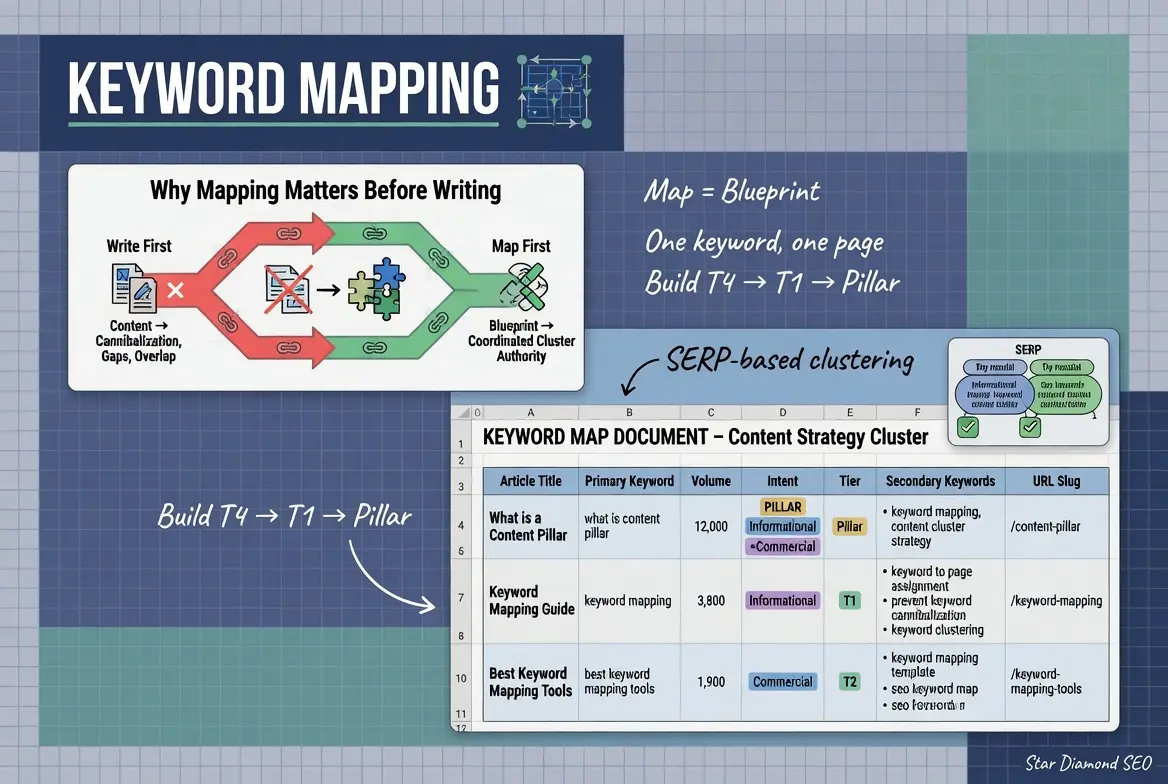
Why Keyword Mapping Matters Before Writing
Most content operations start writing before they finish mapping. A topic gets selected, a primary keyword gets chosen, and the writer begins. The secondary keywords are identified during writing or added during editing. The relationship between the article and other articles in the cluster is considered loosely if at all. The result is content that targets keywords competently on a page-by-page basis but fails to build the coordinated topical authority that makes a cluster outperform isolated pages.
Keyword mapping performed before writing solves problems that are expensive to fix after publication. It prevents cannibalization by ensuring no two pages in the cluster target the same primary keyword. It prevents gaps by ensuring every valuable keyword in the topic space has a designated page. It prevents overlap by drawing clear boundaries between what each article covers. And it establishes the internal linking architecture by defining the topical relationships between pages before the links are built.
The map is not a suggestion that writers consult. It is the blueprint that drives the entire production process. Every article’s scope, depth, heading structure, and internal link targets derive from the keyword map. Changing the map after production begins means rewriting content that was built on the old structure. The investment in thorough mapping before writing begins pays for itself by eliminating revisions that would have been necessary without it.
Pulling the Keyword Data
The keyword data for a content pillar comes from three sources, and the best maps draw from all three.
The content gap analysis provides the keywords your competitors rank for that you do not. These are the proven opportunities: keywords with confirmed search volume where someone else is already capturing the traffic. The gap analysis gives you the competitive landscape. It tells you which keywords have demand and which of those keywords your site is currently invisible for.
Search suggestions from Ahrefs, SEMrush, or Google Suggest provide the semantic variations and long-tail queries that surround your pillar topic. Enter the pillar keyword and pull every related suggestion. These suggestions represent the actual language searchers use when exploring the topic, which often differs from the keyword phrases that keyword research tools surface in their main databases. The suggestions reveal question-format queries, comparison queries, and specific use-case queries that make excellent tier article targets.
SERP analysis for the pillar keyword provides the topical expectations Google has already established. Search the pillar keyword. Read the top five results. Note every subtopic they cover. These subtopics represent Google’s understanding of what a comprehensive resource on this topic should include. Missing a major subtopic that every competitor covers is a comprehensiveness gap that the keyword map should address.
Merge the data from all three sources. Deduplicate. Remove branded terms and irrelevant queries. What remains is the complete keyword universe for your pillar topic. The clustering process that follows organizes this universe into the article-level groups that become your tier structure.
Clustering Keywords Into Article-Level Groups
The raw keyword list contains dozens to hundreds of keywords. Each one is a search query. The clustering process groups queries that should be answered by the same page. Two keywords belong in the same cluster when a single article is the best answer for both queries. Two keywords belong in different clusters when they require different content to answer properly.
The clustering method that produces the cleanest results is SERP-based clustering. Search two keywords. If the top five results for both keywords share three or more URLs in common, Google considers them the same topic and a single page can rank for both. If the top results share zero or one URL, Google considers them distinct topics that require separate pages. This method uses Google’s own classification as the clustering authority rather than relying on semantic similarity alone.
In practice, SERP-based clustering is time-intensive for large keyword sets. A practical shortcut is grouping by obvious topical affinity first, then spot-checking the SERP overlap for borderline cases. Keywords like “keyword mapping,” “how to map keywords,” “keyword mapping template,” and “keyword to page mapping” clearly belong together. Keywords like “keyword mapping” and “keyword research tools” might seem related but serve different intents and require different content. The SERP check confirms which borderline pairs belong together and which need separate pages.
Each resulting cluster becomes one article. The cluster contains between 3 and 15 keywords, depending on the breadth of the subtopic. The highest-volume keyword in the cluster becomes the primary keyword candidate. The remaining keywords become secondary keywords and LSI terms that provide topical depth within the article.
Assigning Primary Keywords
Every article targets exactly one primary keyword. The primary keyword is the query the article is optimized to rank for. It appears in the title tag, the first paragraph, at least one H2 heading, and the URL slug. The selection of the primary keyword determines the article’s scope, format, and competitive positioning.
The primary keyword should be the highest-volume keyword in the cluster that the article can realistically rank for. “Realistically” accounts for the site’s current authority, the competitive landscape for that keyword, and the content quality required to compete. A keyword with 12,000 monthly searches is the right primary keyword if the content can match or exceed what currently ranks. If the top results are all from DR 80+ sites with thousands of backlinks, that keyword might be a better long-term target while a lower-volume, lower-competition keyword from the same cluster serves as the primary keyword for now.
The primary keyword also determines the search intent the article must match. A primary keyword with informational intent requires an educational article. A primary keyword with commercial intent requires an evaluation or comparison piece. The intent is non-negotiable. The content format follows from the primary keyword’s intent, not from the writer’s preference or the site’s template.
Once assigned, the primary keyword is locked. No other page on the site should target it. If a future article needs to reference the topic, it links to the existing page rather than creating a competing page. One keyword, one page. The principle is simple. Violating it creates cannibalization that is harder to fix than it was to prevent.
Secondary Keywords and LSI Terms
Secondary keywords are the supporting search queries that the article should incorporate naturally. They provide topical depth beyond the primary keyword and capture additional search traffic from variations and related queries. An article targeting “keyword mapping” as the primary keyword might have secondary keywords like “keyword to page assignment,” “seo keyword map,” “keyword clustering,” and “prevent keyword cannibalization.”
Secondary keywords do not need to appear in headings or in the title. They should appear naturally in the body content where the topic warrants their inclusion. A comprehensive article about keyword mapping will naturally discuss keyword clustering, assignment, and cannibalization because those concepts are inherent to the subject. The secondary keywords guide the writer toward covering these related concepts without forcing mechanical insertion.
LSI (Latent Semantic Indexing) terms are the broader semantic vocabulary that signals topical comprehensiveness to Google. They are not keywords to target. They are terms that naturally appear in thorough content about the topic. For an article about keyword mapping, LSI terms include “search volume,” “keyword difficulty,” “content architecture,” “topic clusters,” “SERP analysis,” “search intent,” “primary keyword,” “anchor text,” and “internal linking.” These terms do not need to be tracked or counted. They appear organically when the writer genuinely understands the subject and covers it with depth.
The distinction between secondary keywords and LSI terms is practical, not theoretical. Secondary keywords have confirmed search volume and could theoretically serve as primary keywords for their own pages. LSI terms are the semantic context that Google expects to see in comprehensive content about the topic. Secondary keywords are assigned deliberately. LSI terms emerge naturally from thorough SEO writing.
Intent Classification Per Keyword
Every keyword in the map should be classified by search intent. The classification determines the content format, the call-to-action structure, and the position of the resulting article within the site architecture.
Informational keywords (“what is keyword mapping,” “how to cluster keywords”) produce educational articles. These articles build topical authority, attract organic backlinks, and establish expertise signals that support the site’s overall quality assessment. They sit as tier articles in the content cluster, supporting the pillar from below.
Commercial keywords (“best keyword mapping tools,” “keyword mapping vs keyword grouping”) produce evaluation and comparison content. These articles capture searchers in the consideration phase who are comparing options before making a decision. They link to service pages or pillar pages that convert the visitor’s interest into action.
Transactional keywords (“keyword mapping template download,” “hire keyword research specialist”) produce landing pages and service pages designed to convert. These keywords typically have the highest CPC values because advertisers pay premium prices for clicks from people ready to act. They sit close to the conversion point in the site architecture.
The intent classification prevents format mismatches. An informational keyword targeted with a sales page will not rank because the content format does not match the intent Google has assigned to the query. A transactional keyword targeted with an educational blog post will rank but will not convert because the visitor wanted to act, not learn. The classification ensures every keyword gets the content format that matches its intent.
Preventing Keyword Cannibalization
Keyword cannibalization occurs when two or more pages on the same site target the same primary keyword. Instead of one strong page ranking for the keyword, Google must choose between multiple competing pages from the same domain. The result is usually that neither page ranks as well as one consolidated page would have.
Cannibalization is the most common structural problem in content-heavy sites, and it almost always results from building content without a keyword map. A site publishes “SEO Writing Guide” in January and “How to Write for SEO” in June. Both pages target essentially the same query. Google indexes both. Neither ranks well because Google cannot determine which one the site considers authoritative for the topic.
The keyword map prevents cannibalization at the planning stage. Before any article enters production, check the map to verify that no existing page targets the same primary keyword. If overlap exists, the solution is consolidation (merge the content into one stronger page), differentiation (adjust one page’s primary keyword to a distinct but related query), or assignment (designate one page as the canonical target and redirect or deoptimize the other).
For existing sites with potential cannibalization, run a site: search for each primary keyword. If multiple pages from your site appear in the results for the same keyword, cannibalization is occurring. The fix depends on the severity. Mild overlap (two pages ranking positions 5 and 12 for the same keyword) can be resolved by strengthening the internal linking to the preferred page. Severe overlap (two nearly identical articles competing) requires consolidation: redirect the weaker page to the stronger one and merge the best content from both.
Building the Map Document
The keyword map should be a living document that every person involved in content production can reference. A spreadsheet works. The structure should include one row per article with columns for the article title, primary keyword, search volume, keyword difficulty, search intent, secondary keywords (3 to 5), URL slug, tier position (pillar, T1, T2, etc.), internal link targets, and production status.
The map document for the content strategy cluster on Star Diamond SEO looks like this in practice. Eight rows, one per article. Each row defines the article’s target keyword, its position in the tier hierarchy, the specific secondary keywords it should incorporate, and the internal links it should contain. The writer opens the map, selects the next article in the build order, and has every keyword decision pre-made. The writing focuses on producing quality content rather than making keyword decisions mid-draft.
Maintain the map alongside the on-page checklist. The keyword map tells the writer what to write and which keywords to incorporate. The on-page checklist tells the writer how to structure and optimize the page after the content is written. Together, they form the complete production specification for every article in the cluster.
Update the map as articles are completed. Mark production status. Record the live URL once published. Note any keyword adjustments made during writing. The map should reflect the actual state of the cluster at all times, not just the planned state. Discrepancies between the plan and the execution are decision points: either the plan was wrong and should be updated, or the execution drifted and should be corrected.
Mapping Keywords to Pillar-Tier Positions
The keyword map determines the tier structure of the cluster. The relationship between keyword volume, keyword breadth, and tier position follows a consistent pattern.
The pillar page targets the broadest, highest-volume keyword in the cluster. This is the head term that defines the topic. For the content strategy cluster, that keyword is “what is a content pillar” at 12,000 monthly searches. The pillar covers the topic comprehensively, linking down to every tier article that dives deeper into specific subtopics.
T1 articles target the next tier of keyword volume: the major subtopics that warrant their own dedicated coverage. These are keywords in the 2,000 to 5,000 monthly search range that are too broad for a section within the pillar but too specific to serve as the pillar itself. The content cluster strategy article targets “seo content strategy” at 4,100/mo. It is a complete article on its own but it supports the pillar from one level below.
T2 through T4 articles target progressively more specific keywords. Each tier narrows the focus and deepens the coverage on a single aspect of the broader topic. The keyword volumes decrease as the specificity increases. A T4 article might target a keyword with 500 monthly searches, but that keyword represents a highly specific query that the article can answer definitively, which often means faster ranking and higher conversion rates than broader keywords with more competition.
The build order reverses the tier hierarchy. Write the deepest tier articles first and work upward to the pillar. By the time the pillar is written, every supporting article exists. The pillar can reference and link to actual content rather than planned content. The internal links resolve on publication day. The cluster launches as a complete structure, not as a pillar standing alone with tier articles trickling in over the following weeks.
The keyword map makes this build order possible. Without the map, the writer does not know which articles need to exist before the pillar can be written. With the map, the entire production sequence is defined before the first word is drafted. The map is not overhead. It is the infrastructure that makes coordinated cluster launches feasible.
FAQ
What is keyword mapping in SEO?
Keyword mapping is the process of assigning specific keywords to specific pages within a content structure. Each page receives a primary keyword, secondary keywords, and LSI terms. The map ensures no two pages compete for the same keyword and every valuable keyword in the strategy has a designated page targeting it. The map is created before writing begins and drives the entire content production process.
How many keywords should I assign to each page?
Assign one primary keyword per page, 3 to 5 secondary keywords that provide topical depth, and allow LSI terms to emerge naturally from comprehensive writing about the topic. The primary keyword appears in the title, first paragraph, and heading structure. Secondary keywords appear naturally in the body where the topic warrants their inclusion.
What is keyword cannibalization?
Keyword cannibalization occurs when two or more pages on the same site target the same primary keyword. Google must choose between competing pages from the same domain, and neither page typically ranks as well as one consolidated page would. The keyword map prevents cannibalization by assigning every keyword to exactly one page before writing begins.
How do I cluster keywords into articles?
Group keywords that should be answered by the same page. Two keywords belong in the same cluster when a single article is the best answer for both queries. The most reliable method is SERP-based clustering: if the top five search results for two keywords share three or more URLs, they belong in the same cluster. Group by obvious topical affinity first, then spot-check borderline cases with SERP analysis.
Should the keyword map be created before or after writing?
Before. The keyword map should be complete before the first article in the cluster enters production. The map defines each article’s scope, primary keyword, secondary keywords, tier position, and internal link targets. Creating the map after writing produces keyword assignments that fit the content rather than content that targets the optimal keywords. Mapping first produces better targeting and prevents cannibalization.
How do I handle keywords that could fit multiple pages?
Assign each keyword to the single page where it fits most naturally based on search intent and topical alignment. If a keyword could fit two pages equally well, check the SERP to see which content format Google prefers for that query, then assign the keyword to the page whose format matches. The other page can reference the topic and link to the assigned page rather than targeting the keyword itself.
What tools do I need for keyword mapping?
Ahrefs or SEMrush for keyword data including search volume, difficulty, and search suggestions. Google Search for SERP-based clustering checks. A spreadsheet for the map document itself with columns for article title, primary keyword, volume, difficulty, intent, secondary keywords, slug, tier position, and internal link targets. No specialized keyword mapping tool is required. The strategic interpretation of the data matters more than the tool that surfaces it.