What is an AI Overview Tracker?
AI Summary
What is an AI overview tracker? An AI overview tracker is a tool that monitors whether your pages are cited in Google’s AI-generated answer boxes, which queries trigger them, how your citations compare to competitors, and how those appearances change over time. It fills the measurement gap that Google Search Console and traditional rank trackers leave open.
What it is and who it is for: This article is for SEO practitioners and site owners who rank well in organic results but have noticed they are absent from the AI Overview that sits above those results. It explains why organic rankings and AI Overview citations run on different logic, what an AI overview tracker actually measures, and how to determine whether the gap matters enough to act on.
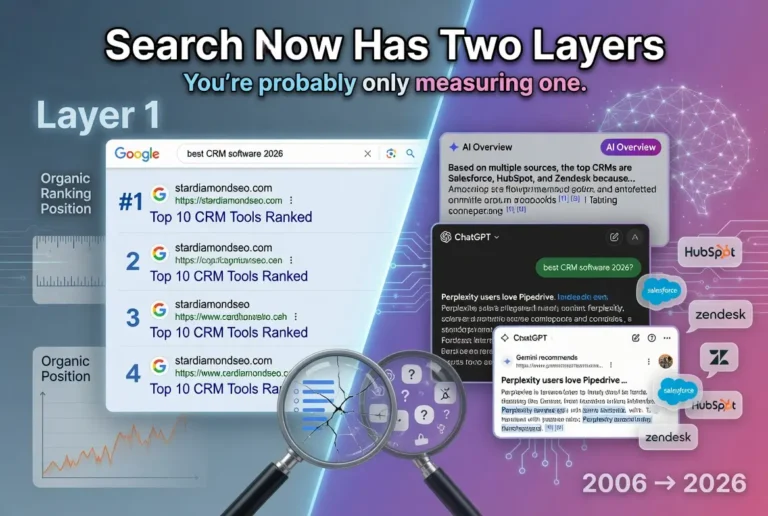
The rule: Ranking first on Google and being cited in the AI Overview are two separate achievements that require overlapping but distinct optimization. A page can hold position one for years and never appear in the AI Overview. A page buried on page two can be the primary source the AI Overview cites. If you are not tracking both layers, you are measuring half of your search visibility.
Ranked First and Still Invisible
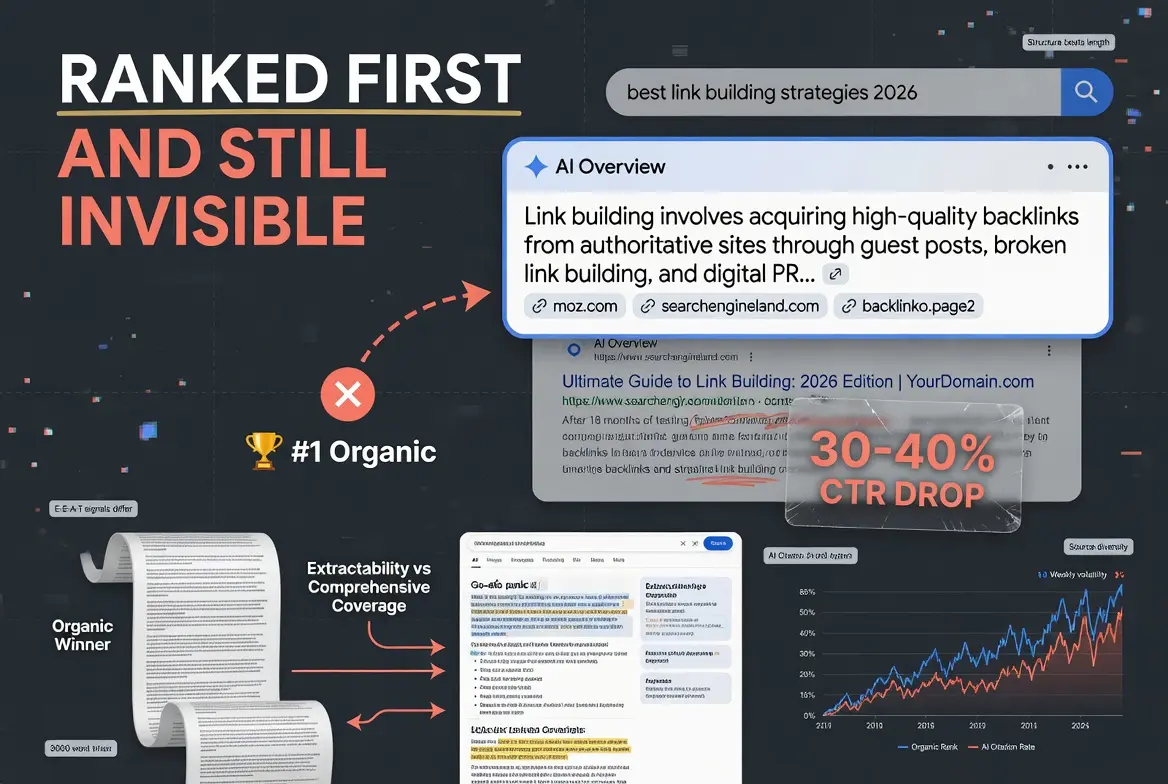
You put in the work. Keyword research, content strategy, internal linking, backlinks, months of building authority on a topic. Google rewards you with position one. And then someone searches your keyword, an AI Overview appears above the organic results, and your page is nowhere in it. The AI Overview cites three sources. None of them are you. One of them ranks on page two.
This is not a bug. It is two different systems evaluating the same content with different priorities. Google’s organic ranking algorithm evaluates hundreds of signals to determine which pages best satisfy a search query. Google’s AI Overview system evaluates which sources are most useful for synthesizing a direct answer to that query. The overlap is real but incomplete. A page optimized to rank first in organic results is not automatically optimized to be cited in the AI-generated answer above those results.
The frustration is understandable. You earned the position. The AI Overview sits above it and takes the attention. Studies from early 2026 showed that AI Overviews reduce organic click-through rates by 30 to 40 percent on queries where they appear. Your hard-won position one is still there, but fewer eyes reach it because the AI already answered the question before the user scrolled down.
I did not take this seriously enough when AI Overviews first started expanding. I assumed that ranking well organically would naturally lead to AI Overview citations because the signals should overlap. For some pages that turned out to be true. For others, including pages with strong rankings, the AI Overview cited entirely different sources. The disconnect was larger than I expected, and it took tracking both layers side by side to see how wide the gap actually was.
Why AI Overviews Pick Different Sources Than Organic Rankings
The organic algorithm is optimized to rank the best page for a query. The AI Overview system is optimized to extract the best answer from across multiple pages. That distinction changes which content characteristics matter.
For organic rankings, comprehensive coverage wins. A 3,000-word guide that covers every angle of a topic tends to outrank a 500-word page that answers one specific question, all else being equal. For AI Overview citations, extractability wins. The AI system needs content it can pull a clean, direct answer from. A page that buries the answer inside paragraph fourteen of a comprehensive guide is harder to extract from than a page that states the answer clearly in a dedicated section with a descriptive heading.
Content structure matters more for AI Overview citations than for organic rankings. Pages with clear H2/H3 hierarchies, concise paragraphs that make specific claims, FAQ sections with direct answers, and definition-style openings get cited more frequently. The AI system is scanning for content it can synthesize, not content it can rank. Dense prose that reads well for humans but lacks structural markers for machine extraction is exactly the content that ranks well organically but gets passed over by the AI Overview.
Source diversity also plays a role. AI Overviews frequently cite multiple sources within a single answer to synthesize a more complete response. Google’s system appears to favor pulling from several authoritative sources rather than relying on one. If your page covers the entire topic and a competitor’s page covers one specific angle with exceptional clarity, the AI Overview might cite the competitor for that angle and pull from other sources for the rest. Your comprehensive page gets bypassed not because it is worse, but because the AI found a more extractable answer elsewhere for that specific claim.
The E-E-A-T signals that Google evaluates for organic rankings also influence AI Overview citations, but the weighting seems different. In organic rankings, backlink authority and topical authority carry significant weight. In AI Overview citations, factual clarity and source credibility for the specific claim being synthesized appear to carry more. A page from a lesser-known domain that makes a clear, well-supported factual statement can get cited over a page from a high-authority domain that covers the same fact less directly.
What an AI Overview Tracker Actually Measures
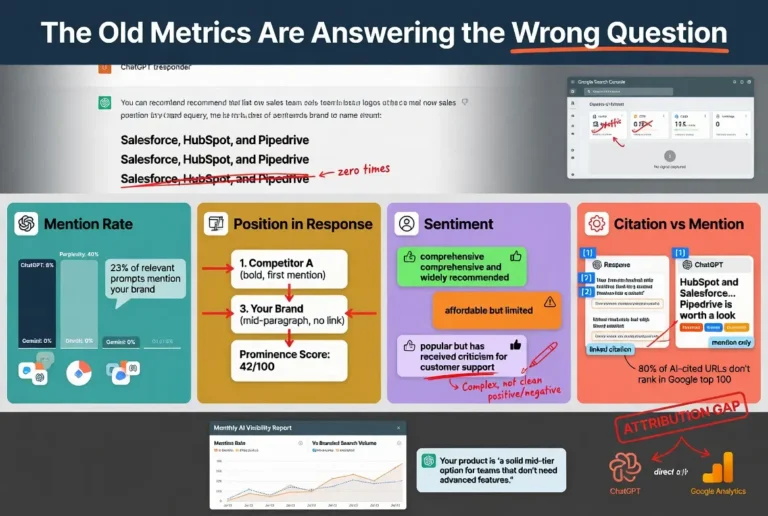
An AI overview tracker monitors a set of keywords and checks whether an AI Overview appears for each one, whether your domain is cited in the AI Overview, which competing domains are cited, and how all of that changes over time. The basic function is surveillance: watching what Google’s AI system does with your keywords so you are not blind to it.
The specific data points most trackers provide include AI Overview presence (did an AI Overview trigger for this keyword), domain citation (was your domain one of the cited sources), citation position (where in the AI Overview your source appeared), competitor citations (which other domains were cited), citation stability (did the same sources appear on repeated checks), and source URLs (which specific pages were cited, not just domains).
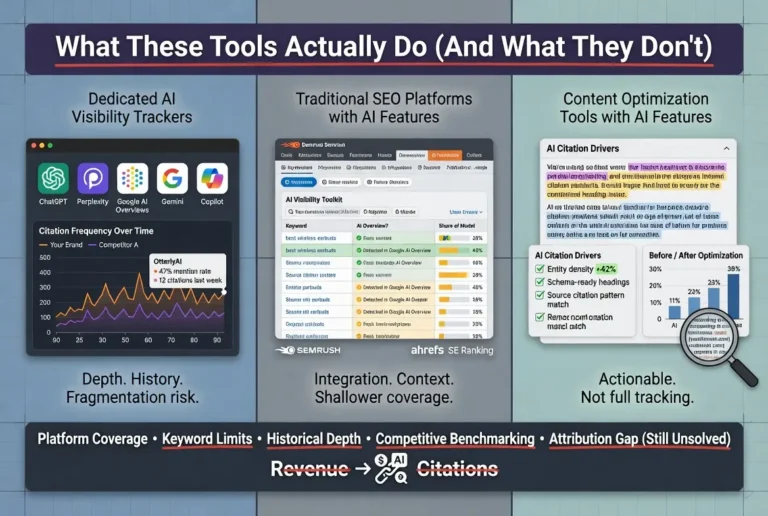
Traditional rank trackers have started adding AI Overview detection as a feature. Most can tell you whether an AI Overview appeared for a tracked keyword. Fewer can tell you whether your domain was cited. Even fewer track citation history over time or provide competitive citation benchmarking. The difference between detection and tracking matters. Detection tells you the landscape changed. Tracking tells you who is winning inside the new landscape and whether your position is improving or declining.
An AI overview checker that only runs a single snapshot is useful for a one-time audit but not for ongoing optimization. AI Overview citations fluctuate. I have tracked queries where the cited sources changed three times in a single week before stabilizing. Without continuous tracking, you would never see the instability or know when the citation finally locked in. That volatility data is where the operational value lives, because it tells you which citations are durable and which are up for grabs.
When the Gap Between Rankings and AI Citations Matters
Not every ranking-to-citation gap is worth closing. If you rank first for a keyword and the AI Overview appears on 2 percent of searches for that keyword, the practical impact of being absent from the AI Overview is negligible. Your organic position captures nearly all the traffic. The AI Overview is an edge case, not a threat.
The gap matters when three conditions are true simultaneously. The AI Overview appears consistently for the keyword, meaning on most searches, not occasionally. The keyword has commercial value, meaning people searching it are evaluating options, comparing solutions, or preparing to buy. And the AI Overview cites your competitors, meaning their brands are visible in the answer box while yours is not.
When all three conditions are met, the AI Overview is not just reducing your click-through rate. It is actively positioning your competitors as the recommended answer while your organic listing sits below, still visible but no longer the first thing the searcher encounters. The competitive damage is real and it accumulates across every search where that pattern repeats.
For informational queries where the searcher wants a fact rather than a recommendation, the gap is less critical. If someone searches “what is on-page SEO” and the AI Overview answers the question using a source that is not your page, you lost an impression but probably not a customer. For queries where the AI Overview says “the best options for X include [competitor], [competitor], and [competitor]” and you are absent, the loss is measurable in pipeline and revenue, even if you cannot track it directly in analytics.
How to Close the Gap
If your page ranks well organically but is not cited in the AI Overview, the problem is almost always content structure, not content quality. The information is there. The AI system cannot extract it efficiently.
Add Direct Answer Sections
For every major question your page answers, create a section with a descriptive heading that mirrors the question and open with a clear, direct answer in the first one or two sentences. Follow with supporting detail. The AI Overview system scans for extractable statements. A heading that says “What is link building?” followed by a paragraph that begins “Link building is the process of…” is more extractable than the same information embedded in paragraph nine under a heading that says “Key Concepts.”
Structure for Multiple Extraction Points
AI Overviews synthesize from multiple sources. If your page provides multiple extractable answers to related questions, you increase the surface area for citation. A page with eight clearly structured subsections gives the AI system eight potential extraction points. A page that covers the same material in flowing narrative gives it one large block to parse, which it will often skip in favor of a source that made the extraction easier.
Build FAQ Sections That Match Real Queries
FAQ sections are citation magnets for AI Overviews. Each question-answer pair is a self-contained extraction unit. The question matches a potential search query. The answer provides a direct response. Google’s AI system can lift the answer cleanly and cite your page as the source. Use questions pulled from real search data, not generic placeholders. The questions people actually search are the ones the AI Overview needs answers for.
Strengthen Entity and Source Authority
AI Overviews favor sources they consider trustworthy for the specific claim being made. Authoritativeness signals that Google evaluates for organic rankings carry forward into AI Overview citation decisions. Author credentials, editorial standards, external citations of your content by other authoritative sources, all of these influence whether Google’s AI considers your page a reliable source worth citing by name. A technically extractable page from a low-authority domain still loses to a slightly less extractable page from a domain Google trusts.
Building a Tracking Approach
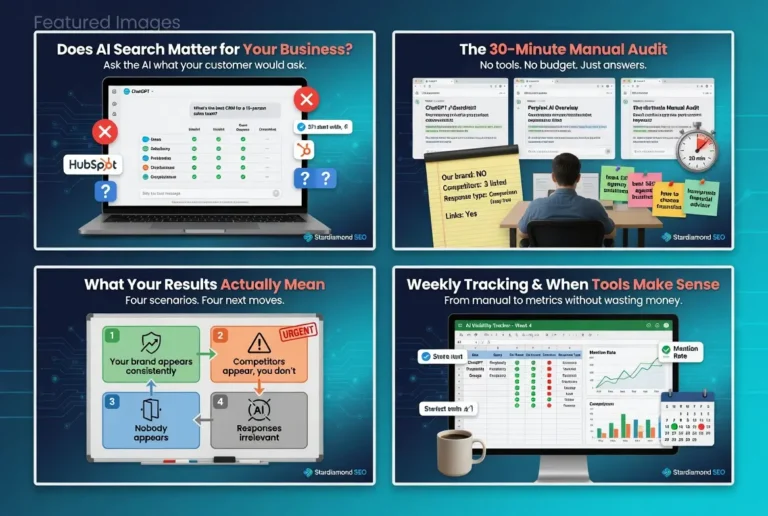
Start with your ten highest-value commercial keywords. Check Google for each one. Note whether an AI Overview appears and whether your domain is cited. Do this weekly for a month. That baseline tells you which keywords have an active ranking-to-citation gap and how stable the citations are.
If the manual audit reveals significant gaps across multiple commercial keywords, an automated AI overview tracker becomes worth the investment. The tracker handles the weekly sampling, stores the history, and shows you trends that manual checking would miss. Most dedicated trackers also provide competitive data, meaning you can see not just whether you are cited but how your citation rate compares to competitors over time.
What to look for in a tracker: coverage of your keyword volume (some tools limit the number of tracked keywords at lower price tiers), historical data storage (at least 90 days of citation history to identify meaningful trends), competitive benchmarking (who else is getting cited for your keywords), and alerting (notification when your citation status changes for high-value keywords). The alerting is more useful than it sounds, because AI Overview citations can change without warning and the faster you know, the faster you can investigate and respond.
Connect the AI Overview tracking data to your existing AI search visibility metrics framework. AI Overview citations are one layer of AI visibility. ChatGPT mentions, Perplexity citations, and Gemini references are separate layers with separate tracking needs. The complete picture requires monitoring all the platforms where your audience asks questions. An AI overview tracker handles the Google layer. Additional tools or manual monitoring handle the rest.
What Google Search Console Does and Does Not Show You
Google Search Console shows you impressions, clicks, and average position for organic results. It does not show you whether an AI Overview appeared for a query. It does not show you whether your page was cited in the AI Overview. It does not show you who else was cited. The data gap is complete. Your site could be losing 30 percent of its click-through rate on a keyword because an AI Overview is answering the query above your listing, and Search Console would show a declining CTR without explaining why.
This matters because most SEO practitioners use Search Console as their primary diagnostic tool. When CTR drops, the reflex is to rewrite the title tag, improve the meta description, check for featured snippet displacement. None of those diagnostics account for the AI Overview layer. An AI overview tracker paired with Search Console data tells the complete story: the CTR dropped because an AI Overview appeared and you are not cited in it. That is a different problem with a different solution than a weak title tag.
Some teams overlay AI Overview tracking data onto Search Console exports to build a unified view. The correlation between AI Overview presence and organic CTR decline is strong enough that it shows up at the keyword level: keywords where an AI Overview appears consistently show lower organic CTR than the same keyword’s historical baseline before AI Overviews triggered. Quantifying that CTR impact per keyword helps prioritize which content gaps to close first. The keywords where you rank well, an AI Overview appears, competitors are cited, and your CTR has dropped are the highest-priority optimization targets.
Why AI Overview Citations Are More Volatile Than Rankings
Organic rankings tend to move slowly for established pages. A page that holds position three today will probably hold a similar position next week unless something significant changes. AI Overview citations are less stable. The same query can cite different sources on different days, sometimes on different hours of the same day.
The volatility comes from how AI Overviews are generated. They are not cached results served from a static index. They are generated in real time by a model that synthesizes from retrieved sources. Which sources get retrieved can vary based on query phrasing, user context, Google’s ongoing testing, and model updates. A page that was cited Monday might not be retrieved Wednesday because the model pulled a different set of sources for that particular generation.
This volatility is why single-snapshot AI overview checkers are insufficient for ongoing optimization. A check that shows you cited today does not mean you will be cited tomorrow. A check that shows you absent today does not mean you are permanently excluded. The pattern over weeks and months is what matters. Stable citation across multiple checks means your content is embedded in the retrieval as a reliable source. Fluctuating citation means your position is contested and the AI system is still deciding which sources to favor.
The practical response to volatility is not to react to individual checks but to track the trend. If your citation rate on a keyword is 60 percent over a month (cited in 6 out of 10 weekly checks), that is a durable position worth protecting. If it drops to 30 percent the following month, something changed and it is worth investigating. The investigation usually points to either new competing content that the AI system finds more extractable, a model update that shifted source preferences, or a change to your own content that inadvertently reduced its extractability.
FAQ
Why am I ranked first on Google but not in the AI Overview?
Organic rankings and AI Overview citations use overlapping but distinct evaluation criteria. Organic rankings reward comprehensive coverage and backlink authority. AI Overviews reward content that is structured for clean extraction with direct answers under descriptive headings. A page can rank first because it is the most authoritative resource on a topic and still be absent from the AI Overview because the AI system found a more extractable answer on a different page.
What does an AI overview tracker do that Search Console does not?
Google Search Console shows impressions, clicks, and average position for organic results. It does not show whether an AI Overview appeared for a query, whether your page was cited in it, or which competitors were cited. An AI overview tracker fills that gap by monitoring AI Overview presence, citation status, competitive citations, and historical trends for your tracked keywords.
How often do AI Overview citations change?
AI Overview citations are more volatile than organic rankings. The same query can cite different sources on different days because AI Overviews are generated in real time rather than served from a static index. Weekly tracking is the minimum frequency needed to distinguish real trends from normal fluctuation. Automated trackers that check daily or multiple times per day capture the volatility patterns that weekly manual checks miss.
Do AI Overviews reduce organic click-through rates?
Studies from early 2026 showed that AI Overviews reduce organic click-through rates by 30 to 40 percent on queries where they appear. The reduction is most severe for informational queries where the AI Overview fully answers the question without requiring a click. For commercial and navigational queries, the impact is smaller because users still want to visit the source to evaluate, compare, or purchase.
How do I get my page cited in AI Overviews?
Structure your content for extraction. Use descriptive headings that mirror search queries, open sections with direct answers in the first one or two sentences, build FAQ sections with real questions from search data, and strengthen your authority signals through third-party citations and author credentials. The AI Overview system selects sources it considers trustworthy and extractable. Pages that make their answers easy to find and pull get cited more frequently.
Should I track AI Overviews manually or use a tool?
Start manually with your ten highest-value commercial keywords. Check weekly for a month to establish a baseline. If the audit reveals significant gaps across multiple keywords and manual tracking exceeds two hours per week, an automated AI overview tracker is worth the investment. The tool’s value is in historical data and competitive benchmarking that manual checks cannot efficiently provide at scale.