Content Cluster Strategy: Build Topic Authority Google Rewards
AI Summary
What is a content cluster strategy? A content cluster strategy is the method of organizing a website’s content into interconnected groups of pages that cover a topic comprehensively. Each cluster consists of a pillar page targeting the broadest keyword and tier articles targeting progressively more specific subtopics, all connected through deliberate internal linking that builds topical authority Google rewards with higher rankings across the entire cluster.
What it is and who it is for: This article is for SEO practitioners, content strategists, and business owners who want to move from publishing isolated articles to building content systems that compound ranking authority over time. It covers how to plan clusters, choose pillar topics, define tier structures, sequence the build order, and launch clusters that hit Google’s index as complete topical ecosystems.
The rule: A content cluster is not a collection of articles about the same general topic. It is an engineered system where every article serves a defined purpose within a hierarchy, every internal link carries deliberate topical signals, and every page makes every other page in the cluster stronger. The architecture produces the authority. Isolated articles just produce content.
Why Clusters Outperform Isolated Articles
A single article, regardless of how well it is written, operates as a standalone unit. It targets one keyword. It earns whatever backlinks it attracts. It passes whatever quality signals it carries. Its ranking potential is bounded by its own authority and the authority of the domain it sits on. That ceiling is fixed until something external changes: a new backlink, an algorithm update, a competitor stumbling.
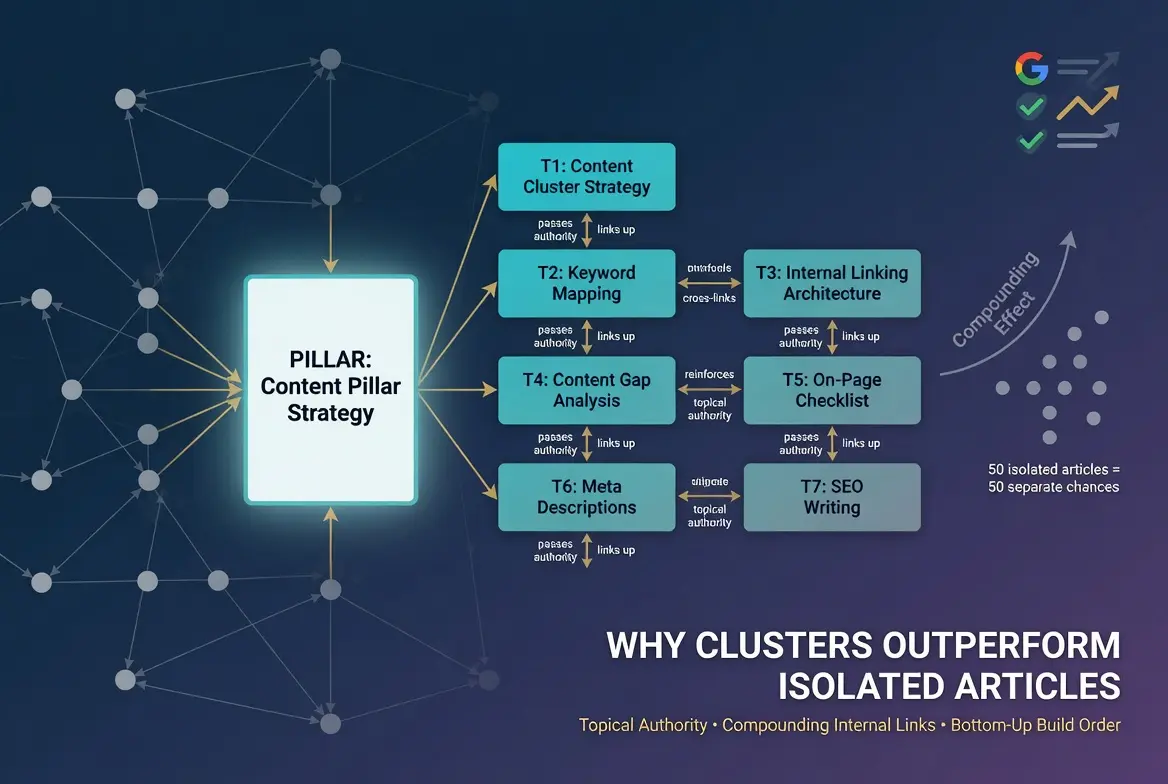
A content cluster operates as a system. The pillar page targets the broad keyword. The tier articles target the specific subtopics. Every tier article links up to the pillar, passing authority and reinforcing Google’s understanding that the pillar is the comprehensive resource on the topic. The pillar links down to every tier, distributing its own authority to the supporting pages. Cross-links between tier articles create a web of topical relationships that tells Google this site does not just cover one aspect of the topic. It covers all of them.
The compounding effect is measurable. A backlink earned by any page in the cluster benefits every other page through the internal linking architecture. A tier article that ranks for a long-tail keyword sends authority upward to the pillar, improving the pillar’s position on the head term. The pillar’s improved position generates more traffic and more backlinks, which flow back down to the tier articles. The cycle reinforces itself with every month of sustained activity.
Isolated articles do not compound. They accumulate. There is a difference. Accumulation adds one unit at a time. Compounding multiplies. A site with 50 isolated articles has 50 independent ranking opportunities. A site with 5 clusters of 10 articles each has 50 ranking opportunities that reinforce each other. The same article count produces materially different results depending on whether the content is organized into clusters or scattered across the site without structural relationships.
Topical Authority: What Google Actually Rewards
Topical authority is not a metric you can look up. It is the emergent result of Google’s assessment that a particular site is a comprehensive, credible source on a particular subject. The assessment is based on observable signals: the number of pages covering the topic, the depth of coverage on each page, the internal linking relationships between those pages, the external backlinks pointing to those pages from other authoritative sources, and the E-E-A-T signals that indicate the content was produced by someone with genuine expertise and experience.
A site with one article about content pillars has minimal topical authority on the subject. A site with eight articles covering content pillars, keyword mapping, internal linking architecture, content gap analysis, on-page optimization, SEO writing, meta descriptions, and cluster strategy has substantial topical authority. Google’s systems can observe that the second site covers the topic from multiple angles, at significant depth, with content that interlinks in a way that demonstrates structural understanding of how the subtopics relate to each other.
This is why the cluster strategy matters more than individual article quality. An exceptional article on a site with no supporting content competes at a disadvantage against a good article on a site with comprehensive topical coverage. The site-level topical authority signal lifts every page in the cluster. The individual article quality determines whether each page deserves its position. Both signals matter. The cluster provides the floor. The article quality determines the ceiling.
Google has not published a formal definition of topical authority as a ranking factor. But the behavior of the algorithm is consistent with the concept: sites that cover topics comprehensively through interconnected content structures rank better for those topics than sites with equivalent domain authority that cover the same topics with isolated, unconnected pages. The practical evidence is strong enough to build a content strategy around, even without a formal confirmation from Google.
Choosing Pillar Topics
The pillar topic defines the cluster. Choosing the right pillar topic determines the keyword volume the cluster can capture, the number of tier articles the topic supports, and the commercial value the cluster generates. A poorly chosen pillar topic produces a cluster that is either too narrow to justify multiple articles or too broad to cover comprehensively.
A good pillar topic has four characteristics. First, sufficient keyword volume: the head term for the pillar should have at least 1,000 monthly searches, with higher volume preferred. Second, subtopic depth: the topic should naturally break into 4 to 8 subtopics that each warrant their own dedicated article. Third, commercial relevance: the topic should connect to the business’s products, services, or expertise in a way that attracts potential customers. Fourth, competitive achievability: the site should be capable of producing content that can compete with what currently ranks for the pillar keyword, supported by a realistic link building and authority building plan.
The content gap analysis is the primary tool for identifying pillar topics. The gaps where competitors rank for high-volume keywords that your site does not cover reveal the topics where cluster building produces the highest return. Filter the gap data by volume, commercial value, and topical alignment with your existing content architecture. The pillar topics that survive the filtering are the candidates for your next cluster builds.
Avoid pillar topics that are too broad. “SEO” is not a pillar topic. It is an entire website. “Content pillar strategy” is a pillar topic. It is broad enough to support multiple subtopics and specific enough to cover comprehensively in a single pillar page with supporting tiers. The scope should be coverable in a 3,000 to 4,000 word pillar article without sacrificing depth. If the pillar would need to be 8,000 words to cover the topic adequately, the topic is too broad and should be split into multiple clusters.
Defining the Tier Structure
The tier structure breaks the pillar topic into subtopics, each assigned to a dedicated article. The structure is not arbitrary. It emerges from the keyword mapping process that groups related keywords into article-level clusters and assigns each group a position in the hierarchy.
Tier 1 articles target the major subtopics with the highest keyword volume after the pillar keyword. They are substantial articles, typically 2,500 to 3,000 words, that could function as standalone resources on their subtopic. They link up to the pillar and down to lower tier articles if the cluster has enough depth to warrant additional levels.
Tier 2 through Tier 4 articles target progressively more specific keywords. Each tier narrows the focus. A T1 article about content cluster strategy covers the broad approach. A T2 article about content gap analysis covers one specific method within the broader strategy. A T3 or T4 article might cover a single tool, a single technique, or a single use case within that method.
Not every cluster needs the same number of tiers. Some topics naturally support 3 articles: a pillar and two supporting tiers. Others support 8 or more. The number of tiers should follow from the keyword data, not from a template. If the keyword mapping process produces 4 article-level clusters, the cluster has 4 tiers. Inventing additional tiers to fill a predetermined template produces thin content that weakens the cluster rather than strengthening it.
The tier articles do not need equal word counts. A T1 article covering a complex strategic concept might run 3,000 words. A T4 article covering a specific tactical technique might run 1,500 words. The depth follows the topic. The word count follows the depth. No filler. If the topic is covered at 1,800 words, the article is 1,800 words. Padding to hit 2,500 dilutes the quality signal and wastes the reader’s time, both of which Google’s quality evaluation systems are designed to detect.
The Bottom-Up Build Order
Clusters are built from the bottom up. The deepest tier articles are written first. The pillar is written last. This order contradicts the intuition that the most important page should be produced first, but the structural logic is sound.
When the pillar is written last, every supporting article already exists. The pillar can reference and link to actual published content rather than planned content. The internal links resolve immediately. The pillar’s scope and depth can be calibrated against the actual coverage provided by the tier articles, avoiding redundancy (the pillar covering subtopics that a tier article covers more thoroughly) and gaps (the pillar referencing subtopics that no tier article actually addresses).
The build order also aligns with how authority compounds. The first tier article published establishes the initial topical footprint. Each subsequent article expands it. By the time the pillar publishes, the site already has topical authority on the subject from the tier articles that preceded it. The pillar launches into a topically prepared environment rather than standing alone as the first and only page on the topic.
The bottom-up order for the content strategy cluster on Star Diamond SEO: T7 (SEO Writing) → T6 (Meta Descriptions) → T5 (On-Page Checklist) → T4 (Content Gap Analysis) → T3 (Internal Linking Architecture) → T2 (Keyword Mapping) → T1 (Content Cluster Strategy, this article) → Pillar (What Is a Content Pillar). Seven articles published before the pillar. Seven pages of topical authority established before the head-term page goes live. Seven sets of internal links pre-wired and ready to resolve.
Pre-Wiring Internal Links Before Publication
Every article in the cluster should contain all of its internal links before any article is published. This means building the entire cluster in draft, with links pointing to URLs that do not resolve yet, and publishing the complete cluster simultaneously or in rapid sequence so that all links activate together.
The alternative, publishing articles one at a time and adding links to earlier articles as new ones go live, produces a period where published articles contain broken or missing links. Google crawls the page during this period and forms an initial assessment based on incomplete linking. Adding the links later requires Google to recrawl and reassess, which happens on Google’s schedule, not yours. The delay between publishing and link completion costs weeks of compounding that pre-wiring eliminates.
The pre-wiring process follows the link map created during keyword mapping. Every article knows which other articles it links to, with what anchor text, before the first word is written. The writer follows the map. The links are built into the content during drafting, not retrofitted during editing. When the cluster launches, the linking architecture is complete from day one.
For articles linking to pages outside the cluster, use the interlink reference sheet that tracks every live URL on the site with its anchor text keyword. Pull link targets from the reference sheet during writing. This ensures the anchor text is consistent with the target page’s primary keyword and prevents duplicate anchor text across articles.
Launching the Cluster
The coordinated cluster launch is the final step that most content operations skip because it requires the discipline to hold finished content unpublished until the entire cluster is complete.
Publish all articles as private drafts first. Verify every internal link resolves correctly. Check that no two articles target the same primary keyword. Confirm the heading hierarchy, anchor text distribution, and schema markup across all articles. This is the quality gate. Every error caught before publication is an error that never reaches Google’s index.
Once verification passes, publish the entire cluster. If you are publishing 8 articles, publish them within a single day. Submit each URL through Google Search Console for indexing. The cluster enters Google’s index as a complete structure: pillar linked to all tiers, tiers linked to each other, every link resolving, every page carrying its full complement of internal link authority from the moment of publication.
The indexing behavior of a coordinated cluster launch differs from the behavior of isolated article publication. Google encounters the pillar page and immediately discovers seven linked supporting pages. The crawl follows the internal links and indexes the entire cluster in a single crawl session rather than discovering pages individually over days or weeks. The topical authority signal is present from the first crawl because the structure is complete from the first crawl.
After launch, submit the updated XML sitemap through Search Console. Monitor the Performance report for impressions on the cluster’s target keywords. Track ranking positions weekly for the first month. The cluster should begin showing impressions within one to two weeks and ranking movement within four to eight weeks, depending on the site’s existing authority and the competitive landscape for the target keywords.
Measuring Cluster Performance
Cluster performance is measured at two levels: the individual article level and the cluster level. Both perspectives are necessary to understand whether the strategy is working and where adjustments are needed.
At the article level, track each page’s ranking position for its primary keyword, the organic traffic it generates, and the impressions it receives in Search Console. These metrics tell you which articles in the cluster are performing and which are underperforming. An underperforming article might need content improvements, additional internal links from other high-authority pages on the site, or external backlinks to boost its individual authority.
At the cluster level, track the aggregate metrics: total organic traffic across all pages in the cluster, total impressions, total keywords ranking in positions 1 through 10, and total keywords ranking in positions 1 through 20. These metrics tell you whether the cluster as a system is gaining authority. A cluster where individual articles fluctuate but the aggregate metrics trend upward is performing well. A cluster where both individual and aggregate metrics are flat after six months needs strategic reassessment.
The pillar page’s ranking for the head term is the primary cluster health indicator. The pillar is the hardest page in the cluster to rank because it targets the broadest, most competitive keyword. When the pillar’s ranking improves, it signals that the topical authority built by the tier articles is lifting the entire cluster. When the pillar is stagnant while the tier articles rank well, the pillar likely needs additional external backlinks or content improvements to match the competitive standard for the head term.
Compare cluster performance against the initial content gap analysis. The keywords that were gaps when the analysis was run should now be positions. Track how many of the original gap keywords the cluster has closed. This metric directly measures whether the cluster strategy is achieving its purpose: converting competitive gaps into ranking positions.
Scaling From One Cluster to a Content Ecosystem
One cluster establishes topical authority on one subject. Multiple clusters establish the site as a comprehensive resource across an entire field. The scaling process follows the same principles applied repeatedly across different pillar topics.
The site architecture defines where clusters live. Each hub category on the site contains subcategories. Each subcategory can contain one or more clusters. The Star Diamond SEO architecture has 10 hub categories with 45+ subcategories. Each subcategory is a potential cluster location. The gap analysis determines which subcategories to prioritize based on keyword opportunity and commercial value.
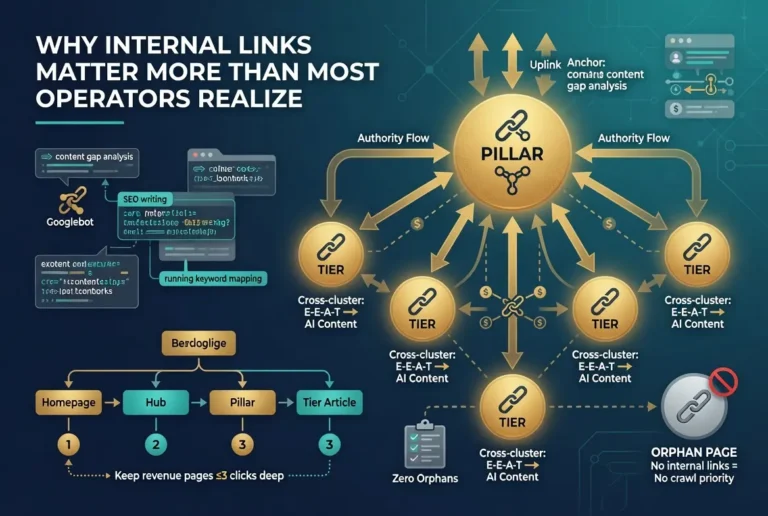
Cross-cluster linking becomes increasingly important as the site grows. An article about SEO writing in the Content Strategy cluster links to the AI content editorial layer article in the AI Content Creation cluster because the topics genuinely intersect. These cross-cluster links build the topical web that connects individual clusters into a site-wide authority signal. Google sees not just “this site covers content strategy” but “this site covers content strategy, AI content, E-E-A-T, link building, search engine mechanics, and SEO services, and all of those topics are connected through a deliberate content architecture.”
The compounding accelerates with scale. The tenth cluster builds faster than the first because the site’s domain authority is higher, the internal linking network is more extensive, the topical authority is more established, and Google crawls the site more frequently because it has learned that the site publishes quality content consistently. The hundredth article ranks faster than the tenth because ninety-nine articles of accumulated topical authority support it from the moment it publishes.
The trust signals that support the entire ecosystem, author attribution, transparency, source citation, and genuine expertise, should be consistent across every cluster. The quality standard is site-wide. One cluster of exceptional content does not compensate for another cluster of thin content. Google’s site-level quality evaluation means that the weakest cluster on the site affects the performance of every other cluster. Build every cluster to the same standard. No exceptions.
FAQ
What is a content cluster strategy?
A content cluster strategy organizes website content into interconnected groups of pages that cover a topic comprehensively. Each cluster has a pillar page targeting the broadest keyword and tier articles targeting specific subtopics. All pages connect through deliberate internal linking that builds topical authority and compounds ranking power across the entire cluster over time.
How many articles should a content cluster have?
A cluster should have as many articles as the topic supports without padding. Most clusters contain 3 to 8 articles: one pillar and 2 to 7 tier articles. The number follows from the keyword mapping process that identifies distinct subtopics warranting their own dedicated pages. A topic that naturally breaks into 4 subtopics should have 4 tier articles. Inventing additional articles to fill a template produces thin content that weakens the cluster.
What is topical authority?
Topical authority is Google’s assessment that a website is a comprehensive, credible source on a particular subject. It emerges from the number of pages covering the topic, the depth of coverage, the internal linking structure, external backlinks, and E-E-A-T signals. Sites with high topical authority on a subject rank better for related keywords than sites with equivalent domain authority but less comprehensive topical coverage.
Should I publish cluster articles all at once or over time?
Publish the entire cluster simultaneously or within a single day. Coordinated cluster launches ensure all internal links resolve immediately, the topical authority signal is complete from the first crawl, and no articles publish as orphan pages with missing links. Building all articles in draft with pre-wired links and launching together produces stronger initial indexing signals than publishing articles individually over weeks.
What is the bottom-up build order?
The bottom-up build order means writing the deepest tier articles first and the pillar page last. By the time the pillar is written, every supporting article exists. The pillar can reference and link to actual content, the internal links resolve on publication, and the scope can be calibrated against the actual coverage provided by the tier articles. The build order aligns with how topical authority compounds from supporting content upward.
How do I measure whether a content cluster is working?
Track metrics at both the article level (ranking position per primary keyword, organic traffic, impressions) and the cluster level (aggregate traffic, total keywords ranking positions 1-10, total keywords ranking positions 1-20). The pillar page’s ranking for the head term is the primary health indicator. Compare the cluster’s keyword rankings against the original content gap analysis to measure how many competitive gaps the cluster has closed.
How long does it take for a content cluster to show results?
Expect initial impressions within one to two weeks of publication and ranking movement within four to eight weeks. Significant traffic impact typically appears between three and six months. The timeline depends on the site’s existing authority, the competitiveness of the target keywords, and the quality of the content. Clusters on established sites with existing topical authority in related areas show results faster than clusters on new sites entering a topic for the first time.