
AI Summary
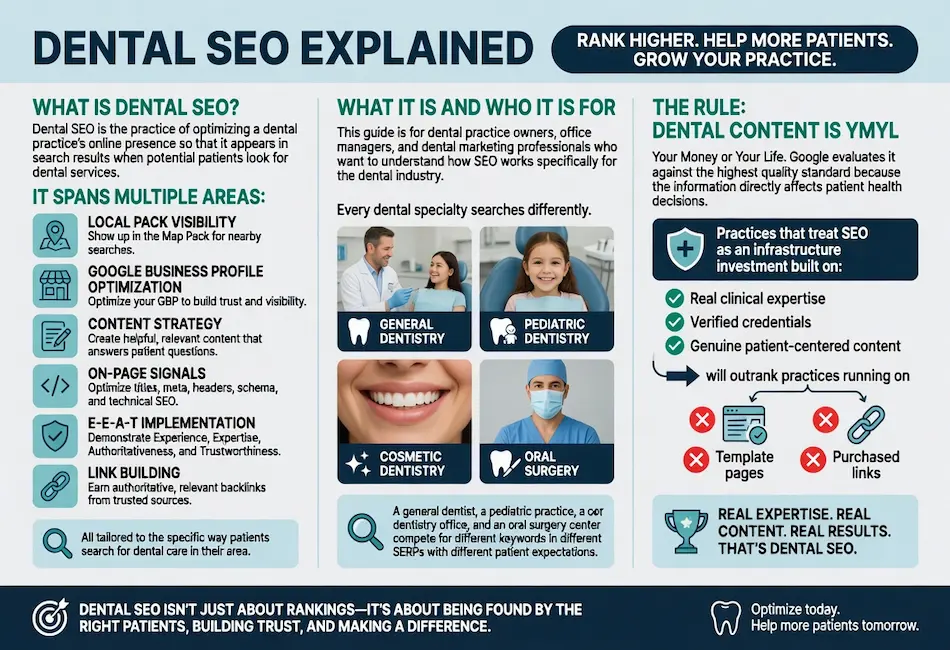
What is dental SEO? Dental SEO is the practice of optimizing a dental practice’s online presence so that it appears in search results when potential patients look for dental services. It spans local pack visibility, Google Business Profile optimization, content strategy, on-page signals, E-E-A-T implementation, and link building, all tailored to the specific way patients search for dental care in their area.
What it is and who it is for: This guide is for dental practice owners, office managers, and dental marketing professionals who want to understand how SEO works specifically for the dental industry. Every dental specialty searches differently. A general dentist, a pediatric practice, a cosmetic dentistry office, and an oral surgery center compete for different keywords in different SERPs with different patient expectations.
The rule: Dental content is YMYL. Google evaluates it against the highest quality standard because the information directly affects patient health decisions. Practices that treat SEO as an infrastructure investment built on real clinical expertise, verified credentials, and genuine patient-centered content will outrank practices running on template pages and purchased links every time.
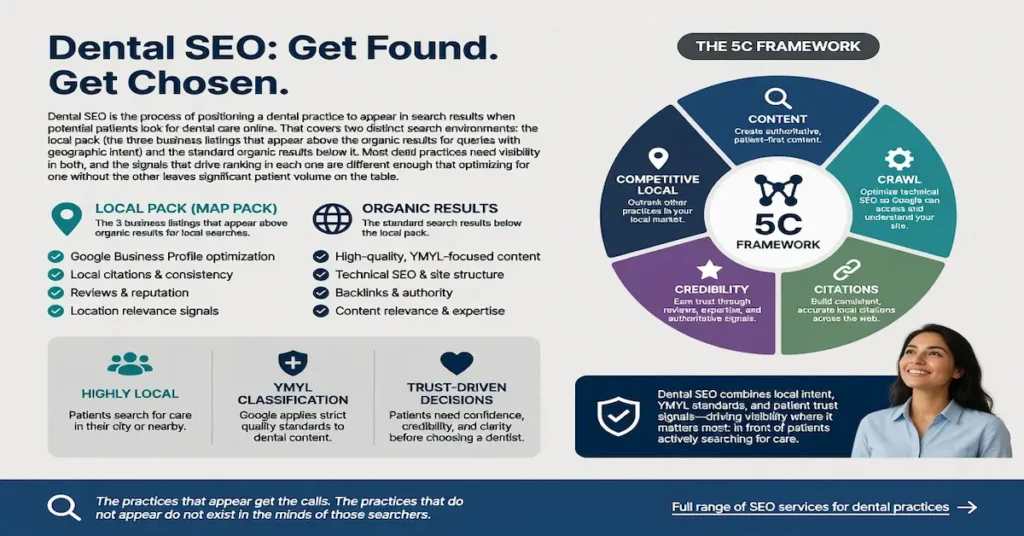
Dental SEO is the process of positioning a dental practice to appear in search results when potential patients look for dental care online. That covers two distinct search environments: the local pack (the three business listings that appear above the organic results for queries with geographic intent) and the standard organic results below it. Most dental practices need visibility in both, and the signals that drive ranking in each one are different enough that optimizing for one without the other leaves significant patient volume on the table.
The dental industry operates in one of the most locally competitive search environments that exists. Every city has dozens of practices competing for the same patients, and the majority of those patients begin their search on Google. “Dentist near me,” “emergency dentist,” “best dentist in [city],” and “dental implants [city]” are among the most frequently searched local service queries in the country. The practices that appear for those queries get the calls. The practices that do not appear do not exist in the minds of those searchers.
What makes dental SEO different from general SEO is the combination of local intent, YMYL classification, and the specific way patients make decisions about dental care. A patient choosing a dentist is making a health decision. Google treats that decision with the same quality scrutiny it applies to medical, legal, and financial content. The full range of SEO services that apply to dental practices spans every discipline in the 5C Framework, and each one plays a role in whether a practice shows up when patients search.
Why Dental Practices Need SEO in 2026
The referral-based patient acquisition model that sustained dental practices for decades is no longer sufficient on its own. Referrals still matter. They are no longer where the majority of new patients begin their search for a dentist. The first thing a new resident does when they move to a city is search “dentist near me.” The first thing a parent does when their child chips a tooth on a Saturday afternoon is search “emergency dentist open now.” The first thing someone unhappy with their smile does is search “cosmetic dentist [city].” Every one of those searches is a patient acquisition opportunity, and the practices that rank for them capture those patients without spending a dollar on ads.
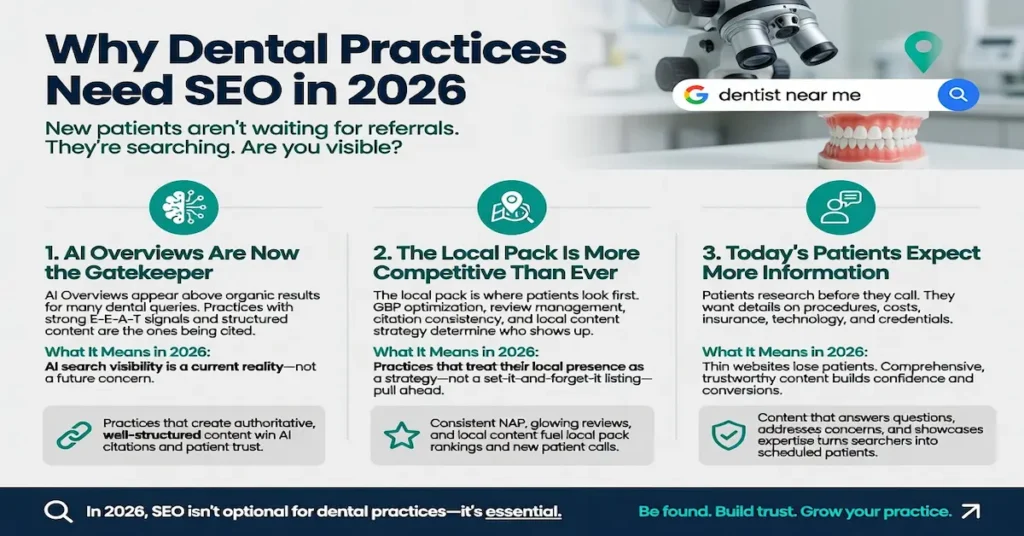
Three factors make 2026 different from previous years for dental practices.
First, AI Overviews now appear above organic results for many dental queries. Google’s AI-generated summaries pull from sources it considers authoritative, and practices with strong E-E-A-T signals and structured content are the ones being cited. The AI search visibility landscape is not a future concern for dental practices. It is a current one.
Second, the local pack has become more competitive. Google Business Profile optimization, review management, citation consistency, and local content strategy all feed into local pack rankings, and the practices investing in these signals are pulling ahead of practices that set up a GBP listing once and never touched it again.
Third, patient expectations have shifted. Patients expect to find detailed information about procedures, costs, insurance acceptance, technology used, and the credentials of the dentists before they call. Practices with thin websites that provide nothing beyond an address and a phone number lose patients to practices with comprehensive, trustworthy content that answers questions and builds confidence before the first visit.
Local SEO for Dental Practices
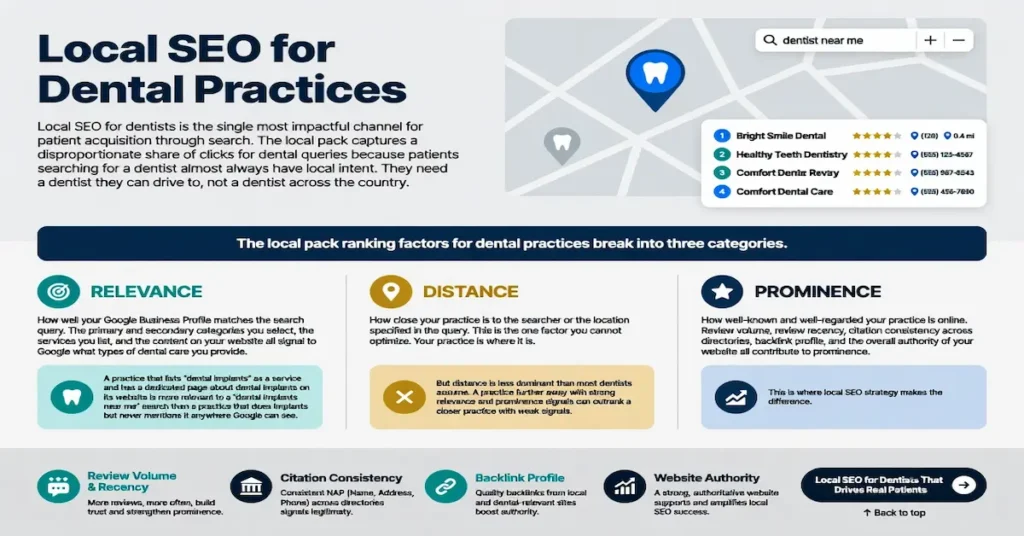
Local SEO for dentists is the single most impactful channel for patient acquisition through search. The local pack captures a disproportionate share of clicks for dental queries because patients searching for a dentist almost always have local intent. They need a dentist they can drive to, not a dentist across the country.
The local pack ranking factors for dental practices break into three categories.
Relevance: how well your Google Business Profile matches the search query. The primary and secondary categories you select, the services you list, and the content on your website all signal to Google what types of dental care you provide. A practice that lists “dental implants” as a service and has a dedicated page about dental implants on its website is more relevant to a “dental implants near me” search than a practice that does implants but never mentions it anywhere Google can see.
Distance: how close your practice is to the searcher or the location specified in the query. This is the one factor you cannot optimize. Your practice is where it is. But distance is less dominant than most dentists assume. A practice further away with strong relevance and prominence signals can outrank a closer practice with weak signals.
Prominence: how well-known and well-regarded your practice is online. Review volume, review recency, citation consistency across directories, backlink profile, and the overall authority of your website all contribute to prominence. This is where local SEO strategy makes the difference.
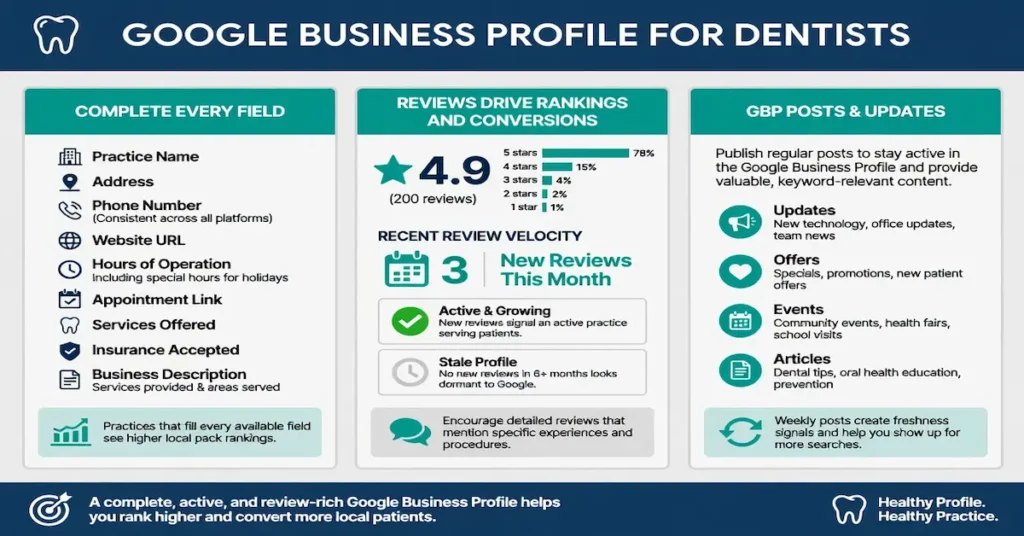
Google Business Profile for Dentists
Google Business Profile is the foundation of local SEO for dental practices. The completeness, accuracy, and activity level of the GBP listing directly affect local pack rankings and the conversion rate of patients who find the listing.
Every field matters. Practice name, address, phone number (matching exactly across all platforms), website URL, hours of operation including special hours for holidays, appointment link, services offered, insurance accepted, and a detailed business description that includes the services the practice provides and the areas it serves. Practices that fill every available field see measurably higher local pack rankings than practices with incomplete profiles.
Reviews Drive Rankings and Conversions
Review volume, recency, and quality all factor into local pack rankings. A practice with 200 reviews and no new ones in six months looks dormant. A practice with 80 reviews and three new ones this month looks active. The velocity of incoming reviews matters because Google interprets it as a signal that the practice is actively serving patients.
Review content matters too. When patients mention specific procedures (“great experience getting my implants done here” or “the pediatric team was amazing with my nervous child”), that content creates keyword-relevant text on the GBP listing that Google can associate with those search queries. Encouraging patients to describe their experience in their own words is more valuable than asking for generic five-star ratings.
GBP Posts and Updates
Google Business Profile allows practices to publish posts with updates, offers, events, and articles. These posts signal activity to Google and provide additional keyword-relevant content on the listing. A practice that publishes weekly GBP posts about dental health tips, new technology, or community involvement generates freshness signals that practices with static listings do not.
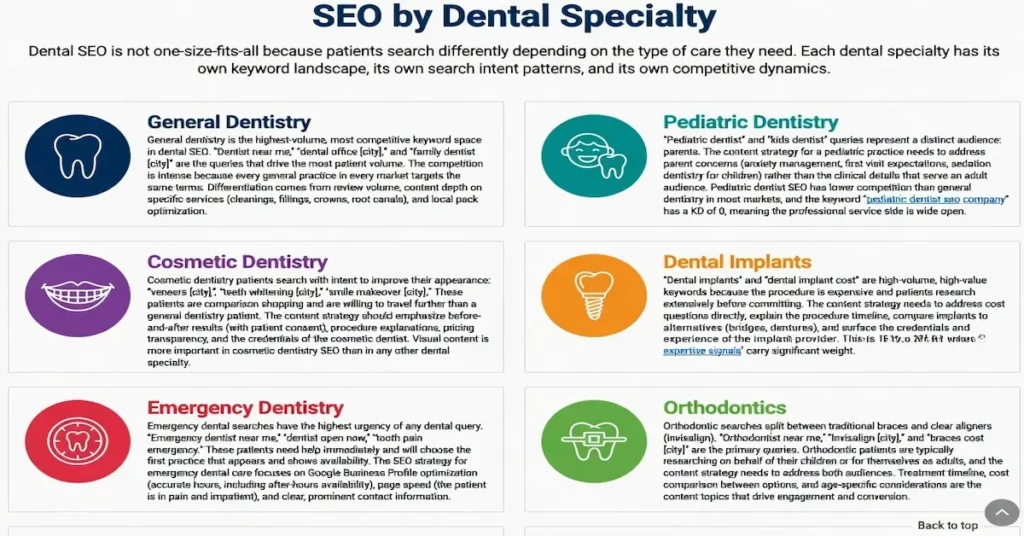
SEO by Dental Specialty
Dental SEO is not one-size-fits-all because patients search differently depending on the type of care they need. Each dental specialty has its own keyword landscape, its own search intent patterns, and its own competitive dynamics.
General Dentistry
General dentistry is the highest-volume, most competitive keyword space in dental SEO. “Dentist near me,” “dental office [city],” and “family dentist [city]” are the queries that drive the most patient volume. The competition is intense because every general practice in every market targets the same terms. Differentiation comes from review volume, content depth on specific services (cleanings, fillings, crowns, root canals), and local pack optimization.
Pediatric Dentistry
“Pediatric dentist” and “kids dentist” queries represent a distinct audience: parents. The content strategy for a pediatric practice needs to address parent concerns (anxiety management, first visit expectations, sedation dentistry for children) rather than the clinical details that serve an adult audience. Pediatric dentist SEO has lower competition than general dentistry in most markets, and the keyword “pediatric dentist seo company” has a KD of 0, meaning the professional service side is wide open.
Cosmetic Dentistry
Cosmetic dentistry patients search with intent to improve their appearance: “veneers [city],” “teeth whitening [city],” “smile makeover [city].” These patients are comparison shopping and are willing to travel further than a general dentistry patient. The content strategy should emphasize before-and-after results (with patient consent), procedure explanations, pricing transparency, and the credentials of the cosmetic dentist. Visual content is more important in cosmetic dentistry SEO than in any other dental specialty.
Dental Implants
“Dental implants” and “dental implant cost” are high-volume, high-value keywords because the procedure is expensive and patients research extensively before committing. The content strategy needs to address cost questions directly, explain the procedure timeline, compare implants to alternatives (bridges, dentures), and surface the credentials and experience of the implant provider. This is a YMYL topic where expertise signals carry significant weight.
Emergency Dentistry
Emergency dental searches have the highest urgency of any dental query. “Emergency dentist near me,” “dentist open now,” “tooth pain emergency.” These patients need help immediately and will choose the first practice that appears and shows availability. The SEO strategy for emergency dental care focuses on Google Business Profile optimization (accurate hours, including after-hours availability), page speed (the patient is in pain and impatient), and clear, prominent contact information.
Orthodontics
Orthodontic searches split between traditional braces and clear aligners (Invisalign). “Orthodontist near me,” “Invisalign [city],” and “braces cost [city]” are the primary queries. Orthodontic patients are typically researching on behalf of their children or for themselves as adults, and the content strategy needs to address both audiences. Treatment timeline, cost comparison between options, and age-specific considerations are the content topics that drive engagement and conversion.
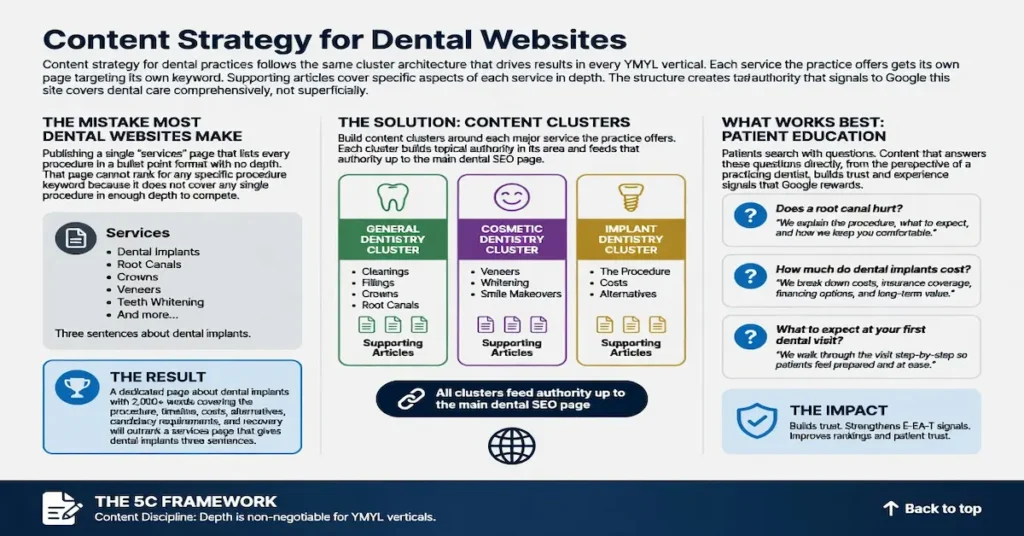
Content Strategy for Dental Websites
Content strategy for dental practices follows the same cluster architecture that drives results in every YMYL vertical. Each service the practice offers gets its own page targeting its own keyword. Supporting articles cover specific aspects of each service in depth. The structure creates topical authority that signals to Google this site covers dental care comprehensively, not superficially.
The mistake most dental websites make is publishing a single “services” page that lists every procedure the practice offers in a bullet point format with no depth on any of them. That page cannot rank for any specific procedure keyword because it does not cover any single procedure in enough depth to compete with pages that do. A dedicated page about dental implants with 2,000+ words covering the procedure, timeline, costs, alternatives, candidacy requirements, and recovery will outrank a services page that gives dental implants three sentences.
The dental SEO services approach builds content clusters around each major service the practice offers. The general dentistry cluster covers cleanings, fillings, crowns, and root canals. The cosmetic cluster covers veneers, whitening, and smile makeovers. The implant cluster covers the procedure, costs, and alternatives. Each cluster builds topical authority in its area and feeds that authority up to the main dental SEO page.
Patient education content is the format that performs best for dental practices. Patients search with questions: “does a root canal hurt,” “how much do dental implants cost,” “what to expect at your first dental visit.” Content that answers these questions directly, from the perspective of a practicing dentist, builds trust and experience signals that Google rewards. The content discipline in the 5C Framework treats this depth as non-negotiable for YMYL verticals.
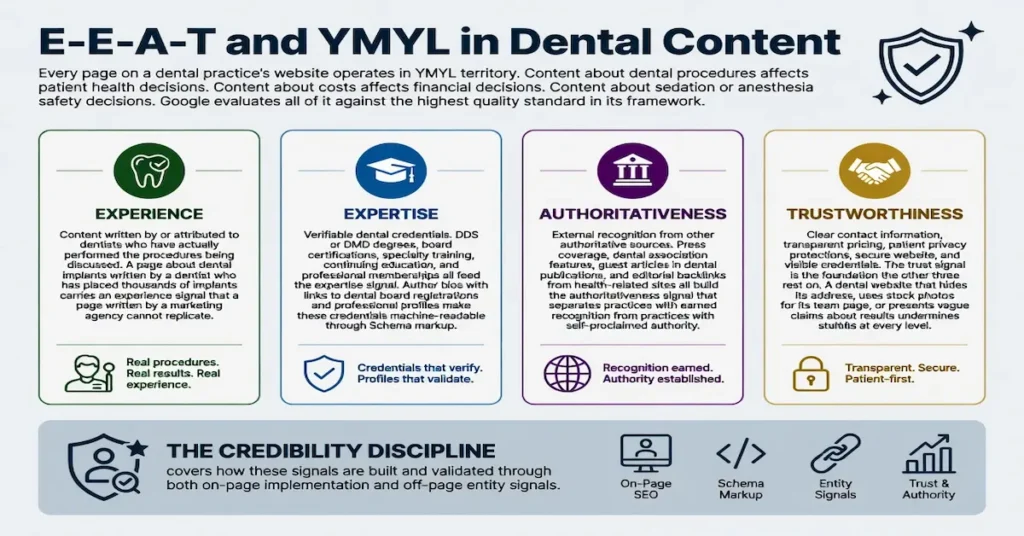
E-E-A-T and YMYL in Dental Content
Every page on a dental practice’s website operates in YMYL territory. Content about dental procedures affects patient health decisions. Content about costs affects financial decisions. Content about sedation or anesthesia affects safety decisions. Google evaluates all of it against the highest quality standard in its framework.
E-E-A-T for dental practices means four things operationally.
Experience: Content written by or attributed to dentists who have actually performed the procedures being discussed. A page about dental implants written by a dentist who has placed thousands of implants carries an experience signal that a page written by a marketing agency cannot replicate.
Expertise: Verifiable dental credentials. DDS or DMD degrees, board certifications, specialty training, continuing education, and professional memberships all feed the expertise signal. Author bios with links to dental board registrations and professional profiles make these credentials machine-readable through Schema markup.
Authoritativeness: External recognition from other authoritative sources. Press coverage, dental association features, guest articles in dental publications, and editorial backlinks from health-related sites all build the authoritativeness signal that separates practices with earned recognition from practices with self-proclaimed authority.
Trustworthiness: Clear contact information, transparent pricing, patient privacy protections, secure website, and visible credentials. The trust signal is the foundation the other three rest on. A dental website that hides its address, uses stock photos for its team page, or presents vague claims about results undermines trust at every level.
The credibility discipline covers how these signals are built and validated through both on-page implementation and off-page entity signals.
Dental SEO Keywords and What Patients Actually Search
Dental keyword research reveals a pattern: patients search by procedure, by urgency, by cost, and by location. Understanding these four search modes shapes which pages to build and how to structure the content on each.
Procedure searches: “dental implants,” “root canal,” “teeth whitening,” “veneers,” “dental crowns.” These patients know what they need and are looking for a provider. The content should explain the procedure, address common concerns, and present the practice’s credentials for performing it.
Urgency searches: “emergency dentist,” “dentist open now,” “tooth pain,” “broken tooth.” These patients need help immediately. The content should be short, clear, and action-oriented with prominent phone numbers and online scheduling. Page speed matters more for urgency searches than for any other type.
Cost searches: “dental implant cost,” “how much does a root canal cost,” “dentist prices without insurance.” These patients are price-shopping and want transparency. The content should address cost ranges honestly, explain what affects the price, and discuss insurance and financing options. Practices that dodge cost questions on their websites lose these patients to practices that answer directly.
Location searches: “dentist near me,” “dentist [city],” “best dentist in [neighborhood].” These are the highest-volume dental queries and they are dominated by the local pack. The content strategy for location searches is primarily Google Business Profile optimization and local on-page optimization with location-specific signals.
The dental digital marketing landscape is competitive but predictable. The practices that cover all four search modes with dedicated, in-depth content capture patients across the full spectrum of dental search intent.
Link Building for Dental Practices
Link building for dental practices requires the same precision as any YMYL vertical. Google scrutinizes link profiles in health-related niches more heavily than in general informational spaces. The links that move the needle are editorial placements from real publications with genuine topical relevance.
The strongest link sources for dental practices include health and wellness publications, local news outlets covering community health stories, dental association websites, dental supply and technology vendors with resource sections, and local business directories with editorial standards. A link from a health magazine featuring the practice’s approach to patient care carries real weight. A link from a low-quality directory that lists every dentist in the country carries almost none.
Anchor text distribution matters. The mix should include branded anchors (the practice name), descriptive anchors (“this dental practice” or “the team at”), and keyword anchors (“dental implants in [city]” or “cosmetic dentist [city]”). A profile dominated by exact-match keyword anchors signals manipulation. The anchor text guide covers the mechanics of building a distribution that looks earned rather than placed.
Press release syndication serves a specific function for dental practices. When a practice announces a new technology, a community initiative, or a milestone, the syndication creates branded mentions across news domains that establish the kind of press footprint that makes editorial link placements look natural in context. The distribution pattern is the substrate that validates the editorial links.
Request your free GSC audit and we will evaluate your practice’s current link profile as part of the assessment.
Dental Practices and AI Search Visibility
AI Overviews now appear for many dental queries, pulling information from sources Google considers authoritative and presenting it above the organic results. When a patient asks Google “how much do dental implants cost” or “what is the best age for braces,” the AI Overview may answer the question directly using content from dental practice websites, health publications, and dental association resources.
Practices with structured content, clear headings, FAQ sections with schema markup, and strong E-E-A-T signals are the ones getting cited in these AI-generated answers. Practices with thin content and weak authority signals are invisible in the AI layer.
AI search visibility strategy for dental practices is the same strategy that works for traditional SEO, with one addition: structuring content so that AI systems can extract and cite it accurately. Clear question-and-answer formatting, concise summary blocks at the top of articles, and FAQ schema that presents information in a parseable format all increase the likelihood of AI citation.Dental practices that invest in AI search visibility now are building presence in a channel that will only grow in importance. The practices that ignore it will find themselves invisible in an increasing share of the search results their patients see.
What We Offer
Star Diamond SEO builds dental SEO strategies using the same cluster architecture and 5C Framework we apply across every YMYL vertical, including healthcare, real estate, and law firm SEO. The framework is the same. The keyword data, competitive landscape, and E-E-A-T requirements are tailored to the dental industry.
Every engagement starts with a free Google Search Console audit. It takes about 15 minutes on our end and gives both sides a clear picture of where the practice stands before any commitments are made. No pressure. No jargon. Real data that makes the rest of the conversation honest.
Contact us to discuss SEO for your dental practice.
FAQ
How much does dental SEO cost?
Dental SEO pricing varies based on market competitiveness, the number of locations, the current state of the website, and the scope of services needed. A solo practice in a small market has different needs than a multi-location group practice in a major metro. The free GSC audit is the starting point because it shows exactly what needs to happen before any pricing gets discussed.
How long does it take for dental SEO to produce results?
Most dental practices start seeing measurable movement in search visibility within three to six months, with meaningful patient leads building over six to twelve months. Local pack improvements can happen faster because GBP optimization and review management produce quicker signals than organic content ranking. The timeline depends on market competition, the current state of the website, and how aggressively the practice invests in content and link building.
Is SEO worth it for dentists?
A single new patient acquired through organic search has a lifetime value of thousands of dollars in dental care. The cost of ranking organically compounds over time while the visibility persists without ongoing ad spend. Paid ads stop generating patients the moment the budget stops. Organic rankings continue generating patients indefinitely once established. For most practices, SEO produces the highest long-term return on marketing investment of any channel.
What is the most important SEO factor for dental practices?
Google Business Profile optimization is the single most impactful factor because the local pack dominates dental search results and GBP is the primary input for local pack rankings. After GBP, the most important factors are review volume and recency, website content depth, and citation consistency across online directories. All of these work together as a system rather than as independent levers.
Do dental practices need a blog?
A blog is the most effective way to build the content depth that drives organic rankings for procedure-specific and informational queries. Patients search for information about procedures, costs, recovery timelines, and dental health topics. A blog that answers those questions from the perspective of a practicing dentist builds topical authority, trust, and E-E-A-T signals that a static service page cannot replicate. The blog content should be organized in clusters around each major service the practice offers.
How do reviews affect dental SEO?
Reviews affect dental SEO through three mechanisms. First, review volume and recency are direct local pack ranking factors. Second, review content creates keyword-relevant text on the GBP listing that Google can match to search queries. Third, review quality affects the conversion rate of patients who find the listing. A practice with a 4.8-star average and recent detailed reviews converts searchers to callers at a higher rate than a practice with a 4.2-star average and old, sparse reviews.
Can a dental practice do SEO without an agency?
A practice can handle some components internally, particularly Google Business Profile management, review solicitation, and basic content publishing. The components that typically require specialized help are technical SEO audits, link building through editorial placements, content cluster architecture, schema markup implementation, and competitive keyword research. The decision depends on whether the practice has someone with both the time and the SEO expertise to execute consistently.