
Law Firm SEO: The Complete Guide to Ranking Your Practice
AI Summary
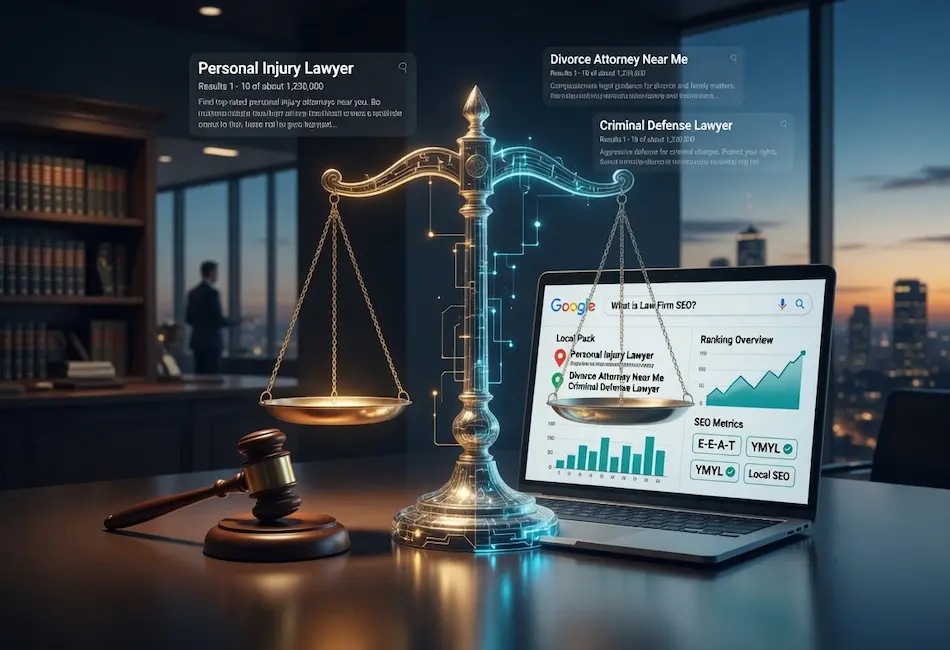
What is law firm SEO? Law firm SEO is the practice of optimizing a legal practice’s online presence so that it ranks in search results for the queries potential clients actually use when they need legal help. It covers everything from local pack visibility and Google Business Profile optimization to content depth across practice areas, technical site health, and the E-E-A-T signals that Google requires from sites operating in YMYL territory.
What it is and who it is for: This guide is for law firm owners, legal marketing directors, and solo practitioners who want to understand how SEO works specifically for the legal industry. Every practice area searches differently. A personal injury firm competes on different keywords, in different SERPs, against different competitors than a family law firm or a criminal defense attorney. This page breaks down what matters for each vertical and how the pieces connect into a strategy that compounds.
The rule: Law firms operate in YMYL territory, which means Google holds legal content to a higher standard than general informational pages. Expertise signals, credentialed authorship, and topical depth are not optional. Firms that treat SEO as a checkbox instead of an infrastructure investment will lose to firms that build authority through content, technical health, and verified credibility across every practice area they serve.
What Is Law Firm SEO
Law firm SEO is the process of positioning a legal practice to appear in search results when potential clients look for legal help online. That sounds straightforward. It is not. The legal industry operates in one of the most competitive and heavily scrutinized search environments that exists, and the strategies that work for a general business website will fall short when applied to a law firm.
The reason is classification. Google categorizes legal content as YMYL, which stands for Your Money or Your Life. Any content that could affect a person’s financial stability, legal standing, health, or safety gets evaluated against a higher standard than content about hobbies or entertainment. Legal content sits squarely in that category. A page about divorce proceedings, criminal defense options, or personal injury claims is giving information that could directly influence someone’s legal decisions. Google does not take that lightly.
What this means in practice is that law firm SEO requires more than keyword targeting and backlinks. It requires verifiable expertise, credentialed authorship, technically sound site architecture, and content depth that demonstrates genuine knowledge of the legal topics being covered. The firms that invest in those foundations rank. The firms that skip them and chase shortcuts spend money without results.
The full range of SEO services that apply to law firms spans on-page optimization, technical SEO, local search, content strategy, link building, and the E-E-A-T signals that Google uses to evaluate whether a site deserves to rank for YMYL queries. This guide breaks down each of those components through the lens of what matters specifically for legal practices, organized by the practice areas where the search dynamics differ most.
Why Law Firms Need SEO in 2026
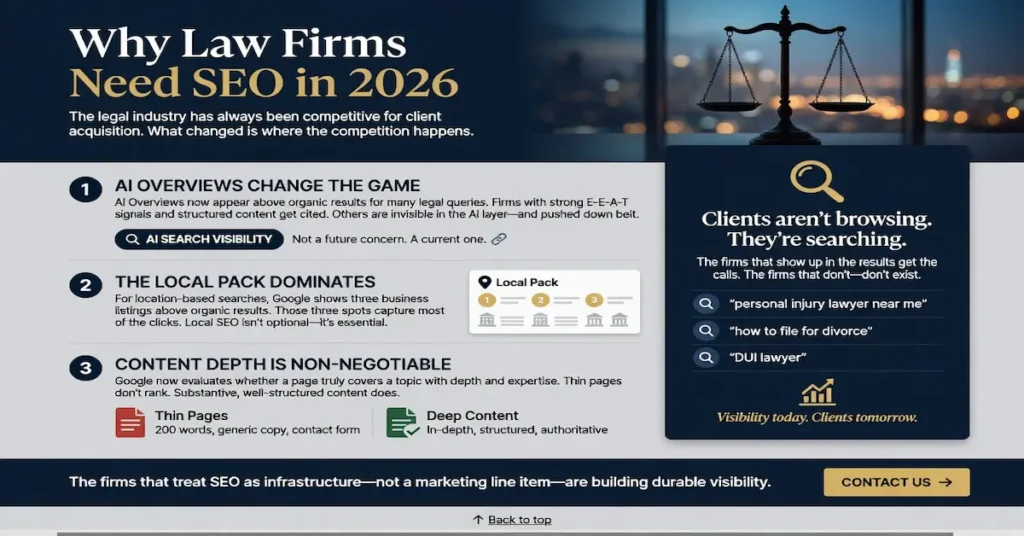
The legal industry has always been competitive for client acquisition. What changed is where the competition happens. A decade ago, firms competed through referral networks, billboards, television ads, and Yellow Pages listings. Those channels still exist. They are no longer where the majority of potential clients begin their search for legal help.
The data is unambiguous. When someone needs a lawyer, the first thing they do is search. They search for “personal injury lawyer near me.” They search for “how to file for divorce.” They search for “DUI lawyer” at two in the morning after getting pulled over. The firms that appear in those results get the calls. The firms that do not appear do not exist in the minds of those searchers.
Three factors make 2026 different from previous years.
First, AI Overviews now appear above the organic results for many legal queries. Google’s AI-generated summaries pull from sources it considers authoritative, and firms with strong E-E-A-T signals and structured content are the ones getting cited. Firms without those signals are invisible in the AI layer and increasingly pushed down in the organic results below it. The AI search visibility landscape is not a future concern. It is a current one.
Second, the local pack dominates legal search results. For any query with geographic intent, Google shows three business listings above the organic results. Those three listings capture a disproportionate share of clicks. Winning a local pack position requires a different set of signals than winning an organic position, and firms that optimize for one without the other leave significant visibility on the table.
Third, content depth is no longer optional. Google’s systems have become increasingly capable of evaluating whether a page genuinely covers a topic or merely touches on it. Thin service pages with 200 words and a contact form do not rank for competitive legal keywords in 2026. Substantive, well-structured pages that demonstrate real knowledge of the practice area do. The firms willing to invest in that depth are pulling ahead of the firms still running on template content.
The firms that treat SEO as infrastructure rather than a marketing line item are the ones building durable visibility. Contact us to discuss where your firm stands.
Personal Injury Lawyer SEO
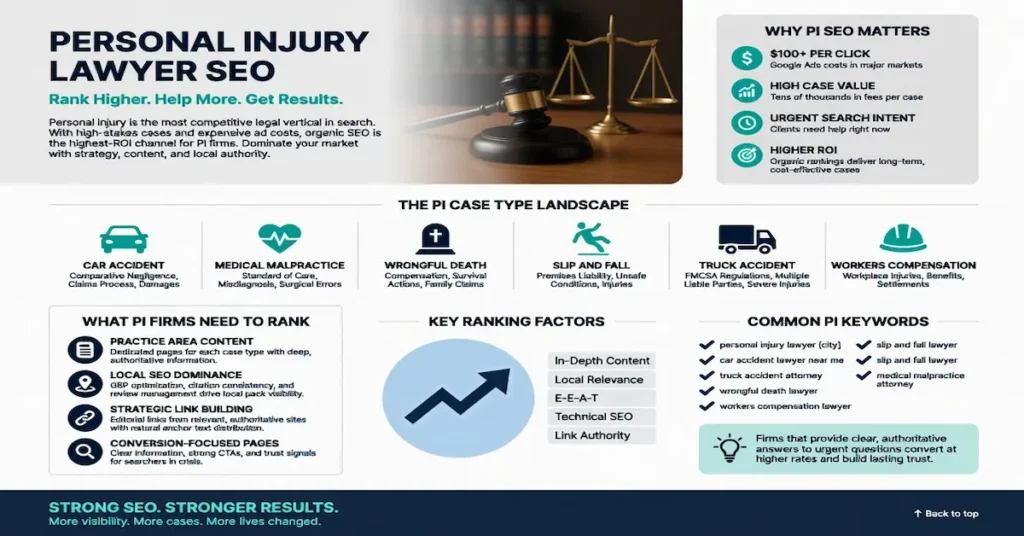
Personal injury is the most competitive legal vertical in search. The reason is economics. A single PI case can generate tens of thousands of dollars in fees, which means firms are willing to spend aggressively on client acquisition. Google Ads for personal injury keywords regularly exceed $100 per click in major markets. That cost pressure makes organic search the highest-ROI channel available to PI firms, and it makes the organic competition fierce.
The search landscape for personal injury breaks down by case type. Car accident lawyers, medical malpractice attorneys, wrongful death firms, slip and fall practices, truck accident specialists, and workers compensation attorneys all compete in overlapping but distinct keyword spaces. A firm that handles all of these case types needs content depth across every one of them. A firm that specializes in one needs to dominate that specific vertical.
What makes PI SEO different from other legal verticals is the urgency of the search intent. Someone searching for a personal injury lawyer is often searching in the immediate aftermath of an incident. They are in pain, confused, and looking for help right now. The firms that rank for these queries and provide clear, authoritative information on their pages convert at higher rates than firms that rank but present generic, templated content.
What PI Firms Need to Rank
The foundation is practice-area-specific content that covers each case type the firm handles. A single “personal injury” page is not enough. Each case type needs its own page targeting its own keyword, with content that demonstrates genuine knowledge of that specific area of law. A page about car accident claims should discuss comparative negligence, statute of limitations by state, the claims process, and what damages are recoverable. That level of depth is what separates ranking pages from pages that sit on page three.
Local SEO is critical for PI firms because most clients hire locally. Google Business Profile optimization, citation consistency, and review management are non-negotiable. A firm with a strong local pack presence for “personal injury lawyer [city]” captures cases that a firm with only organic visibility misses.
Link building for PI firms requires editorial placements from relevant, authoritative sources. The anchor text distribution matters because Google scrutinizes link profiles in competitive spaces more closely than in low-competition verticals. A natural mix of branded anchors, descriptive anchors, and keyword anchors signals legitimacy. A profile dominated by exact-match keyword anchors signals manipulation. The anchor text and link context guide covers the mechanics of getting this right.
Family Law SEO
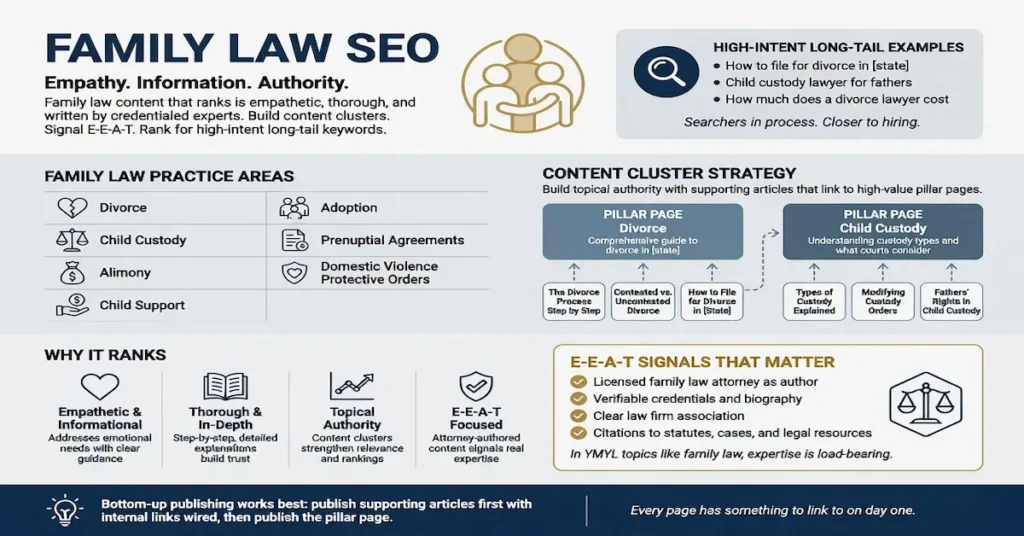
Family law covers divorce, child custody, alimony, child support, adoption, prenuptial agreements, and domestic violence protective orders. The search dynamics differ from personal injury because the emotional context of the searcher is fundamentally different. Someone searching for a divorce lawyer is not dealing with a sudden incident. They are often in the middle of a slow, painful process and are looking for guidance as much as representation.
That emotional context shapes the content strategy. Family law content that ranks tends to be empathetic, informational, and thorough. Pages that explain the divorce process step by step, that break down how custody decisions are made, that clarify the difference between contested and uncontested divorce consistently outperform pages that simply list services and ask for a call.
The keyword landscape in family law is broad. “Divorce lawyer” is the high-volume head term, but the long-tail variations are where the conversion intent lives. “How to file for divorce in [state],” “child custody lawyer for fathers,” “how much does a divorce lawyer cost.” These queries represent people who are further along in their decision-making process and closer to hiring.
Content Structure for Family Law
Family law firms benefit from building content clusters around each practice area they handle. Divorce gets its own cluster with articles covering the process, costs, timeline, contested versus uncontested, division of assets, and state-specific procedures. Child custody gets a separate cluster covering types of custody, modification of custody orders, relocation issues, and fathers’ rights. Each cluster builds topical authority in its area and feeds that authority up to the main family law page.
The content cluster strategy framework applies directly here. Bottom-up publishing means the supporting articles go live first with internal links already wired, and the pillar page publishes last with everything beneath it already indexed. That sequence matters because it means every page has something to link to on day one.
E-E-A-T signals are particularly important for family law because the content directly affects people’s family situations. Credentialed authorship from a licensed family law attorney carries significant weight with Google’s quality systems. Firms that publish family law content under generic bylines or without verifiable credentials are fighting an uphill battle. The expertise signal is not decorative in YMYL verticals. It is load-bearing.
Criminal Defense Lawyer SEO
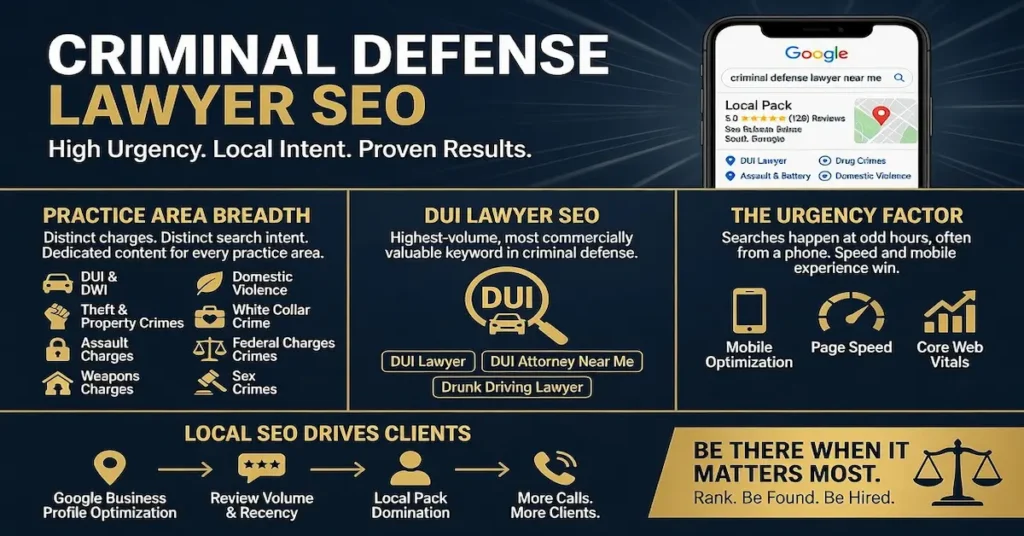
Criminal defense is the legal vertical where search urgency is highest. Someone who just got arrested or charged with a crime is searching for a lawyer immediately. They are searching at odd hours, often from a phone, and their decision-making window is compressed. The firms that appear in those results and present clear, confident information about the charges the person is facing are the ones that get hired.
The practice area breadth in criminal defense is significant. DUI and DWI, drug crimes, assault and battery, theft and property crimes, domestic violence, white collar crime, federal charges, juvenile crimes, weapons charges, and sex crimes all represent distinct search intents with distinct keyword spaces. A criminal defense firm that handles all of these needs dedicated content for each. A firm that focuses on DUI defense needs to own that specific keyword space completely.
DUI lawyer SEO deserves special attention because it is the highest-volume, most commercially valuable keyword in criminal defense. The search volume for “DUI lawyer” and its variations is substantial in every market, and the competition reflects that. Firms that rank for DUI terms in their local market see consistent case flow from organic search alone.
The Urgency Factor
The urgency of criminal defense searches means that mobile optimization and page speed carry more weight in this vertical than in many others. Someone searching “criminal defense lawyer near me” from a holding facility or from the back seat of a car does not have patience for a slow-loading page. Core Web Vitals are not abstract metrics for criminal defense firms. They are the difference between getting a call and losing a potential client to the next result.
Google Business Profile is essential for criminal defense because the local pack dominates the search results for every “[crime type] lawyer near me” query. Review volume and recency matter more in criminal defense than in almost any other legal vertical because the decision is urgent and the stakes are personal. A profile with recent, detailed reviews from satisfied clients converts at a significantly higher rate than a profile with outdated or sparse reviews.
Immigration Attorney SEO
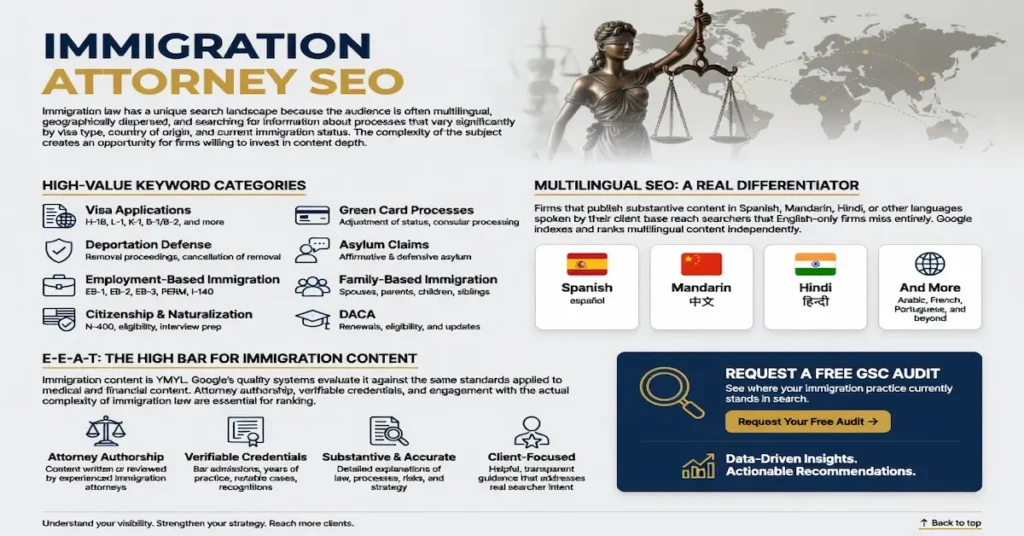
Immigration law has a unique search landscape because the audience is often multilingual, geographically dispersed, and searching for information about processes that vary significantly by visa type, country of origin, and current immigration status. The complexity of the subject creates an opportunity for firms willing to invest in content depth.
The keyword space in immigration law spans visa applications, green card processes, deportation defense, asylum claims, employment-based immigration, family-based immigration, citizenship and naturalization, and DACA. Each of these topics represents a distinct audience with distinct needs and distinct search behavior.
Multilingual content is a real differentiator in immigration SEO. Firms that publish substantive content in Spanish, Mandarin, Hindi, or other languages spoken by their client base reach searchers that English-only firms miss entirely. Google indexes and ranks multilingual content independently, which means a firm with strong pages in both English and Spanish can capture visibility in two search ecosystems simultaneously.
The E-E-A-T bar is high for immigration content because incorrect information can lead to visa denials, deportation, or other life-altering consequences. Google’s quality systems evaluate immigration content against the same YMYL standards applied to medical and financial content. Attorney authorship, verifiable credentials, and engagement with the actual complexity of immigration law are all necessary for ranking.
Request a free GSC audit to see where your immigration practice currently stands in search.
Business Lawyer SEO
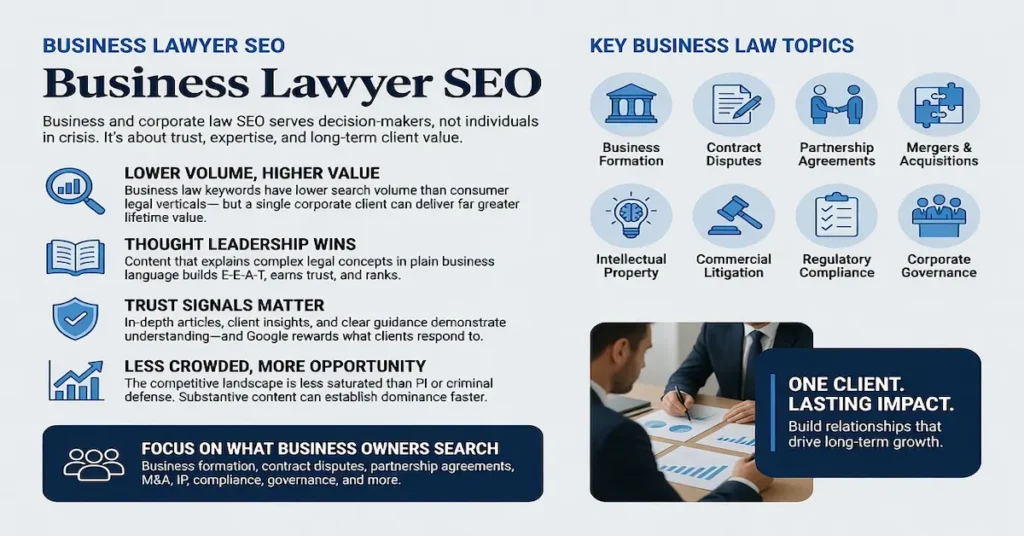
Business and corporate law SEO operates differently from consumer-facing legal verticals because the client is a business owner or executive, not an individual in crisis. The search behavior reflects that difference. Business law queries tend to be more researched, more deliberate, and more focused on finding the right fit rather than the fastest available option.
The keyword space covers business formation, contract disputes, partnership agreements, mergers and acquisitions, intellectual property, commercial litigation, regulatory compliance, and corporate governance. Each of these topics has search volume, but the volume is lower than consumer-facing verticals like personal injury or divorce. What compensates is the client value. A single corporate client relationship can be worth more over time than dozens of individual cases.
Content strategy for business law firms should emphasize thought leadership. Articles that explain complex business legal concepts in accessible language, that address the questions business owners actually have about contracts, liability, and corporate structure, and that demonstrate understanding of the business context build trust signals that Google recognizes and potential clients respond to.
The competitive landscape is less crowded than PI or criminal defense, which means a firm willing to invest in substantive content can establish dominance in business law keywords faster than in higher-competition verticals.
Employment Lawyer SEO
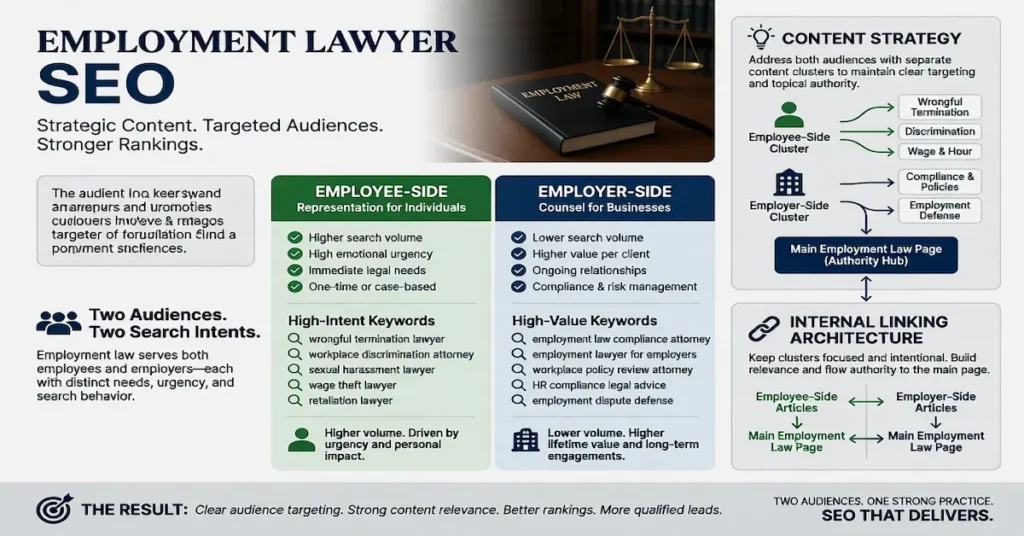
Employment and labor law sits at an interesting intersection because the potential client could be either an employee or an employer, and the search intent differs sharply between the two. An employee searching “wrongful termination lawyer” has a different urgency and different needs than a business owner searching “employment law compliance attorney.” Both are valid audiences, but they require different content and different messaging.
Employee-side employment law keywords tend to have higher volume because employees outnumber employers and because employment disputes create the kind of emotional urgency that drives search behavior. Wrongful termination, workplace discrimination, sexual harassment, wage theft, and retaliation are all high-intent queries where the searcher is looking for representation.
Employer-side keywords are lower volume but higher value per client. Businesses looking for employment law counsel need ongoing relationships, policy reviews, compliance guidance, and representation in disputes. The lifetime value of an employer-side client often exceeds the value of individual employee-side cases.
Content strategy for employment law should address both audiences without diluting the messaging. Separate content clusters for employee-side and employer-side topics keep the targeting clean and prevent Google from being confused about who the page is for. The internal linking architecture should reflect this separation, with employee-side articles linking to each other and employer-side articles linking to each other, both flowing authority up to the main employment law page.

Estate Planning Lawyer SEO
Estate planning is the legal vertical where the client is not in crisis. Nobody is searching for an estate planning lawyer at two in the morning in a panic. The search behavior is deliberate, research-heavy, and often spread across multiple sessions. A potential client might spend weeks reading about wills, trusts, power of attorney, and probate before ever contacting a firm.
That long research cycle creates an opportunity for content-driven SEO. Firms that publish comprehensive, trustworthy guides on estate planning topics build familiarity with potential clients long before those clients are ready to hire. When they do reach the hiring decision, the firm that educated them is the firm that gets the call.
The keyword space covers wills, revocable and irrevocable trusts, power of attorney, healthcare directives, probate, estate tax planning, guardianship, and beneficiary designations. Each topic supports a substantive article that targets specific long-tail keywords while building the firm’s overall authority in estate planning.
Estate planning is a YMYL topic because the information directly affects people’s financial planning and family protection. The E-E-A-T requirements are the same as other legal verticals. Credentialed authorship, verifiable expertise, and content that demonstrates genuine knowledge of estate planning law are all required for ranking. The E-E-A-T framework is not negotiable in this space.
Contact us to discuss SEO for your estate planning practice.
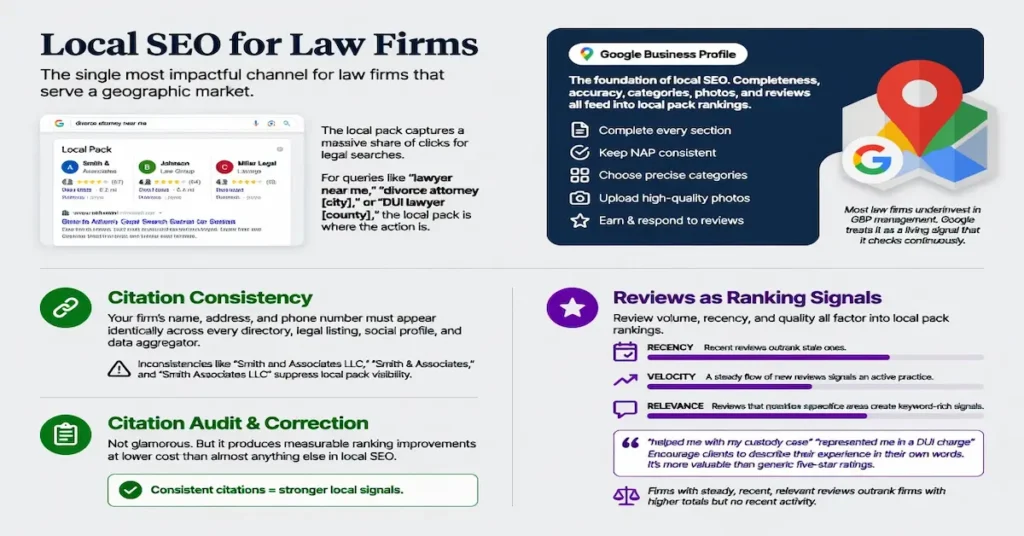
Local SEO for Law Firms
Local SEO is the single most impactful channel for law firms that serve a geographic market. The local pack, those three business listings that appear above the organic results for queries with local intent, captures a massive share of clicks for legal searches. For queries like “lawyer near me,” “divorce attorney [city],” or “DUI lawyer [county],” the local pack is where the action is.
Google Business Profile is the foundation. The completeness of the profile, the accuracy of the business information, the categories selected, the photos uploaded, and the reviews accumulated all feed into local pack rankings. Most law firms underinvest in GBP management because they treat it as a set-it-and-forget-it listing. Google treats it as a living signal that it checks continuously.
Citation Consistency
Your firm’s name, address, and phone number need to appear identically across every directory, legal listing, social profile, and data aggregator on the web. When Google sees “Smith and Associates LLC” on your website, “Smith & Associates” on Avvo, and “Smith Associates LLC” on Yelp, those inconsistencies suppress local pack visibility. Citation audit and correction is not glamorous work. It is work that produces measurable ranking improvements at lower cost than almost anything else in a local SEO.
Reviews as Ranking Signals
Review volume, recency, and quality all factor into local pack rankings. Firms with a steady flow of recent reviews outrank firms with higher total review counts but no recent activity. The review velocity matters because Google interprets it as a signal that the business is actively serving clients. A firm with 200 reviews but none in the last six months looks dormant. A firm with 50 reviews and three new ones this month looks alive.
Review content matters too. Reviews that mention specific practice areas (“helped me with my custody case,” “represented me in a DUI charge”) create keyword-relevant content on the GBP listing that Google can associate with those search queries. Encouraging clients to describe their experience in their own words is more valuable than asking for generic five-star ratings.
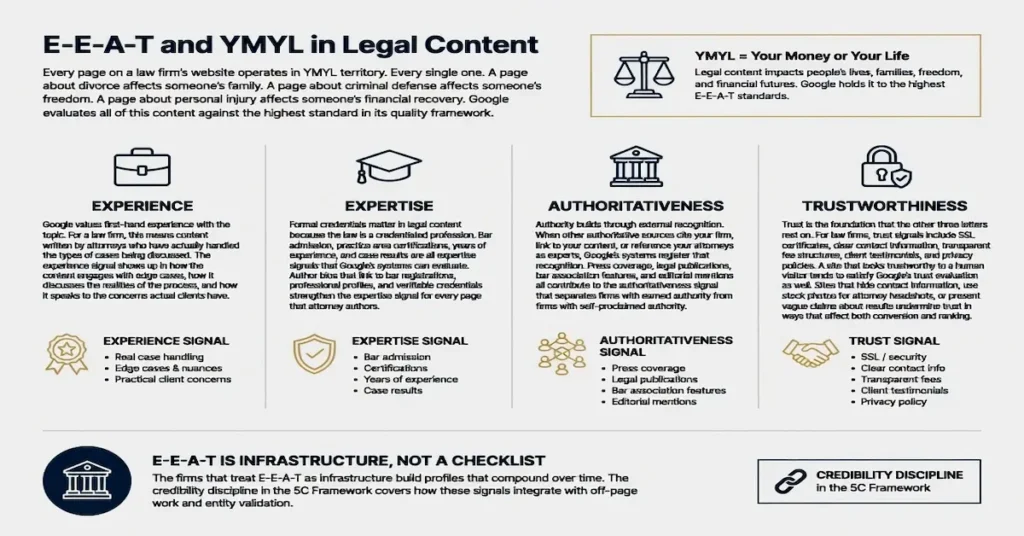
E-E-A-T and YMYL in Legal Content
Every page on a law firm’s website operates in YMYL territory. Every single one. A page about divorce affects someone’s family. A page about criminal defense affects someone’s freedom. A page about personal injury affects someone’s financial recovery. Google evaluates all of this content against the highest standard in its quality framework.
E-E-A-T stands for Experience, Expertise, Authoritativeness, and Trustworthiness. For law firms, each letter carries specific weight.
Experience
Google values first-hand experience with the topic. For a law firm, this means content written by attorneys who have actually handled the types of cases being discussed. A page about DUI defense written by an attorney who has defended DUI cases carries more weight than the same page written by a content writer who researched the topic. The experience signal shows up in how the content engages with edge cases, how it discusses the realities of the process, and how it speaks to the concerns actual clients have.
Expertise
Formal credentials matter in legal content because the law is a credentialed profession. Bar admission, practice area certifications, years of experience, and case results are all expertise signals that Google’s systems can evaluate. Author bios that link to bar registrations, professional profiles, and verifiable credentials strengthen the expertise signal for every page that attorney authors.
Authoritativeness
Authority builds through external recognition. When other authoritative sources cite your firm, link to your content, or reference your attorneys as experts, Google’s systems register that recognition. Press coverage, legal publications, bar association features, and editorial mentions all contribute to the authoritativeness signal that separates firms with earned authority from firms with self-proclaimed authority.
Trustworthiness
Trust is the foundation that the other three letters rest on. For law firms, trust signals include SSL certificates, clear contact information, transparent fee structures, client testimonials, and privacy policies. A site that looks trustworthy to a human visitor tends to satisfy Google’s trust evaluation as well. Sites that hide contact information, use stock photos for attorney headshots, or present vague claims about results undermine trust in ways that affect both conversion and ranking.
The firms that treat E-E-A-T as infrastructure rather than a checklist build profiles that compound over time. The credibility discipline in the 5C Framework covers how these signals integrate with off-page work and entity validation.
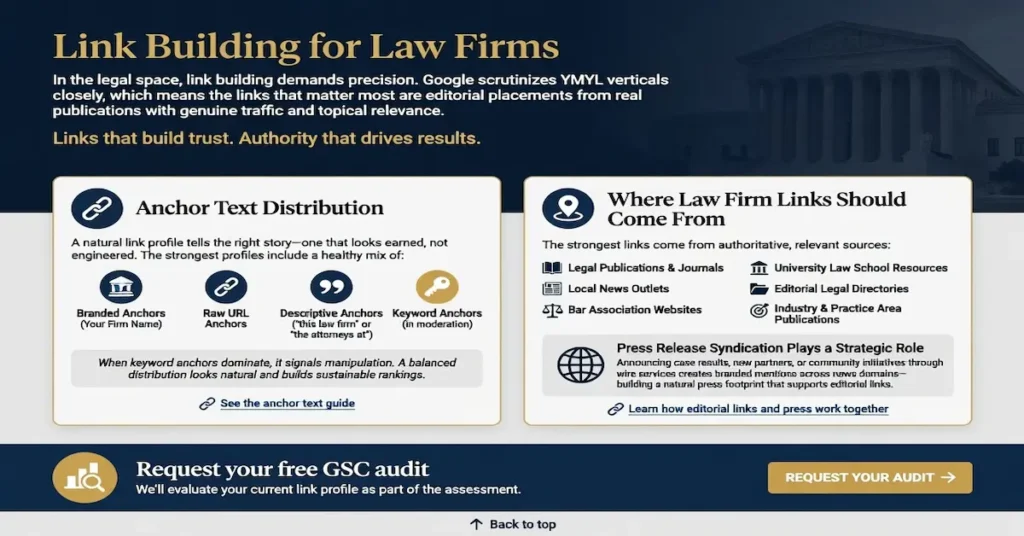
Link Building for Law Firms
Link building in the legal space requires more precision than in most industries because Google scrutinizes link profiles in YMYL verticals more heavily. The links that move the needle are editorial placements from real publications with real traffic and genuine topical relevance. A link from a legal publication, a news outlet covering a case your firm handled, or an industry resource that references your content as authoritative carries real weight.
What does not work is the same thing that does not work in any vertical: mass-produced directory links, PBN placements, and link schemes that produce unnatural anchor text distributions. The difference in legal SEO is that the penalty for getting it wrong is steeper. Google holds YMYL sites to a higher standard, and a link profile that looks manipulated can suppress rankings faster than in a non-YMYL space.
Anchor Text Distribution
The mix of anchor text in your link profile tells Google a story about how people reference your firm. A natural profile has a healthy proportion of branded anchors (your firm name), raw URL anchors, descriptive anchors (“this law firm” or “the attorneys at”), and keyword anchors (“personal injury lawyer in Dallas”). When keyword anchors dominate the profile, it signals manipulation. The anchor text guide covers the mechanics of building a distribution that looks earned rather than placed.
Where Law Firm Links Should Come From
The strongest link sources for law firms include legal publications and journals, local news outlets, bar association websites, university law school resources, legal directories with editorial standards, and industry-specific publications relevant to the firm’s practice areas. A personal injury firm benefits from links on healthcare or insurance-related sites. A business law firm benefits from links on business and finance publications.
Press release syndication plays a specific role in legal link building. When a firm announces a significant case result, a new partner, or a community initiative through a wire service, the syndication creates a distribution pattern of branded mentions across news domains. Those mentions establish the kind of press footprint that makes editorial link placements look natural in context. The link building services page covers how editorial placements and press distribution work together.
Request your free GSC audit and we will evaluate your current link profile as part of the assessment.
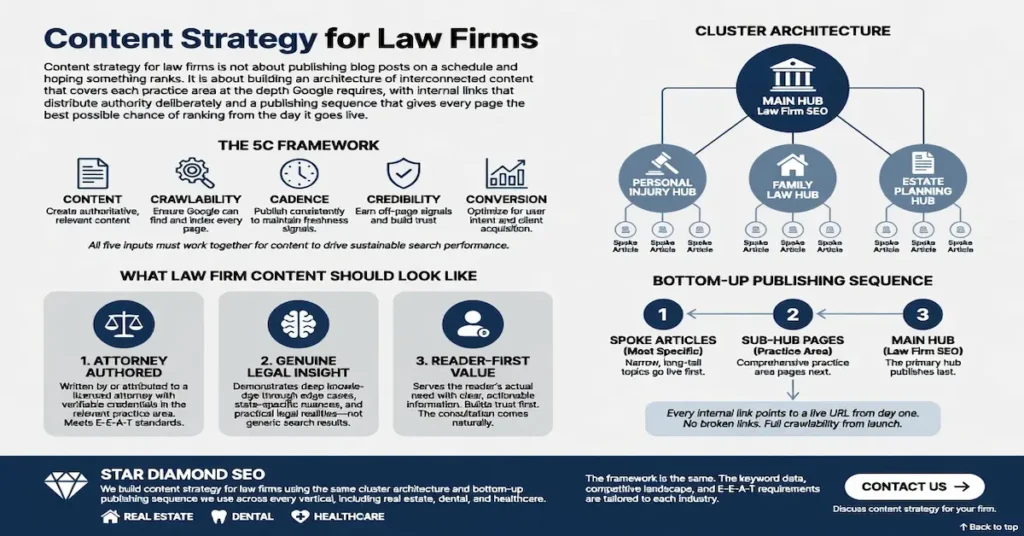
Content Strategy for Law Firms
Content strategy for law firms is not about publishing blog posts on a schedule and hoping something ranks. It is about building an architecture of interconnected content that covers each practice area at the depth Google requires, with internal links that distribute authority deliberately and a publishing sequence that gives every page the best possible chance of ranking from the day it goes live.
The content discipline in the 5C Framework treats content as one of five core inputs. Content without proper crawlability means Google never sees it. Content without cadence means the site’s freshness signals decay. Content without credibility from off-page signals caps out below where it should rank. All five inputs need to work together for the content investment to translate into search performance.
Cluster Architecture for Legal Content
The most effective content architecture for a law firm is a hub-and-spoke model organized by practice area. The main law firm SEO page serves as the primary hub. Each major practice area gets its own sub-hub page that covers that vertical comprehensively. Under each sub-hub, individual spoke articles cover specific topics within that practice area.
This structure works because Google rewards topical depth. A firm that publishes fifteen substantive articles on personal injury topics, all interlinked and feeding authority to a central PI page, sends a stronger signal than a firm with one personal injury service page and nothing supporting it. The cluster effect compounds over time in ways that isolated pages cannot replicate. The content cluster strategy guide covers the mechanics.
What Law Firm Content Should Look Like
Every article on a law firm website should meet three standards.
First, it should be written by or attributed to a licensed attorney with verifiable credentials in the relevant practice area. Generic bylines and content-mill authorship fail the E-E-A-T standard that Google applies to legal content.
Second, it should demonstrate genuine knowledge of the topic through engagement with edge cases, state-specific nuances, and the practical realities of how the legal process works. Content that reads like it was assembled from search results without any legal knowledge behind it gets outranked by content that reads like it was written by someone who has actually practiced in that area.
Third, it should serve the reader’s actual need. Someone searching “how to file for divorce in Indiana” wants to understand the process, the timeline, the costs, and what to expect. They do not want 500 words of filler followed by “call us for a free consultation.” Serve the information need first. The consultation call comes naturally when the reader trusts the source. Quality SEO writing serves the reader and the algorithm simultaneously because Google’s systems are designed to reward exactly that.
Publishing Sequence
Law firm content should publish bottom-up. The most specific, narrowest articles go live first. The broader practice area pages go up next. The main hub page publishes last. This sequence matters because it means every internal link on every page points to a live URL from day one. No broken links. No links pointing to pages that do not exist yet. Every piece of the architecture resolves cleanly from the moment it goes live, and Google’s crawlers can follow the full link structure immediately.
Star Diamond SEO builds content strategy for law firms using the same cluster architecture and bottom-up publishing sequence we use across every vertical, including real estate, dental, and healthcare. The framework is the same. The keyword data, competitive landscape, and E-E-A-T requirements are tailored to each industry. Contact us to discuss content strategy for your firm.
FAQ
How much does SEO cost for a law firm?
Law firm SEO pricing varies based on market competitiveness, practice area focus, and the current state of the firm’s website and search presence. A solo practitioner in a small market has fundamentally different needs than a multi-attorney firm competing for personal injury cases in a major metro. Custom scoping based on actual data is the only honest way to price it. The free GSC audit is where that conversation starts because it shows exactly what needs to happen before any dollar amount gets discussed.
How long does it take for law firm SEO to work?
Most law firms start seeing measurable movement in search visibility within three to six months, with meaningful traffic and lead generation building over six to twelve months. The timeline depends on the competitive landscape of the practice area, the technical health of the existing site, the strength of the current link profile, and how aggressively the firm invests in content. Low-competition practice areas like estate planning or immigration law tend to show results faster than high-competition verticals like personal injury.
Do law firms really need SEO?
If potential clients search for the services a firm offers, and the firm does not appear in those search results, those clients go to the firms that do appear. Referral networks and paid advertising still generate business, but organic search is the channel with the highest long-term ROI because the visibility compounds over time rather than disappearing the moment the ad budget stops. A firm that ranks organically for its core practice area keywords generates leads continuously without paying per click.
What makes law firm SEO different from regular SEO?
Legal content falls under Google’s YMYL classification, which means it gets evaluated against a higher quality standard than general informational content. Law firm websites need verifiable attorney authorship, credentialed bios with schema markup, content that demonstrates genuine legal knowledge, and trust signals that satisfy both human visitors and Google’s quality systems. Firms that apply generic SEO tactics without addressing the YMYL and E-E-A-T requirements specific to legal content consistently underperform firms that build those signals into their foundation.
Is local SEO or organic SEO more important for law firms?
Both matter, and they serve different functions. Local SEO drives visibility in the map pack for queries with geographic intent, which is where most people searching for a lawyer in their area look first. Organic SEO drives visibility in the standard search results for broader queries, informational content, and practice-area-specific terms. A firm that optimizes for local without building organic depth misses the clients who research before they hire. A firm that builds organic content without local optimization misses the clients who search for “lawyer near me.” The strongest strategy runs both in parallel.
What kind of content should a law firm publish for SEO?
The content that ranks for law firms is substantive, practice-area-specific, and written or reviewed by licensed attorneys. Each practice area the firm handles should have its own dedicated page targeting the relevant keywords, supported by articles that cover specific topics within that area. A personal injury firm should have dedicated content for car accidents, medical malpractice, wrongful death, and every other case type it handles. Each article should demonstrate genuine knowledge of the legal process, address the questions potential clients actually ask, and be attributed to an attorney with verifiable credentials.
Can a law firm do SEO without hiring an agency?
A firm can handle some components internally, particularly Google Business Profile management, review solicitation, and basic on-page optimization. The components that typically require specialized help are technical SEO audits, link building through editorial placements, content cluster architecture, and schema markup implementation. The decision depends on whether the firm has someone with both the time and the expertise to execute consistently. Inconsistent SEO effort produces inconsistent results regardless of who is doing the work.